• العربية
  • فارسی
Brand
  • Iran Insight
  • Politics
  • Economy
  • Analysis
  • Special Report
  • Opinion
  • Podcast
  • Iran Insight
  • Politics
  • Economy
  • Analysis
  • Special Report
  • Opinion
  • Podcast
  • Theme
  • Language
    • العربية
    • فارسی
  • Iran Insight
  • Politics
  • Economy
  • Analysis
  • Special Report
  • Opinion
  • Podcast
All rights reserved for Volant Media UK Limited
volant media logo
VOICES FROM IRAN

Lights out, then gunfire: Witnesses recount Mashhad protest crackdown

Hedieh Kimiaee
Hedieh Kimiaee

Iran International

Apr 21, 2026, 12:23 GMT+1
Protesters gather in northeastern Mashhad during anti-government demonstrations in January.

A 32-year-old protester in Mashhad, northeastern Iran, stood in the street as the lights flickered out and the mobile network went dead, believing he had only a one-in-five chance of making it out alive.

"I want this account recorded so that if I live, I can testify in any court, and if I do not, this narrative tells part of the crime that happened in those two nights in Mashhad... Our war with the Islamic Republic continues in the streets. I estimate my chances of staying alive in the coming days at about 20 percent."

These were the last words the young man shared with Iran International before he went missing a few days after the January massacre. There has been no news of his fate for more than eight weeks while the Iranian government continues to cut internet and phone lines.

Witness accounts and reports reaching Iran International describe a coordinated massacre in the city on January 8 and 9, as security forces used a communications blackout to open fire on crowds with live ammunition.

Snipers on rooftops

On Tabarsi Street in Mashhad, members of the Revolutionary Guard took positions on rooftops starting at 9 p.m. Witnesses said they fired directly into the crowds. Plainclothes agents moved through the smoke of tear gas to kill protesters with handguns.

"From 10 p.m. onwards, the number of dead bodies lying on the ground was so high that the smell of blood was clearly felt in the air," one witness told Iran International. He added that security forces attacked an ambulance at midnight and killed or wounded protesters with "finish-off" shots.

Mass burials in secret

At Behesht-e Rezvan cemetery in Mashhad, a source familiar with the matter said the head of the facility reported that more than 400 bodies arrived on the night of January 9. Many could not be identified because they were shot in the face and neck.

Reports indicate that authorities carried out mass burials. The source who was present at the cemetery told Iran International that about 400 people were buried together in a single instance because their faces were unrecognizable from gunshot wounds.

Orders to spread fear

A source within the Khorasan Razavi Governor’s Office told Iran International that provincial leaders met on the morning of January 9. The instruction from higher authorities was to suppress the protests at any cost.

"It was stated that it does not matter how many are killed: 'Just scare the people in such a way that on January 10, no one dares to come to the street and protest,'" the source said.

Firefighters killed for helping

The crackdown also hit emergency workers. Firefighters in Mashhad were ordered by the municipality to participate in the suppression, but many refused and helped the protesters instead.

Hamid Mahdavi, a firefighter and athlete, was shot and killed while helping protesters. Other firefighters who refused the orders have been arrested.

At Farabi Hospital in Mashhad, a nurse said staff issued 500 death certificates between midnight and 7 a.m. on January 10.

In the courtyard of the Chamran clinic, a woman searching for her husband described seeing bodies in black covers stacked in three rows. She said a large trailer arrived and workers with covered faces began throwing more bodies from the vehicle onto the courtyard floor.

The Iranian government has maintained an internet and phone blackout for more than eight weeks. Iran International reports that the Islamic Republic killed more than 36,500 protesters across Iran during the two nights of Jan. 8 and 9.

Most Viewed

Ghalibaf defends Iran-US talks amid hardline backlash
1
INSIGHT

Ghalibaf defends Iran-US talks amid hardline backlash

2
INSIGHT

Iran diplomacy wobbles as factions compete to avoid looking soft on US

3
VOICES FROM IRAN

Bread shortages, soaring prices strain households in Iran, residents say

4
ANALYSIS

The politics of pink: how Iran uses cuteness to rebrand violence

5

War-hit homeowners feel abandoned as Iran’s reconstruction aid fades

Banner
Banner

Spotlight

  • Lights out, then gunfire: Witnesses recount Mashhad protest crackdown
    VOICES FROM IRAN

    Lights out, then gunfire: Witnesses recount Mashhad protest crackdown

  • Family told missing teen was alive, then received his body 60 days later
    EXCLUSIVE

    Family told missing teen was alive, then received his body 60 days later

  • Is Iran entering its Gorbachev moment?
    INSIGHT

    Is Iran entering its Gorbachev moment?

  • Iran crackdown reaches cemeteries as graves of slain protesters defaced
    EXCLUSIVE

    Iran crackdown reaches cemeteries as graves of slain protesters defaced

  • Iran diplomacy wobbles as factions compete to avoid looking soft on US
    INSIGHT

    Iran diplomacy wobbles as factions compete to avoid looking soft on US

  • The politics of pink: how Iran uses cuteness to rebrand violence
    ANALYSIS

    The politics of pink: how Iran uses cuteness to rebrand violence

  • Bread shortages, soaring prices strain households in Iran, residents say
    VOICES FROM IRAN

    Bread shortages, soaring prices strain households in Iran, residents say

  • How images came to carry Iran’s protest dead

    How images came to carry Iran’s protest dead

  • 100 days on: why Iran’s January protests spread across social classes

    100 days on: why Iran’s January protests spread across social classes

  • A man, a dog, and a private wish turned public tragedy in Iran

    A man, a dog, and a private wish turned public tragedy in Iran

•
•
•

More Stories

Scam messages seek crypto for ships’ safe passage through Hormuz, firm warns

Apr 21, 2026, 08:52 GMT+1

Fraudulent messages offering ships safe passage through the Strait of Hormuz in exchange for cryptocurrency have been sent to some shipping companies, Reuters reported on Tuesday, citing a maritime security firm.

Greek risk management firm MARISKS said unknown actors posing as Iranian authorities had contacted companies whose vessels are stuck west of the strategic waterway, asking for transit fees in Bitcoin or Tether in return for “clearance.”

"These specific messages are a scam," the firm said in an alert, adding the communications did not originate from Iranian authorities.

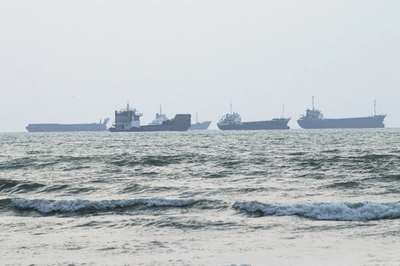
The warning comes as the United States continues a blockade of Iranian ports, while Iran has imposed restrictions on the Strait of Hormuz, a key chokepoint through which about a fifth of global oil and liquefied natural gas once passed before conflict disrupted flows.

Amid ceasefire talks, Tehran has suggested collecting tolls from vessels seeking safe transit, contributing to uncertainty among shipowners.

  • Why the $100 billion Hormuz toll revenue is a myth

    Why the $100 billion Hormuz toll revenue is a myth

  • Iran floats Hormuz transit tolls as Persian Gulf states warn of military response

    Iran floats Hormuz transit tolls as Persian Gulf states warn of military response

Hundreds of vessels and roughly 20,000 seafarers remain stranded in the Persian Gulf due to the disruptions, according to the firm.

On April 18, when Iran briefly allowed limited passage subject to inspections, several ships attempted to transit, but at least two vessels, including a tanker, reported that Iranian boats fired shots, forcing them to turn back.

MARISKS said it believed at least one ship that came under fire while trying to leave the strait on Saturday may have been affected by the fraudulent scheme.

The messages cited by the firm said vessels would need to submit documents for review by Iranian security services, after which a cryptocurrency fee would be set before transit at a pre-arranged time.

Iran executes man as January protest crackdown continues

Apr 21, 2026, 07:29 GMT+1

Iran executed a man on Tuesday over accusations that he set fire to a mosque and what authorities described as anti-security activities, according to the judiciary, in a case tied to anti-establishment protests earlier this year.

Judiciary-affiliated media identified the man as Amirali Mirjafari and said his death sentence had been upheld by the Supreme Court before being carried out early on Tuesday.

State media said Mirjafari had set fire to the Gholhak Grand Mosque in Tehran and acted as a leader of a network accused of links to Israel’s Mossad intelligence service, framing the case as part of efforts against foreign-backed activity.

Authorities said he had confessed after his arrest to taking part in protests in January, damaging public property, including phone booths and buses, and setting fire to motorcycles using gasoline-filled bottles.

Amnesty and other rights groups have repeatedly said Iranian courts rely on confessions obtained under duress in such cases.

Iran has used broad security charges to prosecute people detained during the January protests, which followed a new wave of anti-government demonstrations and a widening crackdown by authorities that became one of the most extensive in recent years.

Tehran has not released official nationwide arrest figures, but Iran International reported earlier this year that the number exceeds 36,500, based on internal security briefings the channel obtained and reviewed.

  • Iran executes two men as protest-related hangings continue

    Iran executes two men as protest-related hangings continue

  • Iran crackdown reaches cemeteries as graves of slain protesters defaced

    Iran crackdown reaches cemeteries as graves of slain protesters defaced

  • Iran refuses to return body of executed teen protester to family

    Iran refuses to return body of executed teen protester to family

Earlier this month, Iran executed 18-year-old Amirhossein Hatami, who had been convicted in the same case linked to the nationwide anti-government protests that the Islamic Republic repressed in what became its broadest crackdown to date.

In a recent report, Amnesty International said 11 men were at risk of imminent execution over participation in the protests. The rights group said they had been subjected to torture and other ill-treatment in detention before being convicted in grossly unfair trials based on forced confessions.

Iran crackdown reaches cemeteries as graves of slain protesters defaced

Apr 21, 2026, 03:53 GMT+1
•
Azadeh Akbari

Iranian authorities have stepped up pressure on families of those killed in January protests, defacing, destroying or covering graves with cement in the northern city of Rasht and the capital Tehran, local sources told Iran International.

In Section 20 of Bagh Rezvan cemetery in Rasht, thick layers of cement had been poured over part of the graves of slain protestors, creating a uniform surface higher than the surrounding gravestones.

In some areas of the cemetery, the cemented section was so large that it was unclear how many graves lay side by side, the sources added.

Some graves showed no names or dates of birth or death, only a grey surface that appeared intended to erase all trace of them. Several others had small headstones roughly the size of an A4 sheet of paper, with only the deceased’s first and last names engraved in small script.

Witnesses said the graves were defaced and damaged in the presence of government agents and plainclothed security forces.

Graves levelled in Tehran

At Tehran’s main cemetery, Behesht Zahra, some graves of those killed were levelled with the ground and covered with cement after third-day mourning ceremonies, a memorial traditionally held three days after burial.

Sources said the graves were covered in a way that made it impossible to determine from a distance how many had been newly dug.

In Section 329 of the cemetery, families also said some gravestones were destroyed or broken in the days following Feb. 11, the anniversary of Iran's 1979 revolution.

Only a small number of families of slain protestors have so far managed to install gravestones, sources told Iran International.

Families said they were pressured to alter inscriptions on the stones.

In some cases, the use of the Persian term Javidnam—meaning eternally remembered and widely used for slain protestors—or the phrase Farzand-e Iran (“Child of Iran”) drew objections from state bodies and threats that the stones would be destroyed.

‘Too costly’

Families also reported threats to destroy the gravestones of Mojtaba Karabi and Azra Bahaderi-Nejad in the northeastern city of Sabzevar. They said paint had been sprayed on the gravestone of Arman Gorjian and a metal plaque at the grave of Maryam Ebrahimzadeh had been defaced.

Some families temporarily removed gravestones to prevent further damage and said they would not reinstall them until restrictions were lifted.

Gravestone sellers advised families to install stones only for the 40th-day memorial ceremony and remove them afterwards to avoid destruction, sources said, adding that many could not afford the cost of reinstalling headstones and its psychological impact.

Iran International previously received an image showing the broken gravestone of slain protestor Behnam Darvishi.

Darvishi was killed on Jan. 8 after being struck by live ammunition on Persian Gulf Boulevard in Tehran and was buried in Nahavand in western Iran.

Precedents

Damage to graves of people killed in the 2022 protests has also been reported in previous years, including those of Majidreza Rahnavard, Siavash Mahmoudi, Kian Pirfalak, Zakaria Khial and Aylar Haghi.

The broader protest movement followed the September 2022 death in custody of Mahsa Jina Amini, which triggered nationwide anti-government demonstrations.

In earlier cases, gravestones were broken while inscriptions were altered or removed.

In August 2023, Amnesty International said it had documented the destruction of graves belonging to more than 20 victims across 17 cities.

The group said graves had been damaged with tar, paint and arson, headstones had been broken, and phrases describing victims as martyrs or stating they died for freedom had been forcibly erased.

Bread shortages, soaring prices strain households in Iran, residents say

Apr 20, 2026, 21:24 GMT+1
•
Hooman Abedi

Bread shortages and steep price hikes are undermining access to a key staple for many in Iran, with citizen accounts received by Iran International describing long lines, flour shortages and prices far exceeding official rates.

“Many bakeries are facing flour shortages and cannot keep up with long lines of customers,” a resident from Malard west of Tehran said.

Another account said: “Right after the war, bread prices doubled. Barbari (a type of Iranian bread) is now 250,000 rials and Sangak is 350,000. Subsidized flour has been removed.”

The reported prices are far above official rates, with the latest approved price for Sangak at about 76,000 rials and Barbari around 55,000.

April 20 marks National Wheat and Bread Day in Iran, meant to highlight the central role of wheat in daily life, but accounts point to worsening conditions for a basic staple.

Conflicting claims on wheat supply

Wheat self-sufficiency has long been a goal promoted by many officials of the Islamic Republic. The first celebration of wheat self-sufficiency was held on November 16, 2004, during the presidency of Mohammad Khatami.

However, this self-sufficiency did not continue in subsequent years for various reasons, including water shortages, and Iran remained reliant on wheat imports. Still, the aspiration for self-sufficiency has continued to be repeated in officials’ statements.

Now, 22 years after the first “self-sufficiency celebration,” as buying bread is becoming an economic challenge for citizens, Ataollah Hashemi, head of the National Wheat Farmers Foundation, has once again reiterated the goal. Speaking on Saturday, April 18, he said: “The country will not need to import wheat this year.”

Yet official customs data shows Iran imported about 2.75 million tons of wheat worth nearly $1 billion in the 10 months to February 2026. The imports were sourced largely from Russia, as well as through intermediaries such as the United Arab Emirates and Turkey.

The reliance on intermediaries, which are not major wheat exporters themselves, points to complications tied to banking restrictions and payment channels, increasing costs through additional transport and fees.

The gap between official statements and import figures raises questions about the sustainability of domestic production and the credibility of self-sufficiency statements.

File photo of a baker handing stacks of Sangak flatbread to customers at a neighborhood bakery.
100%
File photo of a baker handing stacks of Sangak flatbread to customers at a neighborhood bakery.

Rising costs and policy pressures

Bread prices have increased across provinces in the current Iranian year that began on March 21, following subsidy cuts and the move toward a single flour pricing system. Prices now vary depending on flour type and region, with some bakeries selling above official rates.

Despite parliament approving a budget that allocates more than 5,000 trillion rials (over $3 billion) for bread subsidies, no new national price list has been issued for the current year. As a result, last year’s rates remain in effect, while enforcement appears inconsistent.

Inflation and shortages

Before the latest conflict and US-Israeli strikes, annual inflation had already exceeded 70 percent, with food inflation reaching triple digits. Official data shows bread and cereals recorded year-on-year inflation of about 140 percent.

The removal or reduction of subsidized flour in parts of the market has added to the pressure, with more bakeries operating under higher-cost “free flour” systems.

Citizen reports suggest the combined impact of shortages and rising prices is becoming more visible. Long queues at bakeries and inconsistent supply have emerged alongside sharp increases in retail prices.

For many households, bread remains a primary food source, making these changes particularly significant.

The accounts from Tehran and other areas point to a broader strain across the country, where access to basic goods is increasingly shaped by rising costs, uneven supply, and policy shifts that have yet to stabilize the market.

100 days on: the anatomy of Iran’s January crackdown

Apr 20, 2026, 04:02 GMT+1
•
Naeimeh Doostdar

One hundred days after protests erupted across Iran in January 2026, the events still stand out as one of the most widespread and violent protest waves the country has seen in recent years.

What began as an economic protest quickly evolved into a nationwide political crisis, prompting one of the most intense crackdowns in the Islamic Republic’s history.

What distinguishes the January protests from earlier waves is the simultaneous appearance of three dynamics: broad social mobilization, a highly concentrated burst of lethal repression over a very short period, and an organized effort to conceal the scale of the violence.

Unlike some earlier protest waves that were concentrated in specific regions, these demonstrations appeared simultaneously across multiple urban centers, suggesting a buildup of dissatisfaction across different layers of society.

At their peak on January 8, the protests were likely among the largest episodes of social mobilization since the 1979 revolution. The scale of participation appears to have played a key role in shaping the government’s response.

A bloody turning point

The crackdown on January 8 and 9 was unprecedented. Reports and documentation indicate widespread killings during this brief period—violence that can be described as the most concentrated episode of repression in the history of the Islamic Republic.

What made these days particularly notable was not only the number of casualties but the speed with which they occurred.

In earlier protests—such as the November 2019 unrest or the 2022 uprising—violence was spread across several days or weeks. In January 2026, however, a significant portion of the deaths occurred within roughly forty-eight hours.

This “compression of violence” suggests a shift in repression strategy: an effort to break the protest wave quickly before it could consolidate.

Reports by international organizations, including Amnesty International and Human Rights Watch, as well as medical accounts and eyewitness testimony have provided a clearer picture of how the crackdown unfolded.

According to these reports, security forces used live ammunition and lethal firearms extensively and directly against protesters. Weapons reported in use included assault rifles, shotguns and in some cases heavy machine guns.

Witnesses also described the presence of snipers positioned on rooftops and elevated locations, firing deliberately at protesters’ heads, chests and other vital organs.

Alongside these weapons, so-called “less-lethal” tools such as pellet guns and tear gas were also used. Amnesty International reported that pellet rounds were frequently fired at close range or aimed at sensitive parts of the body, causing blindness and permanent injuries.

Taken together, the evidence suggests that the tools used during the crackdown went well beyond standard riot-control measures and approached the use of battlefield weaponry against civilians.

A war of numbers

One of the most contested aspects of the January protests remains the number of people killed.

Government officials have acknowledged roughly three thousand deaths. Rights groups have suggested at least double that. Iran International says the number exceeds 36,000, based on internal security briefings obtained and reviewed by the channel.

Additional reports mention thousands of unidentified victims whose identities have yet to be confirmed.

International bodies, including the United Nations special rapporteur on Iran, have noted that severe restrictions on information have made independent verification difficult. Even so, they say the true number of victims is likely significantly higher than official figures.

The gap between these estimates is not simply a numerical dispute. It reflects the broader environment in which the crackdown unfolded—one where repression was accompanied by efforts to control the narrative and obscure the scale of events.

A multi-layered crackdown

The repression in January 2026 extended far beyond the streets.

Reports indicate that security forces entered hospitals during the peak of the crackdown and detained wounded protesters, effectively turning medical treatment into a security risk.

Such actions not only increased fear among the injured but also discouraged people from seeking medical care.

The management of victims’ bodies and mourning ceremonies also became part of the repression apparatus. Families often struggled to locate the bodies of relatives among large numbers of victims held in forensic facilities.

In many cases bodies were released only after delays or under strict conditions, and funerals were closely monitored or restricted.

These practices suggest that controlling the social and emotional consequences of the killings became nearly as important as suppressing the protests themselves.

The internet blackout

Internet shutdowns played a critical role during the protests.

Unlike the blackout during the November 2019 protests, which followed the expansion of demonstrations, the restrictions in January 2026 appeared closely synchronized with the crackdown itself.

Connectivity disruptions lasted longer and were implemented in a more targeted and controlled manner.

The restrictions severely limited the flow of information, the sharing of images and videos, and even everyday communication between citizens.

As a result, documenting events and verifying reports became extremely difficult, while emergency coordination and independent reporting were also constrained.

If the 2019 protests symbolized repression under a nationwide internet blackout and the 2022 uprising represented the persistence of protest under sustained pressure, the events of January 2026 may mark a new stage where repression operates simultaneously across multiple layers.

The protests themselves may have subsided. But the scale of the violence—and the unanswered questions surrounding it—continue to shape Iran’s political landscape.