• العربية
  • فارسی
Brand
  • Iran Insight
  • Politics
  • Economy
  • Analysis
  • Special Report
  • Opinion
  • Podcast
  • Live TV
  • Iran Insight
  • Politics
  • Economy
  • Analysis
  • Special Report
  • Opinion
  • Podcast
  • Live TV
  • Theme
  • Language
    • العربية
    • فارسی
  • Iran Insight
  • Politics
  • Economy
  • Analysis
  • Special Report
  • Opinion
  • Podcast
  • Live TV
All rights reserved for Volant Media UK Limited
volant media logo
EXCLUSIVE

Iran crackdown reaches cemeteries as graves of slain protesters defaced

Azadeh Akbari
Azadeh Akbari

Iran International

Apr 21, 2026, 03:53 GMT+1
The damaged gravestone of Behnam Darvishi, a slain protestor killed during Iran's nationwide January 2026 protests, is seen after being broken and defaced.

Iranian authorities have stepped up pressure on families of those killed in January protests, defacing, destroying or covering graves with cement in the northern city of Rasht and the capital Tehran, local sources told Iran International.
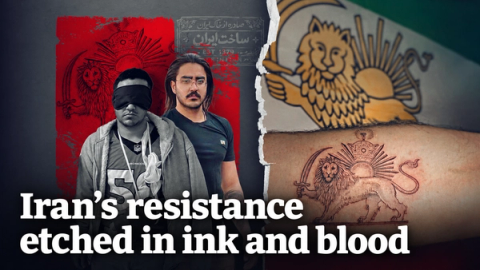
In Section 20 of Bagh Rezvan cemetery in Rasht, thick layers of cement had been poured over part of the graves of slain protestors, creating a uniform surface higher than the surrounding gravestones.

In some areas of the cemetery, the cemented section was so large that it was unclear how many graves lay side by side, the sources added.

Some graves showed no names or dates of birth or death, only a grey surface that appeared intended to erase all trace of them. Several others had small headstones roughly the size of an A4 sheet of paper, with only the deceased’s first and last names engraved in small script.

Witnesses said the graves were defaced and damaged in the presence of government agents and plainclothed security forces.

Graves levelled in Tehran

At Tehran’s main cemetery, Behesht Zahra, some graves of those killed were levelled with the ground and covered with cement after third-day mourning ceremonies, a memorial traditionally held three days after burial.

Sources said the graves were covered in a way that made it impossible to determine from a distance how many had been newly dug.

In Section 329 of the cemetery, families also said some gravestones were destroyed or broken in the days following Feb. 11, the anniversary of Iran's 1979 revolution.

Only a small number of families of slain protestors have so far managed to install gravestones, sources told Iran International.
Families said they were pressured to alter inscriptions on the stones.

In some cases, the use of the Persian term Javidnam—meaning eternally remembered and widely used for slain protestors—or the phrase Farzand-e Iran (“Child of Iran”) drew objections from state bodies and threats that the stones would be destroyed.

‘Too costly’

Families also reported threats to destroy the gravestones of Mojtaba Karabi and Azra Bahaderi-Nejad in the northeastern city of Sabzevar. They said paint had been sprayed on the gravestone of Arman Gorjian and a metal plaque at the grave of Maryam Ebrahimzadeh had been defaced.

Some families temporarily removed gravestones to prevent further damage and said they would not reinstall them until restrictions were lifted.

Gravestone sellers advised families to install stones only for the 40th-day memorial ceremony and remove them afterwards to avoid destruction, sources said, adding that many could not afford the cost of reinstalling headstones and its psychological impact.

Iran International previously received an image showing the broken gravestone of slain protestor Behnam Darvishi.

Darvishi was killed on Jan. 8 after being struck by live ammunition on Persian Gulf Boulevard in Tehran and was buried in Nahavand in western Iran.

Precedents

Damage to graves of people killed in the 2022 protests has also been reported in previous years, including those of Majidreza Rahnavard, Siavash Mahmoudi, Kian Pirfalak, Zakaria Khial and Aylar Haghi.

The broader protest movement followed the September 2022 death in custody of Mahsa Jina Amini, which triggered nationwide anti-government demonstrations.

In earlier cases, gravestones were broken while inscriptions were altered or removed.

In August 2023, Amnesty International said it had documented the destruction of graves belonging to more than 20 victims across 17 cities.

The group said graves had been damaged with tar, paint and arson, headstones had been broken, and phrases describing victims as martyrs or stating they died for freedom had been forcibly erased.

Most Viewed

What the US-Venezuela oil model could mean for Iran’s energy future
1
ANALYSIS

What the US-Venezuela oil model could mean for Iran’s energy future

2

Iran sanctions reach education: Duolingo blocked, TOEFL and GRE in doubt

3

Poverty pushes Iranian children into hazardous border work

4

Iran court sentences 10 protesters to death in Isfahan

5

Iran arrests alleged financial intermediary over €300 million bank debt

Banner
Banner
Banner

Spotlight

  • Iranians hit back at VP's case for pricier gasoline as dollar passes 2.1m rials
    VOICES FROM IRAN

    Iranians hit back at VP's case for pricier gasoline as dollar passes 2.1m rials

  • Nearly half in poll would not buy home in Iran even if they could afford it
    VOICES FROM IRAN

    Nearly half in poll would not buy home in Iran even if they could afford it

  • Syria veteran emerges as key figure in Shahriar crackdown

    Syria veteran emerges as key figure in Shahriar crackdown

  • Iranians tell of shrinking paths to study abroad
    VOICES FROM IRAN

    Iranians tell of shrinking paths to study abroad

  • What the US-Venezuela oil model could mean for Iran’s energy future
    ANALYSIS

    What the US-Venezuela oil model could mean for Iran’s energy future

  • Washington’s economic war on Iran starts in Dubai, not Beijing
    ANALYSIS

    Washington’s economic war on Iran starts in Dubai, not Beijing