• العربية
  • فارسی
Brand
  • Iran Insight
  • Politics
  • Economy
  • Analysis
  • Special Report
  • Opinion
  • Podcast
  • Iran Insight
  • Politics
  • Economy
  • Analysis
  • Special Report
  • Opinion
  • Podcast
  • Theme
  • Language
    • العربية
    • فارسی
  • Iran Insight
  • Politics
  • Economy
  • Analysis
  • Special Report
  • Opinion
  • Podcast
All rights reserved for Volant Media UK Limited
volant media logo
OPINION

Arab states can no longer pretend Tehran’s threat is manageable

Saeed Ghasseminejad Navid Mohebbi
Saeed Ghasseminejad ,
Navid Mohebbi
Jun 6, 2026, 04:11 GMT+1
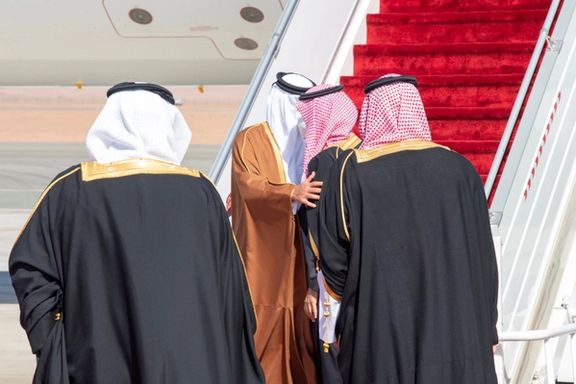
Saudi Arabia's Crown Prince Mohammed bin Salman welcomes Qatar's Emir Sheikh Tamim bin Hamad al-Thani upon his arrival to attend the Persian Gulf Cooperation Council's (GCC) 41st Summit in Al-Ula, Saudi Arabia January 5, 2021

For decades, a dangerous illusion governed the Persian Gulf. Arab capitals knew the Islamic Republic was hostile. Yet, they believed the threat could be managed.

They treated Tehran’s subversion as a chronic illness, not a fatal one. The Arab states of the Persian Gulf opted for quiet diplomacy. Tehran opted for proxies and intimidation. This tense balance was always a house of cards.

That house has collapsed.

The recent war between the United States, Israel, and the Islamic Republic changed everything. It did more than degrade Iran’s military. It shattered a long diplomatic illusion. The regime is not just a disruptive actor. It is a direct existential threat. Specifically, it threatens the economic foundations and long-term stability of the Arab states of the Persian Gulf.

Look closely at the targets the regime chose. Before the war, Saudi Arabia, the United Arab Emirates, and Qatar all signaled a desire for peace. Some lobbied against escalation. Others kept direct lines open to Tehran. Qatar even acted as a mediator.

None of it mattered. Iranian missiles still struck Qatari LNG infrastructure. They targeted Riyadh, the Saudi capital. The United Arab Emirates, historically a vital economic lifeline for Iran, absorbed the most brutal strikes on its primary commercial hubs.

This was a calculated message. Goodwill is no shield when your economic success is the actual target. Tehran does not just view the Arab states of the Persian Gulf as geopolitical rivals. It views their development as an existential threat to its own legitimacy.

For decades, the regime blamed its economic misery on outside enemies. It preached permanent revolution and resistance. Yet, just across the water, the Arab states of the Persian Gulf chose a different path. They built world-class infrastructure, trade, and global growth.

This contrast is terrifying to the Islamic Republic. Ordinary Iranians look across the Persian Gulf and ask a dangerous question: Why does our country, with far greater natural resources, deliver nothing but poverty?

Tehran has no answer. It cannot match the economic model of its neighbors, so it resorts to economic vandalism. If the regime cannot build prosperity at home, it must destroy it next door to level the playing field.

This reality explains why the conflict has evolved beyond mere proxy warfare. The Arab states of the Persian Gulf are accustomed to dealing with asymmetric threats. They have managed Iranian-backed groups like Hezbollah, Iraqi militias, and the Houthis for years.

The current crisis targets something deeper. It is not a standard security dispute. It is a direct assault on the economic model of the Arab states of the Persian Gulf.

Look at the closure of the Strait of Hormuz. Tehran views this vital waterway as a geopolitical jugular. The regime knows that prosperity in the Persian Gulf relies on global investor confidence, open trade, and energy exports. By shutting the Strait, Tehran is holding the entire region's future hostage. If the Islamic Republic cannot climb out of its own economic grave, it will drag its neighbors down into it.

The old playbook is broken. De-escalation, mediation, and managed coexistence are no longer viable strategies. They hold diplomatic utility, but they cannot replace a core security doctrine. The regime proved it will eagerly strike the very neighbors who tried to contain the flames.

The Arab states of the Persian Gulf are confronting a reality they long sought to defer. The Islamic Republic is not a wild animal that can be tamed or managed indefinitely. It is a systemic threat. History shows that treating an expansionist power as a mere management problem only invites more aggressive escalation.

This shift does not require a reckless rush to war. It does mean the Arab states of the Persian Gulf can no longer remain passive observers while others carry the burden. The United States and Israel have already initiated a confrontation. The implications extend far beyond the regime's nuclear ambitions. Leaving this conflict unfinished is highly dangerous. It merely hands Tehran a life support system, giving it time to recover, rebuild, and repeat its destructive cycles.

A deeper transformation is also underway. The strategic interests of key Arab states of the Persian Gulf now directly align with the aspirations of the Iranian people. The average Iranian derives no benefit from the regime’s foreign adventures. Instead, citizens pay the ultimate price through brutal domestic repression, systemic corruption, and engineered economic ruin. The regime behaves like an absentee landlord, burning its own house down for insurance money to fund foreign militias.

By now, the pattern is undeniable. The Islamic Republic’s hostility is not a temporary phase. It stems from a profound systemic insecurity. A neighborhood defined by stability, economic growth, and global integration acts as a mirror. It exposes the regime’s self-inflicted failures. Tehran simply cannot survive the comparison. The old assumptions are officially dead.

The Arab states of the Persian Gulf are not dealing with a conventional rival. They are facing an existential adversary. This adversary views their prosperity and international alignments as an active threat to its survival.

Neutrality is no longer a shield. The Arab states of the Persian Gulf cannot afford to be passive spectators while their future is decided by others. True security will not come from managing the threat from a distance. It will come from actively building a region where totalitarian vandalism can no longer sabotage human progress.

To achieve this, the Arab states of the Persian Gulf can mobilize three vital partners. The first is the Iranian people, who are eager to liberate themselves from their oppressors. The second is Israel, which faces the exact same existential threat but possesses advanced capabilities to directly confront the regime. The third is the United States, whose strategic support remains entirely irreplaceable.

The Arab monarchies of the Persian Gulf should actively coordinate with this triad, first behind the scenes and then openly. Together, they can finally bring down the Islamist regime in Tehran. Only after the Iranian people establish a representative government can the region breathe and find a true partner for peace, regional security, and shared prosperity in Iran.

Most Viewed

Explained: Iran's frozen assets around the world
1

Explained: Iran's frozen assets around the world

2
INSIGHT

As US talks stall, Iran moderates warn of renewed unrest

3
EXCLUSIVE

Iran turns to Iraq’s Umm Qasr as new hub to bypass US blockade

4
OPINION

Arab states can no longer pretend Tehran’s threat is manageable
5
ANALYSIS

Iran's services imports surge as goods trade slumps

Banner
Banner

Spotlight

  • Can Trump crack Iran's negotiating playbook?
    PODCAST

    Can Trump crack Iran's negotiating playbook?

  • Explained: Iran's frozen assets around the world

    Explained: Iran's frozen assets around the world

  • Iran turns to Iraq’s Umm Qasr as new hub to bypass US blockade
    EXCLUSIVE

    Iran turns to Iraq’s Umm Qasr as new hub to bypass US blockade

  • As US talks stall, Iran moderates warn of renewed unrest
    INSIGHT

    As US talks stall, Iran moderates warn of renewed unrest

  • Iran's services imports surge as goods trade slumps
    ANALYSIS

    Iran's services imports surge as goods trade slumps

  • Citizens report growing use of children in Iran security activities
    VOICES FROM IRAN

    Citizens report growing use of children in Iran security activities

•
•
•

More Stories

Trump vs Tehran: how not signing became the deal

May 25, 2026, 04:10 GMT+1
•
Kambiz Hosseini
Trump vs Tehran: how not signing became the deal
100%
US President Donald Trump at the White House in this file photo

US President Trump’s approach toward Iran may better be explained by the political timing of the World Cup and the culture of New York real estate dealmaking: performance, delay, leverage and spectacle.

The cadence of Trump’s remarks about Iran belongs less to the world of foreign policy than to the culture that shaped him long before politics did: New York real estate, tabloid combat, and public brinkmanship treated as performance art.

The comparison that comes closest may not come from diplomacy at all, but from David Mamet’s Glengarry Glen Ross, that ruthless portrait of American real-estate sales culture, where power belongs not to the wisest man in the room, but to the most psychologically relentless.

In the film’s most famous scene appears Blake, the sleek corporate predator whose confidence and aggression are treated as forms of intelligence. He does not simply sell real estate. He sells power, status, and the fantasy of invulnerability itself.

Trump comes from that exact culture, though he did not invent it. He emerged from it.

It is difficult to understand Trump’s approach to Iran through the traditional frameworks of Republican foreign policy because Trump does not instinctively speak that language. He speaks the language of the deal, more specifically, the language of the New York deal.

To diplomats, consistency creates stability and ambiguity introduces risk. For Trump, unpredictability is leverage. Negotiation is a psychological contest in which pressure, timing, perception, and dominance become instruments of power.

One week, a deal appears close. The next, Tehran faces catastrophic consequences if it refuses American demands. To conventional policymakers, the reversals can appear chaotic. But those familiar with the culture of aggressive American salesmanship recognize the game: create urgency, destabilize expectations, project strength, keep the other side uncertain.

But Trump’s instincts are tied not only to commerce, but to performance.

The United States is approaching the 2026 FIFA World Cup, one of the largest international spectacles ever hosted on American soil. Beginning next June, the tournament will unfold across multiple cities before a global audience measured not in millions, but billions.

That context may help explain the curious patience embedded in some of his recent remarks on Iran.

In a Truth Social post on Sunday, Trump insisted negotiators should “not rush into a deal” because “time is on our side.” Pressure on Iran, he wrote, would remain in place until an agreement was “reached, certified, and signed.”

In other words: “get them to sign on the line which is dotted.”

The negotiations with Iran may therefore be less about immediate resolution than about the management of instability until after the World Cup final, a spectacle Trump instinctively understands.

A regional escalation or collapsing diplomatic process in the weeks leading up to the tournament would threaten precisely the atmosphere Trump values most: the image of American strength, prosperity, and control.

This does not mean the negotiations are insincere or a deal is impossible. But it does suggest observers should be cautious about interpreting every public signal as evidence of imminent breakthrough or collapse.

He is not fundamentally opposed to negotiation with Iran. On the contrary, he appears deeply attracted to the possibility of a grand bargain. What he seeks, however, is not simply a workable agreement, but a visible triumph dramatic enough to dominate headlines and simple enough to market politically.

This may be the most distinctly American dimension of Trump’s foreign policy: the belief that geopolitical success must also function as branding. Trump wants ownership of the moment as much as he wants a deal. He wants the image of resolution itself: Iran returning to the table, concessions publicly framed as victories, history compressed into a photograph.

But history rarely cooperates with theatrical instincts. Foreign policy does not bend as easily as commercial real-estate negotiation because nations are not distressed assets waiting to be restructured.

The Islamic Republic measures survival differently: absorbing pressure can itself become a form of victory.

Salesmanship can generate headlines, pressure, and even temporary breakthroughs. But there are crises in which personality eventually collides with structure. That may be the clearest lesson of Trump’s long and unfinished confrontation with Tehran.

The art of the deal becomes far more complicated when the other side sees the conflict as a question of historical survival, when the only thing both sides have in common is a profound sense of mistrust.

Whether there will be a hostile takeover after the World Cup remains unclear. But one does not need to be a geopolitical genius to recognize the underlying logic of pressure if one understands the culture from which Trump emerged.

As Blake says in Glengarry Glen Ross, “The only thing that counts in this life is to get them to sign on the line which is dotted.”

From pulpits to parliament, why Iran’s officials speak in threats

May 22, 2026, 11:59 GMT+1
•
Hossein Zoghi
From pulpits to parliament, why Iran’s officials speak in threats
100%
Supporters attend a pro-government gathering in Iran, where one man holds a placard reading “We buy American scraps,” alongside references to US military equipment including F-16 and F-35 fighter jets, MQ-9 drones and naval destroyers.

Iran’s ruling establishment has increasingly turned to threats and combative rhetoric as it faces mounting economic problems at home and growing diplomatic strain abroad, expanding a wartime language into everyday governance.

Over recent months, hardline clerics, parliamentarians, military figures and diplomats have all adopted a similar tone in speeches, television appearances and social media posts: projecting strength through intimidation.

Pro-government religious speakers have threatened domestic critics during large religious gatherings.

Mahmoud Nabavian, a senior lawmaker on parliament’s national security committee, warned Persian Gulf Arab rulers that “none of their palaces would remain intact” in the event of conflict.

Foreign Minister Abbas Araghchi has spoken on social media of a “long and painful response” to Iran’s adversaries, while foreign ministry spokesman Esmail Baghaei has adopted similarly confrontational language in diplomatic briefings.

Judiciary chief Gholamhossein Mohseni Ejei has also framed Iran as unwilling to bow to outside pressure, while former Revolutionary Guards commander Hossein Kanaani Moghaddam openly described aggressive rhetoric as a method of confronting enemies.

The increasingly coordinated language across state institutions reflects what analysts describe as a deliberate political strategy rather than isolated remarks.

Religious tradition behind the rhetoric

The approach is rooted in a concept drawn from Islamic tradition that emphasizes victory through fear and intimidation.

The idea has historical and religious significance in parts of the Islamic Republic's revolutionary ideology and was widely used during the Iran-Iraq war in the 1980s.

At that time, religious singers and propagandists used emotional chants and battlefield slogans to encourage Iranian fighters and intimidate opponents.

Those performances were largely limited to military fronts and ideological ceremonies.

The same style has now spread into nearly every branch of the Iranian state.

Diplomats increasingly use the language of confrontation rather than negotiation. Members of parliament issue military-style warnings instead of focusing on legislation and economic policy. Judicial officials speak in ideological slogans rather than legal terms.

Men raise their fists during a pro-government gathering in Iran.
100%
Men raise their fists during a pro-government gathering in Iran.

Even Iran’s negotiating teams often use the same tone heard in hardline religious gatherings, blurring the line between diplomacy, domestic propaganda and military messaging.

Pressure at home and abroad

The shift reflects the Islamic Republic’s weakening position rather than growing confidence.

Iran continues to face severe economic difficulties, including soaring inflation, unemployment, currency depreciation and repeated public protests.

The government has also struggled to ease international isolation or achieve major diplomatic breakthroughs despite years of regional confrontation.

Therefore, the aggressive rhetoric has become one of the few remaining ways for the leadership to project authority both domestically and internationally.

The strategy appears aimed at two audiences simultaneously: foreign rivals, who are warned of military escalation, and the Iranian public, where activists, journalists and critics continue to face arrests, interrogations and pressure from security agencies.

But the tactic may also carry political costs. Constant threats can eventually signal weakness and anxiety rather than power, particularly to a population already frustrated by economic hardship and political restrictions.

For many Iranians dealing with inflation, internet disruptions and declining living standards, the increasingly dramatic language from officials has become less a source of fear than a sign of a leadership struggling to maintain control.

Iran lawmaker calls for annual fees on fiber-optic cables crossing Hormuz

May 14, 2026, 12:40 GMT+1
Iran lawmaker calls for annual fees on fiber-optic cables crossing Hormuz
100%

Countries should pay Iran annual fees for fiber-optic cables that pass beneath the Strait of Hormuz, an Iranian lawmaker said, saying that hundreds of billions of dollars in financial transactions move through the lines each day.

“The Strait of Hormuz is a God-given treasure, like other mines and reserves placed at Iran’s disposal,” said Hossein Ali Hajideligani, a member of Iran parliament’s presiding board.

The Strait of Hormuz is a critical route for the digital economy, with several undersea fiber-optic cables running across the seabed and linking India and Southeast Asia to Europe through the Persian Gulf states and Egypt.

Iran had previously warned that submarine cables in the Strait of Hormuz were a vulnerable point for the region’s digital economy, raising concerns about potential attacks on critical infrastructure.

  • IRGC-linked media calls for fees on Hormuz undersea internet cables

    IRGC-linked media calls for fees on Hormuz undersea internet cables

  • IRGC-linked media hints at threat to Persian Gulf undersea internet cables

    IRGC-linked media hints at threat to Persian Gulf undersea internet cables

Last week, IRGC-linked media called for Iran to generate revenue from undersea internet cables passing through the Strait of Hormuz, framing the waterway not only as an energy and shipping chokepoint but also as a digital pressure point.

Hajieligani said Iran should also impose fees on ships passing through the waterway, citing guidance he attributed to Supreme Leader Mojtaba Khamenei’s messages.

He also called for an end to negotiations with the United States, saying Washington had “miscalculated” and was using the process to buy time rather than accept what he called Iran’s “absolute right.”

He said the US was the one that sought a ceasefire and alleged that Washington was after buying time for domestic political purposes.

Iran and UAE clash at BRICS foreign ministers meeting

May 14, 2026, 11:01 GMT+1
Iran and UAE clash at BRICS foreign ministers meeting
100%
Iran's Foreign Minister Abbas Araqchi attends the BRICS foreign ministers' meeting at Bharat Mandapam in New Delhi, India May 14, 2026.

Iran’s foreign minister accused the United Arab Emirates on Thursday of direct involvement in military operations against Iran, escalating Tehran’s criticism of regional states during a BRICS meeting in New Delhi.

Abbas Araghchi made the remarks in response to comments by the Emirati representative and added that he had avoided naming the UAE in his main speech “for the sake of unity.”

“But the truth is that the UAE was directly involved in the aggression against my country,” Araghchi said. “When the attacks started, they didn't even issue a condemnation.”

  • Iran to cast regional conflict as resistance to US power at BRICS meeting

    Iran to cast regional conflict as resistance to US power at BRICS meeting

  • Iran-UAE breakdown leaves Iranian expats in limbo

    Iran-UAE breakdown leaves Iranian expats in limbo

He accused Abu Dhabi of providing bases, airspace, territory, intelligence and other facilities to the United States and Israel during the attacks.

Araghchi said Iran had not attacked the UAE, but had targeted US military bases and facilities on Emirati soil.

He urged the UAE to reconsider its policy toward Iran, saying neither the US military presence nor ties with Israel had protected it.

His remarks came against the backdrop of the war involving Iran, the United States and Israel, during which Tehran said it targeted US military positions in response to attacks on Iran.

They also followed reports that Israeli Prime Minister Benjamin Netanyahu had visited Abu Dhabi during the war and that Israel had provided the UAE with military equipment. The UAE rejected reports of the visit.

Araghchi cited the reports in his remarks, saying the UAE had become “an active partner in this aggression.”

The office of Israeli Prime Minister Benjamin Netanyahu said Wednesday he had made a secret visit to the United Arab Emirates during the US-Israeli war with Iran earlier this year and met UAE President Sheikh Mohammed bin Zayed.


Bahrain court gives life sentence to woman over ties to Revolutionary Guards

May 12, 2026, 09:35 GMT+1
Bahrain court gives life sentence to woman over ties to Revolutionary Guards
100%
Bahrain's flag

A Bahraini court sentenced a woman to life in prison after convicting her of communicating with Iran's Revolutionary Guards with intent to carry out hostile acts against the kingdom and harm its national interests, Bahrain's public prosecution said on Tuesday.

The prosecution said the woman used a social media account to post photos and coordinates of key sites and facilities in Bahrain and shared content that harmed the kingdom's military, political and economic standing.

Authorities said the account also promoted what the prosecution described as Iranian attacks against Bahrain.

The woman admitted to the charges during questioning, prosecutors said, adding that she told investigators she used her social media account to assist those targeting Bahrain by sharing images and coordinates of vital sites alongside messages indicating they could be targeted.

The prosecution said the court also ordered the confiscation of seized items. It did not identify the woman or say when the alleged acts took place.

Bahrain-Iran tensions

The ruling comes days after Bahrain said it had arrested 41 people allegedly linked to a group tied to Iran's Islamic Revolutionary Guard Corps and the ideology of Velayat-e Faqih, or Guardianship of the Jurist – the doctrine underpinning the Islamic Republic’s system of clerical rule and giving Iran’s supreme leader ultimate religious and political authority.

Authorities said legal proceedings were underway and investigations were continuing.

Bahrain's Foreign Minister Abdullatif bin Rashid Al Zayani on Saturday accused Tehran of interfering in the kingdom's internal affairs after the arrests, calling it a violation of international law and good neighborly principles. Iran has not publicly responded to the accusations.