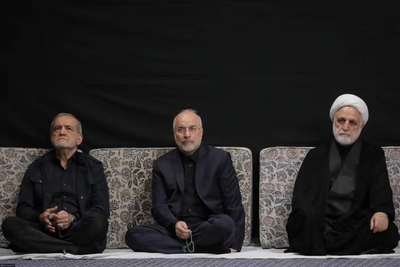
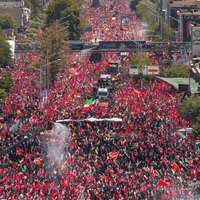
Supporters attend a pro-government gathering in Iran, where one man holds a placard reading “We buy American scraps,” alongside references to US military equipment including F-16 and F-35 fighter jets, MQ-9 drones and naval destroyers.
Iran’s ruling establishment has increasingly turned to threats and combative rhetoric as it faces mounting economic problems at home and growing diplomatic strain abroad, expanding a wartime language into everyday governance.
Over recent months, hardline clerics, parliamentarians, military figures and diplomats have all adopted a similar tone in speeches, television appearances and social media posts: projecting strength through intimidation.
Pro-government religious speakers have threatened domestic critics during large religious gatherings.
Mahmoud Nabavian, a senior lawmaker on parliament’s national security committee, warned Persian Gulf Arab rulers that “none of their palaces would remain intact” in the event of conflict.
Foreign Minister Abbas Araghchi has spoken on social media of a “long and painful response” to Iran’s adversaries, while foreign ministry spokesman Esmail Baghaei has adopted similarly confrontational language in diplomatic briefings.
Judiciary chief Gholamhossein Mohseni Ejei has also framed Iran as unwilling to bow to outside pressure, while former Revolutionary Guards commander Hossein Kanaani Moghaddam openly described aggressive rhetoric as a method of confronting enemies.
The increasingly coordinated language across state institutions reflects what analysts describe as a deliberate political strategy rather than isolated remarks.
Religious tradition behind the rhetoric
The approach is rooted in a concept drawn from Islamic tradition that emphasizes victory through fear and intimidation.
The idea has historical and religious significance in parts of the Islamic Republic's revolutionary ideology and was widely used during the Iran-Iraq war in the 1980s.
At that time, religious singers and propagandists used emotional chants and battlefield slogans to encourage Iranian fighters and intimidate opponents.
Those performances were largely limited to military fronts and ideological ceremonies.
The same style has now spread into nearly every branch of the Iranian state.
Diplomats increasingly use the language of confrontation rather than negotiation. Members of parliament issue military-style warnings instead of focusing on legislation and economic policy. Judicial officials speak in ideological slogans rather than legal terms.
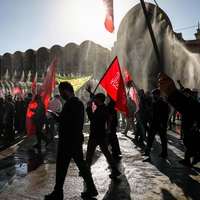
Men raise their fists during a pro-government gathering in Iran.
Even Iran’s negotiating teams often use the same tone heard in hardline religious gatherings, blurring the line between diplomacy, domestic propaganda and military messaging.
Pressure at home and abroad
The shift reflects the Islamic Republic’s weakening position rather than growing confidence.
Iran continues to face severe economic difficulties, including soaring inflation, unemployment, currency depreciation and repeated public protests.
The government has also struggled to ease international isolation or achieve major diplomatic breakthroughs despite years of regional confrontation.
Therefore, the aggressive rhetoric has become one of the few remaining ways for the leadership to project authority both domestically and internationally.
The strategy appears aimed at two audiences simultaneously: foreign rivals, who are warned of military escalation, and the Iranian public, where activists, journalists and critics continue to face arrests, interrogations and pressure from security agencies.
But the tactic may also carry political costs. Constant threats can eventually signal weakness and anxiety rather than power, particularly to a population already frustrated by economic hardship and political restrictions.
For many Iranians dealing with inflation, internet disruptions and declining living standards, the increasingly dramatic language from officials has become less a source of fear than a sign of a leadership struggling to maintain control.
A woman holds a poster depicting Iran’s new Supreme Leader Mojtaba Khamenei, during a rally in Tehran, Iran, on April 29, 2026.
Iranian officials’ recent comments about Supreme Leader Mojtaba Khamenei are aimed at showing he remains in charge and will ultimately decide whether Tehran accepts a deal with the United States to end the war, the Financial Times reported on Thursday.
The report said officials had begun speaking more openly about Khamenei’s condition amid speculations that the Islamic Revolutionary Guards were effectively running decision-making.
“They are projecting that there’s no change . . . the supreme leader was the apex of the system and is still the apex,” Vali Nasr, a former US official and professor at Johns Hopkins University was quoted as saying. “And that he’s alive, functioning and in control.”
He added that the guards were also seeking to project that “they are not running the show and [Khamenei is] not just a figurehead.”
The report referred to remarks by Iran’s President Masoud Pezeshkian and Mazaher Hosseini, a senior official in the Supreme Leader’s office.
Pezeshkian said on earlier this month that he had met with the Supreme Leader, offering a first public account of him meeting Mojtaba Khamenei since he suffered severe wounds at the start of the Iran war on February 28.
Hosseini said later that Mojtaba Khamenei suffered minor injuries to his kneecap, back and behind his ear in the airstrikes that killed his father and wife, insisting he is now in “full health” and dismissing reports of a serious head injury as “lies.”
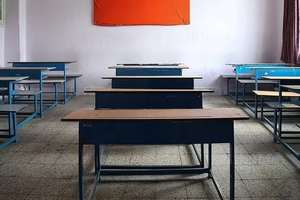
A student attends an online class through Iran’s government-backed Shad platform after schools shifted to remote learning during wartime closures.
Millions of Iranian students saw remote schooling disrupted by internet outages and failures on the state-run online education platform during more than two months of school closures, renewing criticism of Iran’s virtual education system.
An opinion piece published by Etemad newspaper on Tuesday described widespread frustration among students, parents and teachers over the poor performance of the government-backed Shad platform, which authorities rely on for remote education during emergencies.
Schools across Iran have remained closed since the US-Israeli strikes, forcing students back into virtual classrooms years after the country’s first large-scale experiment with online education during the COVID-19 pandemic.
The article argued that many of the same problems identified during the pandemic – including low speed, weak server capacity and repeated outages – remain unresolved despite years of experience with remote learning.
Iran launched the Shad network during the coronavirus outbreak to create a unified national education system after schools shut down nationwide. But users quickly reported technical shortcomings, leading many schools and teachers to rely on alternative messaging and video applications to continue classes.
Although in-person education resumed after the pandemic, the report said authorities failed to significantly improve the platform’s infrastructure despite repeated school disruptions caused by weather conditions, air pollution and energy shortages in recent years.
Internet restrictions deepen problems
The recent conflict and tensions have added new pressure because restrictions on international internet access have reduced the availability of foreign platforms previously used as alternatives during outages.
Domestic applications have also struggled under the surge in traffic from millions of users attempting to access online classes simultaneously, leaving many lessons interrupted or inaccessible.
Teachers have continued trying to keep classes running despite the limitations, often reducing instruction to brief reviews or postponing major lessons until normal schooling resumes.
A student studies at home during online classes in Iran as schools remain closed and lessons continue through the government-backed Shad platform amid ongoing disruptions.
The mounting complaints recently prompted Iran’s State Inspectorate Organization to warn the government that the Shad platform requires updated and sufficient infrastructure to secure public satisfaction.
The oversight body said Shad remains the only widely accepted national platform for virtual education among teachers, students and parents, making its reliability critical during emergencies.
The article argued that online education cannot replace face-to-face teaching, particularly in deprived and remote regions where internet access and digital devices remain uneven.
University students face separate pressures
The disruptions have also extended into higher education. While universities have said to continue courses online, the closure of student dormitories has created financial and logistical difficulties for working students who must remain in their university cities.
Students displaced from dormitories have increasingly turned to low-cost temporary accommodation, raising safety and financial concerns for families.
The report concluded that repeated national emergencies have shown Iran still lacks a reliable and accessible virtual education system capable of sustaining learning during prolonged disruptions.
Two years after former president Ebrahim Raisi’s helicopter vanished in fog, Iran has lost far more than a president: its succession plan, regional shield, aura of safety and confidence that time was on its side.
On May 19, 2024, a helicopter carrying Raisi disappeared in the mountains of Iran’s East Azarbaijan province. The final Iranian inquiry blamed bad weather, dense fog and atmospheric conditions, not sabotage.
But the image was too powerful to ignore: a leadership convoy moving through poor visibility, losing sight of itself, then trying to project a state still in control.
That is the better way to read Raisi’s death – as metaphor, not conspiracy.
The crash did not change Iran because Raisi ruled Iran. He did not. Real power sat above him, with Supreme Leader Ali Khamenei, the Revolutionary Guard, the security state and the regional networks Tehran had built over decades.
Raisi mattered because he showed how continuity was supposed to look. He was loyal, hardline, severe and predictable; a figure once widely discussed as a possible successor to Khamenei.
Raisi was not the Islamic Republic’s future. He was its rehearsal for a future that never arrived.
In May 2024, the system still seemed to have a succession plan, a regional shield and the patience to wait out its enemies. Two years later, almost every pillar that made Tehran look untouchable has been tested or broken.
No sanctuary
The countdown had already begun on October 7, 2023.
Hamas’s attack on Israel opened a war that pulled Iran’s wider network into motion: Hezbollah in Lebanon, militias in Iraq and Syria, the Houthis in Yemen. For years, this was Tehran’s doctrine of strategic depth.
After October 7, that depth became a target map.
By April 2024, Iran and Israel had moved from shadow war into direct confrontation. Then, one month later, Raisi’s helicopter fell out of the fog.
The state answered with the familiar theater of mourning: coffins, black flags, portraits, clerics and commanders. The message was continuity.
But after Raisi, the funerals began to tell another story. One by one, they marked not continuity, but exposure: a system losing the people, places and networks that had made it feel protected.
Former Supreme Leader Ali Khamenei leading the funeral prayer at the coffin of Ebrahim Raisi and other officials killed in the crash
His death forced a snap election. Masoud Pezeshkian, a reformist in tone, won the presidency after a first round marked by record-low turnout. The system gained a softer face, but not a new center of power.
Then came the first great humiliation of the post-Raisi era.
Ismail Haniyeh, Hamas’s political leader, came to Tehran for Pezeshkian’s inauguration. Hours later, he was killed in the Iranian capital.
This was not only the killing of a Hamas leader. It was a message that even the patron’s capital was no sanctuary.
That became the sentence for what followed.
In September 2024, Hezbollah’s pagers and radios exploded across Lebanon and Syria, turning the group’s own communications into weapons against it. Days later, Hassan Nasrallah was killed in Beirut.
A movement built on secrecy and underground command had been pierced from inside and struck from above.
Then Hamas leader in Gaza Yahya Sinwar was killed. Hamas remained, Hezbollah remained, the slogans remained. But the axis was bleeding leaders, territory, routes and confidence.
The deeper break came in Syria.
Bashar al-Assad’s fall in December 2024 was not just the loss of another Islamic Republic's ally. It damaged the geography of Iranian power: the route to Hezbollah, the Mediterranean opening, and the Qasem Soleimani-era claim that weak states could be turned into Iranian depth.
Israel struck Iranian nuclear and military sites during the 12-Day War. The United States then hit the most fortified parts of the nuclear program.
For years, nuclear ambiguity had been Tehran’s shield. In 2025, it became a battlefield.
Outside pressure then met the inside front.
The protests that erupted in late 2025 and early 2026 were driven by economic collapse, repression and the old demand for a different political order. By January 8 and 9, the state answered with mass violence and an internet shutdown.
The Islamic Republic could still shoot, jail and terrify. But it could no longer persuade enough of its own people that it had a future.
Even shocks beyond the Middle East began to feel part of the same weather. The US capture of Venezuelan President Nicolás Maduro in January 2026 mattered less as an Iran story than as an atmosphere: another anti-American ruler, once protected by sovereignty and distance, suddenly exposed.
Then, on February 28, 2026, the war reached the institution at the heart of the Islamic Republic’s power: the supreme leadership.
Ali Khamenei was killed in US-Israeli strikes. For a state built around velayat-e faqih, this was not only the death of a ruler. It was the breaking of an aura.
Mojtaba Khamenei was named Supreme Leader days later. The appointment was meant to project continuity. Instead, it made the Islamic Republic look smaller, more closed and more dynastic.
The revolution born against monarchy had passed its highest office from father to son in wartime.
The funeral that has not happened
And then came the strangest funeral of all: the one that could not settle itself.
Iran postponed Khamenei’s state funeral. Months later, even his burial remained unclear. For a Shiite revolutionary state that has always known how to turn death into power, the delay was astonishing.
The republic of funerals had lost command of its most important ritual.
The old model had four layers. At home, fear contained society. In politics, elections gave the state a civilian mask. In the region, proxies kept enemies away from Iran’s borders. At the strategic level, missiles, nuclear ambiguity and the Strait of Hormuz made the cost of attack seem unknowable.
Since Raisi’s crash, every layer has been damaged.
Fear has produced revolt. Elections have exposed emptiness more than legitimacy. Regional depth has been penetrated. Syria has fallen away. Hezbollah and Hamas have been battered. The supreme leader’s office has lost its aura of untouchability.
Hormuz remains Iran’s strongest card. But it also shows the trap. The strait gives Tehran leverage over oil, shipping and global markets; it also keeps Iran at the center of a crisis it cannot easily end.
This is not the story of a regime that has already fallen. The Islamic Republic still has prisons, missiles, commanders and a long memory for survival.
But it is also not the story Tehran wants to tell.
Two years ago, Raisi’s death was wrapped in the language of martyrdom and continuity. The state said nothing vital had been lost.
Yet what followed revealed how little room the Islamic Republic had left for error.
The crash did not start the chain. October 7 had already started the clocks. But Raisi’s death gave the years after it their image: fog, poor visibility, a convoy losing contact, and a state insisting the road ahead was clear.
Two years later, Iran is still falling through that fog.
The question is no longer whether the Islamic Republic can survive another crisis. It has survived many.
The question is whether it can survive the loss of the things that made survival possible: distance, fear, succession, sanctuary and the belief that time was on its side.
Nandito Badea and George Stana, two Romanian men accused of stabbing the Iran International journalist Pouria Zeraati near his home in Wimbledon in March 2024, appear at Woolwich Crown Court in London, Britain, May 18, 2026, in a courtroom sketch. / Courtesy of Reuters
British prosecutors said on Monday that a team of Romanian men who carried out a 2024 knife attack on Iran International TV presenter Pouria Zeraati in London were acting as proxies for Iran.
Zeraati was stabbed three times in the leg near his home in Wimbledon, southwest London, in late March 2024. He was discharged from the hospital two days later.
Nandito Badea, 21, and George Stana, 25, were arrested in Romania in connection with the attack, and were extradited to Britain on December 17, 2024. They were later charged with allegedly “wounding with intent to cause grievous bodily harm", a charge they denied at a preliminary hearing in London last year.
On Monday, prosecutor Duncan Atkinson told Woolwich Crown Court that “this was no robbery, no fight that got out of control, it was deliberate, planned violence to achieve what it did, that is serious injury to its target."
They had "committed a planned attack preceded by reconnaissance, and which was ordered by a third party acting on behalf of the Iranian state," he added.
Atkinson said Zeraati was an “obvious and readily identifiable target for violence” by proxies acting for Iran.
He said posters had been put up in Tehran in November 2022 featuring pictures of journalists including Zeraati under the heading “Wanted: dead or alive.”
Use of criminal gangs
“In recent years, since 2005, the Islamic Republic has turned less to its own operatives and increasingly to use proxies such as criminal gangs to meet their threatened violence on their behalf,” Atkinson said.
“That has included attacks on persons in this country who have become targets of Iranian intimidation and, effectively, terror,” he added.
Atkinson said Zeraati had been subjected to “extensive reconnaissance.”
He said Stana had been arrested a year earlier in the garden of Zeraati’s apartment with another man while in possession of latex gloves, scissors and a mask.
On the day of the attack, Badea and Andrei confronted Zeraati as he crossed the street from his home to his car, Atkinson said. Andrei held him while Badea stabbed him at the top of his thigh before they fled to a getaway car driven by Stana, the prosecutor added.
The men, who were motivated by money, dumped the car and some clothing before taking a taxi to Heathrow Airport and flying to Geneva, Atkinson said.
A third man accused of involvement, David Andrei, was arrested in Romania but is not involved in the trial.
The trial which began on Monday is expected to last more than two weeks.
In a separate incident last month, three defendants were charged over an alleged arson incident near Iran International’s studios in northwest London, with their trial scheduled to begin on January 25, 2027, at the Central Criminal Court.
In a statement, Iran International said the attack highlights increasing pressure on its journalists and their families, particularly following the recent war involving Iran.
The broadcaster said its staff and their relatives have faced threats and harassment, describing the situation as an effort to silence independent reporting.
Women walk past a Khamenei street banner in Tehran as inflation and rising living costs continue to strain household budgets in Iran.
Iranian President Masoud Pezeshkian said on Monday that Iranians should expect inflation, shortages and economic hardship because the country is at war and facing mounting pressure on its energy infrastructure and oil exports.
“We will definitely have inflation,” Pezeshkian said at a gathering of public relations officials from state institutions.
“We are fighting and we must accept the hardship that comes with it.”
Some critics questioned why prices continued to rise, Pezeshkian said, but argued that economic pain was unavoidable under the current circumstances.
They want to have their cake and eat it too, he said, using a Persian idiom.
The war between the United States, Israel and Iran began with coordinated US-Israeli strikes on Iranian military, nuclear and government targets on February 28. Iran launched missile and drone attacks targeting Israel, the US allies in the region and their infrastructure, while tensions around the Strait of Hormuz disrupted global energy market.
Although direct fighting has eased amid ceasefire and mediation efforts, tensions remain high as disputes over Iran’s nuclear program, sanctions, regional influence and maritime security continue without a lasting diplomatic breakthrough.
The president also opened his remarks with an unusual comment hinting at a lack of control over his own movements and schedule.
“I myself did not know where they were taking me. Suddenly they brought me here,” Pezeshkian said.
Damage and shortages acknowledged
Iran, Pezeshkian said, had suffered serious economic and infrastructure damage and could not pretend conditions were normal.
“It is not the case that we have not been harmed,” he said. “We must take on a wartime condition.”
Attacks, he said, had damaged around 230 million cubic meters of gas infrastructure as well as power plants, petrochemical facilities and major industrial sites, including Iran’s largest steel producer.
“We cannot say the enemy is collapsing and we are flourishing,” he said. “They have problems and we have problems too.”
The president said the public need to lower expectations and reduce consumption in order to withstand the situation.
Oil exports and fuel production under pressure
Pezeshkian also acknowledged growing difficulties in exporting Iranian oil and securing revenues under sanctions and regional pressure.
“They blocked the way and we are not exporting oil either,” he said. “We cannot export oil easily.”
Shoppers buy fruit and vegetables at a market in Tehran amid rising food prices.
Tax collection, he added, had become increasingly difficult because businesses and trade sectors were under economic strain.
Pezeshkian warned that fuel shortages and inflation would worsen without tighter management of energy consumption, saying gasoline production had fallen after damage to production facilities.
“Our gasoline production capacity has fallen. They hit it,” he said.
According to Pezeshkian, Iran currently produces around 100 million liters of gasoline per day while domestic demand has reached roughly 150 million liters daily.
“Do we even have the dollars to import gasoline and burn it?” he said.
The president called for stricter management of water, electricity, gas and gasoline consumption, saying economic problems, unemployment and inflation would deepen without conservation measures.