• العربية
  • فارسی
BrandBrand
  • Iran Insight
  • Politics
  • Economy
  • Analysis
  • Special Report
  • Opinion
  • Podcast
  • Live TV
  • Iran Insight
  • Politics
  • Economy
  • Analysis
  • Special Report
  • Opinion
  • Podcast
  • Live TV
  • Theme
  • Language
    • العربية
    • فارسی
  • Iran Insight
  • Politics
  • Economy
  • Analysis
  • Special Report
  • Opinion
  • Podcast
  • Live TV
All rights reserved for Volant Media UK Limited
volant media logo

Pezeshkian says Iranians must accept inflation as country is in war

May 18, 2026, 10:13 GMT+1Updated: 19:20 GMT+1
Women walk past a Khamenei street banner in Tehran as inflation and rising living costs continue to strain household budgets in Iran.

Iranian President Masoud Pezeshkian said on Monday that Iranians should expect inflation, shortages and economic hardship because the country is at war and facing mounting pressure on its energy infrastructure and oil exports.

“We will definitely have inflation,” Pezeshkian said at a gathering of public relations officials from state institutions.

“We are fighting and we must accept the hardship that comes with it.”

Some critics questioned why prices continued to rise, Pezeshkian said, but argued that economic pain was unavoidable under the current circumstances.

They want to have their cake and eat it too, he said, using a Persian idiom.

The war between the United States, Israel and Iran began with coordinated US-Israeli strikes on Iranian military, nuclear and government targets on February 28. Iran launched missile and drone attacks targeting Israel, the US allies in the region and their infrastructure, while tensions around the Strait of Hormuz disrupted global energy market.

Although direct fighting has eased amid ceasefire and mediation efforts, tensions remain high as disputes over Iran’s nuclear program, sanctions, regional influence and maritime security continue without a lasting diplomatic breakthrough.


The president also opened his remarks with an unusual comment hinting at a lack of control over his own movements and schedule.

“I myself did not know where they were taking me. Suddenly they brought me here,” Pezeshkian said.

Damage and shortages acknowledged

Iran, Pezeshkian said, had suffered serious economic and infrastructure damage and could not pretend conditions were normal.

“It is not the case that we have not been harmed,” he said. “We must take on a wartime condition.”

Attacks, he said, had damaged around 230 million cubic meters of gas infrastructure as well as power plants, petrochemical facilities and major industrial sites, including Iran’s largest steel producer.

“We cannot say the enemy is collapsing and we are flourishing,” he said. “They have problems and we have problems too.”

The president said the public need to lower expectations and reduce consumption in order to withstand the situation.

Oil exports and fuel production under pressure

Pezeshkian also acknowledged growing difficulties in exporting Iranian oil and securing revenues under sanctions and regional pressure.

“They blocked the way and we are not exporting oil either,” he said. “We cannot export oil easily.”

100%
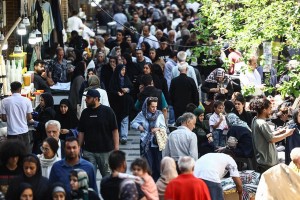
Shoppers buy fruit and vegetables at a market in Tehran amid rising food prices.

Tax collection, he added, had become increasingly difficult because businesses and trade sectors were under economic strain.

Pezeshkian warned that fuel shortages and inflation would worsen without tighter management of energy consumption, saying gasoline production had fallen after damage to production facilities.

“Our gasoline production capacity has fallen. They hit it,” he said.

According to Pezeshkian, Iran currently produces around 100 million liters of gasoline per day while domestic demand has reached roughly 150 million liters daily.

“Do we even have the dollars to import gasoline and burn it?” he said.

The president called for stricter management of water, electricity, gas and gasoline consumption, saying economic problems, unemployment and inflation would deepen without conservation measures.

Most Viewed

Iran's oil output plunges below pre-war domestic needs
1
ANALYSIS

Iran's oil output plunges below pre-war domestic needs

2

Iran's top clerical governing body calls for nuclear doctrine review

3

Iran threatens Armenia as US-run Trump Route clears Yerevan’s parliament

4

Cash-strapped Iranians put multiple organs up for sale

5
INSIGHT

Iranian hardliners urge Iraq to push back against US pressure

Banner
Banner
Banner
Banner
Banner
Banner
Banner

Spotlight

  • Iran's oil output plunges below pre-war domestic needs
    ANALYSIS

    Iran's oil output plunges below pre-war domestic needs

  • Iranian hardliners urge Iraq to push back against US pressure
    INSIGHT

    Iranian hardliners urge Iraq to push back against US pressure

  • Cash-strapped Iranians put multiple organs up for sale

    Cash-strapped Iranians put multiple organs up for sale

  • Iran's intelligence merger debate signals possible security shake-up
    INSIGHT

    Iran's intelligence merger debate signals possible security shake-up

  • Americans ‘a bit naive’ about influence campaigns by Iran, Russia, China
    ONE-ON-ONE

    Americans ‘a bit naive’ about influence campaigns by Iran, Russia, China

  • Trump's Iran dilemma after America's 'everything' election
    OPINION

    Trump's Iran dilemma after America's 'everything' election

  • The faceless judge who sentenced 11 Iranian protesters to death in 2026
    SPECIAL REPORT

    The faceless judge who sentenced 11 Iranian protesters to death in 2026

  • Iran taps reserves again as inflation bites and layoffs mount

    Iran taps reserves again as inflation bites and layoffs mount

  • Can Iran’s economy survive a twin squeeze from blockade and blackout?

    Can Iran’s economy survive a twin squeeze from blockade and blackout?