• العربية
  • فارسی
Brand
  • Iran Insight
  • Politics
  • Economy
  • Analysis
  • Special Report
  • Opinion
  • Podcast
  • Iran Insight
  • Politics
  • Economy
  • Analysis
  • Special Report
  • Opinion
  • Podcast
  • Theme
  • Language
    • العربية
    • فارسی
  • Iran Insight
  • Politics
  • Economy
  • Analysis
  • Special Report
  • Opinion
  • Podcast
All rights reserved for Volant Media UK Limited
volant media logo
OPINION

Iran crossed a political threshold

Mehdi Parpanchi
Mehdi Parpanchi

Iran International executive editor

Jan 9, 2026, 07:29 GMT+0
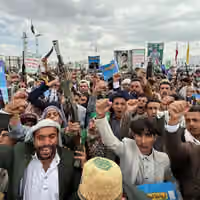
Protesters gather in Tehran as fires burn in the background during anti-establishment demonstrations on January 8, 2026.

What happened in Iran on Thursday night was not simply another protest. Coordinated mass demonstrations unfolded nationwide in response to a direct call from Prince Reza Pahlavi that specified not only the action but also the timing.

Calls for action from outside Iran have been issued many times over the years and largely ignored. This one was answered, simultaneously and at scale. The precision of the call and the response to it surprised supporters and skeptics alike. Thursday night did not produce regime change, but it marked something no less significant: a visible crossing of a political threshold.

Revolutions do not begin on a single night. They surface after long periods of accumulated rupture. Iran has been politically and psychologically boiling for roughly two decades. What we are witnessing today is the outward expression of a process that began with the collapse of legitimacy in 2009.

That year’s presidential election shattered the Islamic Republic’s claim to popular consent. Until then, despite deep frustration, many Iranians still believed meaningful change was possible through participation, through the ballot, reformist candidates, and gradual adjustment within the system. The blatant manipulation of the vote and the violent suppression of mass protests ended that belief. What followed was not merely repression, but an emotional and moral divorce between society and state. The system survived, but consent did not.

The 2015 nuclear agreement briefly altered the trajectory. It reopened the possibility that Iran might normalize and that ordinary people could reclaim what they often describe as a “normal life.” That hope proved fleeting. Billions of dollars entered the country after nuclear-related sanctions were lifted, yet resources were overwhelmingly diverted toward missile and drone programs and the expansion of proxy networks in Syria, Iraq, Lebanon, and Yemen. Meanwhile, the national currency collapsed, inflation surged, and household purchasing power steadily eroded.

These economic realities are widely known. What has been far less understood, particularly across Western media and policymaking circles, is what was happening beneath the surface. Iranian society had largely exited the Islamic Republic at the level of belief. This was no longer dissent or protest. It was post-loyalty. People were no longer asking how to reform the system. They were asking what could replace it.

Symbols matter when legitimacy erodes, especially when long-standing taboos break. A critical moment came in 2018, when a mummified body, widely believed to be that of Reza Shah, was discovered at a construction site in Shahr-e Rey, near Tehran, where his mausoleum once stood before being demolished after the revolution. Whether the remains were authentic was ultimately irrelevant. What mattered was the reaction. Public chants of “Reza Shah, may God bless your soul” emerged, chants that would have been unthinkable in public space just years earlier.

At first, these slogans were interpreted as expressions of anger toward the Islamic Republic rather than positive reassessment of the Pahlavi era. That reading did not hold. The chants returned, spread geographically, and grew more explicit. A psychological barrier had been crossed.

By the mid-2020s, this symbolic shift became increasingly evident on social media, where attention clustered around Reza Pahlavi. Some observers dismissed his prominence there as a product of manipulation or as evidence that social media itself is an unreliable gauge of political reality. Yet the pattern was unmistakable. Content linked to him consistently generated unusually high engagement across Persian-language platforms, circulating organically, resurfacing repeatedly, and sustaining visibility well beyond individual protest cycles.

The current wave of protests made this underlying reality impossible to dismiss. From the outset, calls for Pahlavi’s return were explicit and widespread. Some skeptics again attempted to discredit the scenes by claiming that videos were manipulated or that slogans had been dubbed in. That explanation did not withstand repetition or scale. The same chants were heard across multiple cities and nights in unrelated recordings, revealing in public what had been forming beneath the surface for years.

The significance of Thursday night lies not in raw numbers alone, but in coordination and credibility. Many external calls in the past produced little or nothing. This one did not. For the first time, a call issued for a specific hour was answered across the country. Demonstrations began simultaneously at the designated time, offering clear evidence of collective response rather than scattered unrest. That precision, and the response to it, marked a qualitative shift in Iran’s political dynamics.

The Islamic Republic still controls the machinery of the state. What it lost on Thursday night is exclusivity over its remaining political legitimacy, both domestically and internationally. From this point on, foreign governments are no longer dealing with an uncontested representative of the Iranian nation, but with a regime whose claim to speak for Iran is openly challenged. Power maintained by force can endure for a time. Power stripped of legitimacy does not recover it.
At the same time, Reza Pahlavi crossed a line that many before him failed to reach. This was not symbolism, nostalgia, or digital noise. It was a successful act of political command. Others issued calls from abroad and were ignored. He issued one, and it was answered nationwide and on schedule. That is not popularity. That is operational leadership.

With this, Iran’s opposition space has been fundamentally reordered. The question is no longer whether Iranians are searching for an alternative or whether a leader could emerge. Both questions have been settled. A focal point now exists, and the regime is forced to reckon with it.

From this moment on, Iranian politics operates under new constraints. The state must now respond not to spontaneous unrest, but to an identifiable center of mobilization. History shows that regimes can survive protests. They struggle far more to survive leaders.

After Thursday night, the Islamic Republic faces a reality it has long sought to prevent. It no longer confronts a crowd. It confronts a contender.

Most Viewed

Iran negotiators ordered to return after internal rift over Islamabad talks
1
EXCLUSIVE

Iran negotiators ordered to return after internal rift over Islamabad talks

2
INSIGHT

Iran's digital economy battered by prolonged blackout

3
ANALYSIS

US blockade enters murky phase as tankers spoof signals and buyers hesitate

4
ANALYSIS

Why the $100 billion Hormuz toll revenue is a myth

5

US tightens financial squeeze on Iran, warns banks over oil money flows

Banner
Banner

Spotlight

  • Hardliners push Hormuz ‘red line’ as US blockade tests Iran’s leverage
    INSIGHT

    Hardliners push Hormuz ‘red line’ as US blockade tests Iran’s leverage

  • Ideology may be fading in Iran, but not in Kashmir's ‘Mini Iran'
    INSIGHT

    Ideology may be fading in Iran, but not in Kashmir's ‘Mini Iran'

  • War damage amounts to $3,000 per Iranian, with blockade set to add to losses
    INSIGHT

    War damage amounts to $3,000 per Iranian, with blockade set to add to losses

  • Why the $100 billion Hormuz toll revenue is a myth
    ANALYSIS

    Why the $100 billion Hormuz toll revenue is a myth

  • US blockade targets Iran oil boom amid regional disruption
    ANALYSIS

    US blockade targets Iran oil boom amid regional disruption

  • Iran's digital economy battered by prolonged blackout
    INSIGHT

    Iran's digital economy battered by prolonged blackout

•
•
•

More Stories

Millions of Iranians take to the streets as protest death toll hits 42

Jan 9, 2026, 03:12 GMT+0

Millions of Iranian protesters filled the streets across the country on the 12th day of nationwide protests, with human rights groups saying at least 42 people including five minors have been killed so far.

The 42 documented fatalities include 29 protesters, eight security personnel and five children or adolescents, figures released on Thursday by the US-based rights group HRANA showed.

Reports of many more injured are still being verified amid restricted access to field information and medical data following a total internet shutdown, HRANA said.

More than 2,277 have also been arrested in 12 days of protests that started over economic woes but soon spiraled into an uprising to topple the Islamic Republic, according to the report.

“At least 60 new arrests were recorded on Thursday alone, bringing the total to over 2,277 detainees, among them at least 166 minors and 48 university students, while 45 coerced televised “confessions” have been broadcast by state media since the unrest began,” HRANA reported.

The report cited an extensive strike movement, particularly in Kurdish and Lur areas, saying tens of towns in Kurdistan, West Azarbaijan, Kermanshah and Ilam provinces joined market shutdowns, alongside partial closures in Tehran and cities including Arak, Qazvin, Zanjan, Urmia, Isfahan and Shiraz.

The group reports extensive use of tear gas and shooting—including aerial fire—in several cities such as Bijar, Khorramabad, Behbahan and parts of Karaj, as well as electricity cuts in some locations, which together have hampered documentation and contributed to an “information fog” around the true scale of casualties.

Why Iran is not Venezuela

Jan 8, 2026, 23:24 GMT+0
•
Mehdi Parpanchi

The idea that Iran could change course through a shift at the top—without the collapse of the structure itself, and with a pragmatic figure opening up to the world—rests on a false assumption about how power actually works in Tehran.

That assumption has been reinforced by recent developments in Venezuela, where the United States forcibly removed Nicolás Maduro from power and now appears prepared to work with figures from within the same governing apparatus.

But Iran is not Venezuela, and treating it as such misunderstands the nature of the Islamic Republic’s power structure.

In Venezuela, despite corruption and the concentration of power, the political system is not security-ideological and transnational in the way Iran’s is. Loyalties and alliances in Caracas can shift without forcing a fundamental remake of the establishment.

Can the same be said about Tehran?

Over the past four decades, the original theocracy has evolved into a complex security-ideological power machine whose core lies within the Islamic Revolutionary Guard Corps (IRGC) and its affiliated networks. This machine is not merely an instrument of the system; it has become inseparable from it.

The IRGC, the Quds Force, parallel intelligence bodies, and a web of armed groups across the region are better understood as a single, tightly interwoven power structure. Even the potential departure of Iran’s supreme leader would be unlikely to alter, let alone dismantle, this organism.

Ali Khamenei may embody the Islamic Republic, and his name is often used interchangeably with the “system,” but the state itself encompasses thousands of actors across the Revolutionary Guards, security institutions and affiliated bodies.

These networks have cooperated operationally with aligned forces in Iraq, Syria, Lebanon, Yemen, Afghanistan and Pakistan—working together in war, negotiation, and crisis management.

Other parts of the same apparatus have spent years developing missile and nuclear programs, accumulating expertise, institutional memory, and vested interests.

This is the product of a shared political and security life: a layered network in which relationships, trust, and interests have solidified over time. Such a network does not collapse with the departure of a single figure, or even a single faction.

Security relationships and interests built over decades are far more likely to reproduce themselves than to disappear with a leadership change. The leader may go, but the system’s underlying logic will remain.

That logic rests on several widely entrenched pillars: the expansion of the nuclear program; the development of missile and drone capabilities; the preservation and extension of regional proxy networks; and the definition of political identity in opposition to the United States and the West.

These are not merely policy preferences open to negotiation. They are widely treated within the system as pillars of survival. Betting on figures drawn from within this structure to shed their skin risks reproducing the very logic such a strategy claims to transcend.

The image of a moderate caretaker or a deal-making leader emerging as a Bonaparte-like figure capable of transforming the system is therefore closer to political fantasy than practical possibility.

Comparing Iran to Venezuela is ultimately a comparison between two dissimilar systems.

In Venezuela, alliances can shift while the structure remains intact. In Iran, the structure itself is the source of the crisis. The container and its contents are one and the same. A change of skin does not resolve that contradiction.

For Iranians—and for the wider world—the problem with the Islamic Republic cannot be solved by changing faces. A durable solution can only be contemplated when this structure gives way to an order that is fundamentally different, shaped by actors who are fundamentally different as well.

Trump backs Iran protesters, calls them ‘brave people’

Jan 8, 2026, 22:51 GMT+0

US President Donald Trump warned Iran’s authorities against killing protesters amid nationwide demonstrations on Thursday, praising Iranians as “brave people.”

Millions of Iranians took the streets across the country for a national rally called by exiled Prince Reza Pahlavi.

Trump told podcaster Hugh Hewitt that the Iranian leaders "have been told very strongly… that if they do that, they’re going to have to pay hell.”

This is the third time since the start of protests on December 28 that Trump has warned Tehran not to kill demonstrators or face possible US intervention.

Addressing Iranians directly, he urged them to “feel strongly about freedom,” and said: “There’s nothing like freedom. You’re brave people. It’s a shame what’s happened to your country.”

Protesters in Iran have appealed directly to Trump for protection. Rights groups say at least 36 people have been killed since the protests began on December, while more than 2,000 people have been arrested or detained.

A nationwide internet blackout hit Iran on Thursday according to live network metrics from network monitoring groups.

Asked if he would meet exiled Prince Pahlavi, Trump said he still waits to see what happens in Iran before meeting or endorsing any opposition figure.

"Well, I've watched him, and he seems like a nice person, but I'm not sure that it would be appropriate at this point to do that as President," Trump responded. "I think that we should let everybody go out there and see who emerges. I'm not sure necessarily that it would be an appropriate thing to do."

‘US Back people of Iran’

Vice President JD Vance said the administration stands by “anybody who is engaged in peaceful protests” and seeking to exercise “their rights of free association and to have their voices heard,” including in Iran.

"Obviously, the Iranian regime has a lot of problems, as the President of the United States has said, the smartest thing for them to have done, it was true two months ago, it's true today, is for them to actually have a real negotiation with the United States about what we need to see when it comes to their nuclear program," Vance said to reporters at the White House.

"I'll let the President speak to what we're going to do in the future. But we certainly stand with anybody across the world, including the Iranian people, who are advocating for their rights,” he added.

Amid protests, Iran political blame game spares Khamenei

Jan 8, 2026, 00:33 GMT+0
•
Behrouz Turani

Iranian officials have begun publicly blaming one another and foreign foes for ongoing unrest across the country, exposing sharp divisions in Tehran on one of the greatest challenges yet to the Islamic Republic.

Members of parliament have accused both the government and the public of contributing to the economic collapse that triggered the unrest.

President Massoud Pezeshkian and members of his administration, in turn, have pointed the finger back at parliament, underscoring a familiar pattern of elite infighting during periods of crisis.

Speaking at a meeting with officials and academics on Tuesday, January 6, Pezeshkian acknowledged that responsibility for the current situation was shared.

In a characteristically self-critical tone, he said his administration and the Majles both bore blame for the failures that had led to the unrest.

Elephant in the room

Notably absent from official statements has been any reckoning with the role of Supreme Leader Ali Khamenei or the effects of decades of centralized rule.

In his only intervention on protest so far, Khamenei appeared to urge authorities to tighten the control.

“Protest is legitimate, but protest is different from rioting,” he said on Saturday. “We talk to protesters, but there is no use in talking to rioters. Rioters must be put in their place.”

Protesters have made Khamenei a central target, accusing him of bankrupting the country through military adventurism and the financing of regional proxy groups.

‘US mercenaries’

As demonstrations continued for an eleventh consecutive day on Wednesday, hardline lawmakers reiterated familiar rhetoric dismissing the protests as foreign-instigated.

Fatemeh Mohammadbeigi, a lawmaker from Qazvin, labeled protesters “rioters” and said they should be intimidated into ending what she called their “mutiny.”

“Enemies are importing weapons into Iran,” she asserted, calling on security forces to “confront the rioters with strict measures.”

Rights groups and activist networks say at least 36 protesters have been killed since the unrest began, with many more injured. A hospital in the uniquely restive province of Ilam was attacked to arrest wounded demonstrators.

MP Mohammadbeigi alleged in an interview with moderate outlet Rouydad24 that “Israeli and US mercenaries” were responsible for the hospital raid as well as for shutting down markets and damaging property.

Infighting unabated

Similar claims were echoed by Esmail Kowsari, a Tehran lawmaker, IRGC officer and member of parliament’s national security committee.

Speaking to the state-linked ILNA news agency, Kowsari accused “enemies” of attempting to sow discord in Iran, arguing that Israel and the United States, which he said had been “defeated in the war with Iran,” were now waging a “soft war” through social media.

Kowsari also criticized the government for “leaving the markets uncontrolled” and suggested parliament should summon the president to explain the situation.

Moderate figures have warned that such moves risk deepening the crisis.

Hassan Rassouli, a former governor of the protest hotbed Lorestan, warned that questioning Pezeshkian in parliament “would be tantamount to attacking the commander during a battle.”

In an interview with moderate outlet Khabar Online on Wednesday, he accused hardline lawmakers of staging “a show of authority” at a moment when Tehran—in his words—should focus on containing unrest, not escalating internal power struggles.

Out from the margins: how Ilam became the heart of Iran protests

Jan 7, 2026, 19:55 GMT+0
•
Maryam Sinaiee

The Western Iranian province of Ilam has emerged as one of the epicenters of nationwide protests, with some of the deadliest confrontations yet between demonstrators and security forces.

Roughly half of all reported fatalities so far—around 20 protesters—have occurred by direct gunfire in western provinces, according to activist and local reports.

Many of the deaths have occurred in Ilam, Lorestan, Chahar-Mahal and Bakhtiari, and Kohgiluyeh and Boyer-Ahmad, areas that have long ranked among Iran’s most economically deprived and are home largely to ethnic Kurdish and Lor populations.

The scale of unrest has been especially striking in Ilam.

On Tuesday night, videos showing large crowds protesting peacefully in Abdanan, a city of about 25,000, circulated widely on social media, surprising many Iranians.

A day later, similarly large demonstrations took place in Aligudarz, a city of fewer than 100,000 in neighboring Lorestan, where crowds chanted slogans against Supreme Leader Ali Khamenei.

Witness accounts and videos suggest participation levels unusual for cities of that size—an indication, activists say, of how deeply economic grievances and political anger have penetrated Iran’s smaller, poorer communities.

Despite this, state media have continued to minimize the protests.

The state-affiliated Tasnim News Agency described demonstrations in Lorestan as failed “riots,” claiming people “did not show up,” while acknowledging that inflation there has exceeded the national average.

Attack on hospital

Anger across Ilam intensified further after events at Imam Khomeini Hospital in the provincial capital on Sunday, following the transfer of wounded protesters from demonstrations in Arkavaz, the center of Malekshahi county.

State outlets accused protesters of attacking the hospital, saying police entered the facility to restore order. Eyewitnesses, however, described a security raid in which tear gas was fired inside the hospital and injured protesters were removed.

A rare on-the-ground report by the moderate daily Ham-Mihan, citing multiple witnesses and medical staff, said protesters arriving at the hospital were unarmed and had been shot after a peaceful march.

Several were already dead on arrival, while others later died from gunshot wounds, including injuries caused by military-grade bullets. Some families, the report said, rushed wounded relatives out of the hospital to prevent their arrest.

The incident drew a rare official response from the government.

The Health Ministry stressed the “sanctity” of medical facilities, saying any entry by security forces into hospitals or harm to patients violated humanitarian principles.

Government spokeswoman Fatemeh Mohajerani said damage to medical centers was unacceptable “under any circumstances” and announced that President Masoud Pezeshkian had ordered an investigation, dispatching a representative to Ilam to prepare a report.

For many residents, however, the episode has come to symbolize a broader breakdown: a protest movement spreading from Iran’s margins, met not only with lethal force in the streets, but—according to witnesses—even inside places meant to offer refuge.