• العربية
  • فارسی
Brand
  • Iran Insight
  • Politics
  • Economy
  • Analysis
  • Special Report
  • Opinion
  • Podcast
  • Iran Insight
  • Politics
  • Economy
  • Analysis
  • Special Report
  • Opinion
  • Podcast
  • Theme
  • Language
    • العربية
    • فارسی
  • Iran Insight
  • Politics
  • Economy
  • Analysis
  • Special Report
  • Opinion
  • Podcast
All rights reserved for Volant Media UK Limited
volant media logo

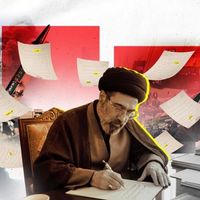
Iran officials seek to show Supreme Leader still in charge - FT

May 21, 2026, 05:33 GMT+1
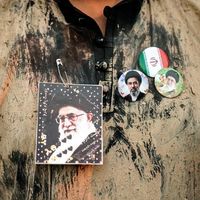
A woman holds a poster depicting Iran’s new Supreme Leader Mojtaba Khamenei, during a rally in Tehran, Iran, on April 29, 2026.

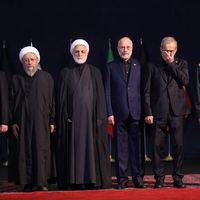
Iranian officials’ recent comments about Supreme Leader Mojtaba Khamenei are aimed at showing he remains in charge and will ultimately decide whether Tehran accepts a deal with the United States to end the war, the Financial Times reported on Thursday.

The report said officials had begun speaking more openly about Khamenei’s condition amid speculations that the Islamic Revolutionary Guards were effectively running decision-making.

“They are projecting that there’s no change . . . the supreme leader was the apex of the system and is still the apex,” Vali Nasr, a former US official and professor at Johns Hopkins University was quoted as saying. “And that he’s alive, functioning and in control.”

He added that the guards were also seeking to project that “they are not running the show and [Khamenei is] not just a figurehead.”

The report referred to remarks by Iran’s President Masoud Pezeshkian and Mazaher Hosseini, a senior official in the Supreme Leader’s office.

Pezeshkian said on earlier this month that he had met with the Supreme Leader, offering a first public account of him meeting Mojtaba Khamenei since he suffered severe wounds at the start of the Iran war on February 28.

Hosseini said later that Mojtaba Khamenei suffered minor injuries to his kneecap, back and behind his ear in the airstrikes that killed his father and wife, insisting he is now in “full health” and dismissing reports of a serious head injury as “lies.”

Most Viewed

Iran finds a new weapon beneath Hormuz
1
ANALYSIS

Iran finds a new weapon beneath Hormuz

2
INSIGHT

How Iran’s blackout warps online picture of public opinion

3
EXCLUSIVE

How an IRGC-linked money laundering network operates from London

4
INSIGHT

Tehran unsure whether Trump is bluffing or preparing for war

5
ANALYSIS

Two years after Raisi’s crash: Iran has no sanctuary

Banner
Banner

Spotlight

  • Iranian influencer’s ‘40 days of motherhood’ sparks debate on foster care

    Iranian influencer’s ‘40 days of motherhood’ sparks debate on foster care

  • Calls for pragmatism grow in Iran but rulers appear unmoved
    INSIGHT

    Calls for pragmatism grow in Iran but rulers appear unmoved

  • How Iran’s blackout warps online picture of public opinion
    INSIGHT

    How Iran’s blackout warps online picture of public opinion

  • Tehran unsure whether Trump is bluffing or preparing for war
    INSIGHT

    Tehran unsure whether Trump is bluffing or preparing for war

  • Why Tehran threatens Trump while pursuing diplomacy
    ANALYSIS

    Why Tehran threatens Trump while pursuing diplomacy

  • How an IRGC-linked money laundering network operates from London
    EXCLUSIVE

    How an IRGC-linked money laundering network operates from London

•
•
•

More Stories

Calls for pragmatism grow in Iran but rulers appear unmoved

May 20, 2026, 19:05 GMT+1
•
Behrouz Turani

A growing range of political voices in Tehran are calling for realism abroad and reconciliation at home rather than deeper confrontation as Washington signals both openness to talks and readiness for further military action.

US President Donald Trump talked up negotiations with Iran on Wednesday before quickly adding that hitting harder was still on the table.

In Tehran, a widening group of moderate, centrist and pragmatic conservative figures are warning the leadership that wartime solidarity cannot be taken for granted and that failure to change course could deepen Iran’s political and economic crisis.

Former MP and prominent moderate Mohsen Mirdamadi said in a May 20 interview with Etemad newspaper that “Iran’s most important assets are its people,” warning the government against overlooking that reality.

“Failing to recognize and appreciate this key asset is more dangerous than the destruction of any infrastructure,” he said.

Mirdamadi asserted that the war had strengthened many Iranians’ sense of patriotism. This public empathy, he argued, creates a responsibility for the government to enact meaningful changes in its policies in order to restore hope in the future.

“Give-and-take and balance are essential for reaching the optimal point,” he said, warning that those “beating the drums of war” could eventually force Iran’s leadership to “drink the chalice of poison” — a reference to accepting painful compromises too late rather than pursuing a timely agreement.

Similar warnings have increasingly appeared even in parts of the conservative camp.

On Wednesday, the conservative daily Jomhouri Eslami urged officials “not to provoke non-belligerent countries against Iran” and warned that threatening friendly states or discussing attacks on undersea communication cables in the Persian Gulf would only deepen hostility toward Tehran.

The paper also called on opponents of negotiations with the United States to reconsider their stance, arguing that constructive engagement with non-hostile countries could benefit Iran.

Other outlets focused on the domestic implications of the war atmosphere.

Rouydad24 warned authorities against using the conflict as a pretext to further restrict civil liberties, including internet access.

“Sustainable security is a product of justice, welfare, and trust in government, not restrictions and pressure on the people,” the outlet wrote, adding that “citizenship rights are not a luxury.”

Conservative commentator Mohammad Mohajeri similarly warned that wartime unity could prove fragile if the government fails to recognize growing public dissatisfaction.

“The government must understand that no war lasts forever,” Mohajeri told Etemad. “Eventually, there will have to be a ceasefire, an agreement or a mechanism to manage the crisis.”

Ali Rabiei, an adviser to President Masoud Pezeshkian, echoed the same concern in comments published by Etemad.

“We have no asset other than the people,” Rabiei wrote. “Please do not allow them to become polarized or fragmented as this is exactly what our enemies want.”

Yet the growing chorus of calls for pragmatism is unfolding alongside signs that Iran’s hardline camp is becoming more radicalized and more tightly aligned around confrontation.

While moderate and pragmatic voices may be broadening across parts of the political spectrum, it is the security establishment and its allies who still appear to hold the upper hand.

Calls for pragmatism are visibly rising. Whether anyone with real hard power is listening is far less clear.

Iranian exile novel shortlisted for International Booker Prize

May 20, 2026, 09:19 GMT+1

Shida Bazyar’s “The Nights Are Quiet In Tehran,” a novel tracing one Iranian family across four decades of revolution, exile and resistance, is among six books shortlisted for the 2026 International Booker Prize.

The novel, translated from German by Ruth Martin, begins after Iran’s 1979 revolution and follows different family members, including a revolutionary father, a literature-loving mother, a daughter visiting Iran for the first time and a son drawn into politics by the 2009 Green Movement.

Prize organizers described the book as a moving novel about oppression, resistance and the desire for freedom.

The International Booker Prize is awarded annually to a book translated into English and published in the UK or Ireland.

“Taiwan Travelogue” by Yáng Shuāng-zǐ, translated from Mandarin Chinese by Lin King, won the 2026 International Booker Prize.

The other shortlisted books were “She Who Remains” by Rene Karabash, “The Witch” by Marie NDiaye, “On Earth As It Is Beneath” by Ana Paula Maia, and “The Director” by Daniel Kehlmann.

Tehran unsure whether Trump is bluffing or preparing for war

May 20, 2026, 04:51 GMT+1
•
Maryam Sinaiee

President Donald Trump’s claim that he postponed a planned military strike on Iran has deepened uncertainty in Tehran, where officials and analysts remain divided over whether Washington is bluffing, buying time or preparing for another round of strikes.

Trump said Monday he had postponed an attack planned for Tuesday, before warning the United States remained ready to hit Iran hard.

Kazem Gharibabadi, Iran’s deputy foreign minister for legal and international affairs, wrote on X that “the United States says it has temporarily halted an attack on Iran to give diplomacy a chance, while simultaneously speaking of readiness for a large-scale strike at any moment. This means calling a threat an opportunity for peace.”

He added that the Islamic Republic was prepared to confront “any military aggression” and that “surrender has no meaning” for Iran.

Mohsen Rezaei, an adviser to Iran’s supreme leader and former commander of the Revolutionary Guards (IRGC), accused Trump of setting and then canceling military deadlines in an attempt to force Iran into submission. He warned that Iran’s armed forces would “force America into retreat and surrender.”

Gharibabadi later told members of parliament that Iran’s latest proposal to Washington included demands such as recognition of Iran’s right to uranium enrichment, lifting the US naval blockade, releasing frozen Iranian assets and ending sanctions. He did not provide details about Washington’s response.

Iranian digital outlet Avash Media cited “a source close to the negotiating team” as claiming that Washington had accepted some Iranian conditions, including ending regional conflicts and establishing a reconstruction fund.

On Tuesday, Vice President JD Vance said Washington and Tehran had made “a lot of progress” in talks and that neither side wanted to see a return to war.

Jalal Sadatian, a regional affairs analyst, told the website Fararu that the comments should be viewed “within the framework of the current Iran-US relationship, which is in a phase marked by political attrition and pressure tactics.”

“There is a perception in Tehran that the United States, for now, is using military threats more for political leverage than because it is truly ready for war,” he said.

“Tehran’s calculation is that if it makes major concessions now under maximum pressure, this model could later expand to issues such as missile capabilities and regional influence,” Sadatian added. “Therefore, Iran’s current policy is a combination of restraint, maintaining readiness and continuing protracted negotiations.”

Reformist journalist Ahmad Zeidabadi questioned Trump’s credibility, writing that if the US president’s account was accurate, then “one must seriously doubt the minimum level of rational calculation in him.”

“Does Trump not know what historic catastrophe restarting the war would bring to the entire Persian Gulf region?” Zeidabadi asked. “Was he planning to resume war without consulting allied leaders?”

Still, several analysts and conservative media outlets warned that the possibility of military escalation remains high.

The conservative newspaper Khorasan, which is close to parliament speaker Mohammad Bagher Ghalibaf, argued that Washington may seek to “unlock negotiations through a limited but effective strike.”

Ehsan Movahedian, a professor of international relations at Allameh Tabataba’i University, told Fararu that “the probability of war in the coming days is very high,” adding that even if conflict does not erupt next week, “that does not mean the danger has disappeared.”

Some Iranian political and media figures argued that the postponement may have had little to do with regional interventions and more to do with operational difficulties.

Ali Gholhaki, a commentator close to Ghalibaf, wrote that “the reason for delaying the attack on Iran appears to be something other than requests from Arab leaders; the United States and Israel are still not certain they can strike their key targets.”

Journalist Davoud Modarresian suggested Pakistani Interior Minister Mohsin Naqvi’s extended visit to Iran could be linked to intelligence-gathering efforts.

“Under the pretext of sending messages, they may be trying to track and identify the locations of leaders and commanders,” he wrote.

Why Tehran threatens Trump while pursuing diplomacy

May 20, 2026, 03:37 GMT+1
•
Negar Mojtahedi

Even as Tehran engages in hardheaded diplomatic maneuvering with Washington, it is advancing a parliamentary proposal offering a €50 million reward for President Trump’s killing.

The ruling establishment, they argue, is trying to project strength after weeks of military and political pressure while using the prospect of talks not as a concession but as another arena of confrontation.

“The Iranian regime is trying to, in their own mind, basically say that we are on par,” Dr. Shahram Kholdi, a Middle East historian, told Iran International. “Even if you're not on par with Trump, we are actually beating him at all levels.”

The proposed bounty, he said, should be read partly as psychological warfare against Trump.

“This award to be passed as a piece of legislation by the Islamic Republic Parliament is effectively part of that psychological war that the Islamic Republic thinks it has to unleash upon Trump,” Kholdi said.

But the rhetoric is unfolding alongside more concrete threats. Tehran has also signaled it could disrupt navigation through the Persian Gulf and the Strait of Hormuz, while pro-government voices have floated attacks on satellite infrastructure, including systems such as Starlink.

'Not rational'

That combination of assassination rhetoric, military pressure and possible diplomacy may appear irrational from the outside. Kholdi argues the problem is that Washington is not dealing with a conventional negotiating actor.

“The problem with these people is that they think … if they behave sanely and rationally, that's insane and irrational,” he said. “That’s the kind of actor Trump is dealing with … The art of the deal does not work with an irrational actor.”

Dr. Eric Mandel, founder of the Middle East Political Information Network (MEPIN), framed the issue as a clash of political cultures and timelines. Western governments may look at the damage inflicted on Iran’s military and industrial infrastructure and conclude Tehran should be searching for a way out. The regime may see the same moment very differently.

“This is a perfect opportunity to realize they don't think like us,” Mandel said.

From Tehran’s perspective, he argued, the fact that the regime has survived is itself a form of victory.

“The Iranians think we have survived. We have survived and that means we are victorious,” he said. “We could outlast the Americans and eventually they're going to have to acquiesce to us.”

The time factor

That survival-first mindset helps explain why Tehran may threaten Trump while still leaving room for talks. In Mandel’s view, negotiations, ceasefires and delays all serve a purpose: they buy time.

“The Iranians got a ceasefire. They rebuilt, they rearm, they dug out missiles that were buried because they know that the longer they can either prolong negotiations, the longer they have ceasefires, that they believe that time will eventually make them the winner here,” he said.

This is why the apparent contradiction may not be a contradiction at all. The threats signal defiance. The talks buy time. The survival narrative sustains the regime internally.

Former State Department appointee Shayan Samii said Tehran’s assassination rhetoric may also backfire by strengthening Washington’s case for escalation.

“These numbskulls in Tehran don't understand that by the mere fact of just saying we want to assassinate the President of the United States—mind you, the sitting President of the United States—we're not talking about a national security threat anymore,” Samii said. “We're talking about a government apparatus coming under attack.”

That, he said, could allow the United States to frame any military response not simply as regional intervention, but as self-defense.

“They can tell the world these guys wanted to assassinate our president, we're not going to sit by,” Samii said.

'Military readiness'

Samii also rejected the idea that Trump’s latest delay should be read mainly as a response to pressure from Persian Gulf Arab states. He said the timing was more likely tied to military planning and target selection.

“It has nothing to do with the request of the Arab countries of the Persian Gulf region,” he said. “It has everything to do with machinations and military readiness and coming up with a solution for the targets that they want to hit.”

The danger, analysts say, is that both sides may be using time for very different purposes. Trump may be waiting for better military and economic conditions. Tehran may be trying to stretch the crisis into a war of attrition.

“They think that they are going to run the United States out of the stamina,” Kholdi said.

For Mandel, that gap in thinking is central to the crisis. American politics operates on elections, markets and public pressure. The Islamic Republic, he said, operates with a far longer and harsher sense of time.

“We're dealing with, trying to say from so many different angles, the calculus that they're making is so different than what ours is,” he said.

That difference may be what makes the current moment especially volatile. Tehran appears to believe threats increase leverage. Washington increasingly risks viewing those same threats as proof diplomacy cannot work.

Tehran and Washington betting the other side blinks first

May 19, 2026, 21:32 GMT+1
•
Behrouz Turani

The competing narratives surrounding the latest US-Iran standoff have become so stark that even basic questions—who is deterring whom, who wants talks and who fears escalation—now produce entirely different answers depending on which capital is speaking.

On Monday, President Donald Trump said he had halted plans to attack Iran following requests from Qatar, Saudi Arabia, the UAE “and some others in the region.”

The same day, Iran’s state television claimed Trump had backed down from threatening military action “at least five times in recent weeks” because he feared Iran’s “firm response.”

On Tuesday, Trump again underscored the volatility of the standoff, saying the United States “may have to give them another big hit” and claiming Tehran was “begging” for a deal.

Rahman Ghahramanpour, a Middle East politics expert, told Tehran-based Khabar Online that both Tehran and Washington increasingly see the confrontation as a “competition over resilience,” with each believing renewed brinkmanship could strengthen its negotiating position.

Khabar Online journalist Mohammad Aref Moezzi described the current dynamic as a familiar “neither war nor peace” scenario: sustained pressure and confrontation without a clear decision to escalate into full conflict or pursue a comprehensive agreement.

Both sides, he argued, still believe they can force concessions without paying the cost of war.

For Iran’s leadership, the overriding objective remains survival and persuading Washington to abandon any notion of regime change.

Ghahramanpour argues that Tehran is trapped in a struggle for survival while Washington faces what he calls a “credibility trap.” The United States wants a visible strategic victory; the Islamic Republic increasingly treats simple endurance as success.

Despite striking numerous military targets in Iran, Washington has yet to achieve a major political breakthrough. In the United States, particularly amid partisan rivalries, that is often framed as a failure for Trump. In Iran, the same reality is presented as proof the Islamic Republic withstood American pressure.

He also noted that many in Israel believe Trump’s presidency may represent the best opportunity to secure full US cooperation against Iran, adding to pressure for a more decisive confrontation before political circumstances change.

The widening gap between Iranian and American perceptions has effectively frozen negotiations.

Although some hardliners in Tehran advocate pre-emptive action, the government appears unwilling to be seen as the side that starts a war.

Washington, meanwhile, continues tightening sanctions and maintaining pressure while also signaling that military action remains an option if diplomacy stalls.

Another Iranian scholar, Ali Asghar Zargar, told Fararu on Tuesday that neither side benefits from the current deadlock.

He described the standoff as a mix of attrition, geopolitical rivalry and competing political narratives in which Iran remains under heavy pressure while the United States has yet to achieve its core objectives.

Zargar also argued that Washington cannot realistically use the Strait of Hormuz as a unilateral pressure tool given the global dependence on the waterway, warning that the longer the impasse continues, the greater the risk of escalation or miscalculation.

What increasingly unites both Iranian and American analysts is the sense that the current stalemate may be unstable, and that neither side has yet found a credible path out of it.