• العربية
  • فارسی
Brand
  • Iran Insight
  • Politics
  • Economy
  • Analysis
  • Special Report
  • Opinion
  • Podcast
  • Iran Insight
  • Politics
  • Economy
  • Analysis
  • Special Report
  • Opinion
  • Podcast
  • Theme
  • Language
    • العربية
    • فارسی
  • Iran Insight
  • Politics
  • Economy
  • Analysis
  • Special Report
  • Opinion
  • Podcast
All rights reserved for Volant Media UK Limited
volant media logo
INSIGHT

Hormuz gives battered Iran room to wait out Trump, experts say

May 15, 2026, 22:45 GMT+1Updated: 23:59 GMT+1
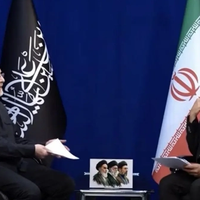
Jon Alterman (left), Danielle Pletka (center) and Bozorgmehr Sharafedin at Iran International's townhall held in Washington DC on May 14, 2026

The Iran war has entered a more ambiguous phase, with the regime battered but not broken, the US struggling to define victory, and the Strait of Hormuz emerging as Iran’s most potent bargaining tool, two Middle East experts said at an Iran International townhall in Washington DC.

The panel, moderated by Iran International’s Bozorgmehr Sharafedin, brought together Danielle Pletka of the American Enterprise Institute and Jon Alterman of the Center for Strategic and International Studies to discuss what comes after a ceasefire that has not ended the wider confrontation.

The debate, held on May 14, came a month after the US naval blockade of Iranian ports began on April 13, intensifying pressure on Tehran’s economy and maritime trade. But the blockade has also pushed shipping, insurance risk and control of Hormuz to the center of the conflict.

A regime under pressure, but not necessarily near collapse

Alterman said the Iranian regime has changed since the war began, but “not in a positive way.” He warned that the war may not have pushed the Islamic Republic toward compromise, but further into the hands of its security establishment.

With Mojtaba Khamenei less visible and Revolutionary Guard hardliners appearing more influential, he said Tehran’s instinct seems to be to “hunker down and wait out” President Donald Trump.

“It feels like the default is toward confrontation rather than compromise,” Alterman said.

For Alterman, that does not necessarily mean the regime is closer to falling. It may instead mean Tehran is more likely to absorb pressure and wait for Trump’s political calendar to become more difficult.

Pletka also warned against assuming that a weakened regime automatically produces a better outcome. She said Washington often frames Iran’s power struggle as one between hardliners and moderates, but the reality is more complicated.

“These are all people who support the system of the Islamic Republic of Iran,” she said. “Some of them want to kill fewer people. Some of them want to kill more people.”

The danger, she suggested, is that US and Israeli strikes weaken Iran militarily while empowering the most repressive factions at home. Alterman put the question more starkly: does the pressure lead to regime collapse, or “just lead to more Iranians suffering for a longer period of time”?

Hormuz changes the balance

The clearest divide between the two experts came over the Strait of Hormuz.

Alterman argued that the war has revealed an uncomfortable truth for Washington: even a damaged Iran can still disrupt one of the world’s most important energy chokepoints.

“Even a weak Iran, a battered Iran, can control the strait,” he said.

It only needs to create enough fear to alter the behavior of shipping companies, insurers, and neighbouring Arab states and energy markets. In that sense, the threshold for disruption is lower than many had assumed.

Pletka sharply disagreed with the idea that Iran truly controls the strait.

“The reason the Iranians control the Strait of Hormuz right now is because we’re letting them,” she said. “We can take control of it. We can do what we want. We can move traffic through.”

She said the issue is no longer only military. It is also about risk, insurance and the willingness of shipowners to send vessels into waters where even a single strike, mine or ambiguous threat can have major consequences.

The result is a paradox: Iran may be weaker than before the war, but it may have discovered a tool it can use more confidently than before.

No clear road to victory or a deal

Both experts were skeptical that the current diplomatic track can quickly produce a comprehensive settlement.

Alterman said the two sides have persuaded themselves that they are excellent negotiators, which makes compromise harder. The best Washington may get, he argued, is not a grand bargain but a framework for drawn-out talks.

“The best-case scenario from a US perspective is locking yourself into negotiations with the Iranians through the end of the Trump administration,” he said.

Such a process could include talks over the nuclear file, missiles and freedom of navigation, but it would likely remain incremental and fragile, with both sides preserving the option to resume escalation.

Pletka said Trump appears most focused on removing Iran’s fissile material and its ability to produce more. But she warned that narrowing the issue to the nuclear file would repeat a familiar mistake.

“Everybody focuses on the nuclear when they need to focus on all of it at once,” she said, pointing to missiles, proxies and Iran’s regional conduct as inseparable parts of the challenge.

That leaves the conflict suspended between competing assumptions. Trump appears to believe economic pressure will force Iran to blink. Alterman suggested Tehran may believe it can outlast him by enduring pain, repressing dissent and waiting for US domestic politics to intervene.

Most Viewed

Iran and UAE clash at BRICS foreign ministers meeting
1

Iran and UAE clash at BRICS foreign ministers meeting

2

Iran to cast regional conflict as resistance to US power at BRICS meeting

3
INSIGHT

Earthquakes and storm revive Tehran’s fears of 'the big one'

4

Iran parliament working on bill that proposes €50m reward for killing Trump

5
ANALYSIS

Xi may help Trump on Iran, but at a price

Banner
Banner

Spotlight

  • Tehran media sees rising risk of war as US talks stall
    INSIGHT

    Tehran media sees rising risk of war as US talks stall

  • 'Class internet' fuels anger in blackout-hit Iran
    INSIGHT

    'Class internet' fuels anger in blackout-hit Iran

  • Xi may help Trump on Iran, but at a price
    ANALYSIS

    Xi may help Trump on Iran, but at a price

  • How one Tehran hospital became a window into Iran’s January massacre
    SPECIAL REPORT

    How one Tehran hospital became a window into Iran’s January massacre

  • Iranians told to post pro-government content to regain internet access
    VOICES FROM IRAN

    Iranians told to post pro-government content to regain internet access

•
•
•

More Stories

'Class internet' fuels anger in blackout-hit Iran

May 15, 2026, 04:37 GMT+1
•
Maryam Sinaiee

President Masoud Pezeshkian has ordered the creation of a special committee to end Iran’s internet blackout, but many Iranians doubt it can overcome resistance from powerful state institutions.

President Masoud Pezeshkian has ordered the creation of a special committee to end Iran’s internet blackout, but many Iranians doubt the government can override the powerful institutions controlling cyberspace policy.

Earlier this week, Pezeshkian tasked First Vice President Mohammad-Reza Aref with forming a body aimed at restoring access to the global internet after more than two and a half months of severe restrictions.

Reformist newspaper Shargh reported that the committee is expected to restore broader access within a month.

Pezeshkian announced the move on X, saying he had instructed Aref to carry out the task while considering “governance sensitivities, the Supreme Leader’s views, and the promise I made to the people.”

During his presidential campaign, Pezeshkian repeatedly promised to ease internet filtering and restrictions. But ordinary Iranians have effectively been cut off from the global internet since US-Israeli strikes began on February 28.

Before the war, some individuals had access to so-called “white SIM cards,” exempt from ordinary filtering restrictions. After the ceasefire, authorities expanded selective access to businesses and approved individuals through services branded as “Internet Pro.”

Many users responding to Pezeshkian’s X post expressed frustration and skepticism.

“Mr. President, don’t make us regret voting for you,” one voter wrote. “End this discrimination, these white SIM cards, these Pro subscriptions, and this class-based treatment of a natural right. We want free internet.”

Another user reminded Pezeshkian that during the election campaign he had said he would resign if he failed to fulfill major promises, including lifting internet restrictions.

It remains unclear whether recent decisions were made by the Supreme Council of Cyberspace (SCC) or the Supreme National Security Council (SNSC). Both are formally chaired by Pezeshkian, but other figures and institutions — including the Revolutionary Guards — wield significant influence within them.

The appointment of Aref to lead the new “Special Taskforce for Organizing and Guiding Cyberspace” also drew criticism from conservative figures.

Former Cultural Heritage Minister Ezzatollah Zarghami, himself a member of the SCC appointed by Khamenei, described the initiative as parallel decision-making overlapping with the council’s responsibilities.

“Transformation and restructuring in the decision-making system must be fundamental and involve changing the governance model in cyberspace,” he wrote on X.

One social media user responded sarcastically: “The president realized he can’t stand up to the Supreme Council of Cyberspace, so he created another council that can do absolutely nothing.”

‘Class-based internet’

The prolonged disruption of international internet access has created serious technical and economic problems inside Iran.

Domestic websites and online platforms have struggled because technical teams lost access to international tools and services. Software licenses expired, search engines failed to properly index Iranian sites, and server disruptions affected service delivery.

The impact on employment has also been severe. Millions of jobs linked to online businesses, social media and international digital services have been disrupted, including work done by programmers, online sellers and content creators.

Selective access programs such as “Pro Internet” and white SIM cards have meanwhile become symbols of inequality for many Iranians.

Some groups offered privileged access — including nurses and certain lawyers — refused to accept it, branding it institutionalized discrimination.

Restrictions on ordinary users have also fueled a growing black market.

According to Iranian media reports, while the official price for a 50-gigabyte Pro Internet package is around 20 million rials, the same service is being resold for as much as 120 million rials. White SIM cards are reportedly advertised on Telegram starting at 440 million rials, depending on the level of access provided.

Even before the current near-total shutdown, millions of Iranians already relied on paid VPN services to access blocked platforms such as Instagram and YouTube.

The high cost has effectively turned internet access into a luxury product many cannot afford in a country where some public sector workers, including teachers, earn roughly 150 million rials per month.

Journalist Sadegh Zangeneh wrote in Khabar Online: “The level of anger and dissatisfaction among the people over the internet shutdown and its divisive consequences should not be sought in reports written by those who have monopolized the internet themselves.”

He added: “Either those who deprive people of the internet in the name of security are betraying the country, or those who auction off national security under the label of ‘Pro Internet’ and other forms of class-based internet are doing so.”

Sociologist Mohammad Fazeli also warned about the social consequences of unequal access, arguing that “discriminatory internet” would become yet another reason for people to confront the state.

State TV emerges as battleground in Iran’s wartime infighting

May 15, 2026, 03:57 GMT+1

Tehran commentariat and figures close to the establishment are increasingly accusing hardliners and state television of deepening divisions and undermining national unity as the country faces war, economic strain and growing public anxiety.

The US-Israeli attacks on Iran and the ensuing regional conflagration have aggravated economic troubles to the point that President Masoud Pezeshkian has warned of widespread unrest.

Media close to Parliament Speaker Mohammad Bagher Ghalibaf, who has sought to position himself as a pragmatist since the death of former Supreme Leader Ali Khamenei, have been among the most vocal critics.

On Thursday, Khorasan newspaper, one of the outlets closest to Ghalibaf, blasted the state broadcaster and several ultraconservative lawmakers for promoting rhetoric that risked “deepening divisions and polarizing the public” at a time of war.

Read the full article here.

State TV emerges as battleground in Iran’s wartime infighting

May 15, 2026, 03:00 GMT+1
•
Behrouz Turani

Tehran commentariat and figures close to the establishment are increasingly accusing hardliners and state television of deepening divisions and undermining national unity as the country faces war, economic strain and growing public anxiety.

The US-Israeli attacks on Iran and the ensuing regional conflagration have aggravated economic troubles to the point that President Masoud Pezeshkian has warned of widespread unrest.

Media close to Parliament Speaker Mohammad Bagher Ghalibaf, who has sought to position himself as a pragmatist since the death of former Supreme Leader Ali Khamenei, have been among the most vocal critics.

On Thursday, Khorasan newspaper, one of the outlets closest to Ghalibaf, blasted the state broadcaster and several ultraconservative lawmakers for promoting rhetoric that risked “deepening divisions and polarizing the public” at a time of war.

The paper singled out hardline MP Ali Khezrian, who it said had received nearly four hours of airtime in less than a week to accuse state officials of serving foreign interests and challenge the authority of the Foreign Ministry and the Supreme National Security Council.

In a counter-accusation, Khorasan alleged that Khezrian had posted a video of a petrochemical facility in Lorestan Province, effectively “updating Israel and the United States’ list of potential sites to strike.”

The paper also accused Khezrian of presenting his own views as those of Iran’s new leader, adding that if a politician from another faction had done so, they would likely have been arrested by security forces.

Meanwhile, conservative figure and former Resalat editor Mohammad Kazem Anbarlui warned in a May 14 interview with ISNA that hardliners were creating dangerous political polarization by exploiting issues such as hijab enforcement and negotiations with the United States.

On the same day, Khabar Online reported that during a live broadcast on Channel 3, a reporter asked demonstrators: “Which political figures were meaner than the meanest animals?” Respondents named politicians associated with rivals of the hardline camp.

The outlet argued that hardliners were increasingly using state television to erode national cohesion. Since the start of the war, it wrote, the broadcaster had selectively featured hardline commentators and public figures.

Instead of offering expert analysis, Khabar Online wrote, the organization was increasingly relying on controversial guests and sensationalist presenters, pushing it “off its professional path” and disrupting “public order and social calm.”

The national broadcaster now resembled “the exclusive domain of hardliners,” it said — a space where they were allowed to undermine decisions of the Supreme National Security Council and state authority.

Even the IRGC-linked Javan newspaper acknowledged the growing concern.

“When people are constantly led to believe that state officials are incompetent, infiltrated, or intimidated, the result is growing pessimism, distrust, and the erosion of national cohesion,” the paper warned in a commentary published the same day.

“A society whose trust has been damaged” becomes more vulnerable to external crises and adversaries’ psychological operations, it added.

“The outcome,” Javan concluded, “is either public anger or despair.”

Earthquakes and storm revive Tehran’s fears of 'the big one'

May 15, 2026, 00:40 GMT+1
•
Maryam Sinaiee

A series of overnight earthquakes and a powerful dust storm rattled Tehran and nearby cities on Tuesday night, reviving fears of a catastrophic earthquake in a capital still psychologically scarred by recent war.

The seismic activity began with a mild 3.4-magnitude tremor before intensifying into a 4.6-magnitude earthquake later in the night. Several aftershocks continued into early Wednesday morning.

At the same time, a storm swept through Tehran, bringing severe dust, power outages and fallen trees. At least seven people were reportedly injured in the storm, though authorities said the earthquakes themselves caused no casualties or major damage.

Still, the tremors revived a long-standing fear in Tehran: the possibility of a devastating earthquake along the active fault lines beneath eastern Tehran and surrounding towns.

The big one may be overdue

ILNA quoted earthquake expert Fariborz Nateghi Elahi criticizing the lack of serious crisis planning for the major quake scientists have long warned about.

“We know an earthquake will happen,” he said. “Not on this scale, but something much, much larger.”

Eastern Tehran and nearby towns sit atop an active fault stretching at least 200 kilometers and capable of generating earthquakes above magnitude 7. Geologists say the fault typically produces a major earthquake roughly once every century.

Nearly 200 years have passed since the last truly destructive event. In 1830, a massive earthquake estimated at magnitude 7.1 devastated Tehran, then a relatively young capital.

Scientists now warn that pressure accumulated underground since then has left the fault in a critical state, primed for a major release of energy.

In December 2017, a 3.5-magnitude tremor caused widespread panic, sending residents into the streets and forcing many families to sleep in their cars overnight. This time, despite the stronger quake, the public reaction appeared noticeably more subdued.

Crisis fatigue

Some residents still spent the night in parks, streets or inside their vehicles, but many on social media said the trauma of recent air and missile attacks during two wars had numbed their reactions.

One psychologist writing on X suggested the muted response could be explained by “crisis fatigue.”

A social media user wrote: “The 2017 earthquake made Tehran residents sleep in their cars until morning. Streets were completely gridlocked, and gas stations were packed. Its magnitude? 3.5. Now our reaction is: ‘Oh, it’s just an earthquake,’ and we pull the blanket over our heads and go back to sleep. I think only a nuclear bomb could still move people in this country.”

Another user described how the storm initially triggered fears of renewed military attacks: “The storm started, windows were shaking, and I thought: ‘Is it fighter jets?’”

She said she then checked the news and realized it was just a storm, which briefly calmed her. “Then the earthquake came, and I thought: well, that’s nothing. Compared to war, everything feels like a joke.”

Xi may help Trump on Iran, but at a price

May 14, 2026, 22:16 GMT+1
•
Andrea Ghiselli

President Trump’s visit to Beijing appears to have confirmed two things about China’s approach to the Iran crisis: it is willing to help prevent further escalation, but not at Tehran’s expense.

Reports during and after the summit, including comments highlighted by Fox News, suggested China had signaled readiness to play a more active role in stabilizing the situation around Iran and the Strait of Hormuz. But any Chinese cooperation is likely to remain limited, transactional and tied to Beijing’s broader strategic priorities.

Before Trump’s departure from Washington, Treasury Secretary Scott Bessent accused China of “funding the largest state sponsor of terrorism,” while Trump himself said he was going to have “a long talk” with Xi. Earlier, the Treasury Department sanctioned five of the so-called “teapot” refineries that process Iranian oil in China.

These moves were not surprising. The war involving the United States, Israel and Iran has shaken the Middle East, threatened global energy flows and become increasingly unpopular among American voters and consumers. Iran has become a priority issue for the White House.

China has reasons to listen. Beijing has already shown some willingness to restrain Tehran, including by nudging Iran toward the Islamabad talks. It does not want the fragile ceasefire to collapse. It does not want the Strait of Hormuz closed. Nor does it want a global downturn that would damage Chinese exports.

China’s investments in electrification and renewable energy have increased its resilience, but they have not made it immune to a major shock in the Middle East. Yet Xi’s help, if it comes, will not be free.

In his recent conversation with Secretary of State Marco Rubio, Foreign Minister Wang Yi made clear that Taiwan remains the core issue for China and the greatest risk in US-China relations. Chinese readouts of the Trump-Xi meeting also placed Taiwan at the center of discussions, with the “situation in the Middle East” appearing much lower on the agenda.

The implication is difficult to miss: if Washington wants Chinese cooperation, Beijing will expect a more accommodating US position on Taiwan. Several current and former American officials have expressed concern that Trump, who said he intended to have “that discussion” with Xi, could delay or reduce the $14 billion weapons package for Taiwan approved by Congress in January.

In other words, China has strong reasons to support de-escalation over Iran, but Beijing also appears to view the crisis through the lens of a much larger strategic bargain with Washington.

Xi’s help is also likely to remain limited. Beijing and Tehran still share a fundamental objective. Both want the Iranian regime to survive. Both want Iran to avoid emerging from the conflict as a defeated and humiliated loser. Both oppose a regional order shaped by the United States and Israel.

For Tehran, defeat would be a regime-threatening disaster. For Beijing, it would be another demonstration that American coercive power can still break an anti-US partner.

China may therefore encourage Tehran to negotiate, support language about regional stability or help Trump claim diplomatic progress. It may even make quiet tactical adjustments to its economic dealings with Iran. But any such move will be carefully calibrated to serve China’s own interests.

China may help stabilize the situation; it will not help Washington defeat Tehran.

The fact that the Chinese embassy in Washington has not denied reports that Wang Yi and Rubio agreed in April that the Strait of Hormuz must remain toll-free is a good example of this dynamic. So too is the American readout stating that China opposes Iran developing nuclear weapons. Both signal goodwill, but neither represents a meaningful shift in Beijing’s position or a compromise of its interests.

This means Trump may have secured Chinese support for de-escalation. He may even have persuaded Xi that a prolonged conflict is too costly for China and that Beijing has an interest in pushing Tehran toward compromise. But he cannot force China to choose Washington over Tehran. Pressure alone is unlikely to work, especially if it requires Xi to appear publicly subordinate to American demands.

There is another problem: it remains unclear what Washington actually wants. It is not enough to accuse China of enabling Iran. The United States still lacks a clearly defined objective. Does it want a ceasefire, renewed nuclear talks, limits on Iranian regional activity, security guarantees for regional partners or some combination of these?

Without a coherent strategy, China will continue using the crisis to extract concessions elsewhere while offering only limited help.

The summit may not have determined the future of the Middle East. But it did reveal something important about the emerging great-power rivalry. The United States remains militarily dominant but strategically erratic. China is economically central but cautious as a security actor.

Trump arrived in Beijing seeking Chinese help on Iran. Xi may offer some. But the price will be high, and the help will not come at Tehran’s expense.