• العربية
  • فارسی
BrandBrand
  • Iran Insight
  • Politics
  • Economy
  • Analysis
  • Special Report
  • Opinion
  • Podcast
  • Live TV
  • Iran Insight
  • Politics
  • Economy
  • Analysis
  • Special Report
  • Opinion
  • Podcast
  • Live TV
  • Theme
  • Language
    • العربية
    • فارسی
  • Iran Insight
  • Politics
  • Economy
  • Analysis
  • Special Report
  • Opinion
  • Podcast
  • Live TV
All rights reserved for Volant Media UK Limited
volant media logo
ANALYSIS

Assad’s downfall could trigger a crisis for Tehran

Morad Vaisi
Morad Vaisi

Iran International political analyst

Dec 1, 2024, 17:22 GMT+0Updated: 12:16 GMT+0
A rebel fighter carries a weapon as he stands at the entrance of Saraqeb town in northwestern Idlib province, Syria December 1, 2024.

The fall of Aleppo to rebels opposing President Bashar al-Assad has caused a critical situation for the Syrian government with implications that may extend to the Islamic Republic of Iran.
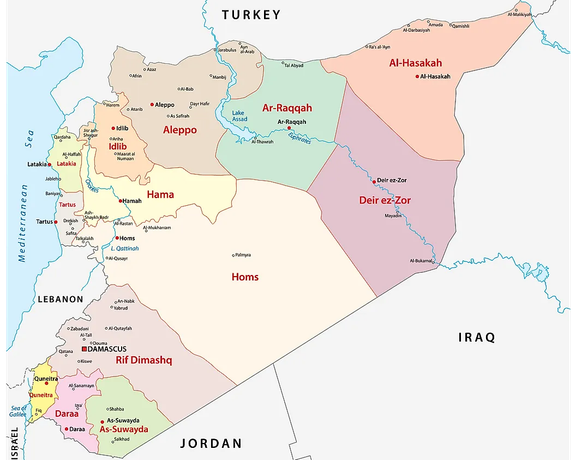
Opposition forces have now advanced towards the outskirts of Hama and Homs, two strategic Syrian cities on the road to Damascus. The potential fall of Damascus and the overthrow of the Assad government is more serious than ever, causing deep concerns for the Islamic Republic and its leader, Ali Khamenei.

100%
Map of Syria (Via World Atlas)

The collapse of Assad’s rule would dismantle a cornerstone of Iran’s regional strategy against Israel. It would also threaten the survival of Iran's proxy groups, which rely heavily on Damascus for support. Without Assad’s backing, these groups could struggle to sustain their operations, jeopardizing the Islamic Republic’s influence in the region.

For Khamenei and Iran’s Revolutionary Guards (IRGC), Assad’s government is a vital pillar of the so-called Axis of Resistance. Its potential fall could even endanger the stability of the Islamic Republic itself.

Map of Syria (Via World Atlas)

The coming days are pivotal for both Assad’s government and Iran. The defeat in Aleppo dealt a major blow to the morale of the Syrian army and government, but the greater concern for Assad and the Islamic Republic is the possibility of opposition forces advancing toward Damascus after consolidating their power in the north and toppling the government.

The opposition forces now control Aleppo and Idlib near Turkey’s borders and are rapidly advancing in Hama and Homs governorates with reports that they are at the gates of the provincial capitals. Capturing the cities of Hama and Homs would give them a strategic advantage, potentially allowing a push toward Latakia, the Assad family’s power base, or Damascus.

The situation today is starkly different from 2016, when Assad, with robust support from Russia, Hezbollah, and Iran, defeated opposition forces in the battle of Aleppo. Several factors have contributed to the weakening of the Assad government and its supporters:

- Russia's involvement in Ukraine: Russia, a key ally of Damascus, is preoccupied with the war in Ukraine, limiting its ability to provide military support compared to 2016.

- Hezbollah's diminished sway: Iran-backed Hezbollah, a powerful armed ally of Damascus, has suffered significant losses in its conflict with Israel and faces domestic pressure in Lebanon to reduce its involvement in regional conflicts.

- Iran's economic constraints: Tehran’s financial woes made worse by US sanctions have restricted its ability to provide financial and military aid to the Assad government. According to estimates, Tehran has spent tens of billions of dollars in Syria but now finds it hard to continue such support.

- Erosion of the IRGC's manpower and logistics in Syria: Key IRGC commanders, including former chief of IRG's extraterritorial Quds Force Qasem Soleimani, have been killed in recent years and the replacement forces do not have the same capabilities. Additionally, proxy groups such as the Afghan Fatemiyoun Division Iraq’s Popular Mobilization Forces (PMF) are less effective than before.

100%
A rebel fighter stands atop of a military vehicle as he carries a Hayat Tahrir al-Sham flag in Saraqeb town in northwestern Idlib province, Syria December 1, 2024.

If Assad’s falls, Iran’s regional foreign policy could face a severe crisis. Damascus plays a crucial role in facilitating the transport of weapons, logistics, and financial support to Iran’s proxy groups. Its collapse would likely lead to:

- Disruption of weapons transfers to Hezbollah via Damascus and Latakia airports.

- Reduced support for Palestinian groups such as Hamas and the Islamic Jihad.

- Destruction of smuggling networks for arms and narcotics into Jordan and the West Bank.

For Iran, preserving Assad's government is a matter of strategic survival. While Khamenei and the IRGC are likely to make every effort to prevent its collapse, their resources and influence are far weaker than in the past. Ultimately, Assad’s fall could dismantle the 'Axis of Resistance’ and pose a serious threat to the Islamic Republic’s future.

Most Viewed

Iran's oil output plunges below pre-war domestic needs
1
ANALYSIS

Iran's oil output plunges below pre-war domestic needs

2

Iran threatens Armenia as US-run Trump Route clears Yerevan’s parliament

3

Cash-strapped Iranians put multiple organs up for sale

4
INSIGHT

Iranian hardliners urge Iraq to push back against US pressure

5
ONE-ON-ONE

Americans ‘a bit naive’ about influence campaigns by Iran, Russia, China

Banner
Banner
Banner
Banner
Banner
Banner
Banner

Spotlight

  • Iran's oil output plunges below pre-war domestic needs
    ANALYSIS

    Iran's oil output plunges below pre-war domestic needs

  • Iranian hardliners urge Iraq to push back against US pressure
    INSIGHT

    Iranian hardliners urge Iraq to push back against US pressure

  • Cash-strapped Iranians put multiple organs up for sale

    Cash-strapped Iranians put multiple organs up for sale

  • Iran's intelligence merger debate signals possible security shake-up
    INSIGHT

    Iran's intelligence merger debate signals possible security shake-up

  • Americans ‘a bit naive’ about influence campaigns by Iran, Russia, China
    ONE-ON-ONE

    Americans ‘a bit naive’ about influence campaigns by Iran, Russia, China

  • Trump's Iran dilemma after America's 'everything' election
    OPINION

    Trump's Iran dilemma after America's 'everything' election

  • The faceless judge who sentenced 11 Iranian protesters to death in 2026
    SPECIAL REPORT

    The faceless judge who sentenced 11 Iranian protesters to death in 2026