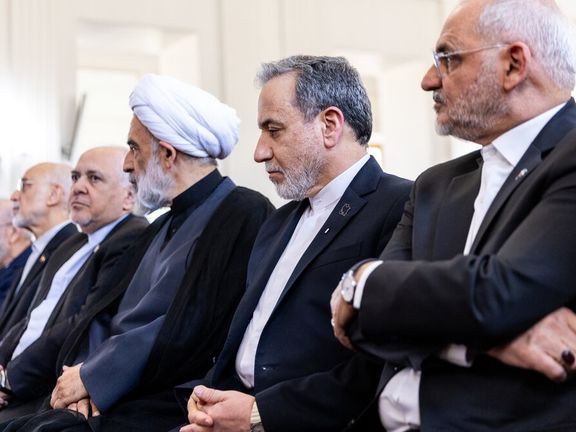
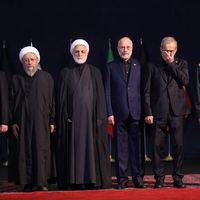
Four prominent moderates sit on both sides of senior cleric and supreme leader appointee Mohsen Qomi in an event to honour two former foreign ministers killed in a crash and by US-Israeli attacks, in Tehran, Iran, May 20, 2026. (Left to right: former nuclear chief Ali Akbar Salehi, former foreign minister Mohammad Javad Zarif, Mohsen Qomi, foreign minister Abbas Araghchi, and president Pezeshkian's chief of staff Mohsen Haji-Mirzaei)
A growing range of political voices in Tehran are calling for realism abroad and reconciliation at home rather than deeper confrontation as Washington signals both openness to talks and readiness for further military action.
US President Donald Trump talked up negotiations with Iran on Wednesday before quickly adding that hitting harder was still on the table.
In Tehran, a widening group of moderate, centrist and pragmatic conservative figures are warning the leadership that wartime solidarity cannot be taken for granted and that failure to change course could deepen Iran’s political and economic crisis.
Former MP and prominent moderate Mohsen Mirdamadi said in a May 20 interview with Etemad newspaper that “Iran’s most important assets are its people,” warning the government against overlooking that reality.
“Failing to recognize and appreciate this key asset is more dangerous than the destruction of any infrastructure,” he said.
Mirdamadi asserted that the war had strengthened many Iranians’ sense of patriotism. This public empathy, he argued, creates a responsibility for the government to enact meaningful changes in its policies in order to restore hope in the future.
“Give-and-take and balance are essential for reaching the optimal point,” he said, warning that those “beating the drums of war” could eventually force Iran’s leadership to “drink the chalice of poison” — a reference to accepting painful compromises too late rather than pursuing a timely agreement.
Similar warnings have increasingly appeared even in parts of the conservative camp.
On Wednesday, the conservative daily Jomhouri Eslami urged officials “not to provoke non-belligerent countries against Iran” and warned that threatening friendly states or discussing attacks on undersea communication cables in the Persian Gulf would only deepen hostility toward Tehran.
The paper also called on opponents of negotiations with the United States to reconsider their stance, arguing that constructive engagement with non-hostile countries could benefit Iran.
Other outlets focused on the domestic implications of the war atmosphere.
Rouydad24 warned authorities against using the conflict as a pretext to further restrict civil liberties, including internet access.
“Sustainable security is a product of justice, welfare, and trust in government, not restrictions and pressure on the people,” the outlet wrote, adding that “citizenship rights are not a luxury.”
Conservative commentator Mohammad Mohajeri similarly warned that wartime unity could prove fragile if the government fails to recognize growing public dissatisfaction.
“The government must understand that no war lasts forever,” Mohajeri told Etemad. “Eventually, there will have to be a ceasefire, an agreement or a mechanism to manage the crisis.”
Ali Rabiei, an adviser to President Masoud Pezeshkian, echoed the same concern in comments published by Etemad.
“We have no asset other than the people,” Rabiei wrote. “Please do not allow them to become polarized or fragmented as this is exactly what our enemies want.”
Yet the growing chorus of calls for pragmatism is unfolding alongside signs that Iran’s hardline camp is becoming more radicalized and more tightly aligned around confrontation.
While moderate and pragmatic voices may be broadening across parts of the political spectrum, it is the security establishment and its allies who still appear to hold the upper hand.
Calls for pragmatism are visibly rising. Whether anyone with real hard power is listening is far less clear.
People walk in Tehran Bazaar, in Tehran, Iran, May 16, 2026.
The comment section under an Iran post can look like a national mood but under a blackout well into its third month, it is often something narrower: a space shaped by whitelisted access, economic privilege, cyber operations and fear.
Iran’s streets and comment sections increasingly project the same official mood: unity, defiance and loyalty. Nighttime rallies supply the images – flags, portraits, organized crowds. Online, many Iran-related posts draw a parallel chorus of praise for the Islamic Republic, celebration of its military posture and attacks on critics, often alongside tributes to slain Supreme Leader Ali Khamenei and his still-unseen successor, Mojtaba Khamenei.
What the screen does not show is the pool of people removed before the argument even begins.
As Iran’s internet blackout pushes deeper into its third month, the question is no longer only what people are saying online.
It is who still has the connection, the permission, the protection or the incentive to say it.
A government-organized public wedding ceremony in Tehran, May 18, 2026
A public square with missing people
The latest crisis did not begin with one switch. During the January uprising, internet access was cut on January 8 and remained fully restricted until January 28. After US-Israeli strikes began on February 28, authorities imposed a new shutdown that has now moved toward its third month.
A normal comment section, however flawed, allows some collision between competing voices. A blackout changes the sample.
Many ordinary users are pushed onto restricted domestic services. Others ration expensive workarounds. Some businesses cannot reach customers. Students lose access to material. Families abroad struggle to maintain daily contact. At the same time, state-aligned users, approved institutions and privileged accounts remain visible on global platforms.
The asymmetry has not been hidden. In March, Iran’s government said it was providing special internet access to select users capable of promoting its messaging online. A government spokeswoman did not use the term “white SIM cards,” but said connectivity was being offered to “those who can better deliver the message.”
That is the controlled sample: not a country speaking freely, but a narrower population still able to speak outward.
Narrative laundering
The most revealing development is not only who receives access. It is what some people are asked to do to regain it.
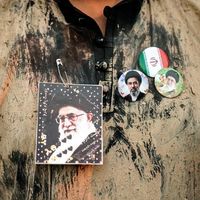
Some Iranians whose SIM cards or internet access had been blocked over alleged online activity against the Islamic Republic said they were told to submit handwritten pledges, provide guarantors and publish pro-government content to restore access.
The notices asked for home and work addresses, bank account information, images of bank cards and links to social media accounts. They also instructed recipients not to publish content deemed harmful to the country’s “psychological, social or political security.”
Some were told to publish at least 20 posts supporting the Islamic Republic and send screenshots as proof.
The posts were not to be uploaded all at once. They had to be spaced out so the activity would appear natural.
Others were ordered to attend nighttime government rallies, photograph themselves carrying flags or images of the Supreme Leader, and provide identification documents from guarantors who would accept responsibility for any future “criminal activity.”
The detail about timing is small, but it carries the whole design. The aim is not merely loyalty. It is loyalty made to look organic.
This is where the street and the screen meet. Organized rallies produce images of public unity. Selective internet access and coerced posting can carry the same choreography into comment sections, reply chains and social platforms.
The state does not need every supportive post to be fake. It needs a system in which supportive voices are easier to see, dissenting voices are harder to hear, and some frightened users learn that getting back online may require a public performance of loyalty.
The access ladder
Iran’s internet is no longer simply available or unavailable. It has been sorted.
At the top are so-called white SIM cards, widely understood as privileged lines that allow largely unrestricted access for trusted insiders and state-aligned users. Below them are paid and limited services such as “Internet Pro,” presented by officials as a business necessity but described by many Iranians as a class-based system of digital inequality.
Reporting on material circulating among users described a four-level structure: white SIM cards, paid Internet Pro, costly VPN access and, for the majority, a restricted domestic network.
The economic filter is severe. Average monthly income in Iran is at around $100 to $200, while the minimum wage is typically below $100. Even official Internet Pro packages and VPN routes can be unaffordable, and black-market access has reportedly pushed prices far higher.
Access also carries political exposure. For those who can afford a connection, the risk is not only cost but traceability. A user may be able to post, but with the knowledge that the same system can block a SIM card, summon a guarantor, demand a pledge or turn an online comment into a legal file.
The older machine
Iranian state-linked online influence operations long predate the current blackout. Microsoft has reported that Iranian cyber-enabled influence activity has been a consistent feature of at least the last three US election cycles.
In January, the Foundation for Defense of Democracies identified what it described as a likely regime-linked influence operation on X during protests, using coordinated accounts to delegitimize dissent, intimidate protesters and reinforce official narratives.
The report said the network included at least 289 accounts posting identical Persian-language content, with behavior suggesting a hybrid of automation and human operation.
But the current phase adds a more intimate layer. Foreign influence operations impersonate a public from a distance. Domestic coercion can pressure the public itself.
The old shorthand of “bots” misses the range of actors now shaping the visible online picture: automated accounts, organized cyber operators, loyalists with privileged access, state-linked media networks, paid voices, and users pushed to perform approval to recover ordinary tools of daily life.
The silence around the noise
The missing side of Iran’s online debate is not abstract.
It is the online seller without customers, the student without class materials, the programmer without contracts, the family unable to make a routine call abroad, and the person with disabilities cut off from services or communities that made daily life more manageable.
Against that background, pro-government comment floods do not prove a national mood. They show that some people still have access, some have protection, some have instructions, and many others have been priced out, cut off or made cautious by fear.
There are genuine supporters of the Islamic Republic. But a system that restricts millions, grants selective access, monitors users, blocks SIM cards and tells some people to space out loyalty posts cannot produce a clean reading of public opinion.
When a government cuts off the people and leaves the microphone to loyalists, the comment section stops being a public square.
It becomes part of the stage.
The real story is not only in the roar under the post. It is in the conditions that made so many others unable to answer back – and in the citizens told that to return to the internet, they must first praise the power that cut them off.
US president Donald Trump speaks to reporters in Washington D.C., May 18, 2026
President Donald Trump’s claim that he postponed a planned military strike on Iran has deepened uncertainty in Tehran, where officials and analysts remain divided over whether Washington is bluffing, buying time or preparing for another round of strikes.
Trump said Monday he had postponed an attack planned for Tuesday, before warning the United States remained ready to hit Iran hard.
Kazem Gharibabadi, Iran’s deputy foreign minister for legal and international affairs, wrote on X that “the United States says it has temporarily halted an attack on Iran to give diplomacy a chance, while simultaneously speaking of readiness for a large-scale strike at any moment. This means calling a threat an opportunity for peace.”
He added that the Islamic Republic was prepared to confront “any military aggression” and that “surrender has no meaning” for Iran.
Mohsen Rezaei, an adviser to Iran’s supreme leader and former commander of the Revolutionary Guards (IRGC), accused Trump of setting and then canceling military deadlines in an attempt to force Iran into submission. He warned that Iran’s armed forces would “force America into retreat and surrender.”
Gharibabadi later told members of parliament that Iran’s latest proposal to Washington included demands such as recognition of Iran’s right to uranium enrichment, lifting the US naval blockade, releasing frozen Iranian assets and ending sanctions. He did not provide details about Washington’s response.
Iranian digital outlet Avash Media cited “a source close to the negotiating team” as claiming that Washington had accepted some Iranian conditions, including ending regional conflicts and establishing a reconstruction fund.
On Tuesday, Vice President JD Vance said Washington and Tehran had made “a lot of progress” in talks and that neither side wanted to see a return to war.
Jalal Sadatian, a regional affairs analyst, told the website Fararu that the comments should be viewed “within the framework of the current Iran-US relationship, which is in a phase marked by political attrition and pressure tactics.”
“There is a perception in Tehran that the United States, for now, is using military threats more for political leverage than because it is truly ready for war,” he said.
“Tehran’s calculation is that if it makes major concessions now under maximum pressure, this model could later expand to issues such as missile capabilities and regional influence,” Sadatian added. “Therefore, Iran’s current policy is a combination of restraint, maintaining readiness and continuing protracted negotiations.”
Reformist journalist Ahmad Zeidabadi questioned Trump’s credibility, writing that if the US president’s account was accurate, then “one must seriously doubt the minimum level of rational calculation in him.”
“Does Trump not know what historic catastrophe restarting the war would bring to the entire Persian Gulf region?” Zeidabadi asked. “Was he planning to resume war without consulting allied leaders?”
Still, several analysts and conservative media outlets warned that the possibility of military escalation remains high.
The conservative newspaper Khorasan, which is close to parliament speaker Mohammad Bagher Ghalibaf, argued that Washington may seek to “unlock negotiations through a limited but effective strike.”
Ehsan Movahedian, a professor of international relations at Allameh Tabataba’i University, told Fararu that “the probability of war in the coming days is very high,” adding that even if conflict does not erupt next week, “that does not mean the danger has disappeared.”
Some Iranian political and media figures argued that the postponement may have had little to do with regional interventions and more to do with operational difficulties.
Ali Gholhaki, a commentator close to Ghalibaf, wrote that “the reason for delaying the attack on Iran appears to be something other than requests from Arab leaders; the United States and Israel are still not certain they can strike their key targets.”
Journalist Davoud Modarresian suggested Pakistani Interior Minister Mohsin Naqvi’s extended visit to Iran could be linked to intelligence-gathering efforts.
“Under the pretext of sending messages, they may be trying to track and identify the locations of leaders and commanders,” he wrote.
The competing narratives surrounding the latest US-Iran standoff have become so stark that even basic questions—who is deterring whom, who wants talks and who fears escalation—now produce entirely different answers depending on which capital is speaking.
On Tuesday, Trump again underscored the volatility of the standoff, saying the United States “may have to give them another big hit” and claiming Tehran was “begging” for a deal.
Khabar Online journalist Mohammad Aref Moezzi described the current dynamic as a familiar “neither war nor peace” scenario: sustained pressure and confrontation without a clear decision to escalate into full conflict or pursue a comprehensive agreement.
Both sides, he argued, still believe they can force concessions without paying the cost of war.
People walk by an anti-US mural in Tehran, Iran, May 18, 2026
The competing narratives surrounding the latest US-Iran standoff have become so stark that even basic questions—who is deterring whom, who wants talks and who fears escalation—now produce entirely different answers depending on which capital is speaking.
On Monday, President Donald Trump said he had halted plans to attack Iran following requests from Qatar, Saudi Arabia, the UAE “and some others in the region.”
The same day, Iran’s state television claimed Trump had backed down from threatening military action “at least five times in recent weeks” because he feared Iran’s “firm response.”
On Tuesday, Trump again underscored the volatility of the standoff, saying the United States “may have to give them another big hit” and claiming Tehran was “begging” for a deal.
Rahman Ghahramanpour, a Middle East politics expert, told Tehran-based Khabar Online that both Tehran and Washington increasingly see the confrontation as a “competition over resilience,” with each believing renewed brinkmanship could strengthen its negotiating position.
Khabar Online journalist Mohammad Aref Moezzi described the current dynamic as a familiar “neither war nor peace” scenario: sustained pressure and confrontation without a clear decision to escalate into full conflict or pursue a comprehensive agreement.
Both sides, he argued, still believe they can force concessions without paying the cost of war.
For Iran’s leadership, the overriding objective remains survival and persuading Washington to abandon any notion of regime change.
Ghahramanpour argues that Tehran is trapped in a struggle for survival while Washington faces what he calls a “credibility trap.” The United States wants a visible strategic victory; the Islamic Republic increasingly treats simple endurance as success.
Despite striking numerous military targets in Iran, Washington has yet to achieve a major political breakthrough. In the United States, particularly amid partisan rivalries, that is often framed as a failure for Trump. In Iran, the same reality is presented as proof the Islamic Republic withstood American pressure.
He also noted that many in Israel believe Trump’s presidency may represent the best opportunity to secure full US cooperation against Iran, adding to pressure for a more decisive confrontation before political circumstances change.
The widening gap between Iranian and American perceptions has effectively frozen negotiations.
Although some hardliners in Tehran advocate pre-emptive action, the government appears unwilling to be seen as the side that starts a war.
Washington, meanwhile, continues tightening sanctions and maintaining pressure while also signaling that military action remains an option if diplomacy stalls.
Another Iranian scholar, Ali Asghar Zargar, told Fararu on Tuesday that neither side benefits from the current deadlock.
He described the standoff as a mix of attrition, geopolitical rivalry and competing political narratives in which Iran remains under heavy pressure while the United States has yet to achieve its core objectives.
Zargar also argued that Washington cannot realistically use the Strait of Hormuz as a unilateral pressure tool given the global dependence on the waterway, warning that the longer the impasse continues, the greater the risk of escalation or miscalculation.
What increasingly unites both Iranian and American analysts is the sense that the current stalemate may be unstable, and that neither side has yet found a credible path out of it.
File photo shows workers toil on the 2Africa undersea cable project carried out by France’s Alcatel Submarine Networks in Amanzimtoti, South Africa on Feb. 7, 2023.
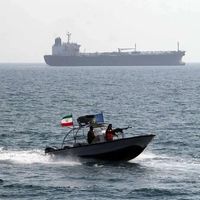
Long viewed as merely an oil chokepoint, the Strait of Hormuz is now emerging as a digital flashpoint, after Iran floated “protection fees” for subsea fiber-optic cables crossing the waterway in a move experts warn could give Tehran new leverage.
Ebrahim Zolfaghari, spokesperson for Iran's military command center, wrote on X last week: “We will impose tolls on internet cables.”
Media outlets close to the IRGC have also said companies such as Google, Microsoft, Meta and Amazon must comply with the Islamic Republic’s laws, and that cable-owning companies must pay permit fees for cables to pass through.
Subsea cables carry the overwhelming majority of the global internet and financial traffic, connecting Europe, Asia and the Persian Gulf through a vast underwater network that powers everything from banking systems and cloud computing to government communications and energy markets.
The risk is no longer theoretical. Alcatel Submarine Networks, the world’s largest cable-laying company, has already paused subsea cable repair operations in the Persian Gulf after issuing force majeure notices tied to growing security risks in the region.
“The undersea network of undersea cables, it's not just important, it’s absolutely critical – trillions of dollars of financial transactions take place through these cables,” said Tom Sharpe, who served 27 years as a Royal Navy officer commanding four warships.
“It’s the internet, which of course if enough of that collapses can have a devastating effect," he said.
While these networks are global, experts say the Persian Gulf is uniquely vulnerable because there are fewer redundant cable routes compared to regions like the Atlantic.
“When you go to other places in the world, let’s say the [Persian] Gulf, there are far fewer, and therefore that redundancy becomes less and less, and therefore the vulnerability goes up,” Sharpe explained.
Iranian lawmakers discussed plans last week that could target submarine cables linking Persian Gulf littoral states to Europe and Asia. Iranian state-linked media have also floated proposals requiring foreign operators to comply with Iranian licensing laws and pay fees for maintenance and repair access.
The proposals appear to be part of a broader effort by Iranian hardliners to test how far Tehran can extend its authority over infrastructure crossing the Persian Gulf, even when that infrastructure is privately owned or tied to foreign governments.
Escalate, test, adjust
Sharpe believes Tehran is following a familiar escalation model — gradually testing international reactions before potentially taking more aggressive steps.
“I think, look, it seems to me at the moment we’re in the sort of inject uncertainty phase. Let’s see what the markets do. Let’s see how the companies react. Let’s see what insurers do,” Sharpe said. “They escalate. They test. They adjust.”
According to Sharpe, the strategy mirrors tactics previously employed by Russia around undersea infrastructure and later adapted by the Houthis in the Red Sea.
“They’re very good at escalation management,” he added. “They don’t go straight to the nuclear option and start just snipping cables.”
Charlie Brown, Senior Advisor at United Against Nuclear Iran, who specializes in maritime sanctions enforcement and the tracking of illicit shipping, said the issue extends far beyond internet access alone because submarine cables often cross multiple jurisdictions and are owned by consortiums involving companies and governments from around the world.
“This goes beyond merely the cable itself and the data on it,” Brown told Iran International. “These are cross-jurisdictional issues that affect many people in many different jurisdictions.”
New toll booth under the sea
Brown described the Islamic Republic’s approach as resembling a mafia-style protection racket aimed at controlling — rather than immediately destroying — critical underwater infrastructure.
“Yeah, it’s very interesting. I mean, so this ends up showing that it’s a money-making racket threatening. So it’s basically a gangster move,” Brown said.
“The IRGC is trying to extend their control to include things on the seabed that don’t belong to them,” he added.
Experts say global internet infrastructure has enough redundancy to prevent a total communications collapse, but warn the bigger risk is the normalization of payments to Tehran.
Max Meizlish, Senior Research Analyst for the Center on Economic and Financial Power at Foundation for Defense of Democracies, sees the cable issue as an extension of Iran’s broader attempts to exert control over the Strait of Hormuz.
“I think that this is just another instance of the Iranian regime putting in place essentially a shakedown in the strait,” Meizlish said.
Since the war began, he said, hardline factions within the Islamic Revolutionary Guard Corps (IRGC) have increasingly pushed to expand Tehran’s leverage over both maritime and digital chokepoints.
“We see slowly Iran extending its sphere of influence,” Meizlish said. “The IRGC hardliners want to come out of this conflict actually from a position of relative strength.”
A warning to Washington
Much of what happens next may ultimately depend on enforcement. Existing US sanctions prohibit dealings with the IRGC, meaning companies that pay such fees could expose themselves to secondary sanctions.
But if enforcement weakens, Meizlish warns, firms may gradually begin viewing payments to Tehran as simply another cost of operating in the region.
“Already it’s come out within the shipping sector,” Meizlish told Iran International. “Some ships have made these payments. We’ve seen traffic go through the Tehran toll booth.”
“If the US doesn’t step up pressure and actually actively enforce these sanctions, then some firms will determine that maybe in their risk-based approach, they can go ahead and do this,” he said.