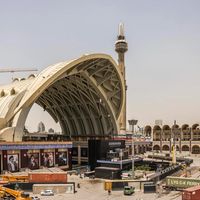
Vehicles pass by two large screens and a huge billboard depicting Iran's slain supreme leader Ali Khamenei, in Tehran, May
Tehran commentariat and figures close to the establishment are increasingly accusing hardliners and state television of deepening divisions and undermining national unity as the country faces war, economic strain and growing public anxiety.
The US-Israeli attacks on Iran and the ensuing regional conflagration have aggravated economic troubles to the point that President Masoud Pezeshkian has warned of widespread unrest.
Media close to Parliament Speaker Mohammad Bagher Ghalibaf, who has sought to position himself as a pragmatist since the death of former Supreme Leader Ali Khamenei, have been among the most vocal critics.
On Thursday, Khorasan newspaper, one of the outlets closest to Ghalibaf, blasted the state broadcaster and several ultraconservative lawmakers for promoting rhetoric that risked “deepening divisions and polarizing the public” at a time of war.
The paper singled out hardline MP Ali Khezrian, who it said had received nearly four hours of airtime in less than a week to accuse state officials of serving foreign interests and challenge the authority of the Foreign Ministry and the Supreme National Security Council.
In a counter-accusation, Khorasan alleged that Khezrian had posted a video of a petrochemical facility in Lorestan Province, effectively “updating Israel and the United States’ list of potential sites to strike.”
The paper also accused Khezrian of presenting his own views as those of Iran’s new leader, adding that if a politician from another faction had done so, they would likely have been arrested by security forces.
Meanwhile, conservative figure and former Resalat editor Mohammad Kazem Anbarlui warned in a May 14 interview with ISNA that hardliners were creating dangerous political polarization by exploiting issues such as hijab enforcement and negotiations with the United States.
On the same day, Khabar Online reported that during a live broadcast on Channel 3, a reporter asked demonstrators: “Which political figures were meaner than the meanest animals?” Respondents named politicians associated with rivals of the hardline camp.
The outlet argued that hardliners were increasingly using state television to erode national cohesion. Since the start of the war, it wrote, the broadcaster had selectively featured hardline commentators and public figures.
Instead of offering expert analysis, Khabar Online wrote, the organization was increasingly relying on controversial guests and sensationalist presenters, pushing it “off its professional path” and disrupting “public order and social calm.”
The national broadcaster now resembled “the exclusive domain of hardliners,” it said — a space where they were allowed to undermine decisions of the Supreme National Security Council and state authority.
Even the IRGC-linked Javan newspaper acknowledged the growing concern.
“When people are constantly led to believe that state officials are incompetent, infiltrated, or intimidated, the result is growing pessimism, distrust, and the erosion of national cohesion,” the paper warned in a commentary published the same day.
“A society whose trust has been damaged” becomes more vulnerable to external crises and adversaries’ psychological operations, it added.
“The outcome,” Javan concluded, “is either public anger or despair.”
A series of overnight earthquakes and a powerful dust storm rattled Tehran and nearby cities on Tuesday night, reviving fears of a catastrophic earthquake in a capital still psychologically scarred by recent war.
The seismic activity began with a mild 3.4-magnitude tremor before intensifying into a 4.6-magnitude earthquake later in the night. Several aftershocks continued into early Wednesday morning.
At the same time, a storm swept through Tehran, bringing severe dust, power outages and fallen trees. At least seven people were reportedly injured in the storm, though authorities said the earthquakes themselves caused no casualties or major damage.
Still, the tremors revived a long-standing fear in Tehran: the possibility of a devastating earthquake along the active fault lines beneath eastern Tehran and surrounding towns.
The big one may be overdue
ILNA quoted earthquake expert Fariborz Nateghi Elahi criticizing the lack of serious crisis planning for the major quake scientists have long warned about.
“We know an earthquake will happen,” he said. “Not on this scale, but something much, much larger.”
Eastern Tehran and nearby towns sit atop an active fault stretching at least 200 kilometers and capable of generating earthquakes above magnitude 7. Geologists say the fault typically produces a major earthquake roughly once every century.
Nearly 200 years have passed since the last truly destructive event. In 1830, a massive earthquake estimated at magnitude 7.1 devastated Tehran, then a relatively young capital.
Scientists now warn that pressure accumulated underground since then has left the fault in a critical state, primed for a major release of energy.
In December 2017, a 3.5-magnitude tremor caused widespread panic, sending residents into the streets and forcing many families to sleep in their cars overnight. This time, despite the stronger quake, the public reaction appeared noticeably more subdued.
Crisis fatigue
Some residents still spent the night in parks, streets or inside their vehicles, but many on social media said the trauma of recent air and missile attacks during two wars had numbed their reactions.
One psychologist writing on X suggested the muted response could be explained by “crisis fatigue.”
A social media user wrote: “The 2017 earthquake made Tehran residents sleep in their cars until morning. Streets were completely gridlocked, and gas stations were packed. Its magnitude? 3.5. Now our reaction is: ‘Oh, it’s just an earthquake,’ and we pull the blanket over our heads and go back to sleep. I think only a nuclear bomb could still move people in this country.”
Another user described how the storm initially triggered fears of renewed military attacks: “The storm started, windows were shaking, and I thought: ‘Is it fighter jets?’”
She said she then checked the news and realized it was just a storm, which briefly calmed her. “Then the earthquake came, and I thought: well, that’s nothing. Compared to war, everything feels like a joke.”
A graffiti of Iran's supreme leader Mojtaba Khamenei with an anti-US mural in the background, Tehran, May 8, 2026
Iranian former diplomats and political analysts struck a pessimistic tone in Wednesday’s media ahead of Donald Trump’s talks with Chinese President Xi Jinping, warning of renewed escalation and portraying China as central to any Iran-US settlement.
Most outlets framed negotiations as deadlocked. Reform-leaning Fararu warned of “the increasing possibility of yet another escalation.”
In an article titled “Negotiating About Negotiating” published by Sharq, former diplomat Kourosh Ahmadi examined the growing impasse after Trump reportedly rejected Iran’s latest 14-point proposal as “completely unacceptable.”
According to Tasnim and IRIB, Tehran’s proposal included demands for the withdrawal of US forces from Iran’s periphery, war reparations, full sanctions relief and a new legal framework for the Strait of Hormuz.
Ahmadi argued that the recent exchange of written messages marked a regression from even the already limited framework of indirect negotiations.
“This is no longer substantive diplomacy,” he wrote, describing the process instead as “negotiating about the method of negotiation.”
He argued that Trump remains focused on Iran’s 60 percent uranium enrichment while Tehran continues prioritizing sovereignty and economic compensation, leaving little common ground.
Rather than full-scale war, Ahmadi predicted prolonged “low-intensity military encounters,” tighter naval blockades and sustained economic pressure aimed at keeping Iran unstable.
In Etemad, foreign policy analyst Morteza Makki argued that after 40 days of military confrontation both Tehran and Washington are now effectively “forced” to seek some form of agreement.
Makki said the conflict had reshaped regional dynamics, arguing that despite heavy costs Iran had preserved key strategic objectives and demonstrated deterrence in the Persian Gulf, while Washington had failed to secure broader goals despite military escalation and operations such as Operation Freedom.
“The White House is now managing the costs of war rather than leading an offensive,” he said.
Makki pointed to domestic pressures in the United States, fears of rising energy prices and reluctance among Arab allies such as Saudi Arabia to enter a broader conflict.
He concluded that both the nuclear issue and the Strait of Hormuz remain negotiable if political will exists, but argued that China is now the only power capable of offering guarantees Tehran would trust.
“It seems China is the only country that can play an effective role in creating space for dialogue and guaranteeing a stable agreement between Iran and the U.S.,” he said.
Expanding on China’s role, Iran’s former ambassador to Beijing Hamid Aboutalebi argued in a Fararu commentary that the confrontation has evolved beyond a regional crisis into a test of China’s willingness to defend partners against US pressure.
He wrote that the conflict was no longer simply about sanctions or Iran’s nuclear program, but about whether Beijing is prepared to challenge a US-centered global order.
According to Aboutalebi, if China succeeds in building alternative financial and energy networks while defending partners such as Iran, Tehran could evolve from an isolated sanctioned state into a key player in an emerging multipolar order.
But if Beijing retreats under pressure, he warned, it would expose the limits of Chinese power despite its global ambitions.
He argued that tensions surrounding the Strait of Hormuz have elevated the conflict into a broader geopolitical contest, increasingly forcing China to balance its ambitions as a global power against its dependence on stability and open trade routes.
US President Donald Trump arrives in China, May 13, 2026
Ahead of Donald Trump’s arrival in Beijing, Iranian officials rejected suggestions that US pressure could weaken Iran-China ties amid growing speculation over a possible Chinese mediation role in the Iran conflict.
Iranian ambassador to China Abdolreza Rahmani-Fazli wrote Monday on X that relations between Tehran and Beijing “are stronger than any US effort aimed at changing China’s position toward Iran through pressure.”
Chinese Foreign Ministry spokesman Guo Jiakun reinforced that message Monday, saying Beijing’s position remained “clear and consistent” and that the priority should be preventing renewed war and further escalation.
Crucially, Beijing also signaled opposition to any US-led blockade of the Strait of Hormuz, saying such actions were “not in the common interests of the international community.”
Observers viewed last week’s meeting in Beijing between Iranian Foreign Minister Abbas Araghchi and Chinese Foreign Minister Wang Yi as an effort to coordinate positions ahead of the expected Trump-Xi talks.
During the meeting, Wang said China was prepared to play a “greater role” in regional peace efforts and encouraged dialogue between Iran and Persian Gulf Arab states.
Trump pressure Xi over Iran
Western media reports indicate Trump plans to press Xi over China’s economic and strategic ties with Iran, particularly oil purchases and alleged military assistance.
While Trump acknowledged he would raise the issue, he also said before departing for Beijing that he did not believe Xi’s cooperation was strictly necessary to manage the crisis.
Tensions between Washington and Beijing over Iran have intensified in recent weeks following the seizure of a Tehran-linked cargo vessel near the Strait of Hormuz.
In a CNBC interview, Trump criticized what he described as China’s “unexpected support for Iran,” saying he had anticipated greater understanding from Beijing.
Former US ambassador Nikki Haley also alleged on X that the seized vessel was carrying chemicals intended for Iran’s missile program, presenting the case as evidence of growing Chinese support for Tehran.
China’s expanding regional role
At a May 8 press conference in Beijing, Rahmani-Fazli said Tehran and Beijing had agreed to advance Xi’s four-point regional security initiative.
The proposal emphasizes peaceful coexistence, respect for sovereignty and territorial integrity and adherence to international law as foundations for stability in the Persian Gulf and the broader Middle East.
Iranian outlet Khabar Online described the initiative as part of Beijing’s broader effort to position itself as a major diplomatic mediator in the region while distancing itself from what it called US unilateralism.
The outlet argued that the approach could strengthen Iran’s negotiating position and increase pressure on Washington to accept at least some Iranian demands.
Rahmani-Fazli said Monday that any future agreement with Washington “must inevitably include guarantees from major powers” and ultimately be raised at the UN Security Council.
Could China become a mediator?
So far, China has largely pursued a cautious approach to the confrontation between Iran and the United States, avoiding direct involvement while calling for de-escalation.
Still, some Iranian analysts believe Beijing may now be willing to take on a more active diplomatic role.
Former Iranian ambassador to China Mohammad Keshavarzzadeh told Shargh newspaper that Chinese officials appeared interested in facilitating negotiations and reducing tensions.
Iranian Foreign Ministry spokesman Esmail Baghaei also suggested Beijing could use Trump’s visit to warn against what Tehran describes as unlawful US pressure and its consequences for regional and global stability.
At the same time, some Iranian analysts believe China may be uneasy with Tehran’s threats to restrict access through the Strait of Hormuz.
Former Iranian diplomat Kourosh Ahmadi told Nour News that Beijing’s primary concern remains preserving open trade routes essential to its export-driven economy.
According to Ahmadi, this could push China to place greater emphasis on protecting the legal status of international waterways and opposing any disruption in Hormuz that might set precedents elsewhere.
Disputes over Chinese support for Iran
Last month, Trump called on Xi not to send weapons to Tehran and claimed China had offered assurances on the matter.
In recent days, the US State Department sanctioned three Chinese satellite companies accused of assisting Iranian military operations by providing imagery linked to Iranian military activity. Beijing rejected the allegations.
The US Treasury Department also sanctioned several companies in mainland China and Hong Kong accused of helping supply weapons-related materials to Iran.
Beijing does not recognize US sanctions on Iranian oil exports and has instructed domestic companies not to comply with American restrictions targeting so-called “teapot” refineries purchasing Iranian crude.
The moves underscore growing US efforts to pressure Beijing over its ties with Tehran ahead of the Trump-Xi meeting.
Iran's president Masoud Pezeshkian meets Chinese counterpart Xi Jinping, September 2025
Iran is increasingly looking to China not just as an economic partner, but as the only major power capable of offering credible guarantees in both the Persian Gulf and any future agreement between Tehran and Washington.
On May 10, Iran’s ambassador to China, Abdolreza Rahmani Fazli, said Beijing could serve as the guarantor of a future deal between Iran and major world powers. He added that any agreement should ultimately be endorsed by the UN Security Council, echoing Tehran’s long-standing preference for multilateral guarantees over bilateral commitments.
A day later, Rahmani Fazli wrote on X that Iran was prepared to support President Xi Jinping’s four-point proposal for “sustainable security” in the Persian Gulf, adding that the position had already been affirmed during recent talks between the two countries’ foreign ministers.
China’s approach to emphasizes mutual guarantees among regional states, with Beijing presenting itself as a mediator and economic stabilizer rather than a military enforcer.
In mid-April, Xi introduced a four-point proposal aimed at moving the region away from the brink of wider war toward what Chinese officials described as a “comprehensive and sustainable security architecture.”
The proposal called for peaceful coexistence among regional powers, respect for sovereignty, adherence to international law and the UN Charter, and balancing security with economic development and reconstruction.
Chinese diplomacy surrounding the Iran crisis has increasingly been framed in Tehran as an alternative to Washington’s military-first approach.
Iranian media and officials have portrayed Beijing as a power capable of maintaining relations with all sides while avoiding direct military involvement.
Tehran and Beijing have both linked these initiatives to their expanding strategic partnership, which Iranian officials increasingly describe as a counterweight to US influence in the region.
Donald Trump’s upcoming visit to China has added new significance to that relationship as ceasefire tensions persist and negotiations remain stalled.
Hossein Mousavian, Iran’s former ambassador to Germany, recently reiterated that security guarantees remain one of Tehran’s central demands in any negotiations with Washington.
Iranian commentators argue that while Tehran does not trust the Trump administration to uphold a purely bilateral agreement, Chinese involvement could provide a framework both sides may find harder to abandon.
Still, major obstacles remain.
Trump has repeatedly rejected any agreement resembling the 2015 nuclear deal, arguing that it failed to protect US interests. Iran, meanwhile, continues to push for a broader truce framework without first resolving disputes over its nuclear program, a position unlikely to gain traction in Washington.
Tensions escalated further on May 12, when Parliament Speaker Mohammad Bagher Ghalibaf said Iran was prepared for war if Trump rejected Tehran’s terms. The same day, Trump said military options remained on the table.
Against that backdrop, Beijing has increasingly signaled that its immediate priority is preventing further disruption in the Persian Gulf and ensuring safe navigation through the Strait of Hormuz, a critical artery for global energy markets.
For Tehran, China’s growing diplomatic role offers more than mediation. It represents the possibility of a powerful external guarantor at a time when trust between Iran and the United States appears close to collapse.
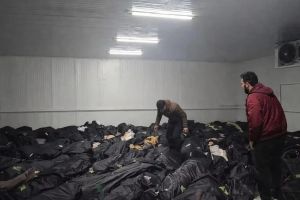
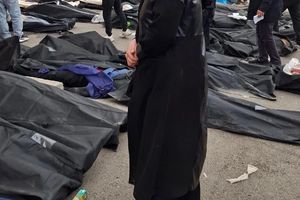
Alghadir hospital in east Tehran is one of the places where the January massacre could be seen in full: a five-body morgue overflowing, blood on the floors, and families searching through blankets and body covers for the people they loved.
As security forces opened fire around Haft Hoz and Tehranpars, two protest flashpoints in east Tehran, the wounded and the dead were carried to Alghadir hospital, where images and videos later captured one of the clearest records of the January massacre.
Some bodies were wrapped in blankets or plastic. Others were placed in garbage bags or left on top of one another.
After the images spread online, Hossein Kermanpour, the Health Ministry’s public relations chief, confirmed they were real. He said about 150 wounded people and 36 bodies were brought to Alghadir on January 8, while the morgue could hold only five bodies. The images, he said, were “accurate.”
The scenes formed one fragment of the wider January massacre, in which more than 40,000 people were killed in two days as the Islamic Republic moved to crush a nationwide uprising.
Iran International has identified and verified nine of the people whose bodies were taken to Alghadir or whose final hours passed through the hospital. Among them were a 17-year-old student, a 19-year-old woman, a father, a worker, a young man trying to build a future, and a protester shot while helping a wounded girl.
A witness said there were so many dead inside Alghadir that bodies were placed on top of each other. Security forces outside threatened to burn the hospital with everyone inside if the doors were not opened, while relatives of the wounded tried to block their entry.
A wounded protester said officers later entered, hit a nurse on the head with a baton and took several people away. Doctors hid some of the wounded in a storage room. “We kept hearing gunfire,” the protester said. “It sounded like coup de grace shots being fired at the wounded.”
Medical staff said body bags ran out, some of the dead were put in garbage bags, two vans came in the morning and took bodies away, and the corridors, elevators and courtyard were covered in blood as people carried the wounded in blankets toward surgery.
A nurse said January 9 was worse than the previous night. Security forces fired pellets and threatened those trying to help the wounded in the street, she said. One girl had been hit in the eye, one person had been shot in the heart and another had both legs torn apart. “I did not know who to help first,” she said.
Witnesses said security forces and Basij members set up checkpoints around Haft Hoz and near Sarallah Mosque, where the Zakereen Basij base is located. Armed forces were stationed on four sides of the square, they said, and shots were fired even inside the hospital grounds.
A source said many of the wounded had come from around Rashid police station in Tehranpars. Some who died after being taken to surgery were removed through the rear door of the operating room by IRGC and Basij forces, while relatives waited on the other side for news.
One hospital worker described a girl with long hair under a cloth, her head severed and her body missing. A staff member who saw the scene could not return to work for two days, the source said. Another witness said an elderly hospital guard suffered a fatal heart attack after seeing a headless body.
Several sources said security forces later reviewed Alghadir’s security cameras to control records of who had entered the hospital and how the wounded and dead had been moved.
But behind the scenes from Alghadir were individual lives that could still be traced. Families searched corridors, storage rooms, courtyards and morgues for those who had disappeared into the chaos of those two nights. Iran International has identified and verified nine of them.
Aida Aghili
Aida Aghili: The woman in the checkered blanket
Aida Aghili, born on June 23, 1991, joined the uprising in Haft Hoz on January 8. While chanting slogans, she was shot twice in the head at close range and killed.
Before leaving, she hugged her mother and told her what should be done with her belongings if she did not return.
Security bodies tried to bury her in the Behesht Zahra cemetery section used for executed prisoners, but her family resisted. She was buried beside her grandmother on January 11.
On her birthday, Aida had written on Instagram of stress “inside my bones,” “a war in my soul and my homeland,” and a freedom she still believed would come.
Hossein Heidari
Hossein Heidari: ‘Your place is on the street'
Hossein Heidari, 50, was killed in Haft Hoz on January 8, two days before his birthday. He was shot in the back of the head and the side.
Before joining the protests, he had written: “Your place is on the street; every night until freedom, we will not sit down for a moment.”
His family first searched for him at Ansari hospital, where they found no trace of him. They later found his body in Alghadir’s back courtyard, wrapped in a blue blanket.
Hossein loved Esteghlal, the Tehran football club known as the Blues.
His family identified him by his boots, a birthday gift from his daughter. Relatives described him as joyful and fond of laughter. He was buried on January 12 under security restrictions.
Gholamreza Mozhdehi
Gholamreza Mozhdehi: A man taken alive to hospital
Gholamreza Mozhdehi, 52, was wounded during night protests in Tehranpars on January 8 and taken to hospital while still showing signs of life, witnesses said.
Security agents prevented him from receiving medical help. Hours later, his body was found in Alghadir’s basement, in an area used for hospital waste, beside other bodies.
He had a live bullet wound to the neck, pellet injuries to the head, and wounds from knives or machetes. Married with two children, he had joined the protests in solidarity with others.
Mohsen Ghahremanpour
Mohsen Ghahremanpour: Shot at close range, buried in silence
Mohsen Ghahremanpour was 22 and from Malayer, Hamadan province. On January 8 in Tehranpars, security forces shot him in the head and eye from about one meter away.
People took him to Alghadir, where he died. His body was later found in the hospital’s back courtyard.
Relatives said the family faced threats and financial pressure, including a demand for 3.5 billion rials, about $1,945, to release his body.
Iran International has documented similar cases in which authorities demanded money from families or pressured them to sign papers identifying killed protesters as members of the Basij, the IRGC’s paramilitary force, turning the dead into evidence for the Islamic Republic’s own account of the crackdown.
Under that pressure, Mohsen was buried in silence as a Basij member.
He had worked as a laborer and had recently begun container construction.
Setareh Rafiei
Setareh Rafiei: The 19-year-old found in storage
Setareh Rafiei was killed in Tehranpars on January 8. She had been shot twice with live rounds, once in the heart and once in the head.
Her family later found her body in a storage area at Alghadir, among many others left there after the morgue filled.
Pouya Derakhshan
Pouya Derakhshan: A student lost among the dead
Pouya Derakhshan was 17 and a student. On January 8, he was near the Haft Hoz metro station with friends when security forces attacked protesters.
Sources said he was beaten on the head with batons, then shot in the heart. People called an ambulance and he was taken to Alghadir, where doctors found he had no pulse.
After his body was transferred to Kahrizak morgue, a wrong identification code left him missing among the dead.
Relatives had to open the covers of several bodies before identifying him at the washing facility in Behesht Zahra cemetery. He was buried on January 10 in section 326 under security measures.
Sahar Bayat
Sahar Bayat: A body held for days
Sahar Bayat was killed in the evening of January 8 while returning from protests with her husband and friends.
Sources said a live round hit her from behind and she died at the scene.
Her body was first taken to Alghadir, then transferred to Kahrizak. Her husband spent one night at Alghadir and three nights at Kahrizak waiting for her body to be released.
Sources said authorities refused to hand over the body until money was paid. Relatives were also forced to sign pledges that no slogans would be chanted at the funeral. Sahar was buried in Tuyserkan, Hamadan province.
Amir Hossein Emamjomeh
Amir Hossein Emamjomeh: A father shot beside his wife
Amir Hossein Emamjomeh was 29 and the father of a daughter. He was killed during the January 8 protests in Tehranpars after being shot with a live round.
Sources said he was in the crowd with his wife when he was targeted by a sniper, apparently because of the white hat he was wearing. The bullet struck near his nose.
People took him to Alghadir, but he died from his injuries.
Mohammad Radmannia
Mohammad Radmannia: Shot while helping a wounded girl
On January 9, he was on Tavousi Street in Nezamabad when he went to help a wounded girl. He was shot directly in the head and killed.
Sources said people took him to Alghadir, but security agents did not allow treatment. His body was not handed over to his family.
Mohammad had repeatedly helped wounded protesters, taking some into homes to bandage their wounds.
In his final moments, he was again moving toward someone who had been shot.
People who knew him described him as kind, athletic and fond of animals.
His fortieth-day memorial was held on what would have been his birthday.
The nine cases verified by Iran International are not a full list of those taken to Alghadir. They are names recovered from one hospital, in one part of Tehran, over two nights of the crackdown.