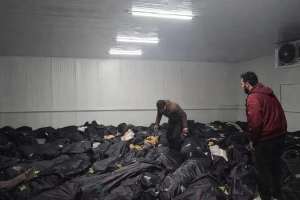
Alghadir hospital in east Tehran is one of the places where the January massacre could be seen in full: a five-body morgue overflowing, blood on the floors, and families searching through blankets and body covers for the people they loved.
As security forces opened fire around Haft Hoz and Tehranpars, two protest flashpoints in east Tehran, the wounded and the dead were carried to Alghadir hospital, where images and videos later captured one of the clearest records of the January massacre.
Some bodies were wrapped in blankets or plastic. Others were placed in garbage bags or left on top of one another.
After the images spread online, Hossein Kermanpour, the Health Ministry’s public relations chief, confirmed they were real. He said about 150 wounded people and 36 bodies were brought to Alghadir on January 8, while the morgue could hold only five bodies. The images, he said, were “accurate.”
The scenes formed one fragment of the wider January massacre, in which more than 40,000 people were killed in two days as the Islamic Republic moved to crush a nationwide uprising.
Iran International has identified and verified nine of the people whose bodies were taken to Alghadir or whose final hours passed through the hospital. Among them were a 17-year-old student, a 19-year-old woman, a father, a worker, a young man trying to build a future, and a protester shot while helping a wounded girl.
A witness said there were so many dead inside Alghadir that bodies were placed on top of each other. Security forces outside threatened to burn the hospital with everyone inside if the doors were not opened, while relatives of the wounded tried to block their entry.
A wounded protester said officers later entered, hit a nurse on the head with a baton and took several people away. Doctors hid some of the wounded in a storage room. “We kept hearing gunfire,” the protester said. “It sounded like coup de grace shots being fired at the wounded.”
Medical staff said body bags ran out, some of the dead were put in garbage bags, two vans came in the morning and took bodies away, and the corridors, elevators and courtyard were covered in blood as people carried the wounded in blankets toward surgery.
A nurse said January 9 was worse than the previous night. Security forces fired pellets and threatened those trying to help the wounded in the street, she said. One girl had been hit in the eye, one person had been shot in the heart and another had both legs torn apart. “I did not know who to help first,” she said.
Witnesses said security forces and Basij members set up checkpoints around Haft Hoz and near Sarallah Mosque, where the Zakereen Basij base is located. Armed forces were stationed on four sides of the square, they said, and shots were fired even inside the hospital grounds.
A source said many of the wounded had come from around Rashid police station in Tehranpars. Some who died after being taken to surgery were removed through the rear door of the operating room by IRGC and Basij forces, while relatives waited on the other side for news.
One hospital worker described a girl with long hair under a cloth, her head severed and her body missing. A staff member who saw the scene could not return to work for two days, the source said. Another witness said an elderly hospital guard suffered a fatal heart attack after seeing a headless body.
Several sources said security forces later reviewed Alghadir’s security cameras to control records of who had entered the hospital and how the wounded and dead had been moved.
But behind the scenes from Alghadir were individual lives that could still be traced. Families searched corridors, storage rooms, courtyards and morgues for those who had disappeared into the chaos of those two nights. Iran International has identified and verified nine of them.
Aida Aghili
Aida Aghili: The woman in the checkered blanket
Aida Aghili, born on June 23, 1991, joined the uprising in Haft Hoz on January 8. While chanting slogans, she was shot twice in the head at close range and killed.
Before leaving, she hugged her mother and told her what should be done with her belongings if she did not return.
Security bodies tried to bury her in the Behesht Zahra cemetery section used for executed prisoners, but her family resisted. She was buried beside her grandmother on January 11.
On her birthday, Aida had written on Instagram of stress “inside my bones,” “a war in my soul and my homeland,” and a freedom she still believed would come.
Hossein Heidari
Hossein Heidari: ‘Your place is on the street'
Hossein Heidari, 50, was killed in Haft Hoz on January 8, two days before his birthday. He was shot in the back of the head and the side.
Before joining the protests, he had written: “Your place is on the street; every night until freedom, we will not sit down for a moment.”
His family first searched for him at Ansari hospital, where they found no trace of him. They later found his body in Alghadir’s back courtyard, wrapped in a blue blanket.
Hossein loved Esteghlal, the Tehran football club known as the Blues.
His family identified him by his boots, a birthday gift from his daughter. Relatives described him as joyful and fond of laughter. He was buried on January 12 under security restrictions.
Gholamreza Mozhdehi
Gholamreza Mozhdehi: A man taken alive to hospital
Gholamreza Mozhdehi, 52, was wounded during night protests in Tehranpars on January 8 and taken to hospital while still showing signs of life, witnesses said.
Security agents prevented him from receiving medical help. Hours later, his body was found in Alghadir’s basement, in an area used for hospital waste, beside other bodies.
He had a live bullet wound to the neck, pellet injuries to the head, and wounds from knives or machetes. Married with two children, he had joined the protests in solidarity with others.
Mohsen Ghahremanpour
Mohsen Ghahremanpour: Shot at close range, buried in silence
Mohsen Ghahremanpour was 22 and from Malayer, Hamadan province. On January 8 in Tehranpars, security forces shot him in the head and eye from about one meter away.
People took him to Alghadir, where he died. His body was later found in the hospital’s back courtyard.
Relatives said the family faced threats and financial pressure, including a demand for 3.5 billion rials, about $1,945, to release his body.
Iran International has documented similar cases in which authorities demanded money from families or pressured them to sign papers identifying killed protesters as members of the Basij, the IRGC’s paramilitary force, turning the dead into evidence for the Islamic Republic’s own account of the crackdown.
Under that pressure, Mohsen was buried in silence as a Basij member.
He had worked as a laborer and had recently begun container construction.
Setareh Rafiei
Setareh Rafiei: The 19-year-old found in storage
Setareh Rafiei was killed in Tehranpars on January 8. She had been shot twice with live rounds, once in the heart and once in the head.
Her family later found her body in a storage area at Alghadir, among many others left there after the morgue filled.
Pouya Derakhshan
Pouya Derakhshan: A student lost among the dead
Pouya Derakhshan was 17 and a student. On January 8, he was near the Haft Hoz metro station with friends when security forces attacked protesters.
Sources said he was beaten on the head with batons, then shot in the heart. People called an ambulance and he was taken to Alghadir, where doctors found he had no pulse.
After his body was transferred to Kahrizak morgue, a wrong identification code left him missing among the dead.
Relatives had to open the covers of several bodies before identifying him at the washing facility in Behesht Zahra cemetery. He was buried on January 10 in section 326 under security measures.
Sahar Bayat
Sahar Bayat: A body held for days
Sahar Bayat was killed in the evening of January 8 while returning from protests with her husband and friends.
Sources said a live round hit her from behind and she died at the scene.
Her body was first taken to Alghadir, then transferred to Kahrizak. Her husband spent one night at Alghadir and three nights at Kahrizak waiting for her body to be released.
Sources said authorities refused to hand over the body until money was paid. Relatives were also forced to sign pledges that no slogans would be chanted at the funeral. Sahar was buried in Tuyserkan, Hamadan province.
Amir Hossein Emamjomeh
Amir Hossein Emamjomeh: A father shot beside his wife
Amir Hossein Emamjomeh was 29 and the father of a daughter. He was killed during the January 8 protests in Tehranpars after being shot with a live round.
Sources said he was in the crowd with his wife when he was targeted by a sniper, apparently because of the white hat he was wearing. The bullet struck near his nose.
People took him to Alghadir, but he died from his injuries.
Mohammad Radmannia
Mohammad Radmannia: Shot while helping a wounded girl
On January 9, he was on Tavousi Street in Nezamabad when he went to help a wounded girl. He was shot directly in the head and killed.
Sources said people took him to Alghadir, but security agents did not allow treatment. His body was not handed over to his family.
Mohammad had repeatedly helped wounded protesters, taking some into homes to bandage their wounds.
In his final moments, he was again moving toward someone who had been shot.
People who knew him described him as kind, athletic and fond of animals.
His fortieth-day memorial was held on what would have been his birthday.
The nine cases verified by Iran International are not a full list of those taken to Alghadir. They are names recovered from one hospital, in one part of Tehran, over two nights of the crackdown.
Iran executed Ehsan Afrashteh on Wednesday on accusations of espionage and intelligence cooperation with Israel, the judiciary’s Mizan News reported.
Afrashteh, who was born in the central city of Isfahan in 1993 and held a master’s degree in civil engineering, was arrested in early 2024 after returning from Turkey and spent several months in solitary confinement under interrogation at a security facility, according to Iran Human Rights Monitor.
Mizan claimed Afrashteh had become fluent in English, French and Hebrew during what it described as his cooperation with Israel.
It accused him of selling sensitive information to Israel and claimed that he had been trained by Mossad in Nepal.
The judiciary-linked outlet also claimed that he initially carried out instructions while working as an online taxi driver.
Several human rights organizations had previously warned that he was at imminent risk of execution.
Iranian poet Peyman Farahavar remains at risk of execution after the country’s Supreme Court rejected his request for judicial review, a rights group said on Tuesday.
The case against him stemmed from his poetry, political writings and protest activities, the Abdorrahman Boroumand Center said, citing sources close to his family, who also said he had not taken part in any armed activities.
The US-based group said former cellmates reported torture during interrogation, the destruction of some of his handwritten poems and denial of full medical care despite serious health problems.
Farahavar, a 37-year-old father from Iran’s northern province of Gilan, was sentenced to death on accusations of “armed rebellion against the state” (baghi) and “enmity against God” (moharebeh) by a Revolutionary Court in Rasht.
Farahavar was arrested in Rasht in September 2024 and later transferred to Lakan Prison after being held at an Intelligence Ministry detention center, the group said.
Iran has been carrying out near-daily executions, which has raised fears for detainees believed to be facing the death penalty over January’s anti-government protests, as well as prisoners accused of espionage during the war with the United States and Israel.
Some Iranians say security bodies blocked their internet or SIM cards over alleged online activity against the Islamic Republic, then demanded pro-government posts, written pledges and guarantors to restore access, according to messages sent to Iran International.
The unsigned notices asked recipients to provide personal details including home and work addresses, bank account information, images of bank cards and links to all their social media accounts.
They were also instructed to sign handwritten pledges not to publish content deemed harmful to the country’s “psychological, social or political security.”
The notices warned that users’ activities were being monitored through “smart surveillance and artificial intelligence systems” and said repeated violations could lead to judicial action and heavier punishment.
Some citizens were further instructed to publish at least 20 posts supporting the Islamic Republic on social media and send evidence that the posts had been uploaded.
The demands mark the latest effort by Iranian authorities to tighten control over online activity following waves of dissent and criticism on social media over the past year.
Recipients were told not to publish all pro-government posts in a single day “to make the activity appear natural,” according to the messages.
Some were also ordered to attend nighttime government rallies that began after US and Israeli attacks earlier this year and continued after a ceasefire took hold. Participants were instructed to photograph themselves carrying Islamic Republic flags or images of Supreme Leader Ali Khamenei.
In several cases, authorities requested identification documents from a guarantor who would accept responsibility for any future “criminal activity” by the targeted individual.
In August 2025, many Iranians wrote on social media that their SIM cards had been abruptly disconnected without warning or court orders after they published critical posts online, particularly in the aftermath of the 12-day war.
Some said security bodies contacted them through the domestic messaging platform Eitaa and told them to meet a series of demands or report to entities including the Prosecutor’s Office cyber division to regain access.
During those visits, citizens said they were ordered to submit copies of their national ID cards and sign written pledges promising to stop critical online activity.
Similar measures were reported in October 2024, when journalists and political activists said security bodies blocked their SIM cards, forced them to delete posts and ordered them to publish content that contradicted their views.
Eight women political prisoners held in Tehran’s Evin Prison have been barred from meeting family members and lawyers following tighter security measures and pressure linked to collective protest activities inside the ward, according to information obtained by Iran International.
Shiva Esmaili, Golrokh Iraee, Sakineh Parvaneh, Forough Taghipour, Zahra Safaei, Marzieh Farsi, Elaheh Fouladi and Varisheh Moradi were denied visitation rights in recent weeks after participating in memorial gatherings and protest-related events inside the women’s ward, sources familiar with the situation said.
Prison authorities have also increased surveillance and patrols inside the ward, with officers entering cells daily and sometimes at night under the pretext of inspections, a source close to prisoners’ families told Iran International.
Women prisoners in Evin had for years marked political and ideological occasions through gatherings, songs, readings and commemorations for killed protesters and veteran activists, the source said. Prison officials have recently intervened directly in such activities and threatened participants, the source added.
The source said some women recently transferred to the ward were also warned by prison and security officials after attending a small number of the gatherings.
Prison staff have in recent months used insulting language toward detainees and threatened them with transfer to solitary confinement, another source familiar with conditions in the ward told Iran International.
Prisoners face solitary confinement threats
Ghazal Marzban, another woman prisoner in Evin, was recently held in solitary confinement for five nights after protesting the handling of her case, a source familiar with the situation said.
File photo of Eight women political prisoners held in Tehran’s Evin Prison who have been barred from meeting family members.
The women’s ward in Evin, often described by activists as a focal point of the “Woman, Life, Freedom” movement, has repeatedly issued statements and organized protests over executions, arrests, economic hardship and the suppression of demonstrations in Iran.
Prisoners in the ward have also staged sit-ins and hunger strikes against death sentences in recent years, after which some faced punitive measures including restrictions on phone calls, visits and new legal cases.
A source close to prisoners’ families said the growing restrictions and threats of solitary confinement reflected efforts by prison and security authorities to silence dissent inside the ward.
Prisoner with tumors denied urgent treatment
Separate information obtained by Iran International shows that Mohtaram Parandin, an imprisoned artist and painter known as Mahshar, has been denied urgent medical treatment despite suffering from two tumors near the cerebellum and throat as well as severe heart disease.
A source familiar with her condition said prison doctors had warned that immediate surgery was necessary because the tumor near her cerebellum had affected her vision, speech and movement.
“The effects of the illness are visible in the way she walks and speaks,” the source said.
Despite recommendations from prison medical staff, authorities have not approved her transfer for treatment and have also rejected requests for medical leave and conditional release although she has served more than half of her sentence, the source added.
The source said documentation required for temporary medical leave had already been submitted to the prosecutor’s office.
Parandin, the mother of a teenage son, became the head of her household after the death of her husband. Her son also suffers from a chronic illness and has faced difficulties during her imprisonment.
Rights groups and prisoners’ families have for years accused Iranian prison authorities of denying political prisoners adequate medical care, with several detainees dying in custody after prolonged illness or delayed treatment.
A prominent international academic organization focused on Iranian studies has urged the United Nations and the European Union to condemn US-Israeli attacks on universities and educational institutions in Iran during the March and April conflict.
In a letter dated May 11, the Committee on Academic Freedom of the Association for Iranian Studies (AIS) warned that Iran’s educational system had become “a frontline in the widening U.S.-Israel war against the country.”
The letter was addressed to several senior international figures, including UN High Commissioner for Human Rights Volker Türk, UNESCO chief Audrey Azoulay, EU foreign policy chief Kaja Kallas and US Secretary of State Marco Rubio.
The group accused the United States and Israel of systematically targeting universities, schools, research centers and medical institutions in violation of international humanitarian law.
It cited reported damage to major universities including Sharif University of Technology, Shahid Beheshti University, Amir Kabir University and the Iran University of Science and Technology.
AIS, founded in 1967, is one of the leading international scholarly organizations focused on Iran and Persianate studies. Its Committee on Academic Freedom has frequently criticized the Islamic Republic’s repression of student activism, arrests of academics and crackdowns on campuses following protests and political unrest in Iran.
In its latest statement, the group argued that the war had compounded the trauma already inflicted on Iranian students and universities by state repression.
“The 2026 war and the resulting disruption of education, following upon such attacks and repressive measures, have inflicted both physical and psychological trauma on students at all levels—effects that many young Iranians are likely to carry throughout their lives,” the letter said.
The letter also referred to strikes on medical research institutions including the Pasteur Institute of Iran and the Tofigh Daru pharmaceutical research center, as well as attacks on schools.
It rejected US-Israeli arguments that some institutions constituted legitimate “dual use” targets because of alleged links to Iran’s military sector, arguing that such claims ignored proportionality and the cumulative harm inflicted on civilians and educational infrastructure.
The organization called for international condemnation of attacks on educational institutions, pressure to end the war and support for rebuilding damaged academic infrastructure.