Iran's president Masoud Pezeshkian meets Chinese counterpart Xi Jinping, September 2025
Iran is increasingly looking to China not just as an economic partner, but as the only major power capable of offering credible guarantees in both the Persian Gulf and any future agreement between Tehran and Washington.
On May 10, Iran’s ambassador to China, Abdolreza Rahmani Fazli, said Beijing could serve as the guarantor of a future deal between Iran and major world powers. He added that any agreement should ultimately be endorsed by the UN Security Council, echoing Tehran’s long-standing preference for multilateral guarantees over bilateral commitments.
A day later, Rahmani Fazli wrote on X that Iran was prepared to support President Xi Jinping’s four-point proposal for “sustainable security” in the Persian Gulf, adding that the position had already been affirmed during recent talks between the two countries’ foreign ministers.
China’s approach to emphasizes mutual guarantees among regional states, with Beijing presenting itself as a mediator and economic stabilizer rather than a military enforcer.
In mid-April, Xi introduced a four-point proposal aimed at moving the region away from the brink of wider war toward what Chinese officials described as a “comprehensive and sustainable security architecture.”
The proposal called for peaceful coexistence among regional powers, respect for sovereignty, adherence to international law and the UN Charter, and balancing security with economic development and reconstruction.
Chinese diplomacy surrounding the Iran crisis has increasingly been framed in Tehran as an alternative to Washington’s military-first approach.
Iranian media and officials have portrayed Beijing as a power capable of maintaining relations with all sides while avoiding direct military involvement.
Tehran and Beijing have both linked these initiatives to their expanding strategic partnership, which Iranian officials increasingly describe as a counterweight to US influence in the region.
Donald Trump’s upcoming visit to China has added new significance to that relationship as ceasefire tensions persist and negotiations remain stalled.
Hossein Mousavian, Iran’s former ambassador to Germany, recently reiterated that security guarantees remain one of Tehran’s central demands in any negotiations with Washington.
Iranian commentators argue that while Tehran does not trust the Trump administration to uphold a purely bilateral agreement, Chinese involvement could provide a framework both sides may find harder to abandon.
Still, major obstacles remain.
Trump has repeatedly rejected any agreement resembling the 2015 nuclear deal, arguing that it failed to protect US interests. Iran, meanwhile, continues to push for a broader truce framework without first resolving disputes over its nuclear program, a position unlikely to gain traction in Washington.
Tensions escalated further on May 12, when Parliament Speaker Mohammad Bagher Ghalibaf said Iran was prepared for war if Trump rejected Tehran’s terms. The same day, Trump said military options remained on the table.
Against that backdrop, Beijing has increasingly signaled that its immediate priority is preventing further disruption in the Persian Gulf and ensuring safe navigation through the Strait of Hormuz, a critical artery for global energy markets.
For Tehran, China’s growing diplomatic role offers more than mediation. It represents the possibility of a powerful external guarantor at a time when trust between Iran and the United States appears close to collapse.
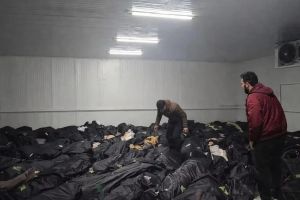
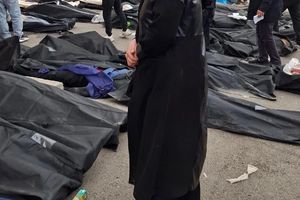
Alghadir hospital in east Tehran is one of the places where the January massacre could be seen in full: a five-body morgue overflowing, blood on the floors, and families searching through blankets and body covers for the people they loved.
As security forces opened fire around Haft Hoz and Tehranpars, two protest flashpoints in east Tehran, the wounded and the dead were carried to Alghadir hospital, where images and videos later captured one of the clearest records of the January massacre.
Some bodies were wrapped in blankets or plastic. Others were placed in garbage bags or left on top of one another.
After the images spread online, Hossein Kermanpour, the Health Ministry’s public relations chief, confirmed they were real. He said about 150 wounded people and 36 bodies were brought to Alghadir on January 8, while the morgue could hold only five bodies. The images, he said, were “accurate.”
The scenes formed one fragment of the wider January massacre, in which more than 40,000 people were killed in two days as the Islamic Republic moved to crush a nationwide uprising.
Iran International has identified and verified nine of the people whose bodies were taken to Alghadir or whose final hours passed through the hospital. Among them were a 17-year-old student, a 19-year-old woman, a father, a worker, a young man trying to build a future, and a protester shot while helping a wounded girl.
A witness said there were so many dead inside Alghadir that bodies were placed on top of each other. Security forces outside threatened to burn the hospital with everyone inside if the doors were not opened, while relatives of the wounded tried to block their entry.
A wounded protester said officers later entered, hit a nurse on the head with a baton and took several people away. Doctors hid some of the wounded in a storage room. “We kept hearing gunfire,” the protester said. “It sounded like coup de grace shots being fired at the wounded.”
Medical staff said body bags ran out, some of the dead were put in garbage bags, two vans came in the morning and took bodies away, and the corridors, elevators and courtyard were covered in blood as people carried the wounded in blankets toward surgery.
A nurse said January 9 was worse than the previous night. Security forces fired pellets and threatened those trying to help the wounded in the street, she said. One girl had been hit in the eye, one person had been shot in the heart and another had both legs torn apart. “I did not know who to help first,” she said.
Witnesses said security forces and Basij members set up checkpoints around Haft Hoz and near Sarallah Mosque, where the Zakereen Basij base is located. Armed forces were stationed on four sides of the square, they said, and shots were fired even inside the hospital grounds.
A source said many of the wounded had come from around Rashid police station in Tehranpars. Some who died after being taken to surgery were removed through the rear door of the operating room by IRGC and Basij forces, while relatives waited on the other side for news.
One hospital worker described a girl with long hair under a cloth, her head severed and her body missing. A staff member who saw the scene could not return to work for two days, the source said. Another witness said an elderly hospital guard suffered a fatal heart attack after seeing a headless body.
Several sources said security forces later reviewed Alghadir’s security cameras to control records of who had entered the hospital and how the wounded and dead had been moved.
But behind the scenes from Alghadir were individual lives that could still be traced. Families searched corridors, storage rooms, courtyards and morgues for those who had disappeared into the chaos of those two nights. Iran International has identified and verified nine of them.
Aida Aghili
Aida Aghili: The woman in the checkered blanket
Aida Aghili, born on June 23, 1991, joined the uprising in Haft Hoz on January 8. While chanting slogans, she was shot twice in the head at close range and killed.
Before leaving, she hugged her mother and told her what should be done with her belongings if she did not return.
Security bodies tried to bury her in the Behesht Zahra cemetery section used for executed prisoners, but her family resisted. She was buried beside her grandmother on January 11.
On her birthday, Aida had written on Instagram of stress “inside my bones,” “a war in my soul and my homeland,” and a freedom she still believed would come.
Hossein Heidari
Hossein Heidari: ‘Your place is on the street'
Hossein Heidari, 50, was killed in Haft Hoz on January 8, two days before his birthday. He was shot in the back of the head and the side.
Before joining the protests, he had written: “Your place is on the street; every night until freedom, we will not sit down for a moment.”
His family first searched for him at Ansari hospital, where they found no trace of him. They later found his body in Alghadir’s back courtyard, wrapped in a blue blanket.
Hossein loved Esteghlal, the Tehran football club known as the Blues.
His family identified him by his boots, a birthday gift from his daughter. Relatives described him as joyful and fond of laughter. He was buried on January 12 under security restrictions.
Gholamreza Mozhdehi
Gholamreza Mozhdehi: A man taken alive to hospital
Gholamreza Mozhdehi, 52, was wounded during night protests in Tehranpars on January 8 and taken to hospital while still showing signs of life, witnesses said.
Security agents prevented him from receiving medical help. Hours later, his body was found in Alghadir’s basement, in an area used for hospital waste, beside other bodies.
He had a live bullet wound to the neck, pellet injuries to the head, and wounds from knives or machetes. Married with two children, he had joined the protests in solidarity with others.
Mohsen Ghahremanpour
Mohsen Ghahremanpour: Shot at close range, buried in silence
Mohsen Ghahremanpour was 22 and from Malayer, Hamadan province. On January 8 in Tehranpars, security forces shot him in the head and eye from about one meter away.
People took him to Alghadir, where he died. His body was later found in the hospital’s back courtyard.
Relatives said the family faced threats and financial pressure, including a demand for 3.5 billion rials, about $1,945, to release his body.
Iran International has documented similar cases in which authorities demanded money from families or pressured them to sign papers identifying killed protesters as members of the Basij, the IRGC’s paramilitary force, turning the dead into evidence for the Islamic Republic’s own account of the crackdown.
Under that pressure, Mohsen was buried in silence as a Basij member.
He had worked as a laborer and had recently begun container construction.
Setareh Rafiei
Setareh Rafiei: The 19-year-old found in storage
Setareh Rafiei was killed in Tehranpars on January 8. She had been shot twice with live rounds, once in the heart and once in the head.
Her family later found her body in a storage area at Alghadir, among many others left there after the morgue filled.
Pouya Derakhshan
Pouya Derakhshan: A student lost among the dead
Pouya Derakhshan was 17 and a student. On January 8, he was near the Haft Hoz metro station with friends when security forces attacked protesters.
Sources said he was beaten on the head with batons, then shot in the heart. People called an ambulance and he was taken to Alghadir, where doctors found he had no pulse.
After his body was transferred to Kahrizak morgue, a wrong identification code left him missing among the dead.
Relatives had to open the covers of several bodies before identifying him at the washing facility in Behesht Zahra cemetery. He was buried on January 10 in section 326 under security measures.
Sahar Bayat
Sahar Bayat: A body held for days
Sahar Bayat was killed in the evening of January 8 while returning from protests with her husband and friends.
Sources said a live round hit her from behind and she died at the scene.
Her body was first taken to Alghadir, then transferred to Kahrizak. Her husband spent one night at Alghadir and three nights at Kahrizak waiting for her body to be released.
Sources said authorities refused to hand over the body until money was paid. Relatives were also forced to sign pledges that no slogans would be chanted at the funeral. Sahar was buried in Tuyserkan, Hamadan province.
Amir Hossein Emamjomeh
Amir Hossein Emamjomeh: A father shot beside his wife
Amir Hossein Emamjomeh was 29 and the father of a daughter. He was killed during the January 8 protests in Tehranpars after being shot with a live round.
Sources said he was in the crowd with his wife when he was targeted by a sniper, apparently because of the white hat he was wearing. The bullet struck near his nose.
People took him to Alghadir, but he died from his injuries.
Mohammad Radmannia
Mohammad Radmannia: Shot while helping a wounded girl
On January 9, he was on Tavousi Street in Nezamabad when he went to help a wounded girl. He was shot directly in the head and killed.
Sources said people took him to Alghadir, but security agents did not allow treatment. His body was not handed over to his family.
Mohammad had repeatedly helped wounded protesters, taking some into homes to bandage their wounds.
In his final moments, he was again moving toward someone who had been shot.
People who knew him described him as kind, athletic and fond of animals.
His fortieth-day memorial was held on what would have been his birthday.
The nine cases verified by Iran International are not a full list of those taken to Alghadir. They are names recovered from one hospital, in one part of Tehran, over two nights of the crackdown.
Iran’s defiant response to a US proposal on ending the conflict is fueling new fears that the fragile ceasefire could collapse and fighting resume within days.
Tehran handed its response to the latest US proposal to Pakistan on Sunday for delivery to Washington. On Monday, President Donald Trump said “the ceasefire is on life support.”
The exchange has fueled growing expectations in Iranian media and political circles that another military confrontation may be approaching.
Arash, a 45-year-old engineer in Tehran, said many people were once again preparing for the possibility of war.
“Filling gasoline tanks and stocking up on food and water for emergencies has again become a priority,” he said.
Iran’s defiant response to a US proposal on ending the conflict is fueling new fears that the fragile ceasefire could collapse and fighting resume within days.
Tehran handed its response to the latest US proposal to Pakistan on Sunday for delivery to Washington. Hours later, President Donald Trump dismissed the Iranian reply as “totally unacceptable” and warned Monday that “the ceasefire is on life support.”
The exchange has fueled growing expectations in Iranian media and political circles that another military confrontation may be approaching, even as officials insist they remain open to diplomacy on their own terms.
Arash, a 45-year-old engineer in Tehran, said many people were once again preparing for the possibility of war.
“Filling gasoline tanks and stocking up on food and water for emergencies has again become a priority,” he said.
Tehran rejects key US conditions
Iranian state-linked media strongly denied Western reports suggesting Tehran’s response included compromises on nuclear issues.
Tasnim News Agency, affiliated with the Revolutionary Guards (IRGC), rejected claims that Iran’s proposal addressed the future of its nuclear materials or enrichment activities.
Iran's state broadcaster IRIB described the American proposal as “meaning Iran’s surrender to Trump’s excessive demands.”
According to IRIB, Iran’s counterproposal emphasized compensation for war damages, recognition of Iran’s sovereignty over the Strait of Hormuz, the lifting of sanctions and the release of frozen Iranian assets.
Former IRGC commander-in-chief Mohammad Ali Jafari said Monday that no further negotiations would take place unless Iran’s conditions were met.
Mixed signals
President Masoud Pezeshkian struck a more conciliatory tone during a meeting with senior police commanders on Sunday.
While acknowledging deep distrust toward Washington, Pezeshkian said Iran would remain committed to any agreement reached “while taking into account the concerns of the Supreme Leader and the interests of the Iranian nation.”
“The rational, logical and nationally beneficial preference is for the victory achieved by the armed forces on the battlefield to be completed in diplomacy as well,” he added.
Foreign Ministry spokesman Esmaeil Baghaei also said Monday that Tehran’s proposal was “reasonable and generous,” but accused Washington of continuing to insist on “unreasonable demands.”
Baghaei said Iran’s immediate priority was ending the war rather than negotiating details of the nuclear program, adding that decisions regarding “the nuclear issue, enriched materials and enrichment itself” would be announced later “at the appropriate time.”
Some hardline figures, however, are increasingly arguing that Iran should openly pursue nuclear weapons capability as a deterrent against future attacks.
Ebrahim Rezaei, spokesman for parliament’s National Security and Foreign Policy Committee, said lawmakers had questioned the value of remaining in the Nuclear Non-Proliferation Treaty and stressed the need to preserve Iran’s nuclear “achievements.”
Limited optimism
Despite the dominance of hardline rhetoric in official circles, online reactions suggested skepticism toward maximalist demands and calls for escalation.
Under a commentary published by Alef News listing Iran’s conditions, one reader wrote sarcastically: “Do not expect them to accept all these conditions unless you completely defeat them and even take prisoners.”
Another commented: “These are a list of wishes, and nobody is asking what they would receive in return.”
The skeptical comments drew significantly more support from readers than hardline calls for confrontation.
State television has repeatedly discussed the possibility of renewed fighting, often portraying another conflict as likely but manageable.
Reformist website Rouydad24 wrote that “the political atmosphere inside Iran is not favorable to a quick agreement,” arguing that hardline factions view any retreat as surrender while the government is trying to avoid appearing weak without securing sanctions relief.
“For now,” the outlet concluded, “the most likely scenario is not a comprehensive agreement but continued attritional negotiations combined with temporary ceasefires and crisis management—a situation that is neither full peace nor total war.”
People walk in Tehran's Grand Bazaar, where a banner depicting Iran's slain supreme leader Ali Khamenei hangs above, April 2026
As prices continue to soar across Iran, hardline clerics and pro-government figures are increasingly attempting to shift blame away from the state even as economic pressure deepens for ordinary citizens.
In Mashhad, firebrand Friday prayer leader Ahmad Alamolhoda claimed that “US Army infantry is responsible for rising prices.” He later said the remark was metaphorical, arguing that the war had triggered hyperinflation and that “profiteers and the main culprits behind rising prices are the US army’s infantry.”
Earlier in the week, Hossein Shariatmadari, editor of the hardline daily Kayhan, wrote that “rising prices and hoarding are the products of the enemy’s infiltration in the government.”
While Iran’s armed forces were “working miracles,” he argued, the economy had been left undefended, allowing enemies to undermine battlefield gains.
Shariatmadari, who for decades attacked previous administrations over inflation and economic mismanagement, remained notably quiet during the ultraconservative governments of Mahmoud Ahmadinejad and Ebrahim Raisi.
In 2024, he claimed rising prices had “nothing to do with the performance of the government or parliament,” describing inflation as part of a foreign conspiracy.
Last week, he questioned why parliament had stopped monitoring the government’s performance. Days later, lawmakers held an online session with Agriculture Minister Gholamreza Nouri Ghezeljeh to discuss food prices, a move widely mocked in Iranian media as ineffective and detached from public hardship.
While Alamolhoda urged Iranians to embrace a vague “jihadist economy,” Shariatmadari called on officials to confront an unspecified “economic mafia.”
Moderate outlets, however, framed the crisis differently. The daily Arman Melli argued on Sunday that the latest surge in prices could not be explained solely by wartime conditions, pointing instead to years of structural economic problems, rising state expenditures and populist policymaking.
The paper also called for “effective use of diplomacy” to end the conflict while safeguarding national interests, arguing that renewed negotiations could help stabilize the economy.
The reformist website Rouydad24 described a society undergoing “economic and psychological erosion,” where inflation was no longer an abstract statistic but a daily reality.
Families were removing meat from their diets, patients cutting medication in half and tenants being pushed toward cheaper outskirts of major cities.
Economic newspapers described parliament’s online session as “a bitter confession” that authorities were losing control of the situation, reflected in shrinking household budgets, disappearing essentials and rising public anxiety.
Despite government claims of wage increases of up to 60 percent for workers, many public employees say they have not received the raises. Unemployment is rising, layoffs are spreading and businesses are shutting down, while temporary contracts leave many workers with little protection against dismissal.
Iranian media now report complaints about living costs even among government supporters attending nightly demonstrations. Families that once lived modest but stable lives increasingly struggle to afford housing, medical treatment, tuition and other basic necessities.
Many workers say they are still earning salaries set years ago in an economy where prices change almost daily, leaving much of Iran’s working and middle classes crushed by relentless inflation.
Taliban soldiers celebrate on the second anniversary of the fall of Kabul on a street near the US embassy in Kabul, Afghanistan, August 15, 2023.
The relationship between the Taliban and Iran, once marked by military confrontation and nearly pushed to war, is now defined by caution and quiet engagement.
The Taliban, who present themselves as representatives of a hardline Sunni Islamist movement, and the Iranian system, one of the main centers of Shiite political power, now maintain relations in which practical politics and mutual necessity have largely replaced deep-rooted sectarian hostility.
At first glance, the relationship appears contradictory. The 1998 Mazar-e-Sharif incident, when Iranian diplomats were killed and both sides nearly went to war, remains firmly embedded in the memory of both regimes.
Yet more than two decades later, the regional landscape has changed, enemies have shifted and one principle has again proven true: in the Middle East and across Central and South Asia, religion is often expressed rhetorically while decisions are driven by political interests.
From opposition to engagement
When the Taliban returned to power in 2021, Iran was among the few countries that did not completely shut its doors. Tehran neither formally recognized the Taliban administration nor severed ties with it.
Iran understood that an Afghanistan facing economic collapse, international isolation and political uncertainty contained both risks and opportunities—and chose engagement over exclusion.
The Taliban, constrained by sanctions, frozen assets and diplomatic isolation, were in turn forced to rely on neighboring countries. Iran—with its long shared border, fuel, electricity, transit routes and regional influence—became a practical partner.
After the death of Mullah Omar, the Taliban’s second leader, Mullah Akhtar Mohammad Mansour, emerged as a central bridge to Iran. His close associates, including Ibrahim Sadr, Mullah Shirin and Mullah Talib, established Sunni religious schools in Iran’s Sistan-Baluchistan region.
Over the past two decades, Iran pursued what Afghan officials describe as a “multi-track policy,” maintaining ties with Afghanistan’s republican government while simultaneously expanding covert and overt contacts with the Taliban to preserve influence under any future political arrangement.
Former senior Afghan presidential adviser Mohammad Iqbal Azizi says Iran significantly deepened ties with the Taliban after 2004, largely because of shared opposition to the US military presence.
“That’s why Mullah Mansour, Ibrahim Sadr and others went to Iran and received support from there,” he said.
Former head of Afghanistan’s Presidential Administrative Office Fazl Mahmood Fazli told Afghanistan International that some tribes maintain longstanding links with Iran.
“In recent years, Ishaqzai, Noorzai and Alizai Taliban commanders even cooperated with the IRGC in smuggling operations, and these relations have become so strong that they have now taken on a new form of partnership,” he said.
Former Pakistani senator Afrasiab Khattak said Iran has long maintained relations across Afghanistan’s political spectrum.
“Afghanistan is important for Iran, and its relations with Afghan governments are based on pragmatic politics,” he said. “Iran simply cannot operate on a purely religious basis.”
Khattak added that Iran invested heavily in ties with the Taliban during the war years and that its influence over some Taliban figures remains visible.
A key factor driving closer ties has been the Taliban’s deteriorating relationship with Pakistan. Relations with Iran help the Taliban avoid isolation, while Tehran understands the leverage this dependency creates.
Shared threats, shared interests
A central factor in improving Taliban-Iran relations has been the logic of shared threats.
The US military presence in Afghanistan represented a mutual challenge for both sides and laid the groundwork for gradual rapprochement. Iran sought to limit US influence while the Taliban fought directly against it.
Iran also faced broader security concerns linked to Afghanistan: border stability, ISIS-Khorasan, Baloch militancy, drug trafficking and refugee flows. From Tehran’s perspective, many of these issues could only be managed through engagement with the Taliban.
Economic factors also play a major role. Sanctions and isolation have pushed the Taliban toward regional economic networks, with Iran becoming an important supplier of fuel, electricity and goods. Tehran meanwhile seeks access to Afghanistan’s market, transit routes and water resources.
Relations between Kabul and Tehran appear to have grown closer following recent US and Israeli strikes on Iran. Facing pressure from Washington, Israel and parts of the Arab world, Tehran appears increasingly unwilling to lose Taliban cooperation.
A founding member of the Taliban movement, speaking anonymously to Afghanistan International-Pashto, said Mullah Akhtar Mansour opposed basing ties with Iran on sectarian identity.
“I remember in 2000 when Mullah Akhtar Mansour came to Pakistan and we met in Quetta,” he recalled. “Mansour carried a message from Mullah Mohammad Omar saying relations with Iran should be built on interests—not religious differences.”
He added that Iran supported Taliban forces in Helmand, Herat, Kandahar, Zabul, Ghazni, Maidan Wardak and Farah during the insurgency.
Former Afghan acting defense minister Shah Mahmood Miakhel said shared fears over ISIS-Khorasan have also created room for cooperation.
“The Taliban have learned from their first rule that conflict with Iran costs them dearly,” he said. “And Iran now feels more reassured because of the Taliban’s deteriorating relations with Pakistan.”
Iran and Afghanistan share nearly 900 kilometers of border, while refugee flows, narcotics trafficking, smuggling and water disputes remain impossible to manage without sustained engagement.
Abdul Ghafoor Liwal, the last ambassador of Afghanistan’s former republican government to Iran, said Tehran openly acknowledged its pragmatic reasoning.
“Iran officially told me that the Taliban are enemies of the United States, and so are we,” he said. “And because Iran shares a long border with Afghanistan, it is compelled to maintain relations with the Taliban.”
A Taliban Foreign Ministry official, also speaking anonymously, said the relationship is driven heavily by economics.
“Afghanistan is a good market for Iran, and Iran is a good source of goods for us,” he said.
Pragmatism without trust
Despite growing cooperation, the relationship remains constrained by deep ideological and geopolitical divides.
Iran’s Shiite Islamic Republic derives legitimacy from the doctrine of Velayat-e Faqih, while the Taliban adhere to a hardline Sunni Deobandi interpretation of Islam. The two sides do not view each other as natural allies so much as necessary and manageable rivals.
Regional rivalries further complicate the picture. Just as India-Pakistan competition shapes Afghanistan, so too does the rivalry between Iran and Arab states.
Although the Taliban have avoided directly condemning Iranian attacks on Arab countries, they have at times described regional escalation as destabilizing. Taliban officials also seek stronger relations with Saudi Arabia, Qatar and the UAE, making outright alignment with Tehran difficult.
The Taliban continue seeking better relations with the United States and Europe, particularly in hopes of easing diplomatic isolation and refugee pressures.
Domestically and bilaterally, disputes over Afghan refugees and Helmand River water rights remain persistent sources of tension.
The Taliban also hope Iran will eventually recognize their government formally. Tehran, however, appears determined to keep recognition as leverage.
For now, necessity binds Tehran and the Taliban more tightly than ideology divides them. But the relationship rests less on trust than on a volatile region in which both sides fear isolation more than each other.