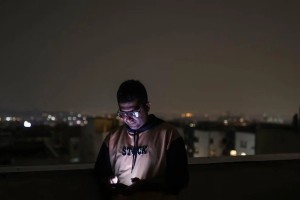
A man walks past clothing stores in Tehran, Iran, amid widespread internet disruptions.
Some Iranians say security bodies blocked their internet or SIM cards over alleged online activity against the Islamic Republic, then demanded pro-government posts, written pledges and guarantors to restore access, according to messages sent to Iran International.
The unsigned notices asked recipients to provide personal details including home and work addresses, bank account information, images of bank cards and links to all their social media accounts.
They were also instructed to sign handwritten pledges not to publish content deemed harmful to the country’s “psychological, social or political security.”
The notices warned that users’ activities were being monitored through “smart surveillance and artificial intelligence systems” and said repeated violations could lead to judicial action and heavier punishment.
Some citizens were further instructed to publish at least 20 posts supporting the Islamic Republic on social media and send evidence that the posts had been uploaded.
Pressure campaigns expand online
The demands mark the latest effort by Iranian authorities to tighten control over online activity following waves of dissent and criticism on social media over the past year.
Recipients were told not to publish all pro-government posts in a single day “to make the activity appear natural,” according to the messages.
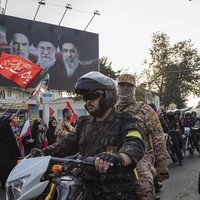
Some were also ordered to attend nighttime government rallies that began after US and Israeli attacks earlier this year and continued after a ceasefire took hold. Participants were instructed to photograph themselves carrying Islamic Republic flags or images of Supreme Leader Ali Khamenei.
In several cases, authorities requested identification documents from a guarantor who would accept responsibility for any future “criminal activity” by the targeted individual.
In August 2025, many Iranians wrote on social media that their SIM cards had been abruptly disconnected without warning or court orders after they published critical posts online, particularly in the aftermath of the 12-day war.
Some said security bodies contacted them through the domestic messaging platform Eitaa and told them to meet a series of demands or report to entities including the Prosecutor’s Office cyber division to regain access.
During those visits, citizens said they were ordered to submit copies of their national ID cards and sign written pledges promising to stop critical online activity.
Similar measures were reported in October 2024, when journalists and political activists said security bodies blocked their SIM cards, forced them to delete posts and ordered them to publish content that contradicted their views.
Businesses across Iran are cutting jobs, scaling back operations and facing possible closure as internet disruptions, inflation and the economic fallout from war deepen pressure on employers and consumers, according to messages sent to Iran International.
A nail and manicure instructor said her business had effectively stopped operating since March last year as customers struggling to cover basic expenses reduced spending on beauty services.
The woman said internet outages had also cut off income from selling online training packages. At the same time, the signal for her point-of-sale payment terminal had been disabled.
Businesses across Iran are cutting jobs, scaling back operations and facing possible closure as internet disruptions, inflation and the economic fallout from war deepen pressure on employers and consumers, according to messages sent to Iran International.
A nail and manicure instructor said her business had effectively stopped operating since March last year as customers struggling to cover basic expenses reduced spending on beauty services.
The woman said internet outages had also cut off income from selling online training packages. At the same time, the signal for her point-of-sale payment terminal had been disabled.
An AI-generated image shows an Iranian nail and manicure instructor works on a client at her salon.
“When I followed up, they told me the signal for payment devices used by ‘non-essential businesses’ had been suspended indefinitely for security reasons,” she told Iran International.
Industrial firms report layoffs, bankruptcies
Messages received by Iran International also pointed to growing unemployment and bankruptcies in industries linked to petrochemicals, ports and construction.
Many workers who lost jobs or faced layoffs said they had turned to ride-hailing services such as Snapp or other unstable work to survive.
One worker in the industrial sector said the price of steel profiles used in construction had more than doubled since before the war, rising from 700,000 rials ($0.38) per kilogram to 1.55 million rials ($0.85).
“Because of these price increases, we’ve been unemployed for three months and can no longer afford raw materials,” he said.
Steel profile prices have risen between 120% and 160% over the past year, according to accounts sent to Iran International.
A cabinet-maker said the price of a single MDF sheet had climbed from 30 million rials ($16.50) last year to between 150 million rials ($82.50) and 170 million rials ($93) this year.
“With raw material costs rising 400% to 470%, continuing the business and paying rent is no longer possible,” he said.
Other citizens previously told Iran International that shortages of iron sheets and petrochemical materials in cities including Isfahan had forced many industrial workshops to close.
Iran International also received reports of layoffs and business slowdowns in ports and logistics hubs.
An employee at Rajaei Port said many workers had been dismissed and those still employed often received salaries late.
“The port has become very quiet,” the worker said.
Rajaei, one of Iran’s main commercial ports, was hit by a major fire in May 2025 after what authorities described as an explosion involving a container carrying hazardous chemicals including sodium perchlorate. The blast killed dozens of people.
Several contractors linked to the port had already faced financial difficulties before the explosion and the subsequent war, according to workers familiar with the situation.
Another resident from Bandar-e Emam wrote that companies linked to the port had reduced staff and struggled to pay wages on time.
Iranian outlet Rouydad24 reported on May 7 that workers at Mobarakeh Steel had seen wages reduced to the official minimum despite earlier assurances that salaries would be paid without disruption following US and Israeli attacks.
The report said many skilled workers had turned to app-based taxi driving for income.
Restaurants squeezed by rising prices
Restaurants and food businesses have also come under pressure from higher prices and weakening consumer demand.
The owner of a fast-food restaurant in Lahijan, north of Iran, said the cost of ingredients changed so rapidly that menu prices had to increase almost daily.
An AI-generated photo shows a fast-food restaurant worker preparing sandwiches at his shop.
“The ingredients for a sandwich sold today for one million rials ($0.55) may cost 1.1 million rials ($0.60) to replace a few days later,” the restaurant owner wrote to Iran International. “Customers are unhappy and we are also being hurt by the situation.”
The decline of the rial had pushed the monthly minimum wage including benefits down to roughly $88 in real terms.
A restaurant owner in Kish said he had already laid off more than 10 employees and now saw closure as the only remaining option.
Customers and business owners also reported sharp increases in fast-food prices, with some sandwiches selling for around five million rials ($2.75) and pizzas reaching 1.2 million rials ($6.60).
Iran's handwoven carpet exports, once worth nearly $2.5 billion annually, have now "virtually stopped," a provincial industry official said, reflecting the steep decline of one of the country's best-known exports.
"At the moment, carpet exports have nearly reached zero," Abdolrahman Tasmim Ghatee, head of the union of handicrafts sellers and handwoven carpet producers in Fars province, told the Iranian Labor News Agency (ILNA), a semi-official labor-focused news outlet.
He said exports, which once stood at close to $2.5 billion, had fallen to less than $50 million in recent years, with little trade now taking place.
Market slump hits producers
Tasmim Ghatee said around 90% of the sector depended on tourism, especially foreign visitors, but international tourism had largely dried up.
"Some shops do not make a single sale during the week because there are simply no buyers," he said. "After paying for food and daily expenses, people have nothing left to spend on decorative goods, handicrafts and carpets."
He said the market downturn had worsened after the war that began in late February between Iran, Israel and the United States, which disrupted trade and deepened economic uncertainty, even as a fragile ceasefire remains in place.
Fighting has largely stopped, but tensions persist amid stalled negotiations between Washington, Tehran and Israel over sanctions, regional security and Iran's nuclear program.
Iranian handwoven carpet exports generated more than $2 billion in revenue in 1994, one of the industry's strongest years, before entering a long decline driven by sanctions, rising competition and weaker global demand.
Exports fell to $69 million in 2019 and just $2 million in the second quarter of 2020, according to customs data and industry reports. By March 2024, exports had dropped to $39.7 million from $426 million in 2017, according to officials cited by ILNA.
Industry figures have blamed US sanctions, trade restrictions, currency rules and stronger competition from India, Turkey, Afghanistan, China and Pakistan for the downturn. The United States, once a major market for Iranian carpets, reimposed restrictions on Iranian rug imports after Washington withdrew from the 2015 nuclear deal in 2018.
Weavers leave the trade
The number of carpet weavers in Fars province has dropped by about 80% from around 6,000 in 2018 to roughly 1,000 now, Tasmim Ghatee said.
"When carpets and handicrafts are not sold, naturally the weaver will not continue working," he said.
He described how rural women could spend six months weaving a carpet while covering raw material costs and household duties, only to find no market for the finished product.
"How can she start again?" he said.
Officials push digital sales
Gholamhossein Zanhari, head of the carpet department at Fars province's industry and trade office, said the sector needed safer export routes and stronger online sales to survive.
He pointed to regional markets including Armenia, Georgia, Oman and Turkey, as well as Japan, South Korea and Singapore, as potential destinations and said platforms such as Etsy and eBay could help producers reach consumers directly.
"Digitalization is not just a sales tool, but a way to maintain business continuity" during crises, he said.
Australia sanctioned seven Iranian individuals and four entities on Tuesday over what it called the Islamic Republic’s crackdown on protesters and women and its destabilizing activity through missile and shadow-banking networks.
The Australian foreign ministry said the measures targeted senior officials and entities involved in violence against women and children, mass arrests, torture, forced confessions, internet restrictions and the wrongful detention of foreign nationals.
It said the sanctions were also aimed at parts of Iran’s shadow banking system, which it said helps fund groups such as Hamas, support Tehran’s ballistic missile program and enable other destabilizing activity.
Among those sanctioned was Interior Minister Eskandar Momeni Kalagari, who Australia said is also deputy commander-in-chief of the Law Enforcement Forces, one of the entities listed over its role in the crackdown.
Australia also sanctioned Ruhollah Momen Nasab, saying he was responsible for deploying 80,000 forces to surveil women and girls in schools, universities, public spaces and online and enforce mandatory hijab rules.
Another listed individual was accused of establishing neighborhood intelligence databases through door-to-door data collection and patrols to identify and punish opponents of the Islamic Republic, while others were sanctioned over the wrongful detention of foreign nationals, the government said.
The sanctioned individuals were Momeni, Momen Nasab, Majid Feiz Jafari, Ghorban Mohammad Valizadeh, Mohsen Ebrahimi, Nasser Zarringhalam and Mansour Zarringhalam.
The listed entities were the Law Enforcement Forces of the Islamic Republic of Iran; Seraj Cyberspace Organization, an IRGC-established cyber outfit accused of recruiting and mobilizing pro-Islamic Republic internet users to spread disinformation and attack opponents online; and the exchange firms Berelian Exchange and GCM Exchange.
“Australia continues to stand with the brave people of Iran against a brutal, oppressive regime,” the government said.
The announcement was made alongside new UK sanctions targeting 12 individuals and entities linked to Iran over what Britain called hostile activity, including plotting attacks and providing financial services to groups seeking to destabilize the United Kingdom.
The United States also imposed sanctions on Monday on three individuals and nine companies accused of helping Iran ship oil to China, while EU foreign policy chief Kaja Kallas said the bloc would expand its Iran sanctions to include those responsible for obstructing freedom of navigation.
Australia said Prime Minister Anthony Albanese’s government has imposed more than 230 sanctions on Iranian individuals and entities, including more than 100 linked to the Islamic Revolutionary Guard Corps.
A Bahraini court sentenced a woman to life in prison after convicting her of communicating with Iran's Revolutionary Guards with intent to carry out hostile acts against the kingdom and harm its national interests, Bahrain's public prosecution said on Tuesday.
The prosecution said the woman used a social media account to post photos and coordinates of key sites and facilities in Bahrain and shared content that harmed the kingdom's military, political and economic standing.
Authorities said the account also promoted what the prosecution described as Iranian attacks against Bahrain.
The woman admitted to the charges during questioning, prosecutors said, adding that she told investigators she used her social media account to assist those targeting Bahrain by sharing images and coordinates of vital sites alongside messages indicating they could be targeted.
The prosecution said the court also ordered the confiscation of seized items. It did not identify the woman or say when the alleged acts took place.
Bahrain-Iran tensions
The ruling comes days after Bahrain said it had arrested 41 people allegedly linked to a group tied to Iran's Islamic Revolutionary Guard Corps and the ideology of Velayat-e Faqih, or Guardianship of the Jurist – the doctrine underpinning the Islamic Republic’s system of clerical rule and giving Iran’s supreme leader ultimate religious and political authority.
Authorities said legal proceedings were underway and investigations were continuing.
Bahrain's Foreign Minister Abdullatif bin Rashid Al Zayani on Saturday accused Tehran of interfering in the kingdom's internal affairs after the arrests, calling it a violation of international law and good neighborly principles. Iran has not publicly responded to the accusations.