• العربية
  • فارسی
Brand
  • Iran Insight
  • Politics
  • Economy
  • Analysis
  • Special Report
  • Opinion
  • Podcast
  • Iran Insight
  • Politics
  • Economy
  • Analysis
  • Special Report
  • Opinion
  • Podcast
  • Theme
  • Language
    • العربية
    • فارسی
  • Iran Insight
  • Politics
  • Economy
  • Analysis
  • Special Report
  • Opinion
  • Podcast
All rights reserved for Volant Media UK Limited
volant media logo
INSIGHT

As Iran’s economy sinks, hardliners turn to conspiracy

Behrouz Turani
Behrouz Turani

Iran International

May 11, 2026, 22:10 GMT+1
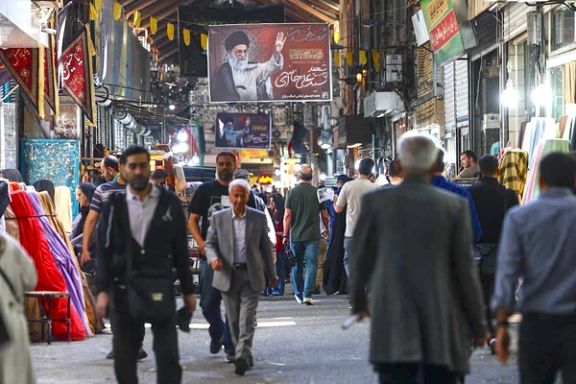
People walk in Tehran's Grand Bazaar, where a banner depicting Iran's slain supreme leader Ali Khamenei hangs above, April 2026

As prices continue to soar across Iran, hardline clerics and pro-government figures are increasingly attempting to shift blame away from the state even as economic pressure deepens for ordinary citizens.

In Mashhad, firebrand Friday prayer leader Ahmad Alamolhoda claimed that “US Army infantry is responsible for rising prices.” He later said the remark was metaphorical, arguing that the war had triggered hyperinflation and that “profiteers and the main culprits behind rising prices are the US army’s infantry.”

Earlier in the week, Hossein Shariatmadari, editor of the hardline daily Kayhan, wrote that “rising prices and hoarding are the products of the enemy’s infiltration in the government.”

While Iran’s armed forces were “working miracles,” he argued, the economy had been left undefended, allowing enemies to undermine battlefield gains.

Shariatmadari, who for decades attacked previous administrations over inflation and economic mismanagement, remained notably quiet during the ultraconservative governments of Mahmoud Ahmadinejad and Ebrahim Raisi.

In 2024, he claimed rising prices had “nothing to do with the performance of the government or parliament,” describing inflation as part of a foreign conspiracy.

Last week, he questioned why parliament had stopped monitoring the government’s performance. Days later, lawmakers held an online session with Agriculture Minister Gholamreza Nouri Ghezeljeh to discuss food prices, a move widely mocked in Iranian media as ineffective and detached from public hardship.

While Alamolhoda urged Iranians to embrace a vague “jihadist economy,” Shariatmadari called on officials to confront an unspecified “economic mafia.”

Moderate outlets, however, framed the crisis differently. The daily Arman Melli argued on Sunday that the latest surge in prices could not be explained solely by wartime conditions, pointing instead to years of structural economic problems, rising state expenditures and populist policymaking.

The paper also called for “effective use of diplomacy” to end the conflict while safeguarding national interests, arguing that renewed negotiations could help stabilize the economy.

The reformist website Rouydad24 described a society undergoing “economic and psychological erosion,” where inflation was no longer an abstract statistic but a daily reality.

Families were removing meat from their diets, patients cutting medication in half and tenants being pushed toward cheaper outskirts of major cities.

Economic newspapers described parliament’s online session as “a bitter confession” that authorities were losing control of the situation, reflected in shrinking household budgets, disappearing essentials and rising public anxiety.

Despite government claims of wage increases of up to 60 percent for workers, many public employees say they have not received the raises. Unemployment is rising, layoffs are spreading and businesses are shutting down, while temporary contracts leave many workers with little protection against dismissal.

Iranian media now report complaints about living costs even among government supporters attending nightly demonstrations. Families that once lived modest but stable lives increasingly struggle to afford housing, medical treatment, tuition and other basic necessities.

Many workers say they are still earning salaries set years ago in an economy where prices change almost daily, leaving much of Iran’s working and middle classes crushed by relentless inflation.

Most Viewed

Netanyahu says Iran regime change ‘possible, not guaranteed’
1

Netanyahu says Iran regime change ‘possible, not guaranteed’

2
ANALYSIS

The strange stability between Tehran and the Taliban

3
TEHRAN INSIDER

Tehran’s youth emerge from war more cynical, not more hopeful

4

Drug prices jump up to 400% as shortages strain Iranian pharmacies

5

Iran steps up crackdown on Baha’is with raids, arrests

Banner
Banner

Spotlight

  • As Iran’s economy sinks, hardliners turn to conspiracy
    INSIGHT

    As Iran’s economy sinks, hardliners turn to conspiracy

  • Iranians describe toll of 70 days of internet restrictions
    VOICES FROM IRAN

    Iranians describe toll of 70 days of internet restrictions

  • The strange stability between Tehran and the Taliban
    ANALYSIS

    The strange stability between Tehran and the Taliban

  •  Tehran’s youth emerge from war more cynical, not more hopeful
    TEHRAN INSIDER

    Tehran’s youth emerge from war more cynical, not more hopeful

  • Iran-UAE breakdown leaves Iranian expats in limbo
    INSIGHT

    Iran-UAE breakdown leaves Iranian expats in limbo

  • Canada’s Middle East role: From Pearson’s legacy to passive diplomacy
    ANALYSIS

    Canada’s Middle East role: From Pearson’s legacy to passive diplomacy

•
•
•

More Stories

Drug prices jump up to 400% as shortages strain Iranian pharmacies

May 10, 2026, 08:35 GMT+1

Prices for some medicines in Iran have surged by as much as 400% and pharmacies are struggling to supply critical drugs to patients, a pharmacists’ association official said on Sunday.

Mehdi Zahmatkesh, head of the Pharmacists Association in Razavi Khorasan province, told the state news agency IRNA that shortages were affecting medications for cancer, MS, dialysis, transplant, hemophilia, cardiac, respiratory and psychiatric patients.

“We have faced price increases ranging from 20% to 400% for some medicines,” Zahmatkesh said, attributing the worsening crisis to the removal of subsidized foreign currency and damage caused by the recent war.

The remarks add to growing signs of strain in Iran’s healthcare sector, where citizens and pharmacists have increasingly reported difficulties obtaining essential medication.

Pharmacies struggle with unpaid insurance claims

Pharmacies, Zahmatkesh said, were also facing severe liquidity problems because insurance providers had failed to pay outstanding debts worth between 500 billion and four trillion rials (between $283,000 and $2.26 million).

  • Drug shortages, price surge hit patients across Iran

    Drug shortages, price surge hit patients across Iran

“With the sharp increase in medicine prices and delayed payments from insurers, pharmacies are facing difficulties supplying medicine for hard-to-treat patients,” he said.

Zahmatkesh urged insurance organizations to settle pharmacy claims within the legally mandated 45-day period so pharmacies can maintain enough cash flow to purchase medicine.

The official’s comments came days after Etemad newspaper quoted Iranian Pharmacists Association spokesman Hadi Ahmadi as saying medicine prices had increased between 30% and 300%.

Ahmadi linked the surge to shrinking government resources for subsidies and reduced capacity to support medicine production and imports.

Customers wait inside a pharmacy in Iran amid rising medicine prices and shortages of some drugs across the country.
100%
Customers wait inside a pharmacy in Iran amid rising medicine prices and shortages of some drugs across the country.

Citizens report worsening shortages

In recent weeks, citizens have sent messages to Iran International describing worsening shortages, steep price increases and growing financial hardship.

“Medicine is impossible to find,” one citizen told Iran International. “After searching through 100 pharmacies, even if we find the drug we need, we have to buy it at full price because insurers haven’t paid pharmacies. It’s a disaster.”

Reports received by Iran International also point to rising shortages of psychiatric medication, with some patients and pharmacy workers saying people have been forced to stop or alter treatment because drugs are unavailable or unaffordable.

  • Soaring prices push medicine beyond Iranians' reach

    Soaring prices push medicine beyond Iranians' reach

The latest complaints come as Iran continues to face high inflation, a weakening currency and deepening economic stagnation that have sharply increased living costs for many households.

Healthcare costs weigh on low-income families

Zahmatkesh called for broader insurance coverage to reduce the burden of healthcare costs on patients, particularly low-income families already struggling with inflation and declining purchasing power.

Despite a 45% increase in the minimum wage this year, according to Etemad, the sharp fall in the value of the rial has made treatment costs increasingly unaffordable for poorer households.

Iran-UAE breakdown leaves Iranian expats in limbo

May 9, 2026, 06:01 GMT+1
•
Maryam Sinaiee

The war has pushed relations between Iran and the United Arab Emirates close to rupture, disrupting one of the region’s most important commercial relationships and leaving ordinary Iranians who built lives and businesses caught in the fallout.

Hundreds of thousands of Iranians who built lives and businesses in the UAE now face visa cancellations, frozen finances and mounting uncertainty as relations between Tehran and Abu Dhabi deteriorate.

According to several affected residents, Iranian nationals who left the UAE during the recent conflict—whether for Iran or third countries—are no longer being allowed to return, even to collect their belongings. In some cases, families still inside the Emirates have reportedly been given only weeks to leave.

Many Iranian residents say they have also been instructed to transfer funds abroad and are increasingly unable to use UAE bank accounts.

While properties and businesses have not formally been confiscated, some owners can no longer manage them directly and must rely on proxies or powers of attorney to sell assets.

Foreign companies operating in the UAE are also becoming increasingly reluctant to deal with Iranian individuals or firms, particularly those connected to trade with Iran. Many export orders involving Iran have reportedly been canceled.

“No one knows what tomorrow will bring”

Reza, a 40-year-old Iranian who has lived in Dubai with his wife for more than eight years, said Iranians still inside the UAE have not yet been deported but remain under constant pressure.

“For now, our residency status in Dubai has not changed,” he said. “But my friends say Sharjah, Abu Dhabi and other emirates are cancelling visas even for Iranians who are still inside the country.”

Reza said he and his wife, a physician, have effectively lost their livelihoods despite retaining residency permits. His wife’s hospital declined to renew her contract, while his own import-export business has ground to a halt.

“My situation is very unclear,” he said. “No one knows what tomorrow will bring.”

He added that although his company’s licence has not officially been revoked, it can no longer function because trade involving Iran has effectively stopped.

“With work permits cancelled, people can no longer use their own assets,” he said. “A food wholesaler’s store has been shut down and, because he no longer has a business licence, he cannot even sell the goods sitting in his warehouse.”

According to Reza, the pressure is even greater on intermediaries accused of helping Iran circumvent sanctions by selling oil or moving funds abroad. He said many have already been expelled from the UAE and had their bank accounts frozen.

A critical trade relationship disrupted

For years, Dubai, particularly Jebel Ali port, served as one of Iran’s most important commercial gateways, handling a large share of Iranian imports and transit trade. The UAE was often Iran’s largest or second-largest trading partner after China.

That trade route now appears severely disrupted amid rising regional tensions and what Iranian media describe as a tightening maritime blockade.

The UAE said Friday it had intercepted new missile and drone attacks allegedly launched from Iran, adding that three residents were injured.

Earlier this week, Iran’s Khatam al-Anbiya Central Headquarters denied carrying out attacks on the UAE but warned that any operation launched from Emirati territory against Iranian islands, ports or coastlines would receive a “crushing and regret-inducing response.”

Iranian media have meanwhile intensified criticism of Abu Dhabi. Jam-e Jam newspaper described the alleged seizure of Iranian assets as “modern-day robbery and open hostility,” while Abolfazl Khaki of Iran’s Chamber of Commerce accused the UAE of showing “maximum hostility” toward Iranian traders during the recent conflict.

“The recent experience showed that the UAE is no longer a safe place for Iranian investors,” Khaki said.

Iranian officials are now openly discussing alternative trade hubs. Nadir Pourparcham of Iran’s Chamber of Commerce said trade ties with the UAE “will never return to the way they were” and pointed to Qatar’s Hamad Port as a possible replacement. Iranian media have also promoted Pakistan’s ports as alternative corridors for Iranian trade.

The conservative outlet Mashregh News argued that Iran no longer needed “unreliable intermediaries” such as the UAE and said closer ties with China and Pakistan could help Tehran withstand economic pressure.

“It is time for Dubai to understand that Iran’s geography is not for sale,” the outlet wrote.

Iran runs dry as Islamic Republic funds ideology and foreign proxies

May 8, 2026, 19:26 GMT+1
•
Mohammad Nayeb Yazdi, Mehdi Ketabchy, Saeed Ghasseminejad

Iran’s water crisis is not only about scarcity or drought. It is also about where the Islamic Republic chooses to spend the country’s money, and what it leaves unfunded at home.

In a system where political and ideological objectives consistently outweigh environmental sustainability and public welfare, even severe and widely recognized crises fail to trigger meaningful correction.

In this sense, Iran’s water crisis is not a failure of resources, it is a consequence of deliberate choices. The impact of decades of misguided water engineering and policy decisions is already visible across Iran’s water systems.

Major lakes and wetlands such as Urmia Lake have shrunk. Groundwater has been depleted across more than half of the country’s plains, land subsidence is accelerating, and per capita water availability has fallen to near or below 1,000 cubic meters.

At the same time, access to reliable drinking water has become increasingly uncertain. Water quality is declining because of inadequate wastewater treatment and aging infrastructure, while policy still emphasizes large-scale agricultural self-sufficiency despite mounting environmental constraints.

It would be easy to assume that these failures could stem partially from financial limitations. But this is not a story of absolute constraint. Even under sanctions, Iran has continued to generate substantial revenues, particularly from oil exports, over the past decade.

The water crisis is not necessarily due to a lack of resources, but how those resources are allocated. Based on Iran’s FY1404 (2025-2026) public budget, significant funding is still directed toward religious and ideological institutions, amounting to roughly $750 to $860 million annually, depending on exchange rates.

At the same time, Iran’s regional activities, including support for groups such as Hezbollah, Hamas, Palestinian Islamic Jihad, the Houthis, and allied militias, are widely estimated, based on publicly reported figures, to cost an additional $1.1 to $1.5 billion each year.

These estimates reflect direct financial transfers and likely understate total support, which also includes substantial non-cash assistance such as weapons, equipment, and logistical backing.

In total, nearly $1.8 to $2.4 billion per year is allocated to priorities that do little to address Iran’s most urgent domestic challenges. Even redirecting a portion of these resources toward water management and infrastructure could support large-scale, practical solutions. Over a five-year period, such a shift would mobilize roughly $10 billion, enough to move beyond short-term fixes and begin addressing some of the structural drivers of Iran’s water crisis.

Based on order-of-magnitude cost benchmarks for standard water infrastructure projects, a reallocation of roughly $10 billion over five years could finance a coherent national water program. This would include a full-scale effort to reduce water losses in Tehran’s aging distribution network, where non-revenue water (NRW), water lost before it reaches consumers due to leaks, aging infrastructure, and inefficiencies is estimated at roughly 25 to 30 percent.

It could also support the deployment of potable reuse facilities across major urban centers such as Tehran, Mashhad, Isfahan, Shiraz, Yazd, and Ahvaz, helping relieve pressure on overstretched freshwater supplies.

In parallel, a targeted desalination and conveyance package could be implemented for Sistan and Baluchestan province, designed specifically to secure drinking water in a region facing chronic shortages, rather than to support inland agriculture.

Such an investment could also enable the construction of dozens of wastewater treatment plants nationwide, depending on facility size and treatment level, addressing both water quality degradation and reuse potential in regions struggling with untreated discharge.

Beyond urban infrastructure, even limited investments in agriculture could deliver measurable benefits. For example, modernizing irrigation in a single province such as Isfahan, where more efficient systems can reduce water use by roughly 30 to 60 percent, could significantly lower demand in one of Iran’s most water-stressed regions.

Even at the current economic development and growth, over a five-year period, roughly $10 billion directed toward ideological priorities could instead finance a nationwide water recovery program: upgrading Tehran’s water distribution system to reduce losses, building 10 potable reuse facilities for major cities, developing seven coastal desalination plants for southern Iran, and constructing a strategic water transfer system to Zahedan in Sistan and Baluchestan.

It could also fund eight large wastewater treatment plants, dozens of mid-size facilities across the country, and modernize irrigation in Isfahan. Instead, those resources are being directed elsewhere. Now imagine how the country’s water infrastructure can be overhauled if the regime is gone and Iran is back on the path to growth and prosperity, with access to the latest technologies the world has to offer, to tackle this issue.

These figures are illustrative, not precise. They highlight both Iran’s potential capacity to invest in water infrastructure and the scale of resources currently misallocated, without even accounting for additional spending on missile programs, and nuclear development, which further underscores the magnitude of available resources.

Ultimately, the constraint is neither technical nor financial: it is political. As long as the current regime remains in power, resources that could stabilize and modernize Iran’s water systems will continue to be diverted toward non-productive ideological ends.

Ghalibaf pushes for the role many thought he already had

May 8, 2026, 18:00 GMT+1
•
Behrouz Turani

Parliament Speaker Mohammad Bagher Ghalibaf appears to be trying to solidify his position inside Iran’s fractured post-war leadership after recent weeks exposed the limits of assumptions that he had effectively emerged as the country’s de facto ruler.

In an audio message published on May 6, Ghalibaf laid out five requests directed at Iranians at home and abroad, framing austerity, solidarity and public mobilization as essential to surviving what he described as one of the most critical periods in Iran’s contemporary history.

The intervention marked Ghalibaf’s clearest political re-emergence after a period in which hardline factions appeared to sideline him despite his elevated wartime profile.

Ghalibaf rose to prominence during the 12-day war with Israel and the United States in 2025, when he was widely seen as one of slain supreme leader Ali Khamenei’s most trusted political figures.

After Khamenei’s death, he headed Iran’s delegation in the Islamabad talks with the United States — perhaps the clearest sign yet of his standing within the new order.

Repeated remarks by President Donald Trump hinting at regime change in Iran and suggesting that a figure from inside the system could ultimately emerge reinforced speculation abroad that Ghalibaf might become the face of a post-Khamenei transition.

But his position soon appeared less secure. Hardline critics accused him of weakness in negotiations and insufficient resistance to Western pressure, and for a period he largely retreated from public view before gradually re-emerging.

In the May 6 message, Ghalibaf urged Iranians to recognize that the country was engaged in “one of the biggest wars in Iran’s contemporary history,” arguing that enduring hardship was necessary to secure a strategic victory.

His central appeal focused on austerity, with Ghalibaf calling saving and reduced consumption “the missile the people can fire at the heart of the enemy.”

He also called for reviving mutual-aid networks similar to those formed during the COVID-19 pandemic and urged the Basij militia to return to what he described as its historic role as a neighborhood-based problem-solving force helping citizens navigate daily hardships.

The appeal contrasted sharply with the Basij’s prominent role in suppressing protests during the 2022 Women, Life, Freedom movement and the unrest of January 2026.

Ghalibaf’s final request targeted Iranians professionals and experts abroad, whom he urged to contribute ideas and resources to help manage wartime economic pressures. He encouraged expatriates not to wait for official outreach but to “force officials” to use their capabilities.

The appeal quickly drew criticism from some Iranians overseas, with users on social media arguing authorities could not simultaneously seek help from expatriates while hardliners continued threatening confiscation of assets and punitive measures against critics abroad.

Ghalibaf’s remarks came amid broader calls from establishment figures for the government to repair its relationship with the public after months of unrest, war and economic pressure.

Former government spokesman Ali Rabiei and centrist politician Mohammad Atrianfar, both former intelligence officials, have argued in recent days that the state must first reconcile with its own citizens before it can stabilize the country externally.

In an interview with Khabar Online, Atrianfar warned that failing to respond seriously to public demands risked further erosion of public trust and legitimacy, pointing specifically to internet restrictions and communication controls as symbols of the widening gap between the state and society.

The comments reflect growing concern within parts of Iran’s political establishment that war, economic hardship and repeated crackdowns have deepened public alienation, forcing even longtime insiders to speak increasingly openly about the system’s legitimacy crisis.

Work equipment shortages squeeze Iranian livelihoods

May 8, 2026, 11:33 GMT+1

Rising fertilizer prices and shortages of basic work equipment are squeezing Iranian farmers, laborers and small business owners as inflation, unemployment and falling purchasing power deepen during the fragile ceasefire.

Information received by Iran International points to growing financial pressure across sectors including agriculture, fishing, retail and manufacturing after weeks of disruption linked to conflict, internet shutdowns and trade uncertainty.

The price of potassium fertilizer for a 50-kilogram sack has increased tenfold compared to last year, reaching about 70 million rials (around $40), one farmer told Iran International.

Rice farmers typically require around six sacks of fertilizer per hectare, sharply increasing cultivation costs at a time when many already struggle with falling incomes.

  • Iran taps reserves again as inflation bites and layoffs mount

    Iran taps reserves again as inflation bites and layoffs mount

The farmer added that urea fertilizer prices have also risen severalfold in recent months.

Mehdi Hosseinizadeh, head of Iran’s Association of Pesticide and Fertilizer Importers, linked the increase in fertilizer prices on Thursday to damage suffered by some petrochemical facilities during the war and shipping disruptions through the Strait of Hormuz.

Hosseinizadeh also cited rising import costs, shortages in global fertilizer markets, difficulties securing supplies from China and India, and problems related to currency allocation and import registration.

Another farmer had earlier told Iran International that the price of drip irrigation tape rose from 4 million rials ($2.25) to 30 million ($17), while fertilizer costs climbed from 8 million rials ($4.5) to more than 100 million ($57).

Drip irrigation tape is a thin polymer tube used in irrigation systems to deliver water gradually to plant roots and reduce water consumption in row crops.

Workers report layoffs and business closures

Citizens from several provinces described worsening conditions for workers and tradespeople during the ceasefire period following the conflict.

A fisherman from Qeshm island said he had been unemployed for several months and that falling prices for export fish had increased pressure on local fishermen.

Another resident from Sarbandar, Khuzestan province, described rising unemployment among port workers and shrinking household incomes.

  • Iran’s labor market cracking under layoffs and inflation

    Iran’s labor market cracking under layoffs and inflation

“Everything I earn goes toward rent, transportation and a small amount of food,” the resident said.

Several citizens had previously told Iran International they were selling household goods, work tools and personal belongings to cover food and basic living expenses after losing jobs and income.

One former worker from Tehran said he had been unemployed for nearly three months after beginning work in the electrical equipment market.

“My financial situation has deteriorated sharply and daily life has become difficult to endure,” he said.

A florist from Arak said the prices of supplies including paper, glue, ribbons, boxes and floral foam had quadrupled over the past two months.

Residents in Kashan also described carpet factories shutting down and laying off workers.

Shopkeepers in several parts of Tehran, also reported widespread business closures.