US president Donald Trump speaks to reporters in Washington D.C., May 18, 2026
President Donald Trump’s claim that he postponed a planned military strike on Iran has deepened uncertainty in Tehran, where officials and analysts remain divided over whether Washington is bluffing, buying time or preparing for another round of strikes.
Trump said Monday he had postponed an attack planned for Tuesday, before warning the United States remained ready to hit Iran hard.
Kazem Gharibabadi, Iran’s deputy foreign minister for legal and international affairs, wrote on X that “the United States says it has temporarily halted an attack on Iran to give diplomacy a chance, while simultaneously speaking of readiness for a large-scale strike at any moment. This means calling a threat an opportunity for peace.”
He added that the Islamic Republic was prepared to confront “any military aggression” and that “surrender has no meaning” for Iran.
Mohsen Rezaei, an adviser to Iran’s supreme leader and former commander of the Revolutionary Guards (IRGC), accused Trump of setting and then canceling military deadlines in an attempt to force Iran into submission. He warned that Iran’s armed forces would “force America into retreat and surrender.”
Gharibabadi later told members of parliament that Iran’s latest proposal to Washington included demands such as recognition of Iran’s right to uranium enrichment, lifting the US naval blockade, releasing frozen Iranian assets and ending sanctions. He did not provide details about Washington’s response.
Iranian digital outlet Avash Media cited “a source close to the negotiating team” as claiming that Washington had accepted some Iranian conditions, including ending regional conflicts and establishing a reconstruction fund.
On Tuesday, Vice President JD Vance said Washington and Tehran had made “a lot of progress” in talks and that neither side wanted to see a return to war.
Jalal Sadatian, a regional affairs analyst, told the website Fararu that the comments should be viewed “within the framework of the current Iran-US relationship, which is in a phase marked by political attrition and pressure tactics.”
“There is a perception in Tehran that the United States, for now, is using military threats more for political leverage than because it is truly ready for war,” he said.
“Tehran’s calculation is that if it makes major concessions now under maximum pressure, this model could later expand to issues such as missile capabilities and regional influence,” Sadatian added. “Therefore, Iran’s current policy is a combination of restraint, maintaining readiness and continuing protracted negotiations.”
Reformist journalist Ahmad Zeidabadi questioned Trump’s credibility, writing that if the US president’s account was accurate, then “one must seriously doubt the minimum level of rational calculation in him.”
“Does Trump not know what historic catastrophe restarting the war would bring to the entire Persian Gulf region?” Zeidabadi asked. “Was he planning to resume war without consulting allied leaders?”
Still, several analysts and conservative media outlets warned that the possibility of military escalation remains high.
The conservative newspaper Khorasan, which is close to parliament speaker Mohammad Bagher Ghalibaf, argued that Washington may seek to “unlock negotiations through a limited but effective strike.”
Ehsan Movahedian, a professor of international relations at Allameh Tabataba’i University, told Fararu that “the probability of war in the coming days is very high,” adding that even if conflict does not erupt next week, “that does not mean the danger has disappeared.”
Some Iranian political and media figures argued that the postponement may have had little to do with regional interventions and more to do with operational difficulties.
Ali Gholhaki, a commentator close to Ghalibaf, wrote that “the reason for delaying the attack on Iran appears to be something other than requests from Arab leaders; the United States and Israel are still not certain they can strike their key targets.”
Journalist Davoud Modarresian suggested Pakistani Interior Minister Mohsin Naqvi’s extended visit to Iran could be linked to intelligence-gathering efforts.
“Under the pretext of sending messages, they may be trying to track and identify the locations of leaders and commanders,” he wrote.
The competing narratives surrounding the latest US-Iran standoff have become so stark that even basic questions—who is deterring whom, who wants talks and who fears escalation—now produce entirely different answers depending on which capital is speaking.
On Tuesday, Trump again underscored the volatility of the standoff, saying the United States “may have to give them another big hit” and claiming Tehran was “begging” for a deal.
Khabar Online journalist Mohammad Aref Moezzi described the current dynamic as a familiar “neither war nor peace” scenario: sustained pressure and confrontation without a clear decision to escalate into full conflict or pursue a comprehensive agreement.
Both sides, he argued, still believe they can force concessions without paying the cost of war.
People walk by an anti-US mural in Tehran, Iran, May 18, 2026
The competing narratives surrounding the latest US-Iran standoff have become so stark that even basic questions—who is deterring whom, who wants talks and who fears escalation—now produce entirely different answers depending on which capital is speaking.
On Monday, President Donald Trump said he had halted plans to attack Iran following requests from Qatar, Saudi Arabia, the UAE “and some others in the region.”
The same day, Iran’s state television claimed Trump had backed down from threatening military action “at least five times in recent weeks” because he feared Iran’s “firm response.”
On Tuesday, Trump again underscored the volatility of the standoff, saying the United States “may have to give them another big hit” and claiming Tehran was “begging” for a deal.
Rahman Ghahramanpour, a Middle East politics expert, told Tehran-based Khabar Online that both Tehran and Washington increasingly see the confrontation as a “competition over resilience,” with each believing renewed brinkmanship could strengthen its negotiating position.
Khabar Online journalist Mohammad Aref Moezzi described the current dynamic as a familiar “neither war nor peace” scenario: sustained pressure and confrontation without a clear decision to escalate into full conflict or pursue a comprehensive agreement.
Both sides, he argued, still believe they can force concessions without paying the cost of war.
For Iran’s leadership, the overriding objective remains survival and persuading Washington to abandon any notion of regime change.
Ghahramanpour argues that Tehran is trapped in a struggle for survival while Washington faces what he calls a “credibility trap.” The United States wants a visible strategic victory; the Islamic Republic increasingly treats simple endurance as success.
Despite striking numerous military targets in Iran, Washington has yet to achieve a major political breakthrough. In the United States, particularly amid partisan rivalries, that is often framed as a failure for Trump. In Iran, the same reality is presented as proof the Islamic Republic withstood American pressure.
He also noted that many in Israel believe Trump’s presidency may represent the best opportunity to secure full US cooperation against Iran, adding to pressure for a more decisive confrontation before political circumstances change.
The widening gap between Iranian and American perceptions has effectively frozen negotiations.
Although some hardliners in Tehran advocate pre-emptive action, the government appears unwilling to be seen as the side that starts a war.
Washington, meanwhile, continues tightening sanctions and maintaining pressure while also signaling that military action remains an option if diplomacy stalls.
Another Iranian scholar, Ali Asghar Zargar, told Fararu on Tuesday that neither side benefits from the current deadlock.
He described the standoff as a mix of attrition, geopolitical rivalry and competing political narratives in which Iran remains under heavy pressure while the United States has yet to achieve its core objectives.
Zargar also argued that Washington cannot realistically use the Strait of Hormuz as a unilateral pressure tool given the global dependence on the waterway, warning that the longer the impasse continues, the greater the risk of escalation or miscalculation.
What increasingly unites both Iranian and American analysts is the sense that the current stalemate may be unstable, and that neither side has yet found a credible path out of it.
File photo shows workers toil on the 2Africa undersea cable project carried out by France’s Alcatel Submarine Networks in Amanzimtoti, South Africa on Feb. 7, 2023.
Long viewed as merely an oil chokepoint, the Strait of Hormuz is now emerging as a digital flashpoint, after Iran floated “protection fees” for subsea fiber-optic cables crossing the waterway in a move experts warn could give Tehran new leverage.
Ebrahim Zolfaghari, spokesperson for Iran's military command center, wrote on X last week: “We will impose tolls on internet cables.”
Media outlets close to the IRGC have also said companies such as Google, Microsoft, Meta and Amazon must comply with the Islamic Republic’s laws, and that cable-owning companies must pay permit fees for cables to pass through.
Subsea cables carry the overwhelming majority of the global internet and financial traffic, connecting Europe, Asia and the Persian Gulf through a vast underwater network that powers everything from banking systems and cloud computing to government communications and energy markets.
The risk is no longer theoretical. Alcatel Submarine Networks, the world’s largest cable-laying company, has already paused subsea cable repair operations in the Persian Gulf after issuing force majeure notices tied to growing security risks in the region.
“The undersea network of undersea cables, it's not just important, it’s absolutely critical – trillions of dollars of financial transactions take place through these cables,” said Tom Sharpe, who served 27 years as a Royal Navy officer commanding four warships.
“It’s the internet, which of course if enough of that collapses can have a devastating effect," he said.
While these networks are global, experts say the Persian Gulf is uniquely vulnerable because there are fewer redundant cable routes compared to regions like the Atlantic.
“When you go to other places in the world, let’s say the [Persian] Gulf, there are far fewer, and therefore that redundancy becomes less and less, and therefore the vulnerability goes up,” Sharpe explained.
Iranian lawmakers discussed plans last week that could target submarine cables linking Persian Gulf littoral states to Europe and Asia. Iranian state-linked media have also floated proposals requiring foreign operators to comply with Iranian licensing laws and pay fees for maintenance and repair access.
The proposals appear to be part of a broader effort by Iranian hardliners to test how far Tehran can extend its authority over infrastructure crossing the Persian Gulf, even when that infrastructure is privately owned or tied to foreign governments.
Escalate, test, adjust
Sharpe believes Tehran is following a familiar escalation model — gradually testing international reactions before potentially taking more aggressive steps.
“I think, look, it seems to me at the moment we’re in the sort of inject uncertainty phase. Let’s see what the markets do. Let’s see how the companies react. Let’s see what insurers do,” Sharpe said. “They escalate. They test. They adjust.”
According to Sharpe, the strategy mirrors tactics previously employed by Russia around undersea infrastructure and later adapted by the Houthis in the Red Sea.
“They’re very good at escalation management,” he added. “They don’t go straight to the nuclear option and start just snipping cables.”
Charlie Brown, Senior Advisor at United Against Nuclear Iran, who specializes in maritime sanctions enforcement and the tracking of illicit shipping, said the issue extends far beyond internet access alone because submarine cables often cross multiple jurisdictions and are owned by consortiums involving companies and governments from around the world.
“This goes beyond merely the cable itself and the data on it,” Brown told Iran International. “These are cross-jurisdictional issues that affect many people in many different jurisdictions.”
New toll booth under the sea
Brown described the Islamic Republic’s approach as resembling a mafia-style protection racket aimed at controlling — rather than immediately destroying — critical underwater infrastructure.
“Yeah, it’s very interesting. I mean, so this ends up showing that it’s a money-making racket threatening. So it’s basically a gangster move,” Brown said.
“The IRGC is trying to extend their control to include things on the seabed that don’t belong to them,” he added.
Experts say global internet infrastructure has enough redundancy to prevent a total communications collapse, but warn the bigger risk is the normalization of payments to Tehran.
Max Meizlish, Senior Research Analyst for the Center on Economic and Financial Power at Foundation for Defense of Democracies, sees the cable issue as an extension of Iran’s broader attempts to exert control over the Strait of Hormuz.
“I think that this is just another instance of the Iranian regime putting in place essentially a shakedown in the strait,” Meizlish said.
Since the war began, he said, hardline factions within the Islamic Revolutionary Guard Corps (IRGC) have increasingly pushed to expand Tehran’s leverage over both maritime and digital chokepoints.
“We see slowly Iran extending its sphere of influence,” Meizlish said. “The IRGC hardliners want to come out of this conflict actually from a position of relative strength.”
A warning to Washington
Much of what happens next may ultimately depend on enforcement. Existing US sanctions prohibit dealings with the IRGC, meaning companies that pay such fees could expose themselves to secondary sanctions.
But if enforcement weakens, Meizlish warns, firms may gradually begin viewing payments to Tehran as simply another cost of operating in the region.
“Already it’s come out within the shipping sector,” Meizlish told Iran International. “Some ships have made these payments. We’ve seen traffic go through the Tehran toll booth.”
“If the US doesn’t step up pressure and actually actively enforce these sanctions, then some firms will determine that maybe in their risk-based approach, they can go ahead and do this,” he said.
Iran’s state broadcaster is facing criticism after airing programs in which presenters and government supporters handled rifles and other weapons on camera, with critics saying the displays blurred wartime messaging with intimidation at home.
Iranian state television channels have in recent days broadcast multiple programs featuring members of the Revolutionary Guards (IRGC), often with their faces covered, demonstrating the use of light and heavier weapons.
The televised demonstrations included Kalashnikov rifles, PK machine guns and shoulder-fired RPG launchers.
The channels also showed footage of women, men, teenagers and young people learning how to use and disassemble weapons in mosques and nighttime gatherings organized by government supporters.
Participants shown in the broadcasts said they had volunteered “to defend the country” and “the system.”
One of the most criticized broadcasts aired on Ofogh TV under the title “War Headquarters.”
In the program, after receiving instruction from an IRGC member, the presenter pointed a weapon toward an image displaying the flag of the United Arab Emirates and fired at it.
Relations between Iran and the UAE, long one of Iran’s largest trading partners, have sharply deteriorated following the recent regional conflict.
Reports indicate that the UAE has expelled many Iranian nationals in recent months.
The reformist newspaper Sazandegi wrote: “Shooting at the flag of a neighboring country has left public opinion shocked and astonished.”
A reader commenting on the Rouydad24 news website wrote: “Television presenters firing at the UAE flag on state TV have handed Iran’s enemies a perfect excuse for Iranophobia. Perhaps the shooting segment itself was orchestrated by infiltrators or a fifth column.”
In another televised segment, an IRGC member demonstrated shooting techniques using an unloaded Kalashnikov while aiming at an image of Israeli Prime Minister Benjamin Netanyahu displayed on a studio wall.
After him, the presenter pointed the weapon toward the forehead of US President Donald Trump and said: “I hope these bullets will one day hit their target.”
State broadcaster defends the programs
Officials from Iran’s state broadcasting organization, IRIB, defended the scenes.
Mohsen Bormahani, deputy head of IRIB, told the IRGC-affiliated Tasnim News Agency: “In wartime conditions, and in a country simultaneously engaged in struggle against all the powers and oppression in the world, it is natural for the national media to adopt a wartime posture.”
Bormahani said familiarizing young people and the general public with weapons helped them “become acquainted with the concepts of jihad, resistance, and defense, and strengthen their sense of responsibility and readiness within the framework of religious, cultural, Iranian, and Islamic values.”
He said the appearance of television hosts carrying weapons served as “a reminder of these teachings to the public.”
Hassan Abedini, political deputy of IRIB, separately told Mehr News Agency that the displays were symbolic and intended to project military readiness among government-backed war volunteers.
Media criticism and public anxiety
Several Iranian media outlets sharply criticized the broadcasts and warned that they could create widespread feelings of insecurity.
Rouydad24 wrote: “Broadcasting weapons training on television, in a country that already has an army, the IRGC, security forces, the Basij, and millions of men with mandatory military training, raises a troubling question more than it demonstrates ‘strength’: who exactly are these training programs intended for, and what situation are people being prepared for?”
The outlet added: “If the country’s official television suddenly starts teaching the general public how to use weapons, the question arises whether such an action unintentionally conveys the message that the official guarantors of security are no longer sufficient.”
Rouydad24 warned that the broadcasts presented “a future in which ordinary citizens must prepare themselves for the collapse of order – a situation where weapons have left the barracks and people are forced to defend their homes and streets themselves. This is precisely the image governments usually try never to convey to society.”
The conservative news website Khabar Online also criticized the broadcaster, writing that IRIB may have intended to signal to foreign enemies that “all segments of the nation are ready for battle,” or to project unity at home.
But it said media experts viewed the approach as poor judgment.
Warnings about psychological harm
Khabar Online warned that the broadcasts reproduced “guerrilla and paramilitary imagery that belongs in barracks, not on national television.”
It added: “Seeing a television presenter holding an assault rifle not only fails to create a sense of security, but also intensifies feelings of insecurity, anxiety, and war trauma among the public, especially children and vulnerable groups.”
The reformist newspaper Sazandegi also warned that the episode had raised serious concerns for the psychological security of society and the country’s international image.
It wrote: “Promoting militarism in general television programming creates a tense and anxious atmosphere in society. The proper place for displays of military power is training grounds and official parades, not the live studio of a nationwide television channel with a cultural and social mission.”
Critics see message to opponents
Some critics said the televised weapons displays appeared aimed less at a foreign enemy than at political opponents inside the country, amid growing public frustration and economic strain.
Iranian sociologist Hossein Ghazian told Iran International that the broadcasts symbolized political repression and were intended to pressure critics into silence while also justifying economic hardships through a wartime atmosphere.
One commenter on Rouydad24, referring to the deadly crackdown on protests in January, wrote: “This criminal cult is preparing for the massacre of defenseless and unarmed ordinary people, just like before, and dark days are certainly ahead. Otherwise, with these worn-out Kalashnikovs, against whom are they planning to fight? Are they going to fight F-35s, F-18s, and F-22s with these?”
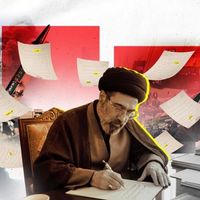
Two years after former president Ebrahim Raisi’s helicopter vanished in fog, Iran has lost far more than a president: its succession plan, regional shield, aura of safety and confidence that time was on its side.
On May 19, 2024, a helicopter carrying Raisi disappeared in the mountains of Iran’s East Azarbaijan province. The final Iranian inquiry blamed bad weather, dense fog and atmospheric conditions, not sabotage.
But the image was too powerful to ignore: a leadership convoy moving through poor visibility, losing sight of itself, then trying to project a state still in control.
That is the better way to read Raisi’s death – as metaphor, not conspiracy.
The crash did not change Iran because Raisi ruled Iran. He did not. Real power sat above him, with Supreme Leader Ali Khamenei, the Revolutionary Guard, the security state and the regional networks Tehran had built over decades.
Raisi mattered because he showed how continuity was supposed to look. He was loyal, hardline, severe and predictable; a figure once widely discussed as a possible successor to Khamenei.
Raisi was not the Islamic Republic’s future. He was its rehearsal for a future that never arrived.
In May 2024, the system still seemed to have a succession plan, a regional shield and the patience to wait out its enemies. Two years later, almost every pillar that made Tehran look untouchable has been tested or broken.
No sanctuary
The countdown had already begun on October 7, 2023.
Hamas’s attack on Israel opened a war that pulled Iran’s wider network into motion: Hezbollah in Lebanon, militias in Iraq and Syria, the Houthis in Yemen. For years, this was Tehran’s doctrine of strategic depth.
After October 7, that depth became a target map.
By April 2024, Iran and Israel had moved from shadow war into direct confrontation. Then, one month later, Raisi’s helicopter fell out of the fog.
The state answered with the familiar theater of mourning: coffins, black flags, portraits, clerics and commanders. The message was continuity.
But after Raisi, the funerals began to tell another story. One by one, they marked not continuity, but exposure: a system losing the people, places and networks that had made it feel protected.
Former Supreme Leader Ali Khamenei leading the funeral prayer at the coffin of Ebrahim Raisi and other officials killed in the crash
His death forced a snap election. Masoud Pezeshkian, a reformist in tone, won the presidency after a first round marked by record-low turnout. The system gained a softer face, but not a new center of power.
Then came the first great humiliation of the post-Raisi era.
Ismail Haniyeh, Hamas’s political leader, came to Tehran for Pezeshkian’s inauguration. Hours later, he was killed in the Iranian capital.
This was not only the killing of a Hamas leader. It was a message that even the patron’s capital was no sanctuary.
That became the sentence for what followed.
In September 2024, Hezbollah’s pagers and radios exploded across Lebanon and Syria, turning the group’s own communications into weapons against it. Days later, Hassan Nasrallah was killed in Beirut.
A movement built on secrecy and underground command had been pierced from inside and struck from above.
Then Hamas leader in Gaza Yahya Sinwar was killed. Hamas remained, Hezbollah remained, the slogans remained. But the axis was bleeding leaders, territory, routes and confidence.
The deeper break came in Syria.
Bashar al-Assad’s fall in December 2024 was not just the loss of another Islamic Republic's ally. It damaged the geography of Iranian power: the route to Hezbollah, the Mediterranean opening, and the Qasem Soleimani-era claim that weak states could be turned into Iranian depth.
Israel struck Iranian nuclear and military sites during the 12-Day War. The United States then hit the most fortified parts of the nuclear program.
For years, nuclear ambiguity had been Tehran’s shield. In 2025, it became a battlefield.
Outside pressure then met the inside front.
The protests that erupted in late 2025 and early 2026 were driven by economic collapse, repression and the old demand for a different political order. By January 8 and 9, the state answered with mass violence and an internet shutdown.
The Islamic Republic could still shoot, jail and terrify. But it could no longer persuade enough of its own people that it had a future.
Even shocks beyond the Middle East began to feel part of the same weather. The US capture of Venezuelan President Nicolás Maduro in January 2026 mattered less as an Iran story than as an atmosphere: another anti-American ruler, once protected by sovereignty and distance, suddenly exposed.
Then, on February 28, 2026, the war reached the institution at the heart of the Islamic Republic’s power: the supreme leadership.
Ali Khamenei was killed in US-Israeli strikes. For a state built around velayat-e faqih, this was not only the death of a ruler. It was the breaking of an aura.
Mojtaba Khamenei was named Supreme Leader days later. The appointment was meant to project continuity. Instead, it made the Islamic Republic look smaller, more closed and more dynastic.
The revolution born against monarchy had passed its highest office from father to son in wartime.
The funeral that has not happened
And then came the strangest funeral of all: the one that could not settle itself.
Iran postponed Khamenei’s state funeral. Months later, even his burial remained unclear. For a Shiite revolutionary state that has always known how to turn death into power, the delay was astonishing.
The republic of funerals had lost command of its most important ritual.
The old model had four layers. At home, fear contained society. In politics, elections gave the state a civilian mask. In the region, proxies kept enemies away from Iran’s borders. At the strategic level, missiles, nuclear ambiguity and the Strait of Hormuz made the cost of attack seem unknowable.
Since Raisi’s crash, every layer has been damaged.
Fear has produced revolt. Elections have exposed emptiness more than legitimacy. Regional depth has been penetrated. Syria has fallen away. Hezbollah and Hamas have been battered. The supreme leader’s office has lost its aura of untouchability.
Hormuz remains Iran’s strongest card. But it also shows the trap. The strait gives Tehran leverage over oil, shipping and global markets; it also keeps Iran at the center of a crisis it cannot easily end.
This is not the story of a regime that has already fallen. The Islamic Republic still has prisons, missiles, commanders and a long memory for survival.
But it is also not the story Tehran wants to tell.
Two years ago, Raisi’s death was wrapped in the language of martyrdom and continuity. The state said nothing vital had been lost.
Yet what followed revealed how little room the Islamic Republic had left for error.
The crash did not start the chain. October 7 had already started the clocks. But Raisi’s death gave the years after it their image: fog, poor visibility, a convoy losing contact, and a state insisting the road ahead was clear.
Two years later, Iran is still falling through that fog.
The question is no longer whether the Islamic Republic can survive another crisis. It has survived many.
The question is whether it can survive the loss of the things that made survival possible: distance, fear, succession, sanctuary and the belief that time was on its side.