Iran blocks families of 1980s execution victims from memorial gathering
A file photo of Khavaran Cemetery
Iranian security and law enforcement forces prevented families of political prisoners executed in the 1980s, including during the mass killings of summer 1988, from entering Tehran’s Khavaran cemetery on Friday to commemorate their relatives, according to activists and witnesses.
Security and police forces were deployed at the site from early Friday morning and, as in previous years, sealed the cemetery gates to block families from entering, a Telegram channel called Charter of Freedom, Welfare and Equality reported. The forces also prevented relatives from gathering outside the entrance, displaying photographs of their loved ones or laying flowers.
Despite the restrictions, some families marked the anniversary by scattering flowers along the road leading to the cemetery or throwing bouquets over the walls into Khavaran, the report said.
Khavaran is widely known as the main burial site for victims of mass executions carried out in the 1980s, particularly during the summer of 1988, when thousands of political prisoners were executed following orders issued by Ruhollah Khomeini. Special tribunals later referred to by survivors as “death commissions” ordered the executions while many prisoners were already serving sentences.
Exact figures remain unknown due to official secrecy, but rights groups estimate that around 5,000 political prisoners – mainly supporters of the People's Mojahedin Organization of Iran, also known as Mojahedin-e-Khalq, and leftist movements – were executed in 1988 alone.
Unanswered appeals to the president
The restrictions come despite repeated appeals by families. In January 2024, dozens of relatives of those executed in the 1980s wrote an open letter to President Masoud Pezeshkian, saying they had been barred from Khavaran for more than 11 months and subjected to humiliating treatment by officials in charge of the site. They demanded an end to other burials at the cemetery and the removal of all obstacles to mourning and remembrance.
No public response from Pezeshkian has been reported, and access restrictions have continued.
Erasing evidence
The Telegram channel also said burials of deceased Baha’i citizens continue in mass graves at Khavaran, despite longstanding objections from families and the Baha’i community. In March 2024, the Baha'i International Community reported the destruction of more than 30 Baha’i graves at the site.
Families have repeatedly warned that such actions amount to desecration and an attempt to erase evidence of past crimes. “Commemorating loved ones and collective mourning is the most basic human right,” the group said, adding that preventing memorials denies the dignity of the victims and seeks to silence demands for justice.
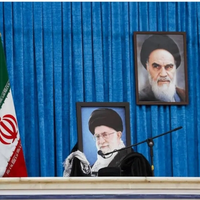
Pictures of slain IRGC commanders and Islamic Republic’s founder Rouhollah Khomeini at a state-organized anti-US rally in Tehran
Iran’s theocracy exits 2025 battered yet still standing, with analysts telling Eye for Iran that Tehran is interpreting survival after a punishing war with Israel, regional losses and domestic strain as grounds for taking greater risks in 2026.
At the start of 2024, Iran appeared to be riding high — expanding regional reach, edging closer to nuclear threshold status and projecting confidence at home and abroad. That trajectory began to reverse in late 2024 and accelerated into 2025.
The past year brought direct confrontation with Israel and later the United States, the weakening of Tehran’s regional proxy network and mounting domestic pressures. What it did not bring was collapse.
That survival, analysts warn, may now be shaping how the Islamic Republic approaches 2026 — not as a moment for restraint, but as proof that it can endure unprecedented pressure and press forward.
The defining moment of the year was the June war with Israel, a confrontation that punctured long-held assumptions about Iran’s deterrence while stopping short of triggering a regime change.
On Eye for Iran, Middle East analyst and former Israeli intelligence official Avi Melamed who directs the Inside the Middle East fellowship program for policy and security professionals; journalist and investigative reporter Jay Solomon, author of The Iran Wars; and historian Shahram Kholdi assessed what the Islamic Republic’s survival says about the year that is about to end and why its interpretation of that survival could make the coming year more volatile.
Fear is breaking — but survival is being reframed
Avi Melamed pointed to a psychological shift inside Iran as one of the most consequential developments of 2025.
“The most significant one is that I think that we are witnessing now a very significant shift in Iran in the sense that many Iranian people are no longer afraid of this regime,” he said.
That erosion of fear has coincided with widespread social defiance, particularly among younger Iranians and women, even as repression continues.
Shahram Kholdi said that Tehran is not reading this moment as a loss. Instead, he argued, the leadership is internalizing 2025 through a survivalist lens — one that encourages defiance rather than restraint.
“If something that can kill you doesn’t destroy you, it makes you stronger,” Kholdi said, describing what he sees as the clerical establishment’s core mentality after the June war with Israel.
That belief, he argued, helps explain why executions have continued and why the Islamic Republic is signaling resolve despite suffering unprecedented blows.
A strategic reversal — interpreted as a test passed
Externally, 2025 marked a sharp break from the trajectory that once favored Tehran. Jay Solomon described the year as a reversal after decades in which Iran expanded influence through proxies and deterrence.
“The word I’d use for the year is weakness,” he said.
Solomon pointed to Israeli strikes, the degradation of Hezbollah and Hamas, and Iran’s struggle to manage overlapping crises — from inflation and water shortages to public dissent.
Yet despite expectations of mass bloodshed following the June conflict, the Islamic Republic ultimately pulled back, reinforcing its own perception that it had weathered the storm.
Why 2026 may be more volatile
For the analysts the biggest concern for 2026 was the risk ahead.
Iran’s deterrence model has been punctured but not abandoned. Instead, Tehran appears determined to rebuild — restoring proxy leverage, advancing missile capabilities and reasserting influence amid uncertainty.
The outlet cited an Israeli security source saying that Israel's military intelligence had conveyed the assessment to the United States in an indication that Israel is urging Washington to again act to address the alleged threat.
Melamed warned that this environment heightens the risk of miscalculation. Kholdi argued that the belief that Iran “didn’t lose” the June war makes confrontation more likely, not less. Solomon added that shifting political currents in the United States are being closely watched in Tehran and Tel Aviv alike, narrowing the window for restraint.
The danger, the panel suggested, is that survival itself is being treated as victory.
As 2026 begins, the Islamic Republic may be weaker — but convinced it has passed a test. That conviction could shape the year ahead more than any battlefield outcome.
A 56-year-old Iranian radiologist who evaded execution but received a long prison term for his participation in Iran’s 2022 protests says he has launched a hunger strike to protest what he describes as “inhumane” treatment in prison.
In an audio file obtained by Iran International, Hamid Qarahassanlou (Gharehassanlou) said he started the hunger strike on Thursday, December 25, in protest at “inhumane and shocking” conditions of detention in the Yazd Central Prison.
Qarahassanlou and his wife Farzaneh were arrested on November 4, 2022, in Karaj after participating in protests where a member of the Basij militia, Rouhollah Ajamian (27), was beaten to death by angry protesters but both denied any involvement in the incident.
Qarahassanlou was initially sentenced to death and his wife to twenty-five years prison, but their sentences were later reduced due to a strong backlash on social media and lack of evidence of their involvement in a second trial.
Farzaneh is serving a five-year jail term in Mashhad prison, over 900 km (565 miles) away from Yazd, where her husband is jailed.
In the audio recording, Hamid said that although two and a half years have passed since his imprisonment in Yazd Prison, he remains held in the prison’s quarantine ward and, despite repeated requests to the prison administration, has not been transferred to the political prisoners’ ward.
He named the prison’s warden as Hassan Madadi Moghaddam, who he said would be responsible for any consequences.
Qarahassanlou further warned that his life is under threat in the quarantine ward, and emphasizes that he has been “deprived of the basic rights of a prisoner,” that his access to welfare facilities has been restricted, and that he has been exposed to multiple illnesses.
Hamid Qarahassanlou hospitalized, image released in February 2023 by Iranian state-media
Later in the audio file, he also spoke of inadequate food and months-long deprivation of sunlight, saying: “I have faced numerous problems in terms of nutrition and have been deprived of sunlight for months.”
“Given my lack of access to any means to seek justice, I have no choice but to go on a hunger strike. I hereby announce the start of my hunger strike until my demands are met, and any harm to my life resulting from this will be the responsibility of the prison warden, Mr. Madadi.”
While Qarahassanlou was spared execution in the Basij militant’s murder case, the Islamic Republic’s judiciary executed two young protesters, Mohammad Mehdi Karami, 22, and Mohammad Hosseini, 39, in January 2023 over Ajamian’s death after a hasty trial that human rights activists called a travesty of justice.
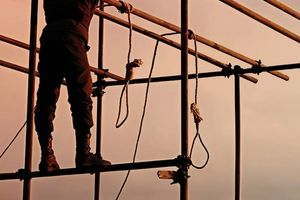
File photo of preparations for a public execution in Iran
Iran carried out at least 1,922 executions in 2025, more than twice the number recorded the previous year and the highest figure documented in over a decade, according to a new annual report published by a US-based human rights group.
The report by the Human Rights Activists News Agency (HRANA), covering the period from January 1 to December 20, said executions rose by 106% compared with 2024, marking a sharp escalation in the use of capital punishment by Iran’s judiciary.
At least 10 executions were carried out in public, the report said, while the vast majority were conducted behind closed doors.
95% of executions, according to the findings, were not officially announced by Iranian authorities or state-affiliated media, underscoring what HRANA described as a systematic lack of transparency.
In addition to those executed, at least 168 people were newly sentenced to death in 2025, while Iran’s Supreme Court upheld death sentences in at least 56 cases.
Of those executed whose gender could be confirmed, 1,681 were men and 59 were women. The gender of roughly 10% of those put to death could not be verified due to limited official information, HRANA said.
Drug and murder cases dominate
Executions, the report found, were overwhelmingly linked to two categories of charges. Murder cases accounted for 47.55% of executions, while 46.10% were related to drug offences.
Human rights organizations have long criticized Iran’s use of the death penalty for narcotics-related crimes, arguing that such cases often involve unfair trials and disproportionately affect poorer and marginalized communities.
HRANA also documented the execution of at least two individuals who were under the age of 18 at the time of the alleged offences, placing Iran among the few countries worldwide that continue to carry out executions of juvenile offenders, in violation of international law.
Prisons and provinces most affected
Executions were unevenly distributed geographically. The highest numbers were recorded in Alborz province, which hosts Ghezel Hesar prison – one of the country’s main execution sites – followed by Khorasan Razavi, Isfahan, Fars and Lorestan provinces.
The prisons with the highest number of executions included Ghezel Hesar in Karaj, Dastgerd prison in Isfahan, Adelabad prison in Shiraz, Vakilabad prison in Mashhad and Dieselabad prison in Kermanshah, the report said.
HRANA’s data shows that executions declined between 2015 and 2020, before rising sharply from 2021 onward, reaching a peak in 2025.
Part of broader repression
The report placed the surge in executions within a wider pattern of human rights violations. In 2025, HRANA recorded at least 2,606 protests and strikes across Iran, including more than 2,100 protest gatherings and over 400 labor strikes, many linked to unpaid wages, inflation and deteriorating living conditions.
It also documented thousands of cases of prisoners’ rights violations, including prolonged detention without trial, denial of medical care, solitary confinement and transfers to unsuitable detention facilities.
The increase in executions has drawn international concern. Earlier this month, the UN General Assembly adopted a resolution condemning Iran’s human rights record, with particular emphasis on capital punishment. Mai Sato, the UN special rapporteur on human rights in Iran, has warned that the scale and secrecy of executions could amount to crimes against humanity.
Institutions and officials linked to rights violations
In another section of its report, HRANA identified state institutions and officials most frequently linked to reported human rights violations in 2025, based on data collected throughout the year.
A total of 480 legal entities affiliated with different branches of the Islamic Republic, according to HRANA, were identified as human rights violators. Among them, 10 institutions accounted for the highest number of recorded cases over the past year.
The Ministry of Intelligence topped the list with 231 reported cases, followed by the Intelligence Organization of Iran’s Law Enforcement Forces (FARAJA) with 172 cases, and the Islamic Revolutionary Guards Corps with 146 reports.
Judicial bodies also featured prominently. Branch 26 of Tehran’s Revolutionary Court was linked to 42 cases, followed by Evin Prison with 36 reports and Branch 36 of Tehran’s Court of Appeal with 24 cases.
HRANA also identified individuals who, based on documented cases, played the most direct roles in human rights violations. These figures, the report said, were predominantly judicial officials who contributed through issuing verdicts, handling cases or playing key roles in judicial and security processes.
According to the data, those named include Iman Afshari, Abbasali Houzan, Mohammad Taghi Taghizadeh, Mostafa Azizi, Abolghasem Salavati, Sajjad Dousti, Mohammadreza Tavakkoli, Qasem Hosseini Kouhkamarei, Ahmad Darvish-Goftar and Ali Ansari.
Iran’s handwoven carpet industry has fallen to its lowest level on record, hit by US sanctions, restrictive foreign-currency rules and regional instability that have driven exports close to collapse, the Financial Times reported on Friday.
“The costs of making a carpet are high and the profits low,” Akram Fakhri, a 45-year-old weaver in Kashan, told the FT, describing the pressures facing artisans across Iran.
Once a flagship of Iran’s non-oil exports, Persian rugs are expected to generate less than $40mn in the year to March 2026, down from $41.7mn the previous year, according to the Carpet and Handicrafts Commission of Iran’s Chamber of Commerce.
Export revenues have stayed below $100mn for six consecutive years, compared with a peak of more than $2bn three decades ago – figures that commission chair Morteza Haji Aghamiri described as “so meagre we can say it is practically zero.”
The downturn accelerated after 2018, when then US president Donald Trump withdrew from the Iran nuclear deal and imposed “maximum pressure” sanctions. As foreign reserves tightened, Iran required exporters to sell part of their foreign-currency earnings to the central bank at the official exchange rate rather than at market rates.
The rule destroyed incentives to export, Industry representatives said. “It completely paralysed the sector. None of them have any motivation to stay active in global markets,” said Abdollah Bahrami, head of the National Union of Handwoven Carpet Co-operatives.
For weavers such as Fakhri, the economics no longer work. She told the FT she must invest $250 in wool and silk and spend a year weaving a single carpet, only to hope it might sell for more than $600. Without social security or state support, she said the work has become physically exhausting. “I work with constant back and leg pain. But hiring an assistant weaver is beyond my means.”
Iranian carpets were once exported to about 80 countries, but sales are now largely limited to markets such as the UAE, Germany, Japan, the UK and Pakistan. As Iran lost ground, competitors from Turkey, India, China and Afghanistan moved in. “After the US market closed, some traders began rerouting Persian rugs to the US through third countries… hurting Iran’s craft by concealing its identity,” said Mohsen Shojaei, a carpet trader in Mashhad.
Regional tensions have compounded the decline. Shojaei said: “The disruption of regional airspace after the war with Israel, along with other political tensions, caused foreign traders to lose confidence.”
While officials have promised support, industry figures remain bleak. “The future? The future is gone. The sound of the loom in villages and towns has fallen silent,” Bahrami said.
A man searches through a garbage bin on a city street in Iran, highlighting the harsh realities of poverty and economic struggle faced by many residents.
Comments by Iran’s foreign minister describing international sanctions as having blessings have sparked a wave of criticism from economists and social media users, many accusing senior officials of being detached from the economic hardship faced by ordinary citizens.
Speaking on Thursday at a meeting with economic activists in Isfahan, Abbas Araghchi said Iran must accept the reality of sanctions and learn to live with them.
“We must accept that sanctions exist and accept that it is possible to live with sanctions,” he said. “Sanctions have their costs… I know very well what sanctions mean and what their costs are. I know their problems and I also know their blessings.”
The remarks quickly drew criticism as Iran grapples with soaring inflation, a weakening rial and sharp rises in the price of basic goods, pressures that have hit low-income households hardest.
Senior officials are insulated from the realities of sanctions, Economist Mohammad Tabibian wrote in a note. “We all know that he and other gentlemen can live well and comfortably even under far worse conditions,” Tabibian wrote.
“Please do not speak on behalf of the people. Ask the people themselves and let them describe their own situation.”
Social media backlash
Users on social media platforms, including X, also reacted angrily. One user identified as Yousef pointed to the recent surge in the dollar’s exchange rate hitting 1.36 million rials, writing: “The blessings are for rent-seekers and mafias. For the people, only poverty and hunger remain.”
Iran's FM Abbas Araghchi
Another user, Zahidi, criticized what he described as the lavish lifestyles of senior officials.
“Even if people are pushed into conditions worse than total deprivation, it is still a blessing for Mr. Araghchi and his friends,” he wrote, adding that the gap between officials and ordinary citizens has grown impossibly wide.
Others described the comments as offensive. A user named Azita called the remarks “shameful,” writing: “Do not speak on behalf of the nation. Sanctions have only brought misery. What blessing?”
‘People below the poverty line’
Further criticism focused on the contradiction between official rhetoric and lived experience. One user wrote that while people are being driven below the poverty line, “embezzlers ride in luxury limousines.” Another commented: “Sanctions for people mean medicine shortages, unemployment, poverty and constant anxiety. If sanctions are a blessing, publish the list of beneficiaries.”
Another post argued that Araghchi’s comments were impossible to accept for people “whose backs have been broken under the weight of sanctions,” adding that any benefits accrue to networks involved in evading sanctions, not to the public.
The backlash reflects broader public frustration with economic conditions after years of sanctions and policy mismanagement, as the cost of living continues to climb and the national currency loses value.
For many critics, Araghchi’s remarks underscored a widening disconnect between Iran’s political leadership and the daily struggles of its citizens.