The Hormuz get out of jail card turned to a grave

Avi Avidan
Political and strategic analyst
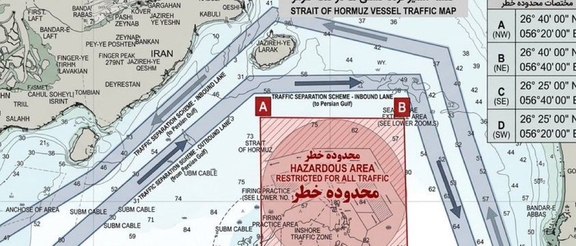
For decades the IRGC relied on its ability to threaten closure of the Strait of Hormuz as its premier economic shield and golden get out of jail card.
Political and strategic analyst
For decades the IRGC relied on its ability to threaten closure of the Strait of Hormuz as its premier economic shield and golden get out of jail card.
Roughly 21 million barrels per day of oil and petroleum products normally transit the strait. That volume accounts for one fifth of global petroleum liquids consumption and one quarter of all seaborne traded oil.
Yet the destinations of those flows expose the asymmetry that ultimately doomed the strategy.
In the first half of 2025 ~89% percent of crude oil and condensate flowed eastward to Asian markets.
China absorbed 37.7 percent of the total followed by India at 14.7 percent South Korea at 12 percent Japan at 10.9 percent and other Asian buyers at 13.9 percent.
Europe received just 3.8 percent and the United States only 2.5 percent. The IRGC was never holding the West hostage. It holds the East.
By throttling traffic during the conflict the regime exercised its only economic "card". Ship transits collapsed to under ten percent of normal levels even after the ceasefire. Insurance rates soared and oil prices spiked.
The move they thought would delivered short term tactical breathing room and helped force negotiations. Yet the decision transformed a potent deterrent into a wasting asset.
The primary victims were Asian importers especially China and India. Those nations faced immediate cost spikes and supply uncertainty.
Beijing responded by drawing down its strategic petroleum reserve which covers more than four months of imports while accelerating purchases of Russian African and Latin American crude.
India pursued parallel diversification.
More critically Persian Gulf producers gained the political urgency and capital they needed to lock in permanent bypass infrastructure.
Saudi Arabia ramped its East West Petroline to near its seven million barrels per day capacity routing crude to Red Sea terminals at Yanbu.
The United Arab Emirates expanded the Abu Dhabi Crude Oil Pipeline to Fujairah on the Gulf of Oman. Additional overland proposals and expanded export terminals emerged almost immediately.
Once those routes reach commercial scale the strait loses its status as a global chokepoint. It becomes a regional inconvenience whose disruption matters far less to the broader market.
Simultaneously United States crude exports have surged to a record 4.9 million barrels per day in April 2026 with forecasts pointing toward five million or higher in coming months. That volume covers roughly 23 percent of normal full Hormuz traffic and about one third of the crude and condensate segment.
Asian refiners have redirected demand toward US Gulf Coast barrels to fill the shortfall from Middle East shut ins estimated at 7.5 to 9.1 million barrels per day. The surge not only caps price spikes but also cements American producers as the flexible swing supplier to Asia.
This development accelerates the very diversification that erodes Iranian leverage.
The one year five year and ten year horizons reveal starkly divergent outcomes.
For IRGC the picture darkens at every stage. In the first year oil revenues collapse despite temporary price spikes because export volumes remain minimal. The economy already contracting from war damage and sanctions faces hyperinflation in food prices and widespread shortages.
Over five years bypass pipelines and alternative supply chains become permanent fixtures. Petrodollar inflows never recover and sanctions compound the isolation.
By year ten Iran confronts structural marginalization as a secondary supplier at best. Internal pressures from economic rot and factional rivalry mount inexorably.
The regime is forced to move first. It cannot sustain years of revenue denial while rivals reroute around it. Diplomatic capitulation or escalated domestic repression becomes inevitable well before the five year mark.
China absorbs the heaviest short term pain yet emerges stronger. Higher import costs slow some refinery runs in the first year but strategic reserves Russian pipelines and surging United States imports prevent outright shortages.
Over five years Beijing locks in new sourcing habits and accelerates renewables and domestic production. By year ten China enjoys markedly improved energy security with far less exposure to any single chokepoint. The crisis ultimately serves as an expensive but effective catalyst for diversification but shines a light on Chinese dependency on US rendering any multipolar aspirations null, China isn't a pole probably never was if it can't survive without IRGC cheap oil paid with the blood of Iranians.
The United States stands as the unambiguous winner across all horizons. Export revenues boom in the first year as shale producers respond to sustained high prices.
Over five and ten years America solidifies its role as the reliable Atlantic basin supplier to Asian demand. Strategic leverage deepens without proportional domestic pain.
Arab states astride the Persian Gulf also gain by converting crisis into durable infrastructure and expanded market access.
In strategic terms the IRGC executed a classic use it or lose it blunder. By weaponizing the eastern hostage it compelled the very adaptations that render the hostage irrelevant. Global energy flows have begun a permanent eastward rerouting that favors flexible producers over vulnerable chokepoint holders.
The 2026 crisis therefore accelerates the long term isolation of Iran. It diminishes the regime's economic shield permanently and hastens the internal collapse dynamics already evident before the conflict.
What began as a tactical gambit to survive immediate pressure has instead locked in decades of strategic decline. The geography of oil trade the scale of United States export capacity and the self interest of Asian importers have combined to ensure that the IRGC traded its last "card" for time it didn't get and burned what it could not afford to waste relevance and economic potential to climb out of the grave it dug itself.
The Hormuz closure wasn't a surprise to any serious person, one might argue Trump turned what the enemy believed to be a leverage to a ticking time bomb trap the IRGC just walked into.
IRGC was never the end goal, China is.





“I work as a freelance web developer and my income has dropped to zero because of the internet outage. I am selling my belongings to cover debts,” a citizen wrote in a message to Iran International.
Another said: “As a student and computer technician, I am stuck in uncertainty. Online classes are heavily disrupted, and I cannot even access the internet to complete projects. My workplace has no customers.”
NetBlocks said on Thursday the disruption had lasted 1,128 hours, describing the shutdown as unprecedented in scale for a country with deep reliance on global connectivity. The group added that its estimate, based on its COST methodology, also reflects wider social and human rights impacts.
Digital economy grinds to a halt
The outage has hit Iran’s digital sector, which had absorbed part of the country’s unemployment pressure over the past decade. Online businesses have lost access to customers, payment systems, and essential tools tied to the global internet.
The Rokna news website said on Wednesday the disruption amounted to a shutdown of the digital economy, noting that the cut to international internet access dealt a direct blow to online businesses.
Hundreds of small digital enterprises have been unable to maintain sales, customer communication, or after-sales services. Layoffs have spread across technology firms and media organizations, affecting employees whose work depends on stable connectivity, the outlet added.
Journalists and media workers have also faced income losses and job cuts as communication channels narrowed and publishing operations slowed, according to the report.
Workers face mounting financial strain
“I managed to connect briefly using expensive VPNs, but I have lost my job due to the internet disruption. I have loans to repay and rent to cover, and many others are in the same situation,” another citizen told Iran International.
Accounts from across the country point to a broader slowdown. “Prices have increased several times over. Many people have lost their jobs. At least 50 percent of shops are closed,” one resident said, adding that only essential services such as repair shops and small markets remain partially active.
Delays in salary payments have become more common in some businesses, increasing pressure on workers already affected by rising prices. Inflation has further reduced real wages, leaving even those still employed struggling to cover basic living costs.
Professional networks also reflect the downturn. Users on LinkedIn have publicly said they are seeking new job opportunities, indicating a rise in job seekers among skilled and experienced workers.
Experts warn of lasting damage
Economic journalist Arezoo Karimi said the losses extend beyond immediate income declines, warning of wider consequences for employment and growth.
“This means zero income for businesses that depend on international connectivity. It leads to layoffs and rising unemployment,” Karimi said, adding that daily losses run into tens of millions of dollars.
Karimi said the broader economic impact could reach several times the direct losses, pointing to reduced production and slower economic growth. Inflation, already elevated, is likely to worsen if disruptions continue.
“Businesses are not only losing income, they are losing their position in international markets and online visibility. These are damages that cannot easily be reversed,” Karimi added.
With limited access to global markets and tools, many digital workers now face a choice between prolonged uncertainty and leaving the country.
The outage has exposed the dependence of Iran’s digital economy on stable international connectivity, with weeks of disruption enough to dismantle businesses built over years.
A letter issued by a senior official at the National Petrochemical Company instructed producers to stop exports and redirect supply to domestic industries.
The directive said the move aims to support downstream industries and consumers following damage caused by recent attacks and to ensure adequate supply in the domestic market, the report said.
Attacks, curbs hit sector
Domestic prices for petrochemical and related products have been held at pre-conflict levels despite rising global prices, officials said, adding the measures would remain in place to support local industry and consumers.
Companies were also told to return export cargoes that have not yet cleared customs, with associated costs to be reported for possible adjustments to domestic pricing.



Key petrochemical hubs in Asaluyeh and Mahshahr have been hit in recent weeks, including strikes on utilities supplying feedstock to plants, disrupting production.
The US military has also begun blocking shipping traffic in and out of Iran’s ports this week, a move aimed at reducing Iran’s export revenues as Tehran and Washington consider a second round of talks.
Economic strain deepens
The measures come as Iran faces mounting economic pressure, with reports sent by citizens to Iran International describing factory closures and layoffs in industrial hubs due to shortages of raw materials and weak demand.
Residents said businesses have struggled with disrupted supply chains and an ongoing internet shutdown, which has further strained operations and added to rising prices.
Fatemeh Mohajerani, the spokesperson for the Iranian government, said on Tuesday losses from the US-Israeli military campaign are estimated at around $270 billion.
The New York Times, citing three Iranian officials and two economists, reported that early estimates broadly align with that figure, placing the damage at roughly $300 billion or higher.
Preliminary estimates by the US-based think tank Foundation for Defense of Democracies also suggest Iran absorbed roughly $150–$300 billion in economic damage.
Using a population of about 92 million, the lower estimate of $150 billion translates to roughly $1,600 per person, rising to nearly $3,250 per person under the higher estimate.
These figures reflect national wealth lost through destruction, halted production and disrupted trade.
Iran’s central bank has warned President Masoud Pezeshkian that rebuilding the country’s war-damaged economy could take more than a decade, sources familiar with internal deliberations told Iran International.
In a stark assessment delivered to the president in recent days, senior economic officials said the damage inflicted during the 40-day war with the United States and Israel—combined with Iran’s already fragile economic situation—could take up to 12 years to repair.
Industrial sectors bear largest losses
Petrochemicals account for the largest share of damage. Iran’s petrochemical sector, with annual sales of $29.1 billion, has seen about 85% of export capacity disrupted following strikes on major hubs including Mahshahr and South Pars. Estimated losses range from $30 billion to $50 billion.
Energy infrastructure has also been heavily affected. Refineries, storage depots and gas facilities have been struck, weakening a sector that generated about $78 billion in exports in 2024. Losses are estimated at $15 billion to $25 billion.
Steel production, which underpins both industrial output and reconstruction, has been severely reduced, with about 70% of capacity disrupted. Losses are estimated at $5 billion to $10 billion.
Beyond physical losses, the war has triggered a sharp contraction in output.
Experts estimated a decline of more than 10% in GDP, equivalent to $34 billion to $44 billion in lost economic activity, affecting an economy that was already under strain before the conflict.
Beyond physical damage, policy-driven disruptions have compounded the losses.
Internet shutdown
A nationwide internet blackout beginning Feb. 28 has imposed additional costs.
Direct losses are estimated at $37 million to $42 million per day, totaling $1.5 billion to $2.5 billion over more than five weeks.
Afshin Kolahi, a member of Iran’s Chamber of Commerce, said Monday indirect losses could raise the daily figure to $70 million to $80 million due to disruption to online businesses.
Online sales fell by about 80% during the shutdown, while the Tehran Stock Exchange lost 450,000 points within four days.
The shutdown is affecting multiple layers of the economy simultaneously, according to economic analyst Masoumeh Taherkhani.
“The Iranian economy is damaged at three levels by internet disruption, starting with the digital core, which employs between four and five million people,” Taherkhani told Iran International. “Then the platform layer collapses, and finally the broader economy is affected in a way that spreads across production and services.”
Taherkhani said the combined effect leads to widespread job losses. “When the economy is fully stagnant, the outcome is unemployment for workers, and that is not something that can easily be reversed,” she said.
Trade disruption and self-inflicted losses
Disruptions linked to the Strait of Hormuz have added further pressure, with estimated losses of $5 billion to $15 billion.
The restrictions have affected imports of essential goods and weakened non-oil exports, contributing to supply chain disruptions across the economy.
A US naval blockade targeting Iran’s maritime trade routes is expected to deepen losses.
Sanctions strategist and former US Treasury official Miad Maleki estimated that cutting off seaborne trade could eliminate about $435 million in daily economic activity, equivalent to roughly $13 billion per month.
Iran relies on the Persian Gulf for more than 90% of its trade, leaving it highly exposed to sustained disruption.
Oil exports of about 1.5 million barrels per day – generating roughly $139 million daily – could be halted almost entirely, removing the country’s main source of foreign currency.
What the losses could have funded
The scale of damage corresponds to investment levels that could have reshaped core sectors of the economy.
A large combined-cycle power plant with capacity of around 1,000 to 1,500 megawatts typically costs between $600 million and $1 billion to build, depending on technology and fuel infrastructure.
At the lower estimate of $150 billion in losses, Iran could have financed roughly 150 to 250 such plants. At the upper estimate of $300 billion, that rises to between 300 and 500 plants, enough to eliminate electricity shortages and significantly expand export capacity.
In housing, average construction costs for a modest apartment unit range between $30,000 and $50,000. With $150 billion, between 3 million and 5 million housing units could have been built. At $300 billion, that increases to roughly 6 million to 10 million units, enough to address shortages across major urban areas.
High-speed rail construction typically costs between $20 million and $40 million per kilometer. The lower estimate of losses could have funded approximately 3,750 to 7,500 kilometers of rail, while the higher estimate could support up to 15,000 kilometers, connecting major cities nationwide.
A modern hospital costs between $200 million and $500 million to construct and equip. The lower-end losses could have built 300 to 750 hospitals, while the higher estimate could fund up to 1,500 facilities, expanding healthcare access across the country.
What it means for individual Iranians
The per capita loss of up to $3,250 represents a substantial share of annual income for many households.
With average monthly earnings between $150 and $200, an individual earns roughly $1,800 to $2,400 per year, meaning a $3,250 equivalent exceeds a full year of income for many citizens.
If such an amount were available, it could cover between 12 and 20 months of living expenses for an average worker. Families could use it toward housing costs, including down payments or completing home purchases in smaller cities.
Small businesses could be launched with startup capital of $2,000 to $5,000, enabling self-employment in sectors such as retail, services or online commerce. Households could also afford private healthcare, education or relocation costs that are otherwise beyond reach.
Even the lower estimate per person represents several months of income, providing a buffer against inflation, job loss or unexpected expenses.
The overall range reflects damage already incurred, with additional losses building as trade, production and financial flows remain disrupted.
At up to $3,250 per person and rising, the economic toll underscores the scale of damage to Iran’s productive capacity, with long-term implications for recovery and growth.


