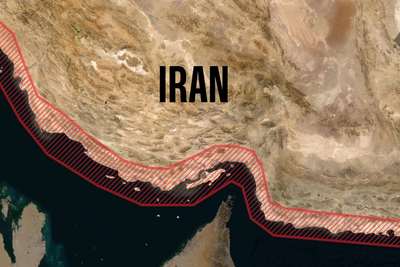
The front page of Iran's Hamshahri newspaper shows military personnel under the title "Champions of the Sky".
Israel is reassessing the impact of its June military campaign on Iran’s ballistic missile program as analysts say Tehran is keen to rebuild its core deterrent in a move that could set the stage for renewed war.
Iran’s ballistic missile stockpile appears largely intact following the June war, with roughly 2,000 heavy missiles still in its arsenal, according to Al-Monitor.
The outlet cited an Israeli security source saying that Israel's military intelligence had conveyed the assessment to the United States in an indication that Israel is urging Washington to again act to address the alleged threat.
A senior Israeli official told lawmakers in a closed Knesset briefing, according to Israeli outlet Ynet, that large-scale ballistic missile production has resumed roughly six months after the June war.
“Iran is taking steps to rebuild its missile production capabilities," Greg Brew, Iran analyst with the Eurasia Group think thank, told Iran International," which is not surprising given that it is imperative for the regime to strengthen its position following the war in June.”
Brew said rebuilding missile capacity is a more likely near-term goal than reviving the country's stricken nuclear program, which would carry significantly higher political and military risks.
Iran's Foreign Minister Abbas Araghchi said last month that Tehran had rebuilt its missile power beyond pre-war levels. Iran has also signaled its prowess publicly.
Last week, the Islamic Revolutionary Guard Corps announced major naval exercises in the Persian Gulf involving cruise and ballistic missiles with a reported range of 2,000 kilometers, as well as suicide drones.
The critical question, analysts say, is whether Iran’s rebuilding efforts will be tolerated.
“The real question is whether these steps will be enough to trigger action by Israel,” Brew said. “I’m inclined to think that Israel will act preemptively to prevent Iran from rebuilding a missile arsenal that could theoretically overwhelm Israeli air defenses.”
Such a move would almost certainly require American backing, Brew added.
While Israel’s campaign inflicted significant damage, analysts note it was always constrained in its ability to impose lasting limits on Iran’s missile program.
Farzin Nadimi, a senior fellow at the Washington Institute said Israeli strikes hit at least 15 of Iran’s 30 to 35 main missile industrial complexes and about 15 of 25 missile bases, with numerous mobile launchers also targeted.
But Iran’s hardened underground infrastructure blunted the long-term impact.
“Considering the industrial basis and hardened nature of IRGC missile tunnel complexes, it is almost beyond doubt that original Israeli estimates of sustainable damage caused to those facilities is over-optimistic,” Nadimi told Iran International, referring to the Islamic Revolutionary Guard Corps.
Israel and the United States expressed public satisfaction at the impact their joint war in June dealt to Iran, while Iranian officials have insisted their capabilities remain intact and have vowed retaliation for any future attacks.
For Shahram Kholdi, an expert on Middle Eastern military history, the reassessment reflects a recalibration of expectations rather than strategic failure.
“The June strikes were aimed at degrading and disrupting Iran’s missile program at a critical moment, not eliminating it outright,” he said.
As Israel and the United States reassess Iran’s missile trajectory, question may no longer whether Tehran is rebuilding, but whether its progress will cross red lines that prompt preemptive action — and whether Washington would support it.
Head of the Mossad intelligence agency David Barnea, right, attends a Hanukkah event in Jerusalem alongside Prime Minister Benjamin Netanyahu and President Isaac Herzog on December 16, 2025.
The head of Israel's Mossad intelligence agency said Iran will seek to revive its nuclear program if given the chance but that Israel would thwart its ambitions to acquire a weapon.
“The idea of continuing to develop a nuclear bomb still beats in their hearts. We bear responsibility to ensure that the nuclear project, which has been gravely damaged, in close cooperation with the Americans, will never be activated,” David Barnea said at an award ceremony for agents in Jerusalem late on Tuesday.
Iran denies seeking a nuclear bomb but Israel along with the United States and Western countries doubt its intentions.
Israel launched a surprise military campaign on Iran in June which was capped off with US strikes on the country's main nuclear sites.
The conflict came after two months of negotiations which failed to win Iranian agreement to a US demand that it end domestic uranium enrichment.
Israeli attacks killed Iranian nuclear scientists as well as hundreds of military personnel and civilians. Iranian counterattacks killed 32 Israeli civilians and an off-duty soldier.
Despite the military setbacks to Tehran, it insists enrichment is its right and called Israeli and US actions aggression which aimed at its sovereignty and progress.
“The ayatollahs’ regime woke up in a moment to discover that Iran is exposed and thoroughly penetrated, yet Iran has not given up its aspiration to destroy the State of Israel,” Barnea continued.
“Iran believes it can deceive the world again and realize another bad nuclear agreement,” he continued. "We did not and will not allow a bad deal to come to fruition.”
US President Donald Trump said his June 22 attacks had "obliterated" Iran's nuclear program and that any attempt at rebuilding will trigger renewed US strikes.
Iran has rejected US demands that it end enrichment, curb its missile program and rein in support for armed allies in the region, leaving diplomacy at a stalemate.
Russian Foreign Minister Sergei Lavrov and Iranian Foreign Minister Abbas Araghchi pose for a picture during a document signing ceremony following their talks in Moscow, Russia, December 17, 2025.
Iran and Russia signed a cooperation document between their foreign ministries on Wednesday after talks in Moscow, setting out a consultations program for the years 2026 to 2028.
The document was signed by Iranian Foreign Minister Abbas Araghchi and Russian Foreign Minister Sergey Lavrov at the end of their negotiations.
Lavrov said the consultations plan was drawn up following the entry into force of a comprehensive strategic partnership treaty between the two countries earlier this year.
“Without any doubt, the main and key document in our relations is the comprehensive strategic partnership treaty between the Russian Federation and the Islamic Republic of Iran, which was signed this year and has entered into force,” Lavrov offering no details on the consultations agreement.
He said the treaty formally set out the special nature of bilateral relations and established key areas of cooperation and a long-term, 20-year outlook.
'Treaty deepens long-term cooperation'
The comprehensive strategic partnership treaty, signed in January by Russian President Vladimir Putin and Iranian President Masoud Pezeshkian and ratified by both countries’ parliaments, commits Moscow and Tehran to closer cooperation across political, economic, security and technological fields.
While it does not include a mutual defense clause, the agreement provides for expanded military-technical cooperation, coordination on security issues, closer economic ties and efforts to reduce the impact of Western sanctions, including through financial and trade mechanisms outside the dollar system.
Lavrov said the signing of the 2026-28 consultations plan marked a first in the history of ties between the two countries.
“Today, for the first time in history, we are signing a consultations program between the foreign ministries of Russia and Iran for the years 2026 to 2028,” he said, adding that dialogue between the two ministries was regular and highly valuable.
Broader coordination under sanctions
Both countries have stepped up coordination as they face extensive Western sanctions. They cooperate in forums such as BRICS, the Shanghai Cooperation Organization and the Eurasian Economic Union, and have expanded ties in energy, transport, trade, technology and space.
Iran and Russia say the strategic partnership treaty and the newly signed consultations plan provide a structured roadmap for advancing those ties over the coming decades.
Director Jafar Panahi poses during a photocall for the film "Un simple accident" (It Was Just an Accident) in competition at the 78th Cannes Film Festival in Cannes, France, May 21, 2025.
A film by dissident Iranian director Jafar Panahi has advanced to the shortlist for the international feature film category at the 98th Academy Awards, organizers said on Tuesday.
Panahi’s film, It Was Just an Accident, was included among 15 shortlisted titles as France’s official submission. Films from 86 countries were eligible in the category, with Academy members required to view all shortlisted entries to take part in the nominations round.
The film was made secretly inside Iran and follows the moral dilemma of a group of former political prisoners who believe they have captured the man who once tortured them. The work draws directly on Panahi’s own experiences of detention and surveillance.
It Was Just an Accident won the Palme d’Or at the Cannes Film Festival earlier this year, further cementing Panahi’s standing as one of Iran’s most internationally recognized filmmakers despite long-standing restrictions on his work.
Legal pressure at home
Earlier this month, Panahi’s lawyer said the director had been sentenced in absentia to one year in prison on a charge of propaganda against the state. The ruling also included a two-year travel ban and restrictions on political and social activity. The sentence was issued while Panahi was abroad promoting the film.
Panahi has said he plans to return to Iran after completing the awards campaign, despite the risks. “I have only one passport, the passport of my country,” he said earlier this month.
Oscar nominations will be announced on Jan. 22, 2026. The awards ceremony is scheduled for March 15 in Los Angeles.
Sweden confirmed on Wednesday that one of its citizens was detained in Iran, in a response to questions from Iran International, after Iran’s judiciary disclosed details of a case involving an Iranian-Swedish dual national accused of spying for Israel.
In a written response, Sweden’s foreign ministry said the embassy in Tehran and the ministry were in contact with the family and that the citizen had access to a lawyer, adding that no further details could be provided for consular reasons and to avoid disrupting the case.
Judiciary spokesperson Asghar Jahangir said on Tuesday that the case was examined in Alborz province and heard by the second branch of the Islamic Revolutionary Court, and that a verdict would be issued soon.
“Based on reports and the defendant’s own confessions, he was recruited by the Israeli intelligence services in 2023,” Jahangir told reporters. He said the defendant, identified only as a Swedish citizen since 2020, later traveled to six European capitals to receive espionage training, made several trips to Israel and entered Iran about a month before the recent war, staying in a villa near Karaj. Jahangir said electronic surveillance equipment was discovered during the conflict and that the defendant had confessed to spying for Israel.
Iranian officials say the arrest forms part of a broader picture of alleged espionage uncovered during and after the war. Authorities have said more than 700 people were detained on suspicion of spying or cooperating with Israel following the conflict, which lasted 12 days and included US air strikes on Iranian nuclear facilities.
In November, the intelligence arm of the Islamic Revolutionary Guard Corps has said it dismantled what it described as US-Israeli spy networks inside Iran. Parliament has also approved emergency legislation allowing espionage suspects to be prosecuted under wartime legal provisions.
Executions and international concern
Iran has carried out several executions in recent months over espionage convictions tied to Israel. The judiciary has said those executed were convicted of offenses including “enmity against God” and collaboration with hostile states.
The UN special rapporteur on human rights in Iran and international rights groups say at least a dozen people have been executed on espionage charges this year, many after the war. Rights groups have raised concern about due process, while Iranian authorities say the judiciary is acting in line with domestic law to protect national security.
Canadian conservative MP Garnett Genuis gestures in this image from his official social media handle published December 12, 2025
Member of the Canadian Parliament Garnett Genuis told Iran International the government failed to protect people forced into conscription by Iran’s Islamic Revolutionary Guard Corps (IRGC) when it listed the group a terrorist organization last year.
Genuis, who has advocated for proscription of the IRGC since 2018, said the Liberal government "was dragged kicking and screaming" to the decision and then failed to safeguard those ensnared by Iran’s mandatory conscription laws.
“We shouldn’t be punishing victims of forced conscription,” Genuis said. “We should target those who voluntarily joined or stayed, and those who committed atrocities.”
Canada told Iran International in November it does not automatically reject Iranian men’s permanent residency applications solely for compulsory IRGC service, after a conscript said he was ruled inadmissible for his involuntary service.
Genuis highlighted a bill he backed proposing to amend Canada’s Immigration and Refugee Protection Act (IRPA) to exempt individuals required to serve in a terrorist organization if they met three criteria of completing only the mandatory period, not remaining voluntarily and not participating in terrorist acts or atrocities.
The bill, he said, addressed concerns the Liberals had raised for years yet the government did not adopt it after the IRGC listing.
Last month a Federal Court dismissed an appeal by 40-year-old Iranian asylum seeker Mohammadreza Vadiati’s against the denial of permanent residency despite completing only mandatory IRGC service from 2006 to 2008 in non-combat roles.
‘Required’ not ‘forced’
Genuis criticized Canadian authorities for narrowly interpreting “forced conscription,” often requiring proof of imminent danger to life or health, while his bill deliberately used “required” instead of “forced.”
“If the law says you must do something, that is a requirement, consequences of refusal in Iran — including imprisonment — should be contextualized,” he added.
In a written response to Iran International, Immigration, Refugees and Citizenship Canada (IRCC) said conscription alone does not automatically render someone inadmissible. However, critics say guidance remains vague, allowing excessive officer discretion.
“In the absence of clarity in the law, there is a real risk of wildly inconsistent decisions,” Genuis said, warning similarly situated applicants could face vastly different outcomes.
Under Canada’s anti-terrorism laws, membership in or support for a listed terrorist entity can result in inadmissibility, asset freezes, and criminal penalties.
“The government could easily adopt the exemption via its own legislation — the simplest and fastest solution,” he said. “The Conservatives put forward the solution, the government should implement it.”
The listing of the IRGC – which Canada blames for human rights abuses and the 2020 downing of a civilian airliner PS752 in 2020 – has broad implications for thousands of Iranian nationals who performed compulsory service.
Genuis said listing the IRGC was necessary but innocent people must be spared.
“The IRGC needed to be listed and needs to remain listed,” he said. “But it was never a choice between doing it badly or not doing it at all. We showed how to do it right.”
Genuis also criticized the Liberal government’s record on foreign interference and transnational repression, warning Iranian government-linked threats remain active in Canada.