• العربية
  • فارسی
Brand
  • Iran Insight
  • Politics
  • Economy
  • Analysis
  • Special Report
  • Opinion
  • Podcast
  • Iran Insight
  • Politics
  • Economy
  • Analysis
  • Special Report
  • Opinion
  • Podcast
  • Theme
  • Language
    • العربية
    • فارسی
  • Iran Insight
  • Politics
  • Economy
  • Analysis
  • Special Report
  • Opinion
  • Podcast
All rights reserved for Volant Media UK Limited
volant media logo

Netanyahu wishes Iranians freedom in Nowruz message

Mar 20, 2025, 19:01 GMT+0Updated: 20:46 GMT+0
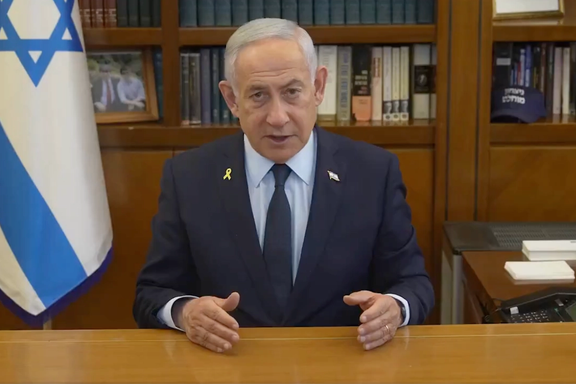
Israeli Prime Minister Benjamin Netanyahu

Israeli Prime Minister Benjamin Netanyahu wished the Iranian people a happy Nowruz in a video message on Thursday, calling for freedom from what he described as the oppression of the Islamic Republic.

"I would like to wish the Iranian people, and Persians everywhere, a happy Nowruz...I wish you freedom," Netanyahu said.

"Real freedom. Freedom from oppression..." he added.

Netanyahu said he wished for a year in which "the people of Iran can finally enjoy Iran's rich natural resources, those resources that have been so long denied to you by an oppressive regime."

He also called for "security" in spiritual, economic, and physical terms, as well as "friendship" with those who "have your best interests at heart, and that includes my country, Israel."

Netanyahu has frequently addressed the Iranian people in video messages, positioning himself as a supporter of Iranian opposition to the country’s leadership.

His message comes amid rising tensions between Iran and Israel, as Israeli officials continue to push for stronger action against Iran's nuclear program.

Earlier this month, Israel's new military chief, Eyal Zamir, warned that 2025 would be focused on war with Iran and its allied groups across the region, underscoring the risk of escalation.

Most Viewed

Iran diplomacy wobbles as factions compete to avoid looking soft on US
1
INSIGHT

Iran diplomacy wobbles as factions compete to avoid looking soft on US

2
ANALYSIS

The politics of pink: how Iran uses cuteness to rebrand violence

3

Scam messages seek crypto for ships’ safe passage through Hormuz, firm warns

4
EXCLUSIVE

Family told missing teen was alive, then received his body 60 days later

5
INSIGHT

Is Iran entering its Gorbachev moment?

Banner
Banner

Spotlight

  • Diplomacy tolls at Hormuz as conflict returns to its doorstep
    OPINION

    Diplomacy tolls at Hormuz as conflict returns to its doorstep

  • Opposition to US talks grows in Tehran as ceasefire deadline nears
    INSIGHT

    Opposition to US talks grows in Tehran as ceasefire deadline nears

  • Tehran moderates see ‘no deal–no war’ limbo as worst outcome
    INSIGHT

    Tehran moderates see ‘no deal–no war’ limbo as worst outcome

  • The future has been switched off here
    TEHRAN INSIDER

    The future has been switched off here

  • Lights out, then gunfire: Witnesses recount Mashhad protest crackdown
    VOICES FROM IRAN

    Lights out, then gunfire: Witnesses recount Mashhad protest crackdown

  • Is Iran entering its Gorbachev moment?
    INSIGHT

    Is Iran entering its Gorbachev moment?

•
•
•

More Stories

Exiled prince calls for global support to overthrow Islamic Republic

Mar 20, 2025, 16:38 GMT+0

Iran's exiled prince Reza Pahlavi urged world leaders, including US President Donald Trump, to stand with Iranians in their struggle for freedom in an address marking their New Year on Thursday.

"Together, we can dismantle the Islamic Republic and end decades of global terror, blackmail, and hostage-taking," he said in the video, titled A Norooz Message to the World: Imagine a New Iran.

"I extend our hand in friendship and partnership— to our neighbors from Israel and the Arab states, to our steadfast allies in the West, including President Trump and the United States, and to leaders across Europe and the G7," he added.

Pahlavi's remarks come amid rising tensions between Washington and Tehran, following an ultimatum from Trump, who sent a letter to Iran's Supreme Leader Ali Khamenei proposing direct negotiations for a new nuclear agreement or face potential military consequences.

Khamenei rejected Trump's letter last week as deceptive, saying Trump's demands would intensify sanctions and increase pressure on Iran.

"A free Iran is no longer a distant dream; it is a reality being forged today by the hands of its own people," Pahlavi said. "The question is not whether Iran will be free, but which nations will be with us in the fight and make our victory sweeter."

He framed the fall of the Islamic Republic as a turning point for global security, arguing that Iran’s current leadership has fueled instability across the Middle East and beyond.

"This new reality will profoundly benefit not only Iranians but citizens everywhere—from the cities of America to the capitals of Europe, from Israel to the Arab world."

Calling himself a servant of the Iranian people, he declared his commitment to leading what he described as historic change, promising a clear and actionable plan to dismantle the Islamic Republic.

While Pahlavi's supporters view him as a unifying figure in the opposition, some Iranians—particularly those skeptical of monarchy—express reservations about his political vision for Iran’s future.

Pahlavi has made clear in interviews, including in an interview with the German outlet Spiegel, that he does not advocate for either a monarchy or a republic, emphasizing that the Iranian people should determine their future governance through a democratic vote.

Tens of thousands of Iranians gathered at major historical sites across the country on Thursday to mark Nowruz, chanting national and pro-monarchy slogans in defiance of the Islamic government.

"Imagine the Middle East liberated from the shadow of nuclear blackmail and threats. Imagine our region without endless proxy wars, extremist ideologies, and terrorism—all driven by a regime whose policies have caused mass migration, instability, and suffering far beyond Iran’s borders," he added.

Houthis target Israel’s Ben Gurion Airport while US continues Yemen strikes

Mar 20, 2025, 10:43 GMT+0

Millions of Israelis took to shelters in the early hours of Thursday morning as Yemen’s Houthis stepped up air attacks on Israel while the US continues to hit deep into the Iran-backed militant group's infrastructure.

"A missile launched from Yemen was intercepted by the IAF [Israeli Air Force] prior to crossing into Israeli territory. Sirens were sounded in accordance with protocol," a statement from the Israeli military said referring to the incident shortly before 4am Thursday.

The Houthis said the missile was a Palestine 2 hypersonic ballistic missile in a statement on their Telegram channel after having been banned from X in the wake of the US returning the group to the list of foreign terrorist organizations in January.

The Houthis said Thursday morning’s missile was aiming at Ben Gurion Airport in Tel Aviv, forcing flights including those from London and Abu Dhabi to re-route and raising questions about the recent return of commercial flights to the Jewish state.

The latest missile attack on Israel comes amid US strikes on Houthi infrastructure including in the capital they control, Sanaa, as President Donald Trump vowed to crack down on the Iran-backed militants currently targeting US assets in the Red Sea, in addition to its ongoing blockade of commercial shipping.

On Monday, Trump threatened to hold Iran accountable for any future Houthi attacks, warning of “dire” consequences in spite of military and political figures in Tehran maintaining that the group operates independently.

On Wednesday, he said it is not enough for Iran to reduce its support of Houthis and all arms provisions must end, citing reports that Tehran has rolled back its supplies to the Yemen group.

The Houthis' military actions were triggered by the resumption of fighting in Gaza this week as Israel vows to use military force to bring back the nearly 60 Israeli hostages, many of whom have been killed in captivity since being held by Iran-backed Hamas since October 7 2023, after a US-brokered ceasefire collapsed.

In allegiance with Hamas, the Houthis have carried out over 100 attacks on commercial shipping in the Red Sea region since November 2023 along with dozens of missile and drone attacks directly targeting Israel. After a near two-month lull, they have resumed attacks, notably targeting Iran's regional adversary.

On Tuesday, the Israeli military confirmed Houthis claims that they had fired a ballistic missile towards Israel, warning they would expand their range of targets in the coming days.

In the largest military operation since Trump's return to office, the Pentagon reported striking 30 targets in Yemen since Saturday. Subsequently, the Houthis claimed multiple direct attacks on the USS Harry S. Truman in the Red Sea, beginning Sunday.

In a Foreign Policy article, Royal United Services Institute fellows Burcu Ozcelik and Baraa Shiban argued that while Iran’s largest ally Hezbollah has been weakened, the Houthis have stepped into the breach.

“While Hezbollah has retreated to rebuild its military capabilities, the Houthis have shown resolve to step up, issuing ultimatums to Israel and acting brazenly to consolidate their domestic grip on power,” they said.

“The Houthis see themselves as playing the role that Hezbollah once played.”

The Yemen experts say that additionally, the Houthis have increased their footprint in Iraq, with their members being embedded with Shiite Iraqi militias, which has also helped them created new and plug into existing shell companies to benefit from the Iraqi financial system that operates “at the behest of Iranian interests”.

“Iran has helped the Houthis in proliferating drones and ballistic missiles. Tehran views the group as a valuable ally and will not shy from directing the IRGC’s efforts to bolster the Houthis’ capabilities even as Iran is under pressure domestically after expenditures in the billions of dollars to prop up Hezbollah, Hamas, and the Assad regime,” they added.

However, with Trump’s determination to punish Iran for the Houthis’ actions, the situation could become more complex.

“In the short term, the Houthis are gaining some recognition and can sustain if they are not facing strong military pressure—something that can change under the Trump administration,” they said.

Another year ends with the erosion of Iran’s governing institutions

Mar 20, 2025, 09:05 GMT+0
•
Behrouz Turani

The Iranian year 1403, which ended on March 20, saw the further weakening of major state institutions as Supreme Leader Ali Khamenei tightened his grip over a network of overlapping bodies, some of which he created himself.

Nonetheless, while the weakening of state institutions, including the parliament and the presidency, has largely succeeded, it does not mean Khamenei rules unchallenged.

As the country’s economy sinks deeper into crisis, many challenges come from within his own conservative camp, where critics—often quietly—hold him responsible for the system’s failures, referring to him indirectly as the "political system."

Throughout the year, Iran struggled with a broken economy and the looming threat of political unrest. Gas and electricity shortages have plagued both industries and households for months, while officials warn of an impending water crisis. Meanwhile, the US dollar has doubled in value against the rial. Most Iranians now see Khamenei as the primary figure responsible for these crises.

With the death of former President Ebrahim Raisi in a helicopter crash in May 2024—widely seen as appointed rather than elected—the Islamic Republic’s leader had to find another obedient aide to serve as a silent partner in governing. But the new president proved to be even more obedient than Khamenei expected.

Rescued from disqualification by the Guardian Council at Khamenei’s behest, he has repeatedly acknowledged that he would not be president without the Supreme Leader’s favor. He has gone even further, openly stating that he has no independent plans or platform and will simply implement Khamenei’s vision for the country.

In a recent example, he told parliament that while he initially supported negotiations with the United States over Tehran’s nuclear program, he opposed them as soon as Khamenei dismissed the idea. “It is as simple as that,” he explained.

The Iranian parliament (Majles), shaped by Khamenei and the Guardian Council in its two most recent elections, was engineered to ensure an overwhelming majority of hardline conservatives. The Guardian Council disqualified nearly all moderate and pro-reform candidates as part of what former Majles Speaker Ali Larijani described as "political purification."

Under both Raisi and Pezeshkian, key decisions on critical issues, including the annual budget and contentious matters like the compulsory hijab bill, were made by the heads of the three branches of government or the Supreme Council of National Security, rather than the Majles. Government insiders often criticize the parliament as "illiterate and inefficient."

The Assembly of Experts, tasked with selecting the next Supreme Leader, has been effectively sidelined, as a three-member committee reporting exclusively to Khamenei now secretly vets candidates for his consideration alone.

Meanwhile, the council’s deputy chief, Ahmad Khatami, was stripped of his privileges for violating unwritten rules set by Khamenei.

The Guardian Council's decisions have also been occasionally overturned by Khamenei himself, allowing disqualified candidates such as Mostafa Moein, Mohsen Mehr Alizadeh, and Massoud Pezeshkian to run for president.

The Expediency Council has become so ineffective and paralyzed by intimidation that it has failed to issue a verdict on approving laws meant to improve Iran’s compliance with international regulation against money laundering.

For years, Khamenei has not publicly assigned it any new responsibilities, instead making all key decisions himself.

Until five years ago, when these institutions functioned with a degree of quasi-efficiency, some Western observers described Iran’s system as resembling a democracy. Today, such a characterization is no longer plausible. Iran’s political landscape is now "unique" for all the wrong reasons.

Iran releases French tourist jailed on espionage charges after 887 days

Mar 20, 2025, 07:20 GMT+0

French citizen Olivier Grondeau was released from 887 days in detention in Iran, French President Emmanuel Macron announced on Thursday in a post on X.

“Our mobilization will not weaken: Cécile Kohler and Jacques Paris must be freed from Iranian jails,” Macron said, referring to other citizens still left behind.

Cécile Kohler and Jacques Paris were arrested in May 2022 while traveling in Iran as tourists, accused of espionage.

Grondeau’s release comes after months of pressure from Paris, which had been demanding the release of its citizens.

In January, Grondeau publicly revealed his identity for the first time in a recorded phone call from prison, aired by France Inter. He described his detention as arbitrary and unbearable.

The 34-year-old tourist, who was arrested on October 12, 2022, in Shiraz during a world tour, said he was a victim of political blackmail as France and Iran negotiated his case.

He was later sentenced to five years in prison for “espionage and conspiracy against the Islamic Republic” and was held in Evin Prison, in a section designated for foreign and dual-national detainees. Exact numbers of such prisoners rights groups brand 'diplomatic hostages', remain undisclosed.

During his phone call, Grondeau pleaded with French authorities to secure his release and expressed hope that his request for parole would be granted.

The French Foreign Ministry, which had already summoned Iran’s ambassador on January 10, denounced the detention conditions of Grondeau, Kohler, and Paris.

“Their situation is intolerable, with inhumane detention conditions that, in some cases, constitute torture under international law,” the ministry stated.

Grondeau shared a cell with 18 other detainees and had limited access to a library and books sent by the French embassy. He also highlighted the harsher conditions faced by Kohler and Paris in his message.

“You, who have the power to influence this matter, hear this truth,” Grondeau said, addressing French authorities.

“Cécile’s strength, Jacques’ strength, Olivier’s strength—it is all running out.”

“Your responsibility is called upon to ensure the survival of three human beings.”

The IRGC has arrested dozens of dual nationals and foreign citizens in recent years, mostly on espionage and security charges.

Most recently, an Italian journalist was released following an arrest that was widely seen as leverage to pressure Italy into freeing an Iranian imprisoned on terrorism charges.

Exiled prince calls for 'final action' against Iran's rulers

Mar 19, 2025, 19:07 GMT+0

Iran's exiled prince Reza Pahlavi urged all Iranians on the eve of their New Year to join forces to topple a ruling system that he said is on the verge of collapse.

“We enter the New Year at a time when the Islamic Republic is at its weakest and most ineffective," Pahlavi said in a video address to Iranians posted on X on Wednesday.

"A unique window of opportunity has emerged for major change and the liberation of Iran from religious tyranny," he added, citing the blows to Tehran's regional influence during the conflict with Israel in the year past.

"The coming year is the year of organizing for the final move."

The New Year in Iranian calendar begins on March 20th, when state media broadcast official address by Iran's president and supreme leader---who sets the agenda for the year ahead, usually with a phrase summing it up.

Pahlavi's message on the eve of the New Year is aimed to cement his position as a prominent opposition figure whose supporters see as Iran's best hope to undo the revolution that ousted his father Mohammad Reza in 1979.

"In the past year, at your call, I accepted the responsibility of leading the national revolution and the transition period," Pahlavi said in his address, calling for dissidents to put aside their differences.

Those supporting the exiled prince consider him to be peerless and above political groupings and coalitions. His critics among the opposition question this assertion and accuse Pahlavi's supporters of stifling debate by attacking those dissidents who do not follow him or criticize his father, the last Shah of Iran.

Pahlavi appeared to address this rift in his message.

"At the start of this new year, I urge all of you, my dear compatriots, to use this occasion to be kinder to one another and to stand more united against our common enemy—the Islamic Republic," he said.