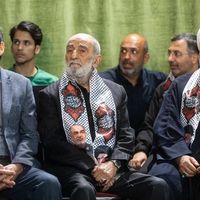
Three prominent politicians discussing Iran's political and economic impasse.
Three prominent centrist and conservative figures in Iran have suggested that the country’s political doctrine must change to address its ongoing problems, especially the economic impasse.
During a roundtable discussion hosted by Sazandegi newspaper, conservative politician and Expediency Council member Mohammad Reza Bahonar, former senior lawmaker and centrist politician Hossein Marashi, and Mahmoud Vaezi, a senior aide to former president Hassan Rouhani, carefully avoided directly naming Supreme Leader Ali Khamenei as the ultimate authority responsible for the country’s major shortcomings.
They spoke cautiously, as some of their critical remarks touched on highly sensitive topics, including constitutional changes and political reforms. The veteran political insiders would not have voiced such criticisms publicly two or three years ago, before Iran's regional influence began to wane and its economic situation reached a critical stage.
They highlighted issues including the government's lack of resources, largely due to massive expenditures in the Middle East aimed at undermining Israel—spending that was undertaken without the consent of the Iranian people or parliament (Majles), as they noted.
Marashi said, "Iran's priority should be addressing its economic crisis," and "politics in Iran should not be left to military organizations," likely referring to the central role the Revolutionary Guards play both in political and economic spheres.
He added: “The government’s priorities remain focused on outdated ideological issues, such as enforcing the hijab on women and restricting access to information on the Internet, rather than tackling the country’s pressing economic crises.”
These failures have left the nation struggling in darkness and cold since November, as the oil-rich country continues to fall short in producing sufficient natural gas and electricity in generating sufficient oil export revenues.
A huge part of the country's income from oil is kept outside the government's treasury and under direct supervision of the Supreme Leader and the Revolutionary Guard.
On December 16 all government offices and schools in 26 of the 31 Iranian provinces were shut down due to blackouts, power shortages and consumption of pollutant fuels in many power plants.
Without elaborating on what was wrong with the Iranian Constitutional Law, Bahonar said that “all the articles of the constitution can be revised except a few that are about the essence of Islam and the nature of the political system as a republic.”
His remarks likely implied that institutions such as the Guardian Council, which hinder free and fair elections, could be dismantled, and that articles granting extraordinary powers to the Supreme Leader could be revised. This would help curb unnecessary spending on religious institutions and costly military ventures abroad.
Elsewhere in their debate, the three politicians said that many of Iran's problems are caused by flaws in the structure of its political system. Without saying how the current system has led to a dictatorship under the Supreme Leader, they called for a democratic political system like those in Japan, Pakistan, Germany, France and the United States.
Marashi criticized Pezeshkian for taking pride in lacking a clear plan for his government or a political party to advance his ideas. He also pointed to the Islamic Republic’s core doctrine, which centers on its ongoing struggle against what it calls “arrogant powers”—a concept now largely synonymous with anti-Americanism.
He argued that “this doctrine cannot drive meaningful progress and must be reformed, much like how China abandoned its rigid ideological approach to achieve development.”
Marashi went on to question the extensive powers of Iran's Judiciary and the absence of judicial independence. He also criticized the current Majles for consistently obstructing the government’s ability to fulfill its responsibilities.
Additionally, he emphasized that Iran’s economy has been held hostage by its nuclear program for the past 19 years. Highlighting the fall of Bashar al-Assad in Syria, he said: “Even maintaining our allies in power depends on prioritizing the economy.”
At the same time, perhaps in an effort to absolve President Masoud Pezeshkian of responsibility for the current crises, three other conservative figures, in reports published by Nameh News website, emphasized that "the Pezeshkian administration has inherited the current economic and political problems from previous governments."
A woman in Iran standing hijab-free in front of a poster promoting hijab
Supreme Leader Ali Khamenei urged Iranian women to resist foreign influence, warning that enemies use soft tactics to incite riots under the pretext of defending women’s rights.
“Everyone, especially women, should be vigilant about the enemy’s soft tactics and not be deceived by slogans and temptations,” Khamenei said in a meeting with a group of women on Tuesday.
"They label it as defending women, advocating for women's rights, or supporting a group of women," he added, pointing to the 'Woman, Life, Freedom' movement. "Yet, under the pretext of defending a single woman, they incite unrest in the country."
The 2022 Woman, Life, Freedom movement began after the death of 22-year-old Mahsa Amini in police custody. The ensuing crackdown, which led to the deaths of at least 550 protesters, was described as a crime against humanity by a UN fact-finding mission.
In his first public statements following the uprising in 2022, Khamenei said the protests had been engineered by Iran's enemies and their allies.
As the hijab war continues, the government has now officially postponed the implementation of the latest and most controversial hijab law, which imposes severe penalties on women and girls who defy veiling requirements, following widespread backlash from the public and international community.
Iran's Supreme National Security Council, in a letter to parliament on Saturday, requested that the implementation of the Hijab and Chastity law be halted. A member of the parliament's presiding board stated that this delay is to allow the government to submit an amended version of the bill for parliamentary review.
Last week, Amnesty International condemned the new law, stating that it intensifies the oppression of women and girls while exposing activists opposing the rules to charges that carry the death penalty.
Amnesty noted that the law, drafted in May 2023, less than a year after the Woman, Life, Freedom uprising, was introduced in response to widespread defiance of compulsory veiling by women and girls.
Iran-backed forces will endure - Khamenei
In his speech, Khamenei emphasized that Tehran's armed groups in the region, including Hamas and Hezbollah, remain strong despite significant challenges posed by external forces.
Addressing the situations in Gaza, Lebanon, and Syria, Khamenei condemned the actions of the United States and Israel, calling their assumption that resistance would end a grave miscalculation.
"They thought resistance was over," Khamenei said. "They are gravely mistaken. The spirit of Seyyed Hassan Nasrallah is alive; the spirit of Sinwar is alive. Their martyrdom has not removed them from existence. Their path continues."
Khamenei dismissed Israel's military operations in Syria, warning that its efforts to encircle and eliminate Hezbollah forces would ultimately fail. "The one who will be uprooted is Israel," he said.
While Israel maintains that it has no interest in conflict with Syria and rarely comments on specific strikes, it has carried out a series of operations targeting weapons facilities and military infrastructure. Since the fall of President Bashar al-Assad, Israel has intensified strikes against military installations across the country.
On Monday, multiple large explosions rocked Syria's coastal areas — home to Russian and pro-Assad military bases, according to the Syrian Observatory for Human Rights.
Israel also maintains troop presence inside the buffer zone and beyond, citing efforts to prevent a repeat of the October 7 attacks, in which Iran-backed Hamas infiltrated Israeli territory, killing over 1,100 people and taking more than 250 hostages.
Iran's Foreign Ministry Spokesman Esmail Baghaei during a press conference on December 17, 2024
Iran will reopen its embassy in Syria, which was stormed by militants following the fall of Damascus, but the matter is not imminent until the staff's security is ensured, Foreign Ministry spokesperson Esmaeil Baghaei said on Tuesday.
“I prefer not to use the word ‘imminent'," he said. "This is on the agenda, and as soon as the necessary conditions are met—both in terms of security and politics—we will move forward with reopening the embassy."
Video footage shared on the day President Bashar al-Assad fled to Moscow showed militants in the embassy, ransacking documents and vandalizing the facility, with shattered glass and broken furniture seen around the building. Iranian media reported that the staff had fled before it was taken over.
Addressing comments made on Monday by the EU foreign policy chief, Kaja Kallas, that Iran and Russia should have no role in Syria's future, Baghaei said: “This is an interesting joke, and I think when she made this comment, she was probably reading history books. The era when foreign powers could dictate to other regions is over.”
Explaining Iran's role in Syria, Baghaei said: “Our presence in Syria was fundamental and principled, and our withdrawal was responsible. We were not seeking expansionism, dominance, or the revival of past empires. What mattered to us in Syria was helping ensure its security in the fight against terrorism.”
Syria, under Assad, was a key component of Iran’s so-called 'Axis of Resistance,' serving as a vital land corridor for supplying weapons and materiel to Hezbollah in Lebanon. Over the years, Israel sought to disrupt this supply line through hundreds of airstrikes.
During the briefing, he also addressed remarks made by several Iranian politicians that Assad government owes approximately $30 to $50 billion to Iran.
He said the number were exaggerated, saying that the debts will be transferred to Syria's new political system based on the principle of state succession. "These figures, such as the claim of a $50 billion debt owed to Iran by Syria, are truly very exaggerated."
As Iran looks to its future after a battered Syria, Iranian President Masoud Pezeshkian will attend the D-8 summit in Egypt, the spokesman confirmed on Tuesday. The summit of the eight major Muslim developing countries, known as the D-8 Organization for Economic Cooperation, will be held on Thursday.
Habibollah Sayyari, the coordinating deputy of Iran's Army
A senior Iranian military officer has expressed concern over the ideological influence of Iran's enemies and the risk of losing out in a technological race for armaments, in a potential sign of greater official unease following regional setbacks.
"The enemies aim to dominate a nation and its land by taking control of minds; we must protect minds, because if they gain control over them, other efforts will be ineffective," Admiral Habibollah Sayyari said in a speech on Monday.
Since nationwide protests in December 2017, there have been increasing signs that many younger Iranians in particular question the Islamic tenets of the governing establishment and oppose regional adventures in Syria, Lebanon and Yemen.
"Ignoring new threats and technologies will undoubtedly lead to strategic surprises for us," Sayyari added. "It is also essential to pay attention to disruptive concepts in warfare."
Israel’s edge in military tactics and weapons have inflicted serious losses on Iran’s main military proxy, the Lebanese Hezbollah in recent months, and have seriously weakened Hamas, its other ally in the region. The fall of Bashar al-Assad in Syria was the latest serious blow to Tehran’s regional influence.
Israel launched a large-scale air attack against Iran in October, devastating its air defenses and several military installations without encountering any serious defense or retaliation.
These led to more expressions of doubt about the Islamic Republic’s foreign and military policy, which openly declares enmity with Israel.
Even many politicians and commentators linked to the governing establishment in Iran have in recent month called for a review of these policies and a serious attempt to improve relations with the West.
Hossein Salami, the commander-in-chief of the IRGC, referred to the developments in Syria as a bitter lesson on Sunday and said that it stands alongside the lessons learned from the Iran-Iraq War.
Sayyari emphasized the importance of social awareness in confronting enemies and referred to inspiring the politically agnostic within society - a group he referred to as the gray spectrum.
"The best way to counter cognitive warfare is to raise awareness among the gray spectrum and increase public vigilance," the admiral said. "The gray spectrum is influential everywhere, and their intelligence and level of awareness must be enhanced for us to effectively prevent this type of warfare."
Funeral of Abbas Nilforoushan, IRGC Deputy for Operations, in Karbala, Iraq
One of Iraq's few independent newspapers has warned that the country may share Syria's fate of prolonged conflict and upheaval if the government fails to distance itself from the Islamic Republic and undertake urgent reforms.
This news analysis comes after Bashar al-Assad in Syria lost his grip on power after support from Iran and its ally Hezbollah were sapped by over a year of conflict with Israel.
Prime Minister Mohammed Shia' al-Sudani, whose tenure is supported in part by Iran-backed armed groups, may now face pressure to prioritize Iraq’s sovereignty over foreign influence according to the daily.
"Iraq remains internally divided over the repercussions of the situation in Syria, with some still supporting intervention at this point. Factions and some actors in the Shiite political scene align with this view, consistent with Tehran’s stance, which has announced the continuation of resistance," wrote Al-Mada.
The Committee to Protect Journalists has said Al-Mada "is seen as one of the only remaining critical newspapers in Iraq".
Operating under the umbrella of the Popular Mobilization Forces (PMF) and supported by the Islamic Revolutionary Guard Corps (IRGC), these groups wield considerable power over Iraq’s governance, military operations, and energy infrastructure.
Despite their original mandate to combat ISIS, many of the militias have since expanded their activities, frequently targeting US forces and installations in Iraq with rockets and drones, and exacerbating tensions between Tehran and Washington.
The paper also highlighted fears of broader regional destabilization following the fall of Bashar al-Assad in Syria, a key ally of Iran.
"Political forces have started warning about scenarios similar to Syria’s situation if rapid internal reforms are not implemented," wrote Al-Mada, citing thinktanks advising Iraqi government to distance itself from the poor governance of the Shiite political forces that have held power since 2003.
Tehran’s armed affiliates in Iraq may be weakened by the developments in Syria. The Australian Arab Institute for Strategic Affairs recently warned that Baghdad faces a critical juncture: either curb the influence of Iran-backed militias or risk becoming a target for escalating Israeli and US military operations.
Adding to the uncertainty are concerns about the potential reactivation of ISIS sleeper cells given the security vacuum next door.
“Iraq is trying to maintain a somewhat balanced relationship with Washington and not align itself entirely with Tehran,” Rahim al-Aboudi, a senior official in the National Wisdom Movement, was quoted as saying.
Growing public discontent
Domestically, public anger toward Iran’s proxies has intensified in recent years, particularly after their violent suppression of 2019 anti-government protests which criticized Iranian influence.
Hashd al-Shaabi fighters during military drills in Iraq
Social media has amplified these frustrations, with posts encouraging attacks on the Iranian embassy and measures to end the activities of armed groups backed by Tehran.
“Numerous individuals or fake accounts have called for citizens to arm themselves in opposition to Iran-backed forces,” Truske Sadeghi, a former Iran International correspondent posted on X.
The warnings of instability echo fears of a repeat of Iraq’s tumultuous recent past.
Unlike the ISIS incursions of 2014 which originated from Syria, analysts warn that any future unrest could arise from within Iraq’s cities, fueled by the same grievances that sparked the 2019 protests but on a potentially larger scale.
While Baghdad has reiterated that its borders are secure, the government’s inability to effectively manage the influence of IRGC-backed militias has left the country vulnerable to both domestic upheaval and regional spillovers.
As Iraq navigates mounting international and domestic pressures, its leadership could face a critical choice: assert greater control over Tehran-backed forces or risk a deeper descent into instability.
Abdulrahman Fattahi, Iran affairs aide to Syria's de facto leader Muhammad al-Julani
Syria's new ruling Hay'at Tahrir al-Sham (HTS) has appointed a deputy for Iranian affairs known for his jihadist sermons as the group builds ties with Iran's Sunnis in a bid to reduce Tehran's influence in the country.
The appointee, Abdulrahman Fattahi—an Iranian-born Sunni cleric and former imam—brings a history of Salafi activism and ideological influence that could help shape HTS’s strategy toward Iran and the Kurdish regions.
Sources close to Fattahi, who withheld their identity for security reasons, told Iran International that his early influence drew criticism from Iranian authorities and eventually led to multiple arrests, culminating in his imprisonment before his departure to Syria in 2015.
Shaped by Salafi teachings
Fattahi’s religious education began in mosques in Mahabad, where he studied Islamic theology under Kurdish clerics. His leanings toward Salafi ideology deepened after he traveled to Iraqi Kurdistan in 1992 to study under Abdulqader Tawhidi, a leading figure in the Tawhid Movement for Iranian Sunnis. Tawhidi’s teachings, rooted in emulating the practices of Salafism, shaped Fattahi’s doctrinal beliefs.
Fattahi, also known as Abu Safiya al-Kurdi, has spent decades advocating Salafi-jihadi ideology. Born in Sulgheh, a village near Mahabad in Iran’s Kordestan Province, his early life and religious studies set the foundation for a trajectory that led from local leadership to regional prominence.
After completing his studies in 1996, Fattahi joined the Islamic Movement of Kurdistan, which maintained ties with Iran’s government. He returned to Iran in the late 1990s, where he became the imam of Ziveh, a village near Mahabad. His Salafi views gained him followers but also drew scrutiny, with Iranian authorities repeatedly detaining him. His last arrest in 2011 resulted in a three-year sentence in Rajaei Shahr Prison near Tehran.
Abdulrahman Fattahi, Iran affairs aide to Syria's de facto leader Muhammad al-Julani
Rise in Syria’s jihadist networks
After his release in 2014, Fattahi left Iran and joined jihadist groups in Syria, where he became a prominent figure in the Movement of Sunni Migrants of Iran. This HTS-aligned faction, formed in 2019, consists of Iranian Sunni jihadists who pledged allegiance to HTS’s predecessor, Jabhat al-Nusra.
In HTS-controlled Idlib, Fattahi rose to senior positions, serving as a Sharia judge and Mufti. Video footage shows him delivering fiery sermons in Kurdish, praising figures like Osama bin Laden and denouncing Iran’s Shia rulers as “Rawafid” (rejectors). In these speeches, he vowed to “liberate Iran’s Sunnis from occupation.”
The source who spoke to Iran International detailed Fattahi’s ability to inspire Kurdish jihadists. His rhetoric, the source said, “combines religious authority with political strategy, making him a key figure in HTS’s evolving regional plans.”
Fattahi’s reported appointment as deputy for Iranian affairs to HTS leader Abu Mohammad al-Joulani signals a potential shift in the group’s regional strategy.
Al-Joulani recently described Iran’s presence in Syria as a significant threat. He said: “We were able to end the Iranian presence in Syria, but we are not enemies of the Iranian people.”
Fattahi’s Kurdish roots and ideological stance position him to influence HTS’s approach to both Iran and the Kurdish regions. His prominence suggests that HTS is leveraging Iranian Sunni dissidents to consolidate its control in Idlib while countering Tehran’s influence in Syria.
For Tehran, Fattahi’s role represents a direct ideological and strategic challenge. His leadership highlights the enduring influence of transnational Sunni jihadist networks and highlights the vulnerabilities posed by Iranian Sunni dissidents.
As HTS seeks to balance its Salafi roots with pragmatic goals in Syria’s fragmented conflict, figures like Fattahi demonstrate the group’s adaptability.
His ascent could also further complicate Iran’s efforts to maintain its foothold in Syria - a key smuggling route to its military allies in the region and trade route amidst sanctions - while countering the resurgence of Sunni militancy on its borders.
Salafis, an ultraconservative branch of Sunni Islam, emphasize a return to the practices and beliefs of the early Muslim community (the Salaf Salih or pious predecessors) and often view later interpretations of Islamic teachings as deviations.
Their rigid adherence to this ideology has historically put them at odds with Shia Muslims, whom they label as Rawafid (rejectors) for not recognizing the legitimacy of the first three caliphs and for their veneration of Imams. Salafis accuse Shias of deviating from the core principles of Islam, regarding many of their rituals and beliefs as innovations (bid’ah) forbidden in Islam.
This animosity has fueled sectarian tensions in regions where Salafis seek influence, often leading to violent clashes. Militant Salafi-jihadi groups, such as ISIS and al-Qaeda, have taken this opposition to an extreme, targeting Shias in their campaigns, excommunicating them (takfir), and justifying violence against them as part of their broader ideological and political objectives. This sectarian divide continues to play a significant role in the dynamics of conflicts across the Middle East.
Image of Abdolrahman Fattahi in Rajaei Shahr Prison in IranKurdish members of the Movement of Sunni Migrants of Iran training militarily in IdlibAbdolrahman Fattahi (in white shirt) in a meeting with Abu Mohammad al-Julani (on chair) in Idlib