• العربية
  • فارسی
Brand
  • Iran Insight
  • Politics
  • Economy
  • Analysis
  • Special Report
  • Opinion
  • Podcast
  • Iran Insight
  • Politics
  • Economy
  • Analysis
  • Special Report
  • Opinion
  • Podcast
  • Theme
  • Language
    • العربية
    • فارسی
  • Iran Insight
  • Politics
  • Economy
  • Analysis
  • Special Report
  • Opinion
  • Podcast
All rights reserved for Volant Media UK Limited
volant media logo
INSIGHT

Iran diplomacy wobbles as factions compete to avoid looking soft on US

Behrouz Turani
Behrouz Turani

Iran International

Apr 21, 2026, 02:02 GMT+1
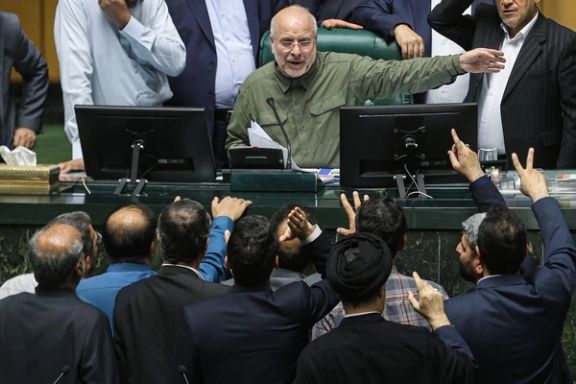
Iran's parliament speaker and chief negotiator Mohammad Bagher Ghalibaf argues with MPs in this prewar file photo

Apparent divisions over negotiations with the United States may have strengthened the most confrontational elements within Iran’s political landscape and facilitated the rise of new hardline actors.

Backed by the more uncompromising faction within the senior ranks of the Islamic Revolutionary Guard Corps (IRGC), these emerging hardliners have been testing their ability to disrupt talks that already face significant obstacles.

Within the IRGC itself, commanders appear to be split into at least two camps. One faction, associated with IRGC Commander Ahmad Vahidi and Supreme National Security Council (SNSC) Secretary Mohammad Bagher Zolghadr, is widely described by Iranian observers as favoring continuation of the conflict.

The opposing faction aligns more closely with former IRGC Air Force commander and current Majles Speaker Mohammad Bagher Ghalibaf. He is believed to retain influence within the IRGC’s aerospace branch and to maintain ties to the household of Iran’s slain leader Ali Khamenei, including his son Mojtaba.

Despite their rivalry, both factions share a core objective: ensuring the survival of the Islamic Republic. Their disagreement lies in the methods and strategic direction needed to achieve that goal.

Similar infighting existed before the latest war and under Ali Khamenei, but the absence of a figure with comparable authority appears to have widened the field to rival forces.

Among civilian political actors, many have attempted to distance themselves from the ultraconservative Paydari Party, which has been the loudest anti-American voice in Tehran for some time. Yet their ideological and personal links to Paydari figures remain evident.

Even Ghalibaf, now seen by many as the de facto leader of Iran’s “pragmatic” camp, has referred to these actors as a radical militia. He has also hinted at their connections to Paydari-aligned figures such as former nuclear negotiator Saeed Jalili and hardline lawmaker Amir Hossein Sabeti, both of whom journalists in Tehran accuse of enticing anti-talks rallies.

Over the weekend, an X account identifying itself as “Fans of Saeed Jalili” sharply criticized Ghalibaf and Foreign Minister Abbas Araghchi, accusing them of falsely suggesting that their more moderate positions toward Washington had been endorsed by Mojtaba Khamenei.

The account demanded that Mojtaba appear publicly—or at least release an audio or video message—to clarify his political intentions. The post was deleted within an hour, and Jalili later distanced himself from its content, though he did not deny links to the account.

Ghalibaf has also criticized calls to continue the war, referring to the large crowds of mostly young Iranians who have taken to the streets nightly to demand renewed attacks on the United States and Israel.

In an unprecedented televised address on Sunday, he told the nation that Iran “controls the battlefield,” but acknowledged that “the US and Israeli militaries are far stronger and more experienced than Iran’s.”

Meanwhile, several members of parliament—including Ali Khezrian, Hamid Rasai and Morteza Mahmoudi—have been reported to be encouraging efforts to unseat Ghalibaf as speaker and to push for the impeachment of Foreign Minister Abbas Araghchi.

Whether these pro-war factions are strong enough to derail the Islamabad talks remains uncertain. The deeper issue is that while Ali Khamenei often managed factional rivalries to maintain control, the emerging leadership—what President Trump has referred to as the “new regime in Iran”—has yet to demonstrate the same ability to balance competing forces.

Under Khamenei, domestic politics remained a relatively contained arena in which rival factions competed but ultimately operated within boundaries he enforced.

The new leadership now faces a far more volatile environment: major military powers are directly engaged in the region, and the Middle East remains perched on a geopolitical powder keg.

Most Viewed

Ghalibaf defends Iran-US talks amid hardline backlash
1
INSIGHT

Ghalibaf defends Iran-US talks amid hardline backlash

2
ANALYSIS

From instability to influence: Pakistan’s pivotal role in US-Iran diplomacy

3
VOICES FROM IRAN

Bread shortages, soaring prices strain households in Iran, residents say

4
ANALYSIS

100 days on: why Iran’s January protests spread across social classes

5

War-hit homeowners feel abandoned as Iran’s reconstruction aid fades

Banner
Banner

Spotlight

  • Iran diplomacy wobbles as factions compete to avoid looking soft on US
    INSIGHT

    Iran diplomacy wobbles as factions compete to avoid looking soft on US

  • The politics of pink: how Iran uses cuteness to rebrand violence
    ANALYSIS

    The politics of pink: how Iran uses cuteness to rebrand violence

  • Bread shortages, soaring prices strain households in Iran, residents say
    VOICES FROM IRAN

    Bread shortages, soaring prices strain households in Iran, residents say

  • 100 days on: the anatomy of Iran’s January crackdown
    INSIGHT

    100 days on: the anatomy of Iran’s January crackdown

  • Ghalibaf defends Iran-US talks amid hardline backlash
    INSIGHT

    Ghalibaf defends Iran-US talks amid hardline backlash

  • From instability to influence: Pakistan’s pivotal role in US-Iran diplomacy
    ANALYSIS

    From instability to influence: Pakistan’s pivotal role in US-Iran diplomacy

•
•
•

More Stories

The politics of pink: how Iran uses cuteness to rebrand violence

Apr 20, 2026, 23:47 GMT+1
•
Negar Mojtahedi

Pink missiles, pink drones and pink firearms. Women with uncovered hair—braids, ponytails, short bobs—stood beside weapons, waved flags and smiled for cameras in scenes broadcast across Iranian media. Tehran appears willing to try almost anything to preserve power.

Critics say the imagery forms part of a new Islamic Republic campaign that pairs missiles with fashion, war with pop culture and force with softness.

Liora Hendelman-Baavur, author of Creating the Modern Iranian Woman, told Iran International the visuals resemble Japan’s “kawaii” culture — imagery built around cuteness — but applied here to rockets and war.

“I think it is trying to make violence look cute,” Hendelman-Baavur said. “It is trying to appeal to the youth, to Gen Z.”

She said the campaign appears aimed at a generation that has filled streets, campuses and online spaces during years of unrest.

“We hear a lot of very aggressive and violent language coming from officials,” she said.

“And we also see it in many of the posters and murals being displayed in Iran. Violence and missiles — with red as the central color — are meant to show they are invincible and victorious. And on the other hand, we have this very light, pinkish, idyllic way of presenting a different reality … to demonstrate a whole different picture of what is really going on.”

A pink-painted missile bearing Persian script sits on display, turning a weapon of war into a piece of stylized propaganda.
100%
A pink-painted missile bearing Persian script sits on display, turning a weapon of war into a piece of stylized propaganda.

The result, she said, is two messages at once: murals, rockets and threats for one audience; pink colors, uncovered hair and festival scenes for another — a duality.

The campaign comes just over 100 days after one of the deadliest crackdowns in modern history, when at least 36,500 people were killed during the bloodiest days of the uprising on January 8 and 9 alone. The Islamic Republic continues to execute political dissidents linked to the January protests.

Any publicity — even negative — is good

For Iranian pop culture expert Siavash Rokni, the scenes are less about change than circulation.

He called the imagery a public relations stunt meant to fill feeds, group chats, broadcasts and headlines with new pictures after months of funeral processions, executions, arrests and mourning.

“With PR stunts, it doesn’t matter if it’s good or bad — what matters is that it circulates,” Rokni said.

He said many Iranians know the difference between staged images and daily life, but viewers abroad may not.

“What worries me isn’t Iranians — it’s people outside Iran who might see this and think everything is normal. That’s where it becomes dangerous.”

Others say the campaign also keeps state control over women at the center of public life. Even without hijab, women’s faces, hair and bodies remain tools in official messaging.

Retreat — for now — on Islamist ideology

It may also point to pressure inside the system itself.

Arash Azizi, author of What Iranians Want: Women, Life, Freedom, told Iran International the Islamic Republic was founded on the goal of building a uniformly Islamist society. If it now loosens one of its core social codes, he said, that carries meaning beyond style.

“They understand that they have to give up on this Islamist ideology,” Azizi said.

He also rejected claims that the war has produced a broad wave of new support for the state.

“There’s no evidence that tons of people were anti-regime before the war and are pro-regime now,” he said.

For now, the pink paint may soften the image, but it does not erase the prisons, the executions, the graves or the anger that still runs beneath the surface of Iran.

Iran says no decision yet on talks as Pakistan prepares to host US team

Apr 20, 2026, 12:05 GMT+1

Iran said on Monday it had not yet decided whether to join a second round of talks with the United States, even as Pakistan prepared to host a US delegation, with Tehran accusing Washington of violating the ceasefire and showing no real seriousness about diplomacy.

Foreign Ministry spokesperson Esmaeil Baghaei said Iran had no plan as of now for the next round of negotiations and said US actions had only deepened mistrust.

“As I am speaking to you now, we have no plan for the next round of negotiations,” he said.

Baghaei said Washington had undermined the process from the outset of the ceasefire.

He said the United States first tried to argue that Lebanon was not part of the truce, despite Pakistan’s mediator saying otherwise, and then continued what Iran describes as a naval blockade and other hostile actions in and around the Strait of Hormuz, including an attack on an Iranian commercial vessel.

He said such actions were clear ceasefire violations and that the blockade itself amounted to aggression under international law.

“Behavior and words are completely incompatible,” he said, adding that Iran would decide its next steps based only on national interests, not deadlines or ultimatums.

Baghaei said Iran had not started the war and had acted only in self-defense. He warned that if the United States or Israel launched any new attack, Iran’s armed forces would respond.

He also said Tehran could not forget what he called two US betrayals of diplomacy over the past year, saying Washington had twice attacked Iran during diplomatic processes.

“We cannot forget that twice America betrayed diplomacy,” he said.

Pakistan remains sole mediator

Baghaei said Pakistan remained Iran’s only formal mediator, though other countries were making efforts.

He said Iran was still reviewing the latest package conveyed through Pakistan after a US 15-point proposal, Iran’s 10-point response, discussions in Islamabad and further review during Pakistani army chief Asim Munir’s visit to Tehran.

He rejected suggestions that Iran had made a wholly new proposal, saying Tehran’s position had remained steady while the US side kept changing its demands.

“The American side keeps changing its demands, but we have remained steadfast,” he said.

He said some US demands were unacceptable and that repeated insistence on them would not change Iran’s position.

Baghaei also dismissed trust as a basis for negotiations with Washington.

“There is no trust,” he said.

Hormuz, Europe and red lines

Much of Baghaei’s remarks focused on the Strait of Hormuz. He said Iran’s actions there were lawful and defensive, arguing that before the US and Israeli attacks there had been no problem in the waterway.

“Before February 28, the Strait of Hormuz was safe and secure,” he said.

He said the international community should hold the United States and Israel responsible for the current insecurity, not Iran.

He added that Iranian authorities were still examining whether recent incidents involving Indian-linked ships had in fact been caused by Iranian forces.

Baghaei said as long as the current situation continued, it was unrealistic to speak of a full return to normal traffic through Hormuz. He said Iran had concluded that new rules or protocols would be needed to ensure safe passage in the future.

He also rejected European criticism, including comments from EU foreign policy chief Kaja Kallas, saying Europe could not invoke international law selectively.

“You cannot use international law as a convenient tool,” he said.

Baghaei said Iran would not negotiate over its defense capabilities and said the transfer of enriched uranium had never been an Iranian option in the talks.

On oil, he said Iran was using all available means to keep its oil industry functioning and maintain exports despite the blockade and wartime pressure.

War-hit homeowners feel abandoned as Iran’s reconstruction aid fades

Apr 20, 2026, 04:56 GMT+1
•
Behrouz Turani

The Iranian government has stepped back from earlier promises to compensate homeowners whose properties were destroyed in US-Israeli strikes, triggering anger among residents who expected the state to take responsibility for rebuilding.

Reports from Tehran suggest the government’s new reconstruction plan has created a deep sense of abandonment among citizens who assumed war-related destruction caused by a national conflict would be covered by the state.

On Thursday, the Iranian Labor News Agency (ILNA) quoted Tehran Province official Mohammad Sadeq Motamedian as saying that “nearly 40,000 residential units across Tehran Province have been damaged.”

Earlier, Donya-ye Eghtesad reported that the Ministry of Roads and Urban Development estimated roughly 45,000 residential and non-residential units were damaged during the March war but did not require demolition, while nearly 1,000 units needed full reconstruction.

Motamedian’s assessment has intensified debate over the true scale of destruction and the government’s approach to rebuilding.

In Tehran, Mayor Alireza Zakani had previously promised full reconstruction of ruined homes and restoration of damaged buildings, but there has been little clarity on how much progress has been made.

The government’s reconstruction strategy became more controversial after spokesperson Fatemeh Mohajerani said on April 15 that the administration would not provide direct financial assistance to rebuild destroyed homes.

Instead, she said the government would offer what officials call “floating density,” a system of additional building permits intended to encourage private developers to help reconstruct damaged housing.

Under the plan, builders could reconstruct damaged or destroyed homes in exchange for permission to add one or two additional floors to new buildings, which they would then be allowed to sell for profit.

Critics say the proposal is unrealistic. Density bonuses cannot compensate families who have lost their homes, especially at a time when construction costs are soaring.

For many displaced households, the absence of direct financial support raises serious questions about how reconstruction could realistically proceed.

Government bodies have also released widely differing figures about the scale of damage. Some officials have suggested only a few thousand homes were affected, while others have put the number in the tens of thousands.

Donya-ye Eghtesad noted that estimates range from about 1,000 homes requiring full reconstruction to tens of thousands with varying levels of damage, leaving residents uncertain about the true scale of destruction and the level of support they can expect.

The discrepancies have fueled speculation that the government may be downplaying the extent of war damage in order to limit financial obligations, reinforcing broader criticism of opaque communication during and after the conflict.

100 days on: the anatomy of Iran’s January crackdown

Apr 20, 2026, 04:02 GMT+1
•
Naeimeh Doostdar

One hundred days after protests erupted across Iran in January 2026, the events still stand out as one of the most widespread and violent protest waves the country has seen in recent years.

What began as an economic protest quickly evolved into a nationwide political crisis, prompting one of the most intense crackdowns in the Islamic Republic’s history.

What distinguishes the January protests from earlier waves is the simultaneous appearance of three dynamics: broad social mobilization, a highly concentrated burst of lethal repression over a very short period, and an organized effort to conceal the scale of the violence.

Unlike some earlier protest waves that were concentrated in specific regions, these demonstrations appeared simultaneously across multiple urban centers, suggesting a buildup of dissatisfaction across different layers of society.

At their peak on January 8, the protests were likely among the largest episodes of social mobilization since the 1979 revolution. The scale of participation appears to have played a key role in shaping the government’s response.

A bloody turning point

The crackdown on January 8 and 9 was unprecedented. Reports and documentation indicate widespread killings during this brief period—violence that can be described as the most concentrated episode of repression in the history of the Islamic Republic.

What made these days particularly notable was not only the number of casualties but the speed with which they occurred.

In earlier protests—such as the November 2019 unrest or the 2022 uprising—violence was spread across several days or weeks. In January 2026, however, a significant portion of the deaths occurred within roughly forty-eight hours.

This “compression of violence” suggests a shift in repression strategy: an effort to break the protest wave quickly before it could consolidate.

Reports by international organizations, including Amnesty International and Human Rights Watch, as well as medical accounts and eyewitness testimony have provided a clearer picture of how the crackdown unfolded.

According to these reports, security forces used live ammunition and lethal firearms extensively and directly against protesters. Weapons reported in use included assault rifles, shotguns and in some cases heavy machine guns.

Witnesses also described the presence of snipers positioned on rooftops and elevated locations, firing deliberately at protesters’ heads, chests and other vital organs.

Alongside these weapons, so-called “less-lethal” tools such as pellet guns and tear gas were also used. Amnesty International reported that pellet rounds were frequently fired at close range or aimed at sensitive parts of the body, causing blindness and permanent injuries.

Taken together, the evidence suggests that the tools used during the crackdown went well beyond standard riot-control measures and approached the use of battlefield weaponry against civilians.

A war of numbers

One of the most contested aspects of the January protests remains the number of people killed.

Government officials have acknowledged roughly three thousand deaths. Rights groups have suggested at least double that. Iran International says the number exceeds 36,000, based on internal security briefings obtained and reviewed by the channel.

Additional reports mention thousands of unidentified victims whose identities have yet to be confirmed.

International bodies, including the United Nations special rapporteur on Iran, have noted that severe restrictions on information have made independent verification difficult. Even so, they say the true number of victims is likely significantly higher than official figures.

The gap between these estimates is not simply a numerical dispute. It reflects the broader environment in which the crackdown unfolded—one where repression was accompanied by efforts to control the narrative and obscure the scale of events.

A multi-layered crackdown

The repression in January 2026 extended far beyond the streets.

Reports indicate that security forces entered hospitals during the peak of the crackdown and detained wounded protesters, effectively turning medical treatment into a security risk.

Such actions not only increased fear among the injured but also discouraged people from seeking medical care.

The management of victims’ bodies and mourning ceremonies also became part of the repression apparatus. Families often struggled to locate the bodies of relatives among large numbers of victims held in forensic facilities.

In many cases bodies were released only after delays or under strict conditions, and funerals were closely monitored or restricted.

These practices suggest that controlling the social and emotional consequences of the killings became nearly as important as suppressing the protests themselves.

The internet blackout

Internet shutdowns played a critical role during the protests.

Unlike the blackout during the November 2019 protests, which followed the expansion of demonstrations, the restrictions in January 2026 appeared closely synchronized with the crackdown itself.

Connectivity disruptions lasted longer and were implemented in a more targeted and controlled manner.

The restrictions severely limited the flow of information, the sharing of images and videos, and even everyday communication between citizens.

As a result, documenting events and verifying reports became extremely difficult, while emergency coordination and independent reporting were also constrained.

If the 2019 protests symbolized repression under a nationwide internet blackout and the 2022 uprising represented the persistence of protest under sustained pressure, the events of January 2026 may mark a new stage where repression operates simultaneously across multiple layers.

The protests themselves may have subsided. But the scale of the violence—and the unanswered questions surrounding it—continue to shape Iran’s political landscape.

Ghalibaf defends Iran-US talks amid hardline backlash

Apr 19, 2026, 23:03 GMT+1
•
Maryam Sinaiee

Iran’s lead negotiator and parliament speaker Mohammad-Bagher Ghalibaf defended indirect talks with the United States in a televised interview Saturday after hardline critics accused him of “betrayal” and even hinted at a “coup” over the negotiations in Islamabad.

The backlash, which has intensified in recent days across hardline media and social platforms, prompted Ghalibaf to sit for a lengthy interview on state television aimed largely at persuading critics who reject any form of diplomacy and advocate continued confrontation.

In the interview, Ghalibaf framed negotiations not as a retreat but as a continuation of the conflict by other means. Diplomacy, he said, is neither a withdrawal from Iran’s demands nor separate from the battlefield, but a way to consolidate military gains and translate them into political outcomes and lasting peace.

Most notably, perhaps, he cautioned against exaggerating Iran’s leverage, stressing that US military superiority and capabilities should not be underestimated.

Hardline critics have intensified attacks on Ghalibaf, particularly on domestic social media platforms such as Eitaa, accusing him of ignoring red lines set by Supreme Leader Ali Khamenei and signaling weakness toward the United States.

One critic wrote in a post that “there is no good in negotiation except harm,” adding that Ghalibaf’s remarks suggested an optimism about progress in the talks that was “worrying.”

Another post went further, calling on the Revolutionary Guard to intervene and stop what it described as Ghalibaf’s “betrayal.”

Similar rhetoric has surfaced in nighttime gatherings by pro-government supporters, where speakers denounce negotiations and potential concessions—such as handing over enriched nuclear material, a core US demand—and chant slogans including “Death to compromisers.”

Ghalibaf did emphasize his personal commitment, declaring that for him there is no distinction between the battlefield and the negotiating table and that he is ready to sacrifice “both my life and my reputation” for “the people to attain their rights.”

The controversy widened after a social media account linked to ultrahardliner Saeed Jalili, a longtime political rival of Ghalibaf and a member of Iran’s national security council, published a post with the hashtag “coup plotter.”

The post called on Mojtaba Khamenei to publicly clarify his position if he indeed supports the negotiations, warning that without such confirmation officials could be accused of acting without the leader’s authorization.

The account was deactivated shortly afterward without explanation.

Jalili, who previously served as Khamenei’s representative on the Supreme National Security Council, has not commented publicly on the controversy, and there has been no official announcement about whether he retains that role under the current leadership.

Despite the backlash, several reformist figures have publicly backed Ghalibaf’s approach.

“A rare historical moment has placed Ghalibaf in a position where anyone who even slightly cares about Iran should support this rational soldier-politician and his decisions on war and peace,” Mohammad Ali Abtahi, a former vice president under Mohammad Khatami wrote on X.

Journalist and commentator Ahmad Zeidabadi also defended him, arguing that volunteering to negotiate in such a tense environment required significant political and reputational risk.

Iranian media outlets have also offered differing interpretations of the interview. The conservative website Tabnak said Ghalibaf was outlining a strategic framework in which military strength, public support and diplomacy operate simultaneously.

The centrist outlet Asr-e Iran described the remarks as a broader roadmap for confronting the United States and Israel, arguing that diplomacy should be seen as a continuation of Iran’s battlefield resistance rather than a departure from it.