Truck drivers strike across Iran over economic hardship
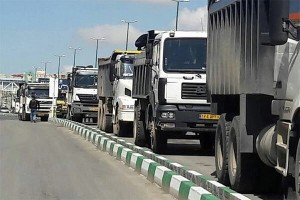
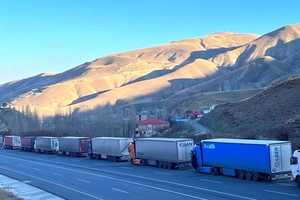
A line of trucks on a road in Iran at night, as truck drivers stage strikes over rising operating costs and worsening economic conditions.
Truck drivers in several Iranian cities have gone on strike over rising operating costs, stagnant freight rates and worsening economic conditions, with reports of work stoppages emerging on Sunday.
A video sent to Iran International showed a group of truck drivers stopping work in Shiraz, southern Iran, on Sunday.
The Telegram channel of the Union of Truck Drivers and Trucking Associations Across Iran also reported strikes in several cities, including Chabahar in southeastern Iran’s Sistan and Baluchestan Province and Dezful in southwestern Khuzestan Province, citing messages from its members.
“We went on strike because of these incompetent officials who do not care about the country or its people. We cannot go on like this anymore,” one driver wrote in a message to the union.
Another driver pointed to soaring truck maintenance costs, saying 40 liters of engine oil and five filters now cost 620 million rials (approximately $230 at the free-market exchange rate).
For comparison, Iran’s minimum monthly wage in 2026 is about 166 million rials ($62), meaning the maintenance bill is equivalent to nearly four months of base pay for a minimum-wage worker.
A third driver urged colleagues to remain patient, arguing that the effects of a transport strike would take more than 24 or 48 hours to become visible.
“Be patient. Produce markets will empty, ports will empty, and factories will come to a halt,” the driver said.
Union backs nationwide strike
The Union of Truck Drivers and Trucking Associations Across Iran announced its full support for a nationwide strike on Saturday, November 21, calling on drivers across the country to stop work from November 22.
The union said freight rates had remained unchanged despite sharp increases in the prices of engine oil, tires and spare parts.
It also cited rising fuel, insurance, toll and repair costs, along with job insecurity and insufficient support for drivers, as reasons for the strike.
“This strike is a cry of protest from drivers who have spent years struggling under the weight of rising prices, injustice and neglect and can no longer endure these unbearable conditions,” the union said in its statement.
Economic pressures deepen
The strikes come as Iran faces renewed electricity outages and reports of long queues at petrol stations in several cities.
The continuation of the protests could encourage other professional groups to join, political analyst Iman Aghayari said in an interview with Iran International.
The authorities are concerned about the potential spread of protests and are seeking to prevent other sections of society from joining through threats, inducements and repression, Aghayari added.
Iran's worsening economic conditions have placed growing pressure on households, particularly workers and pensioners struggling to meet everyday expenses.
A few photographs, a price and an exchange of messages can be enough to initiate a gun deal in Iran, where sellers advertise everything from handguns and Kalashnikovs to weapons made with 3D printers.
An investigation by Iran International found dealers offering firearms through social media and messaging platforms, with some claiming they could deliver weapons anywhere in the country within two weeks.
The sellers describe a market shaped by financial hardship, fears of insecurity and demand from people seeking weapons to threaten or intimidate others.
But the scale of the trade remains unclear, as does how many advertised weapons actually change hands.
Who buys and sells guns in Iran?
One arms dealer told Iran International that some of his suppliers were livestock farmers, nomads and villagers who had owned rifles for years, including Brno, M1 and various shotguns.
Some legally possessed their weapons but had decided to sell them because of financial difficulties and rising living costs, he said.
Others owned unlicensed firearms, particularly military-style weapons, and feared their children or other family members might use them.
The dealer said he purchased weapons from their owners and resold them at a profit.
One seller said concerns about theft and personal security had prompted some wealthy Iranians to purchase firearms to protect themselves and their property.
Other customers, he claimed, were involved in illegal economic activities and sought weapons to collect debts, intimidate others or settle financial disputes.
From handguns to Kalashnikovs
Prices vary widely depending on the type, condition and country of manufacture of a weapon.
According to sellers interviewed by Iran International, prices for licensed Iranian-made firearms start at around 300 million tomans.
Handguns described as Turkish or Pakistani start at approximately 500 million rials, while weapons advertised as Beretta or Glock models can cost as much as $5,000.
One dealer quoted around 2 billion rials for a secondhand Chinese-made Kalashnikov, compared with as much as 8 billion rials for a Russian-made equivalent.
Ammunition is sold separately, with dealers quoting approximately 4,000,000 rials for a Kalashnikov cartridge and 8,000,000 rials for a Brno rifle cartridge.
These are asking prices rather than independently verified completed transactions.
Delivery across Iran
Social media advertisements examined by Iran International featured photographs and videos of firearms, accompanied by model names and prices.
One dealer claimed he could deliver weapons to different parts of Iran in less than 15 days. Another confirmed that delivery to Tehran was possible.
Some sellers demanded full payment before shipment, while others accepted deposits and the balance upon delivery.
One dealer claimed to have contacts with wholesale arms suppliers in Iraq's Kurdistan Region, allowing him to obtain different models from across the border. He promised refunds if a weapon could not be delivered.
Another seller said neither a buyer's identity nor the intended use of a weapon mattered to him. Once payment was received, he said, the firearm would be dispatched.
A market vulnerable to fraud
The proliferation of online gun advertisements has raised questions about how many sellers are genuine.
In a separate investigation conducted last year, reporters contacted five sellers advertising firearms through Telegram channels, but none provided a way to verify that they possessed the weapons on offer.
Two sent identical responses and price lists, raising questions about whether some advertisements were fraudulent or relied on common promotional templates.
Iranian police have reported operations against networks advertising and selling firearms online.
In early November, police announced that they had identified an online firearms distribution channel and seized two military-style handguns during an operation against suspects.
3D-printed guns enter the picture
The investigation also identified advertisements offering small, single-shot firearms described as having been manufactured using 3D printers.
Some have plastic bodies and unconventional shapes that can make them resemble toys, while their manufacture does not necessarily require industrial production facilities or the importation of complete firearms.
However, there is no reliable information about the number of producers in Iran, the volume of sales or the performance of the advertised models.
The emergence of such weapons has raised concerns internationally, with European researchers reporting increasingly sophisticated 3D-printed firearms and growing numbers of seizures.
Scale remains unknown
Official figures show thousands of illegal firearms being seized across Iran, although they offer only a partial picture of the market.
Police spokesman Saeed Montazerolmahdi said in November that firearms seizures had increased by 14% through the end of the Iranian month of Mehr, compared with the corresponding period a year earlier.
He said military-style weapons accounted for 31% of the firearms seized, with seizures in that category rising by 9%.
A review of police and judicial announcements across several provinces, alongside border enforcement reports, produced a combined total exceeding 12,300 firearms.
The figures cover different reporting periods and may overlap, meaning the total does not necessarily represent 12,300 separate weapons.
Iran's mission to the United Nations previously reported that more than 60,000 illegal firearms had been seized and collected during 2022 and 2023.
The Small Arms Survey estimated that Iranian civilians possessed approximately 5.89 million firearms in 2017, equivalent to 7.3 weapons per 100 people.
The estimate included both legally and illegally held weapons. No similarly comprehensive, more recent estimate is available.
The human cost
According to police figures, 1,163 shooting incidents were recorded in Khuzestan during the first six months of the current Iranian year, ranging from armed disputes to gunfire at public celebrations.
In October, two shootings involving family disputes in Dehloran and western Tehran left seven people dead. The perpetrators of both attacks also died by suicide.
The same month, lawyer Taher Ahmadi was killed after encountering an armed confrontation in Shush.
Gunfire at wedding celebrations has also claimed lives. Five-year-old Mohammad Chakeri was killed in Fanouj in August, while 12-year-old Mohammad Omar Tarek died in Dashtiari in September.
These incidents illustrate the consequences of firearm use, but no comprehensive, recent nationwide figures are available for deaths and injuries caused by guns.
Despite increased seizures and tighter laws, the true size of Iran's illegal firearms market remains unknown.
What begins with a photograph, a price and a promise of delivery can end with a weapon in the hands of someone whose intentions the seller never questioned.
A patient receives treatment in a hospital intensive care unit in Iran. (File photo)
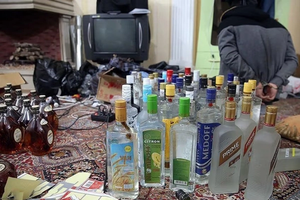
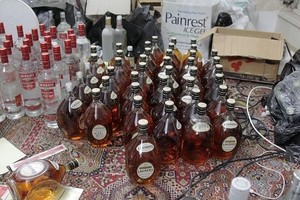
The number of people poisoned by bootleg alcohol in the northeastern Iranian city of Neyshabur has risen to 120, with four dead, health officials said late on Sunday, and police said they had arrested 12 people over its production and sale.
The toll has climbed fast. On Saturday, officials reported 66 people poisoned, and by midday Sunday, 72.
By Sunday night, 120 people had been admitted to hospitals, Seyed Milad Taghdisi Heydarian, acting deputy for treatment at Neyshabur University of Medical Sciences, told the Mehr news agency.
Eleven patients were on ventilators and one had been declared brain dead, he said.
All of the dead and the brain-dead patient were men. Eighteen patients have been sent to hospitals in Mashhad, the provincial capital, about 120 kilometers to the west, and 16 have been discharged.
Police first arrested eight suspects, then three men and a woman they described as the main producers and distributors, Neyshabur's police chief, Mojtaba Mohebbati, said. The investigation was continuing, he said.
Officials have not said what caused the poisonings. Methanol, an industrial alcohol often found in counterfeit drinks, causes blindness, kidney failure and death, and dialysis is one of the main treatments for it.
A banned drink, a deadly market
Alcohol is banned in Iran for Muslims, who face flogging if caught drinking. Only recognized religious minorities are allowed to make it for private use. The ban has created a large black market in which homemade and counterfeit drinks, often made with cheap industrial alcohol, have repeatedly caused mass poisonings.
The worst came in early 2020, when hundreds of people died after drinking methanol in the false belief that it would protect them from COVID-19.
In July 2025, 31 people sought hospital treatment after drinking counterfeit alcohol in Dezful, in the southwest. One died and five were admitted to intensive care. In November 2025, eight people died of alcohol poisoning in Iranshahr and Bampur, in the southeast. One lost their sight.
The real number of alcohol poisonings in Iran could be up to 10 times what emergency departments record, Deputy Health Minister Alireza Raisi said in October 2025. Many people who fall ill avoid hospitals for fear of prosecution.
In September 2025, Raisi called Iran's per capita alcohol consumption a public health challenge and urged more treatment centers. Admissions for alcohol dependence at addiction treatment centers had risen by as much as 50 percent over the previous five years, the Rouydad24 news site reported that month.
Medical personnel in Iran attend to a patient on a stretcher in a hospital emergency ward. (File photo)
A 16-year-old Iranian girl whose death has prompted a criminal investigation was beaten by her father at school and later thrown from a fifth-floor window after the principal accused her of having a boyfriend, a person close to the family told Iran International.
Sogand Sayyadi died on November 14 in the western city of Kermanshah. Her father, Keyumars Sayyadi, has been detained on suspicion of assault and murder, while the school's principal has been arrested on suspicion of negligence.
The account, provided to Iran International by a person familiar with the family, describes years of domestic violence and threats against the teenager, who had hoped to attend university, become a dentist and build a life independent of her father.
The allegations have not been independently verified. Sogand's father denies killing her, and judicial authorities say they are investigating the circumstances of her death, including the possibility of suicide.
Hamidreza Karimi, Kermanshah's prosecutor, told the judiciary-affiliated Mizan news agency that the father was under investigation on charges including assault and murder.
A childhood marked by violence
Sogand was originally from Alirezavandi, a village in Gilan-e Gharb county in western Iran, but lived in the provincial capital, Kermanshah.
Her parents, Keyumars and Tayebeh, separated when she was four. Their divorce proceedings lasted several years, after which her father was awarded custody.
Despite that arrangement, Sogand lived with her paternal aunt, Rakhshandeh, until a few months before her death.
The person close to the family described her as a quiet, reserved girl who worked hard at school and looked forward to becoming financially independent. Neither parent, the source said, provided her with sufficient emotional support.
The source alleged that Sogand had repeatedly been beaten by her father, who objected to her friendship with a female classmate because of the girl's appearance and makeup.
He had threatened to kill Sogand unless she ended the friendship, the source said, adding that the relationship was not romantic.
A private diary reaches the principal
Several days before Sogand's death, photographs of pages from her private diary were reportedly passed to the school's principal, Ghamarnaz Amiri, by someone connected to the family.
The pages apparently contained remarks that displeased Amiri, who, according to the source, already had a strained relationship with the teenager.
After receiving the photographs, Amiri allegedly telephoned Sogand's father, told him his daughter had a boyfriend and instructed him to come to the school to address the situation.
The Iranian news outlet Rokna previously reported that school officials had informed Sogand's father about a matter concerning her private life. It said he subsequently visited the school and took his daughter home.
From the classroom to a fifth-floor window
On November 14, Sogand's father received a call about his daughter, according to the family acquaintance. He went to her school, where he allegedly beat her in front of staff and other students.
The source said he then collected Sogand's school records, took her home by force and continued assaulting her before allegedly throwing her from a window of their fifth-floor apartment.
The human rights news agency HRANA, citing local sources, also reported that Sogand's father threw her from a fifth-floor window following an altercation at home.
According to the family acquaintance, the father prevented people at the scene from calling an ambulance and instead demanded that municipal workers come to collect and bury his daughter's body.
The newspaper Haft Sobh reported that he told investigators, "I am not my daughter's killer," and maintained that her fall from the fifth floor was accidental.
Questions over evidence and the funeral
According to the source, a family member gathered the teenager's personal belongings, including her diary, packed them and removed them from the house.
The source believed the removal of those items was an attempt to destroy evidence of longstanding abuse, particularly because members of the family had initially sought to portray her death as suicide.
That allegation has not been independently substantiated.
The source also said people who attended the washing of Sogand's body before burial had reported seeing fractures to her arms, legs, neck and skull.
Kermanshah's forensic authorities determined that she died from multiple injuries caused by a fall from a height.
According to the source, Sogand's father initially wanted to bury her in the courtyard of his village home, but senior family members objected. She was eventually buried in the cemetery of Dartut Sayyadi village.
Conflicting accounts have emerged about whether her father attended the funeral.
The family acquaintance said relatively few members of his side of the family attended and that some younger relatives stayed away because of his presence.
Judicial investigations into the circumstances of Sogand's death and the school principal's alleged negligence remain underway.
Shadi Kheyri, 22, was an engineering student at Tehran's prestigious Sharif University of Technology
A 22-year-old student at Iran's prestigious Sharif University of Technology has died by suicide after reportedly experiencing severe psychological distress, according to a student news outlet.
Shadi Kheiri, a final-year chemical engineering student, died Friday night at the university's Tarasht women's dormitory in Tehran, United Students reported Saturday, citing accounts it had received.
The circumstances surrounding her death could not be independently verified.
Kheiri, who graduated from Farzanegan High School in the western city of Malayer, had enrolled at Sharif University in 2023.
In a message posted to her personal channel before her death, she had condemned the killing of Sogand Sayyadi, a 16-year-old girl in the western city of Kermanshah whose death has sparked outrage over violence against women and failures in child protection.
"How many more lives must be sacrificed before we finally break our silence?" Kheiri wrote. "Sometimes tragedy is not merely the result of a killer's hand. It is also the result of closed mouths and silent consciences that have stood by watching for years."
Sayyadi's father was arrested on charges including assault and provisionally murder, while her school principal was detained on suspicion of negligence, Kermanshah prosecutor Hamidreza Karimi said on November 17.
Accounts of the case suggested that Sayyadi had warned school officials she might not survive if she was sent home, prompting questions about whether authorities had failed to act on signs that she was in danger.
Forensic authorities said Sayyadi died from injuries sustained in a fall from a height.
Women's rights advocates criticized what they described as broader institutional failures to protect girls facing violence at home.
The case has renewed scrutiny of legislation intended to protect women against violence, which remains unapproved after more than 15 years of disputes between Iranian authorities.
At least 84 women and girls were killed in Iran between late March and October 13, including 12 minors, according to figures published by the Emtedad website on November 16. The figures, compiled from media reports, may not capture the full extent of such killings.
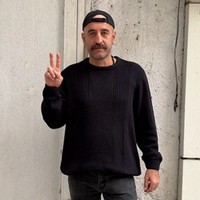
Iran's northern city of Rasht became a battlefield as security forces opened fire on unarmed protesters during January's anti-government demonstrations, leaving people lying in the streets, former political prisoner and protester Masoud Bidarigh told Iran International.
"It was really like a war," Masoud Bidarigh told Iran International, recalling the crackdown by state security forces during nationwide anti-government protests on January 8 and 9.
Bidarigh, a former boxing champion, described witnessing the shooting of a young man by security forces firing from a passing car near Somayeh Park in Rasht on January 9.
"I was just crying. There was nothing I could do," he said.
"People had come onto the streets empty-handed," he added, describing scenes of unarmed protesters collapsing amid gunfire and screams coming from nearby alleyways.
Bidarigh said large crowds gathered across Rasht on January 8 following a call for nationwide demonstrations by Iran’s exiled Prince Reza Pahlavi.
He described joining protesters as they moved through central Rasht, chanting against the Islamic Republic.
‘Gunfire across Rasht’
As demonstrators approached Municipality Square, security forces fired tear gas to disperse the crowds, he said.
Bidarigh said he heard gunfire near the municipality's clock tower and believed armed personnel were shooting from elevated positions.
The shooting intensified as demonstrators moved toward Pol-e Iraq bridge.
"When we reached Pol-e Iraq, the gunfire started," he recalled, describing sustained bursts of automatic weapons fire.
Protesters turned and fled as people fell to the ground, he said.
"The people were empty-handed. They had no weapons, nothing to defend themselves with."
Bidarigh described groups of 15 to 20 motorcyclists charging into crowds near Farhang Square, attacking and dispersing demonstrators.
He said the violence was particularly intense around Falakeh-ye Gaz, where he saw people lying in the streets and heard cries and screams from surrounding alleyways.
Security forces continued pursuing protesters through the streets, he said, as parts of the city were plunged into darkness after streetlights were switched off.
Rasht's historic bazaar engulfed in flames
Bidarigh also described scenes around Rasht's historic bazaar, which was devastated by fire during the January 8 crackdown.
He said he was on Shariati Street, near one of the market's entrances, and saw armed personnel positioned around the surrounding streets.
The market's narrow passageways and limited access routes made it difficult for people to escape or emergency vehicles to enter, he said.
Bidarigh said security forces prevented people from approaching the burning market to help those trapped inside.
"Nobody was allowed to do anything, neither to put out the fire nor to help people," he said.
He accused security forces of responsibility for fires across the city.
Iran International's May 28 investigation, based on testimony from witnesses in Rasht, reported that protesters fleeing gunfire were driven into narrow market passages as flames spread.
Witnesses described security forces blocking market exits and shooting at people attempting to escape. The investigation also documented allegations of delayed firefighting operations and restrictions on emergency personnel.
In a separate June 6 investigation, Iran International reported witness accounts of bloodstains and bloody handprints on buildings in central Rasht following the crackdown.
Armed Toyota vehicles deployed across Rasht
Bidarigh said state security forces deployed large numbers of armed Toyota vehicles across Rasht on January 9.
He said he witnessed a convoy traveling from the direction of Razi toward the city center at approximately 3 p.m.
He estimated that more than 100 vehicles were involved, some carrying masked armed men and weapons mounted on their rear cargo beds.
An October 29 Reuters investigation found that Iran had imported thousands of Toyota Hilux and Land Cruiser vehicles through a defense procurement agency identified as MOD 346428.
Reuters reported that the Islamic Revolutionary Guard Corps (IRGC) and allied groups modified the vehicles to mount heavy machine guns on their rear cargo beds.
The investigation also identified footage from the January protests showing security forces carrying machine guns in a convoy of Land Cruisers in Tonekabon, another northern Iranian city.
Bidarigh said he saw the convoy passing his supermarket before closing the shop at approximately 4 p.m.
He described a significant escalation in violence after 8 p.m., with armed security forces moving through the city on motorcycles, on foot and in vehicles.
"There was no mercy for anyone," he said.
"Gunfire could be heard across the whole of Rasht."
Bidarigh described motorcyclists on Saadi Street chanting "Heydar, Heydar" while firing toward people.
"Blood was smeared across the streets and walls of Rasht," he said.
"The whole city smelled of blood."
From boxing champion to political prisoner
Before his imprisonment, Bidarigh was a competitive boxer in Iran's northern Gilan province. He was also involved in political activism, distributing leaflets and writing anti-government slogans.
Bidarigh said six security personnel assaulted and arrested him on August 12, 2024, while he was distributing leaflets and writing slogans in Rasht's Golsar neighborhood.
He described being beaten and sprayed with pepper spray during the arrest.
Bidarigh said he spent 25 days in Intelligence Ministry custody, subjected to repeated interrogations, physical abuse and solitary confinement.
He described being kept in a small, dark cell, sometimes blindfolded and handcuffed, while interrogators beat and verbally abused him.
Security personnel also searched his supermarket and home, confiscating electronic equipment and approximately 5,000 political leaflets, he said.
He subsequently spent 38 days in Lakan Prison's Meysagh Ward before being released on bail.
Bidarigh said he was later sentenced to one year in prison following proceedings at which he was denied access to a lawyer.
The Iran Human Rights Society previously reported that Branch 3 of the Rasht Criminal Court, presided over by Judge Mehdi Rasekhi, sentenced him on charges including propaganda against the Islamic Republic, insulting Supreme Leader Ali Khamenei and disrupting national security.
The rights group also reported that Bidarigh publicly protested outside Lakan Prison in February 2025 against a death sentence issued for political prisoner Manouchehr Fallah, whom he had met during his imprisonment.
A prison document reviewed by Iran International lists September 6, 2024, as Bidarigh's detention date, 25 days after his reported arrest. Bidarigh said he spent those 25 days in Intelligence Ministry custody. Human Rights Watch has documented Iranian intelligence agencies holding detainees in unofficial facilities without formal registration.
Bidarigh said he returned to prison on April 6, 2025, to serve his sentence and was released on December 13, 2025.
Less than a month later, on January 6, around 10 security personnel confronted and assaulted him in Rasht's Sabzeh Meydan, he said. He was released after approximately 90 minutes.
The lasting toll of the crackdown
Bidarigh said continued threats from security authorities and fears of rearrest forced him to leave Iran in mid-2026.
Months after the January protests, he said he remained haunted by the violence he witnessed security forces inflict on protesters in Rasht.
"Every day, these scenes come back before my eyes," he said.
"I don't know how we survived. I really don't know."