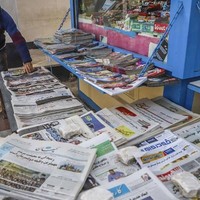
File photo: A man browses newspapers at a newsstand in Iran.
Iran is moving to tighten controls on journalists at home while threatening to pursue exiled media figures abroad, as lawmakers revive a controversial licensing proposal and the judiciary seeks to enlist Interpol in its crackdown on dissidents.
The proposed legislation would require journalists to obtain government-approved licenses to work, potentially placing their professional credentials under direct state oversight.
The proposal, first introduced in 2014, was shelved following strong opposition from journalists and media professionals. Hardliners in parliament revived it last week.
Babak Negahdari, head of the Majles Research Center, was quoted by the hardline news outlet Young Journalists Club as saying the proposal "has been finalized as a bill" and would be brought to a parliamentary vote within the next three months.
The legislation calls for the creation of a "Journalism Organization" modelled on the Iranian Medical Council, which regulates the licensing and professional practice of physicians.
Critics argue that the proposed body would undermine press freedom by placing journalists' professional credentials under state control.
Media lawyer Kambiz Nowrouzi said this week that the bill remains "the same 2014 draft with the same serious problems and fundamental flaws."
In an editorial in the moderate daily Shargh, he argued that the proposed Journalism Organization would effectively function as a government body, creating "a double filter for greater control over professional press organisations."
When introduced in 2014, the proposal was described as "abnormal" and "catastrophic" by journalism professor Hassan Namakdust, who warned it would leave "nothing of journalists' independence, status, and dignity."
Public reaction to its revival has so far been muted, possibly because of the intense security pressures facing journalists today.
The political environment has also changed. Parliament is dominated by hardliners, and the latest proposal originates from lawmakers rather than a government ministry.
Chasing exiled dissidents
Meanwhile, Iran's judiciary has announced efforts to pursue the arrest and extradition of dissidents and media figures living abroad through Interpol, alongside the confiscation of their assets inside Iran.
At a November 17 press briefing, Judiciary Spokesman Asghar Jahangir said authorities had confiscated assets belonging to a number of Iranians living abroad whom Tehran accuses of "treason" and other offences.
He said the judiciary was working through Interpol and its International Affairs Department to secure their arrest and extradition.
Although Jahangir did not release a full list of names, state television and affiliated outlets have repeatedly singled out exiled journalists working for Persian-language broadcasters such as Iran International, BBC Persian and VOA Persian when threatening asset confiscation, consular restrictions and Interpol Red Notices.
However, Article 3 of Interpol's Constitution prohibits the organisation from undertaking activities of a political, military, religious or racial character.
An Interpol Red Notice is also not an international arrest warrant, and Western host countries routinely reject extradition requests based on political or speech-related charges.
Nevertheless, the announcement has heightened concerns among Iranian journalists in Europe and the United States, some of whom fear questioning or delays at border crossings and airports when travelling internationally.
Other restrictive bills
The revived Journalism Organization Bill is the third in a series of legislative initiatives that critics say are intended to restrict freedom of expression and tighten state control over information.
The first two were the Foreign Influence Bill and the Bill to Organise Cyberspace.
The Foreign Influence Bill, which would criminalize interviews and other forms of contact with foreign-based media outlets, received initial parliamentary approval on August 16 by 183 votes to four, with five abstentions.
President Masoud Pezeshkian's cabinet formally opposed the legislation on August 23, but the government has no veto over parliamentary bills. The measure still requires a final parliamentary vote and Guardian Council approval.
The Bill to Organise Cyberspace, also known as the Protection (Sianat) Bill, was submitted to parliament on August 26.
Critics have described it as a rebranded version of the previously shelved Sianat internet bill. Among other measures, it would require internet service providers to identify and verify their users.
The legislation must undergo review by parliament's Social Commission before a floor vote and final consideration by the Guardian Council.
Together, the three proposals would expand state oversight of traditional and digital media, while the judiciary's latest announcement signals continued pressure on Iranian journalists abroad. Whether the revived licensing bill becomes law remains uncertain, but it is now being considered by a hardline-dominated parliament alongside other measures aimed at tightening controls on information.
An illustration published by the Revolutionary Guards-affiliated Fars News Agency depicts the mythical Persian hero Fereydoun leading a convoy of Iranian oil tankers escorted by warships
Iranian hardliners are calling for a convoy of oil tankers to challenge the US naval blockade, threatening military retaliation against regional energy infrastructure if Washington attempts to stop the vessels.
The proposal, published Thursday by the Revolutionary Guards-affiliated Fars News Agency, calls for tankers to sail to China and threatens strikes on oil facilities in the United Arab Emirates, Saudi Arabia and Qatar if the US intervenes. It emerged shortly after reports that an unsanctioned tanker had been loaded at Iran's Kharg Island oil terminal.
Fars dubbed the plan “Operation Fereydoun,” after a legendary hero in the Persian epic Shahnameh.
No official plans for a convoy have been announced, although Foreign Minister Abbas Araghchi said Friday that Iran would break the blockade.
“A blockade is a military action. A military action also has a military response,” political and military analyst Nima Akbarkhani said during a Thursday night discussion on Iranian state television.
Akbarkhani described a previously discussed scenario in which Iranian tankers would sail individually with their Automatic Identification System (AIS) signals switched on and Iranian flags displayed, while Tehran announced in advance which regional facilities it would target if any vessel were attacked.
During the Be Vaght-e Iran program, host Ruhollah Razavi suggested placing media teams, members of the public and international anti-war activists aboard the tankers to increase the political and media costs of any US intervention.
Akbarkhani endorsed the idea, arguing that unlike vessels sent to Gaza, which Israel prevented from reaching their destination despite extensive media coverage, Iran could deter attacks on blockade-breaking tankers by threatening military retaliation.
Support for confrontation grows
Political analyst Mostafa Najafi, recently described in Iranian media as an adviser to Supreme National Security Council Secretary Mohsen Rezaei, wrote on X that Supreme Leader Mojtaba Khamenei had ordered an end to the “neither war nor peace” situation some time ago.
Najafi suggested that the effort extended beyond diplomacy, with military options also under consideration.
“Apparently, Tehran no longer wants to sit back and watch the blockade and threats,” he wrote.
Majid-Reza Hariri, president of the Iran-China Chamber of Commerce, called on Iranians across the political spectrum to support efforts to break the blockade.
“After months of pursuing negotiations in various ways, every Iranian patriot, regardless of political outlook, should support the government in breaking the naval blockade imposed by the aggressive United States by any means possible,” he wrote Friday.
Media analyst Alireza Shiva argued that Iran was signaling that energy security in the Persian Gulf could not be defined unilaterally.
“You cannot target Iran's oil exports while expecting the energy exports of others to continue in complete security,” he wrote on X.
A high-risk strategy
Hardline journalist Parisa Nasr argued that Iran had made a strategic mistake by treating the blockade as a negotiating issue rather than a wartime measure intended to weaken the country and force its surrender.
She advocated a strategy of “bringing the crisis to the brink” to pressure Washington into easing the blockade while strengthening Iran's deterrence against attacks on its tankers.
Energy analyst Abdullah Babakhani offered a more cautious assessment, suggesting that US forces might initially allow some Iranian tankers through before pursuing and potentially seizing them in international waters.
He compared the scenario to operations involving the pursuit and seizure of tankers linked to Venezuela last year, saying Iran's response to such an eventuality remained unpredictable.
China, Iran's largest oil buyer before the blockade, has been identified as the intended destination for the proposed convoy. Whether Beijing would accept the shipments remains unclear.
The proposal therefore presents Tehran with a potentially consequential choice: continue seeking a negotiated end to the blockade or test Washington's willingness to enforce it at the risk of a wider military confrontation.
Siyavush, on the black horse at center, plays polo as the Turanian king Afrasiyab watches. The painting, attributed to Qasim ibn Ali, was made in Tabriz around 1525–30 for Shah Tahmasp’s copy of Ferdowsi’s Shahnameh (Book of Kings). (The Metropolitan Museum of Art, public domain)
A Toronto-based Iranian software engineer has used Claude to explain more than 1.6 million Persian couplets in modern Persian, an effort to help readers understand poetry they still quote and turn to for advice.
One verse about a lavish dowry shows what Arman Nejad hoped to fix. An AI-generated note on Ganjoor, a popular free online library of Persian poetry, had mistaken Delaray, a woman’s name, for the word “dollar.” Readers who turned to the note for help were told the verse described a rise in the value of the US currency.
Errors like that posed a problem for Nejad, who had built a search engine called Ganjoorjoor, roughly “Ganjoor Finder,” for readers who remember what a poem says but have forgotten the words. The search engine draws on Ganjoor’s explanations to find matching verses. A note about exchange rates could send someone looking for poetry about a dowry to the wrong place.
A Persian-language post on X mocks Ganjoor's earlier AI-generated note, which read the name Delaray as the word "dollar" and described a rise in the US currency.
On a sleepless night on November 9, Nejad estimated it would cost about $3,000 to redo the notes and appealed for help on X. By the next morning, he said, the post had drawn 10,000 views and offers of support. Two AI platforms, mana.space and zharf.ai, donated credits, and he covered the rest himself.
By November 16, Nejad had finished the new notes for works by all 245 poets in the collection, from Rudaki to Shahriar. Ganjoor had been using AI-generated notes for about two years. By Nejad’s count, only about 1.5 percent of its couplets had explanations written by people.
Ganjoor said Friday it had published Nejad’s poem summaries and plain-language explanations on its website and in its public data repository. It kept the notes readers had already edited.
Putting AI through Iran’s university entrance exam
To decide which model to trust with the poetry, Nejad gave several of them the first booklet from the humanities track of Iran’s national university entrance exam, known as the Konkour. The exam offered freshly written questions in Persian and an answer key he could use to score each model.
Of the 80 multiple-choice questions, 30 tested Persian language and literature, 20 covered mathematics, and 15 each covered social sciences and psychology. Each model received the same text and images with web access disabled. Nejad tested each at three settings that varied how much processing it could devote to an answer.
Accuracy of each AI model and setting on the 80-question Konkour exam booklet. Claude Opus 5.5 (medium) and Gemini 3.8 Flash (highest) tied at 74 of 80.
Anthropic’s Claude Opus 5.5, on its medium setting, tied for first overall with Google’s Gemini 3.8 Flash on its highest setting. Each answered 74 of 80 questions correctly. On the literature questions, which mattered most to Nejad, Claude came first with 27 out of 30.
Nejad then tested 23 sets of instructions for Claude. He selected 160 poems with human annotations, using half to compare the instructions and reserving the other half to check the winner. Two AI judges, one from Anthropic and one from OpenAI, compared Claude’s explanations with the human notes. The finalists scored between 97.4 and 97.9 percent, so Nejad chose the cheapest to run.
On the 30 Persian literature questions, Claude Opus 5.5 (medium setting) came first, answering 27 correctly.
The instructions gave Claude the poet’s name, the book, the chapter and the surrounding lines. “You don’t need to teach Opus how to read Persian poetry,” Nejad wrote in an essay about the project. “You just need to tell it what it’s reading.”
The full run took about 155,000 requests over several days, Nejad said. It used 566 million tokens, the units of text a language model processes, and cost roughly $3,100.
Majnun’s uncle and Khayyam’s wine
In Nezami’s Leyli and Majnun, an old man named Salim goes looking for Majnun each month to bring him food and clothes. The poet calls him Majnun’s khal, a Persian word for a maternal uncle that can also mean a beauty mark. The old note gave Salim a mole on his forehead. The new one introduces him as Majnun’s uncle and picks up Nezami’s play on both meanings later in the passage, Nejad wrote.
In Nezami’s 12th-century epic Haft Peykar, the word gur can mean both “grave” and “wild ass.” The old note had a man stepping into a grave as a lion approached carrying a bow. In the new reading, King Bahram holds the bow and rides in pursuit of wild asses. It is Bahram whom the poet likens to a lion.
An AI-generated illustration of the corrected reading of Nezami's Haft Peykar, in which King Bahram, bow in hand, gallops after wild asses.
In a quatrain attributed to Omar Khayyam, the earlier note advised readers to keep wise company and avoid pleasure. The new one reads the verse as an invitation to drink wine. Those who spent their lives puzzling over philosophical questions, in this reading, were like sour grapes that shriveled into raisins before they ever ripened.
Nejad said reviewers compared the old and new explanations for 500 randomly selected couplets, reading each alongside its neighboring verses. They preferred the new note in 413 cases, favored the old one in four and judged the two about the same in the remaining 83.
Beyond Hafez
On Yalda, the longest night of the year, many Iranian families make a wish, open the collected poems of the 14th-century poet Hafez at random and read the poem they land on as his answer.
“Hafez left us more than six hundred years ago, and Iranians still ask him for advice,” Nejad wrote. “Getting an answer has never been the hard part. Understanding it is.”
Readers of Hafez have centuries of commentary to draw on. In Istanbul in 1594, the scholar Sudi finished a verse-by-verse commentary on his collected poems for Ottoman readers. For a sense of what readers face elsewhere in the collection, Nejad pointed to Waqif Lahori, who died in 1776. Until this month, Nejad said, none of Waqif’s 12,312 couplets on Ganjoor had an explanation.
“Sudi did Hafez,” Nejad wrote. “In 2026, we did everyone.”
A screengrab from a video sent to Iran International showing a graffiti of executions in Iran's Ekbatan neighborhood in January 2025.
The US State Department on Friday accused Iranian authorities of using death sentences to intimidate protesters demanding basic rights and relief from economic hardship, and of carrying out a wave of executions to silence dissent and maintain their grip on power.
In a post on its Persian-language X account, the department said Tehran was resorting to intimidation and the gallows rather than addressing the country’s crises and the legitimate demands of its people.
“When citizens take to the streets to demand their basic rights and relief from unbearable economic pressures, the regime responds by hastily carrying out death sentences and bringing severe, repressive charges,” the department wrote.
Citing death sentences issued against protesters Amir Delshad, Matin Shabani and Arman Marefati, the department said Iran’s judiciary was being used to instill fear. It said treating free expression as a capital offense exposed the government’s inability to respond to public grievances.
The department said Iranian authorities had announced the executions of more than 730 Iranians since late December 2025, most following what it called sham trials.
A tally compiled from reports by human rights monitors puts the number of people executed in Iran between January 1 and November 18 at no fewer than 1,158. It includes executions the authorities never announced.
Iran Human Rights, a Norway-based monitor, said Monday that at least 39 men had been executed in connection with the January protests and at least 121 people arrested over the demonstrations remained under sentence of death.
Among those executed were Hassan Dioband, Hamid Kazemi and Reza Zangeneh, who were hanged on November 8 over protests in Karaj, west of Tehran, the group said.
An Iran International investigation in October showed Iran had executed nearly two people a week in political and security cases since the January protests, including over protest- and war-related accusations, while another 190 people faced death sentences.
At least 70 people were executed from January 7 to October 5. Human rights organizations and activists say the figures are minimum totals, covering only cases that have been reported and verified.
Of the 70 people executed, 35 were put to death in cases connected to the January protests, nine in cases linked to the 12-day and 40-day wars, and 26 in other political and security cases.
A 23-year-old woman was shot dead at her own birthday party in Iran’s northern Gilan province by a former boyfriend after she refused to marry him, local media reported, days after a 16-year-old girl’s killing by her father set off a national outcry.
Sadaf Haghbin was killed in the early hours of Thursday in Choukam, in Khomam county near the road between Rasht and the Caspian port of Bandar Anzali.
A 29-year-old man walked into the party armed, locked the guests in a room and took Haghbin upstairs, local media in Gilan reported. The Kurdish rights group Hengaw, citing sources close to the family, said he beat her and pressed her to call her parents and say she agreed to marry him. When she refused, he shot her several times.
He shot her first in the heart, then in the face and finally in the head, the local outlet Hirkani reported, citing an informed source, before fleeing. He had a history of violence and abuse toward her, Hengaw said.
Khabaronline reported that her refusal of his proposal was the likely motive, though police have not confirmed it.
The police chief of Khomam county, Iman Jahandideh, said without naming Haghbin that a 29-year-old man had shot a 22-year-old woman with a hunting rifle over “personal disputes” and fled.
He was arrested a few hours later with the rifle, confessed and was handed to the judiciary, the police chief said.
Two killings in four days
Haghbin’s death came four days after Sogand Sayadi, a 16-year-old schoolgirl in the western city of Kermanshah, died after falling from the fifth floor of a building on November 15. Rights groups say her father threw her.
The day before, administrators at her girls’ high school had summoned her father over her relationship with a young man he opposed.
According to rights groups, he beat her in front of her classmates and school staff, after she had warned teachers that her father would kill her if they sent her home with him.
Kermanshah’s prosecutor opened an investigation, and her father was arrested on charges including assault and murder, along with the school principal, on charges of negligence. Iran’s main teachers’ union network condemned the school’s handling of the case.
A petition launched on Tuesday demanding a tough sentence for her father and a change to the law that shields him has gathered more than 220,000 signatures.
A law that protects fathers
Under Article 301 of Iran’s Islamic Penal Code, a father or paternal grandfather who kills his child cannot face qisas, or retribution in kind, the punishment for most murders. He faces at most a prison term, and in practice often a short one.
The rule has been at the center of Iran’s most notorious cases. In May 2020, 14-year-old Romina Ashrafi was beheaded with a sickle by her father in Talesh, also in Gilan province, after she ran away with a man he opposed.
He was sentenced to nine years. In February 2022, 17-year-old Mona Heydari was beheaded by her husband in Ahvaz, in the southwest, who walked through the streets with her head. Each case set off outrage online and calls for reform that were never met.
A bill to protect women from violence has been stuck for about 16 years between the government, parliament and other state bodies and has still not become law.
At least 84 women and girls
At least 84 women and girls were killed in Iran between March 21 and October 13, 12 of them under 18, the Emtedad news site reported on Monday, citing cases reported in the media. Eight of the underage victims were killed by fathers, brothers or other blood relatives.
In August, another 16-year-old in Kermanshah, Hana Rakan, was shot in the head by her father while she slept, Hengaw reported.
The Shargh newspaper reported on Thursday that 125 women and children had died from domestic violence between late March and November. Both counts rely on reported cases and are likely to understate the real number.
After Haghbin’s death, users on social media posted the names of women and girls killed by family members or partners in recent weeks.
Iran has sentenced Pouya Fakhrabadi, a 25-year-old national taekwondo champion, to death over a fire during January’s protests in the central city of Yazd, and a source told Iran International he was tortured into confessing.
Judge Mohammad Bemani, who heads Branch 2 of Yazd’s Revolutionary Court, issued the sentence in a joint case known as the “Yazd telecommunications” case, according to information received by Iran International and the rights group HRANA.
Three other men in the case, Mehdi Rajabi, Mohammad Kargar and Mohini Makki, were each sentenced to 20 years, to be served in internal exile in the prison of Zahedan, in Sistan and Baluchestan province, more than 800 kilometers away.
The charge announced was “taking part in setting fire to public property.” The details of the accusations against the men are not known, and it is not clear whether Fakhrabadi has appealed.
The case stems from protests on January 8 and 9, the days of the January massacre, when Imam Hossein Square in Yazd was one of the city’s main protest sites. The telecommunications building on the square and other government offices nearby, including one belonging to the Imam Khomeini Relief Committee, a state welfare foundation, caught fire.
Pouya Fakhrabadi
‘They broke his head with a rifle butt’
Fakhrabadi, who holds a master’s degree in physical education, was arrested at his home in Yazd on February 20, a source familiar with the case told Iran International. Security agents broke his head with a rifle butt during the raid, leaving a wound that needed 20 stitches, the source said.
In solitary confinement he was severely beaten and tortured and lost about 30 kilograms, the source said. Agents forced him to confess by threatening to kill members of his family and to sexually abuse them. He was denied a lawyer throughout the case.
His sister, who saw the violence during his arrest, suffered severe panic attacks and could barely speak for months afterward, the source said.
Fakhrabadi is a champion in hanmadang, the taekwondo discipline of creative and power breaking. He won gold at the international Kukkiwon Cup, organized by the sport’s world headquarters in South Korea, and has won a national title, setting a new record.
The Yazd detainees
Of 28 people from the January protests held in Yazd prison, 15 have been sentenced to between three and 21 years, and 13 are still awaiting a verdict, HRANA reported on Tuesday.
In the months since the protests, Iran’s judiciary has handed down death sentences, prison terms, floggings and asset confiscations to many of those detained and to other political prisoners.
On Wednesday, the UN General Assembly’s human rights committee adopted a draft resolution condemning the crackdown on the January protests and calling for a halt to all executions, with a view to abolishing the death penalty.
A lawyer facing a wartime charge
In Isfahan, prosecutors have extended the detention of human rights lawyer Amirsalar Davoudi by 30 days and added a new charge, his lawyer, Mehdi Karimi Farsi, told the Emtedad news site.
Davoudi, who was sentenced in 2019 to 30 years in prison and 111 lashes over his work defending political prisoners, was arrested again on October 11. He already faced charges of “spreading falsehoods online,” “propaganda against the system” and “inciting people to war and killing each other to disrupt national security.” He now also faces “producing and spreading false news against national security in wartime.”
Moein Khazaeli, a lawyer, wrote on X that prosecutors brought the new charge under Article 4 of a law toughening penalties for espionage, passed after the June 2025 war. It carries 10 to 15 years in prison, he said, or death if the court treats it as “corruption on earth.” He said the law was being used to stop lawyers defending their clients.
Part of the case against Davoudi stems from a recording he posted on Instagram on October 4 of a wedding ceremony conducted by phone between two of his imprisoned clients, Mahshad Keshani and Alireza Sepahi Badjani. Sepahi Badjani was executed the next day.
Davoudi suffered a heart attack in solitary confinement on November 8 and was taken to Isfahan’s Al-Zahra hospital, Iran Human Rights reported. The next morning, he was taken to court to be charged. He has had no contact with his family since his arrest, his lawyer said, despite a court order on November 15 allowing calls.
UN human rights experts said on November 9 that Davoudi’s arrest was part of a campaign of pressure on independent lawyers, at least 135 of whom faced judicial or security action in Iran between September 2025 and September 2026.