Young Iranians socialize at a café, reflecting a generation navigating personal relationships and social expectations in a country where family attitudes toward dating and intimacy can differ sharply.
Some young Iranian women are leading private lives their families know little about, hiding relationships, sex and personal choices from parents, while an economy that keeps them at home and laws that punish private life leave them nowhere else to go.
Ladan’s mother knows she has a boyfriend. Her father doesn’t.
When the 21-year-old leaves home to meet him, her mother sometimes tells her father that she is going out with university friends.
It is a secret mother and daughter share. But there is another secret Ladan keeps from both parents.
She wants to have sex with her boyfriend before marriage.
“My mother knows I have a boyfriend, but if she found out I wanted to have sex with him, she would probably react very differently. My family doesn’t understand why I should wait for something that might never happen,” Ladan said.
In Ladan’s family, a boyfriend is something her mother can quietly tolerate, as long as her father doesn’t know. Sex is another matter. In families like hers, she said, a daughter’s virginity is still tied to the family’s honor, and a relationship parents might reluctantly accept can become a source of conflict if they believe it involves sex.
Many of her friends no longer see virginity as a measure of a woman’s worth, she said. They regard sex as a personal decision, not something that must wait until marriage.
The state does not. Under the Islamic Republic’s penal code, sex outside marriage is a crime. And Ladan worries about contraception and unintended pregnancy in a country that has made both harder to manage: a 2021 law meant to raise the birth rate ended the free distribution of contraceptives through public health services and tightened the already strict limits on abortion.
She also worries about what would happen if her family discovered her plans. Her mother has accepted one part of her private life and helps hide it from her father. Ladan fears that revealing the rest could cost her that support.
Ladan is one of five young women in Tehran who told Iran International about the parts of their lives they hide from their families. They spoke on condition that their identities be protected. Their names and some personal details have been changed.
Their secrets differ. But all five are hiding from the same two things: their families’ expectations, and a state that writes those expectations into law and has left them too poor to live anywhere else.
Two young people embrace during a nighttime gathering in Tehran.
The price of privacy
Yasaman is 24. She works and earns her own money, but still cannot afford to move out of her parents’ home.
Her mother wants to know why she has not married. Yasaman’s answer is simple: she cannot afford it.
But there is another question nobody asks at home. What is she supposed to do about wanting emotional and sexual intimacy before marriage?
“I also need to have an emotional relationship with someone and feel close to him. But I’m not in a position to get married, and I don’t have a private space where I can spend time with someone I love without worrying,” Yasaman told Iran International.
In Iran, unmarried young adults commonly live with their parents. For many women, that reflects family expectations, but also the cost of living alone. With inflation near 89 percent and rents rising with it, a salary like Yasaman’s does not stretch to a home of her own. Moving out before marriage can also raise questions in more traditional families.
The state’s answer is marriage. It offers young couples marriage loans and urges them to have children. But Yasaman does not want to marry simply to have sex, and she does not have the money to set up a household.
She wants intimacy without being pushed into a marriage she is not ready for.
Yet she cannot afford the privacy that would let her have a relationship on her own terms.
For another of the women, the problem goes beyond finding somewhere private to meet a partner.
She cannot even tell her family whom she loves.
A young man and woman stand together outside a café in Iran at night.
More than a friend
Bahar’s family knows her closest female friend. She visits their home regularly and is one of the most important people in Bahar’s life.
What her parents don’t know is that the two women are in a romantic and sexual relationship.
Bahar is 27, and her family still asks why she has no plans to get married.
“My mother is always asking why I don’t have a boyfriend. I can’t tell her I have a girlfriend. I want to fall in love and live with someone I love, too. But the person I love is a woman,” Bahar said.
Her parents imagine a future in which she meets a man and marries him. Bahar wants to build a life with a woman they already know.
She was reluctant to speak at first, and agreed only after discussing how her identity would be protected.
Both Bahar and her partner live with their families. Neither can afford to rent a home of her own. Even a few hours together without worrying about who might walk in are hard to find.
The law offers them nothing and threatens them with a great deal. Under Iran’s penal code, sexual relations between women are punishable by flogging, and by death after a fourth conviction. Same-sex marriage is not recognized.
Two young women embrace on a street in Iran, where same-sex relationships remain socially sensitive and subject to legal restrictions.
For Bahar, revealing her relationship could mean facing her family’s expectations without the money to leave home.
“If I earned enough to have my own place, maybe I wouldn’t have to hide everything. But right now, if my family finds out, I don’t even know where I would go,” Bahar said.
The woman Bahar wants to share her future with can visit her family home. But in the eyes of Bahar’s parents, she must remain just a friend.
A secret too big to tell
Taraneh, 25, has a job. Last year, when her period was late, she took a pregnancy test.
The result was positive.
She was unmarried, and her boyfriend did not have a steady job. Neither was ready to have a child.
But before she could think about the pregnancy itself, she thought about her father.
“When I saw the test result, the first thing that came into my mind was what would happen if my father found out. Then I started thinking about where I could get the money to end the pregnancy,” Taraneh told Iran International.
She decided to end the pregnancy without telling her family. She did not have enough money to cover the cost, so she borrowed it from a friend.
In Iran, abortion is legal only in narrow cases, such as a serious threat to the mother’s life or a severe fetal abnormality, and only with official approval. The 2021 population law made even those harder to obtain. Women in Taraneh’s position are left with unlicensed clinics or pills bought on the black market, with no one to turn to if something goes wrong.
For an unmarried woman, seeking help with an unintended pregnancy can also mean revealing a sexual relationship her family knows nothing about, and one the law punishes.
Taraneh ended the pregnancy in secret.
Afterward, she worried about her health for some time. But she still could not bring herself to tell her mother.
Her mother had always told her she could come to her with any problem.
This time, asking for help would mean revealing the relationship, the pregnancy and the abortion.
“If I could have talked to my mother, maybe I wouldn’t have felt so alone. But at that moment, all I wanted was for nobody to find out,” Taraneh said.
Her family never found out, even when she was worried about her health.
Young women walk along a shopping promenade in Iran.
The forbidden drawer
Not every secret carries consequences as serious as Taraneh’s.
For Sara, 20, secrecy begins with something much smaller: underwear.
She lives with her family and likes decorative lingerie. She says it is a matter of personal taste and does not necessarily have anything to do with having a sexual partner.
Her mother sees it differently.
Two young women walk together through a shopping mall in Iran.
“I even have to be careful about buying something I wear underneath my clothes. My mother thinks that kind of underwear is only for married women, but I want to decide for myself what I wear,” Sara said.
Her mother sometimes looks through her drawers and wardrobe while tidying her room. So Sara keeps some of her things where her mother is unlikely to look.
She is not hiding a relationship or a pregnancy. She simply wants to choose what she wears without having to justify it.
In a country where the state decides what women must wear in public, Sara is fighting for the last place it does not reach: a drawer that nobody opens without permission.
The weight of silence
In these homes, everyday life goes on. Parents ask their daughters where they are going, when they will marry and what they plan to do with their futures.
The daughters answer, but not always with the whole truth.
For some, the silence protects a relationship. For others, it hides a decision about sex, a medical experience or even an item of clothing.
Since the Woman, Life, Freedom protests of 2022, many young Iranian women have openly defied the state’s rules on how they dress and live. At home, the struggle is quieter. Some mothers have already crossed over, covering for their daughters, keeping their secrets, promising they can come to them with anything.
But each of these five women still has to decide how much of her private life she can share with the people she lives with.
And sometimes, the person she most needs to talk to is the one she cannot tell the truth to.
A woman checks her smartphone on a street in Iran at night.
A bill before Iran’s parliament would require online service providers to verify their users’ identities, making it easier for the state to trace anonymous accounts in a country where social media posts have led to prison terms and even death sentences.
Under the Cyberspace Regulation Bill, which is still under review by lawmakers, providing a digital service to anyone whose identity has not been verified would become a violation.
Users would not have to show their real names in public. But accounts run under pseudonyms could be linked to real people through the data providers collect, and handed to regulators on request.
For Iranians who write under pseudonyms, the difference is between being anonymous to the public and being anonymous to the state. The bill would remove the second.
What the bill would change
Companies that offer services before verifying users would face penalties including advertising bans, a ban on registering new users, fines of up to 10 percent of annual revenue, and suspension or loss of their licenses, according to details published by the Shargh daily in late August.
Failing to hand over information requested by regulators would also count as a violation.
The bill would also strengthen the Supreme Council of Cyberspace, Iran’s highest internet policymaking body, and its executive arm, the National Cyberspace Center.
The latest draft drops an earlier clause that would have made using a VPN a crime, though the state’s powers to block content remain.
‘James the Faithless’
The case of Amirhossein Mousavi shows what can happen once the state puts a name to an account.
Mousavi ran an account on X called James Bidin, a play on the name of the American actor James Dean. In Persian, “bidin” means “faithless” or “without religion.”
A Revolutionary Court sentenced him to death for “corruption on earth” over his online activity, his lawyer, Reza Shafakhah, said on November 4. He also received five years in prison for insulting religious sanctities.
Mousavi, held since December 2024, faced several charges over posts attributed to his account, including national security offenses and alleged cooperation with Israel.
In a letter from Tehran’s Evin prison, he rejected the charges and said his televised confessions had been extracted under pressure from interrogators.
The new bill played no part in his case. It would make the first step, identifying the person behind the account, routine.
Two men use their smartphones on a street in Iran.
The bill follows earlier attempts to tighten state control of the internet. The Internet Protection Bill, known in Iran as the Sianat plan, sought more control over foreign platforms and online communications but stalled after widespread opposition.
The government of President Masoud Pezeshkian withdrew a separate bill on “combating the dissemination of false content in cyberspace” in July 2025 after criticism.
Iran has repeatedly cut off the internet during unrest and war, including during the January massacre and for 88 days after the US and Israel launched their war on Iran on February 28, cutting millions of Iranians off from independent news and from the outside world.
Major international platforms remain blocked, and many Iranians rely on VPNs to get online.
Iran International has documented cases of people whose SIM cards were blocked after political posts or interactions on social media.
Some who tried to have their service restored were asked for personal details, home addresses and the names of their social media accounts.
Australian broadcaster Erin Molan says she was targeted in an Iran-linked cyber-espionage operation after someone posing as a US think tank expert sent her an online meeting invitation.
Australian broadcaster Erin Molan said she was targeted by Iran-linked hackers posing as a US think tank expert, and that the head of Australia’s domestic intelligence agency told her she was one of three Australians targeted.
The other two were journalist Sharri Markson and political commentator Michael Kroger, she said. Molan, host of The Erin Molan Show, told Iran International’s Eye for Iran podcast that she found a security alert she had missed only after reading about a similar approach to Markson.
She contacted police and the head of the Australian Security Intelligence Organization, ASIO, who told her the operation had been linked to Iran.
The case adds to a list of suspected Iranian hacking operations aimed at journalists and public figures who speak out against Tehran, and comes a year after Australia expelled Iran’s ambassador over arson attacks that ASIO linked to Iran.
A message about her father
The first message arrived on X. The sender praised Molan’s work, cited specific things she had said in support of the Iranian people and brought up her late father, Jim Molan, a retired major general and senator.
“Anyone knows the way to my heart is talking to me about my dad,” Molan said. “It’s my favorite subject.”
The name on the message belonged to a real think tank expert. Molan found her profile on the organization’s website and saw she had appeared on CNN. About a month after the first approach, Molan clicked a link to join a meeting.
The screen behaved oddly and she heard strange noises, she said. Nobody joined. When she emailed to ask what had happened, the sender said the expert had been called away and would reschedule. Molan said she was annoyed at having set aside the time, and moved on.
Months later, Markson’s account prompted her to search her inbox, where she found an alert showing a security breach. She sent the material to police.
“The person inside her account was not her,” Molan said of the expert.
A borrowed account
Markson told NewsNation that she had received messages that appeared to come from a former Trump administration official she had known for years. The senders used his X account without his knowledge and repeatedly tried to set up an online meeting. She grew suspicious and contacted him directly. He knew nothing about it.
Markson said Australian intelligence officials linked the operation to Charming Kitten, a hacking group tied to Iran’s Revolutionary Guards that has long impersonated journalists and think tank experts to win targets’ trust.
She said she believed she was singled out for her coverage of antisemitism, her support for Israel and her criticism of the Islamic Republic.
Molan said the messages to her referred to her public statements distinguishing between Iran’s rulers and its people. “They were referencing specific things that I had said in defense of the Iranian people,” she said.
An FBI call
Jonathan Harounoff, a journalist and former Israeli spokesperson to the United Nations, told Eye for Iran that he received an Instagram message from someone posing as a reporter for Britain’s Telegraph.
The sender said they had read his book, Unveiled, and cited specific points they wanted to discuss in an interview.
He was ready to agree, he said, until the sender grew impatient and began sending more links. He contacted the reporter through her work email. She had not sent the messages, and the account was later disabled.
About six months later, he said, the FBI called to tell him he had been targeted in a hacking attempt it attributed to the Iranian state.
From hacking to sabotage
Iran’s cyber operations in the West have gone beyond espionage. On November 10, France blamed a Guards-affiliated unit for an October sabotage campaign against refrigeration controls at more than 700 stores, which French officials said caused fires and spoiled food worth tens of millions of euros (tens of millions of dollars).
Paris summoned Iran’s ambassador. Tehran rejected the accusation.
Molan said the experience made her question even routine encounters. When she arranged to hand her laptop to police in Sydney, she said, she wondered how she could be sure the people she was meeting were really officers.
She has faced threats before. After bomb threats following the October 7 attacks in Israel, she needed police escorts, and people close to her urged her to step away from the subject. She was back on air the following week.
“I cannot be silenced,” she said. “I will never be silenced.”
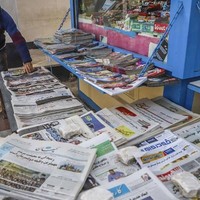
File photo: A man browses newspapers at a newsstand in Iran.
Iran is moving to tighten controls on journalists at home while threatening to pursue exiled media figures abroad, as lawmakers revive a controversial licensing proposal and the judiciary seeks to enlist Interpol in its crackdown on dissidents.
The proposed legislation would require journalists to obtain government-approved licenses to work, potentially placing their professional credentials under direct state oversight.
The proposal, first introduced in 2014, was shelved following strong opposition from journalists and media professionals. Hardliners in parliament revived it last week.
Babak Negahdari, head of the Majles Research Center, was quoted by the hardline news outlet Young Journalists Club as saying the proposal "has been finalized as a bill" and would be brought to a parliamentary vote within the next three months.
The legislation calls for the creation of a "Journalism Organization" modelled on the Iranian Medical Council, which regulates the licensing and professional practice of physicians.
Critics argue that the proposed body would undermine press freedom by placing journalists' professional credentials under state control.
Media lawyer Kambiz Nowrouzi said this week that the bill remains "the same 2014 draft with the same serious problems and fundamental flaws."
In an editorial in the moderate daily Shargh, he argued that the proposed Journalism Organization would effectively function as a government body, creating "a double filter for greater control over professional press organisations."
When introduced in 2014, the proposal was described as "abnormal" and "catastrophic" by journalism professor Hassan Namakdust, who warned it would leave "nothing of journalists' independence, status, and dignity."
Public reaction to its revival has so far been muted, possibly because of the intense security pressures facing journalists today.
The political environment has also changed. Parliament is dominated by hardliners, and the latest proposal originates from lawmakers rather than a government ministry.
Chasing exiled dissidents
Meanwhile, Iran's judiciary has announced efforts to pursue the arrest and extradition of dissidents and media figures living abroad through Interpol, alongside the confiscation of their assets inside Iran.
At a November 17 press briefing, Judiciary Spokesman Asghar Jahangir said authorities had confiscated assets belonging to a number of Iranians living abroad whom Tehran accuses of "treason" and other offences.
He said the judiciary was working through Interpol and its International Affairs Department to secure their arrest and extradition.
Although Jahangir did not release a full list of names, state television and affiliated outlets have repeatedly singled out exiled journalists working for Persian-language broadcasters such as Iran International, BBC Persian and VOA Persian when threatening asset confiscation, consular restrictions and Interpol Red Notices.
However, Article 3 of Interpol's Constitution prohibits the organisation from undertaking activities of a political, military, religious or racial character.
An Interpol Red Notice is also not an international arrest warrant, and Western host countries routinely reject extradition requests based on political or speech-related charges.
Nevertheless, the announcement has heightened concerns among Iranian journalists in Europe and the United States, some of whom fear questioning or delays at border crossings and airports when travelling internationally.
Other restrictive bills
The revived Journalism Organization Bill is the third in a series of legislative initiatives that critics say are intended to restrict freedom of expression and tighten state control over information.
The first two were the Foreign Influence Bill and the Bill to Organise Cyberspace.
The Foreign Influence Bill, which would criminalize interviews and other forms of contact with foreign-based media outlets, received initial parliamentary approval on August 16 by 183 votes to four, with five abstentions.
President Masoud Pezeshkian's cabinet formally opposed the legislation on August 23, but the government has no veto over parliamentary bills. The measure still requires a final parliamentary vote and Guardian Council approval.
The Bill to Organise Cyberspace, also known as the Protection (Sianat) Bill, was submitted to parliament on August 26.
Critics have described it as a rebranded version of the previously shelved Sianat internet bill. Among other measures, it would require internet service providers to identify and verify their users.
The legislation must undergo review by parliament's Social Commission before a floor vote and final consideration by the Guardian Council.
Together, the three proposals would expand state oversight of traditional and digital media, while the judiciary's latest announcement signals continued pressure on Iranian journalists abroad. Whether the revived licensing bill becomes law remains uncertain, but it is now being considered by a hardline-dominated parliament alongside other measures aimed at tightening controls on information.
Siyavush, on the black horse at center, plays polo as the Turanian king Afrasiyab watches. The painting, attributed to Qasim ibn Ali, was made in Tabriz around 1525–30 for Shah Tahmasp’s copy of Ferdowsi’s Shahnameh (Book of Kings). (The Metropolitan Museum of Art, public domain)
A Toronto-based Iranian software engineer has used Claude to explain more than 1.6 million Persian couplets in modern Persian, an effort to help readers understand poetry they still quote and turn to for advice.
One verse about a lavish dowry shows what Arman Nejad hoped to fix. An AI-generated note on Ganjoor, a popular free online library of Persian poetry, had mistaken Delaray, a woman’s name, for the word “dollar.” Readers who turned to the note for help were told the verse described a rise in the value of the US currency.
Errors like that posed a problem for Nejad, who had built a search engine called Ganjoorjoor, roughly “Ganjoor Finder,” for readers who remember what a poem says but have forgotten the words. The search engine draws on Ganjoor’s explanations to find matching verses. A note about exchange rates could send someone looking for poetry about a dowry to the wrong place.
A Persian-language post on X mocks Ganjoor's earlier AI-generated note, which read the name Delaray as the word "dollar" and described a rise in the US currency.
On a sleepless night on November 9, Nejad estimated it would cost about $3,000 to redo the notes and appealed for help on X. By the next morning, he said, the post had drawn 10,000 views and offers of support. Two AI platforms, mana.space and zharf.ai, donated credits, and he covered the rest himself.
By November 16, Nejad had finished the new notes for works by all 245 poets in the collection, from Rudaki to Shahriar. Ganjoor had been using AI-generated notes for about two years. By Nejad’s count, only about 1.5 percent of its couplets had explanations written by people.
Ganjoor said Friday it had published Nejad’s poem summaries and plain-language explanations on its website and in its public data repository. It kept the notes readers had already edited.
Putting AI through Iran’s university entrance exam
To decide which model to trust with the poetry, Nejad gave several of them the first booklet from the humanities track of Iran’s national university entrance exam, known as the Konkour. The exam offered freshly written questions in Persian and an answer key he could use to score each model.
Of the 80 multiple-choice questions, 30 tested Persian language and literature, 20 covered mathematics, and 15 each covered social sciences and psychology. Each model received the same text and images with web access disabled. Nejad tested each at three settings that varied how much processing it could devote to an answer.
Accuracy of each AI model and setting on the 80-question Konkour exam booklet. Claude Opus 5.5 (medium) and Gemini 3.8 Flash (highest) tied at 74 of 80.
Anthropic’s Claude Opus 5.5, on its medium setting, tied for first overall with Google’s Gemini 3.8 Flash on its highest setting. Each answered 74 of 80 questions correctly. On the literature questions, which mattered most to Nejad, Claude came first with 27 out of 30.
Nejad then tested 23 sets of instructions for Claude. He selected 160 poems with human annotations, using half to compare the instructions and reserving the other half to check the winner. Two AI judges, one from Anthropic and one from OpenAI, compared Claude’s explanations with the human notes. The finalists scored between 97.4 and 97.9 percent, so Nejad chose the cheapest to run.
On the 30 Persian literature questions, Claude Opus 5.5 (medium setting) came first, answering 27 correctly.
The instructions gave Claude the poet’s name, the book, the chapter and the surrounding lines. “You don’t need to teach Opus how to read Persian poetry,” Nejad wrote in an essay about the project. “You just need to tell it what it’s reading.”
The full run took about 155,000 requests over several days, Nejad said. It used 566 million tokens, the units of text a language model processes, and cost roughly $3,100.
Majnun’s uncle and Khayyam’s wine
In Nezami’s Leyli and Majnun, an old man named Salim goes looking for Majnun each month to bring him food and clothes. The poet calls him Majnun’s khal, a Persian word for a maternal uncle that can also mean a beauty mark. The old note gave Salim a mole on his forehead. The new one introduces him as Majnun’s uncle and picks up Nezami’s play on both meanings later in the passage, Nejad wrote.
In Nezami’s 12th-century epic Haft Peykar, the word gur can mean both “grave” and “wild ass.” The old note had a man stepping into a grave as a lion approached carrying a bow. In the new reading, King Bahram holds the bow and rides in pursuit of wild asses. It is Bahram whom the poet likens to a lion.
An AI-generated illustration of the corrected reading of Nezami's Haft Peykar, in which King Bahram, bow in hand, gallops after wild asses.
In a quatrain attributed to Omar Khayyam, the earlier note advised readers to keep wise company and avoid pleasure. The new one reads the verse as an invitation to drink wine. Those who spent their lives puzzling over philosophical questions, in this reading, were like sour grapes that shriveled into raisins before they ever ripened.
Nejad said reviewers compared the old and new explanations for 500 randomly selected couplets, reading each alongside its neighboring verses. They preferred the new note in 413 cases, favored the old one in four and judged the two about the same in the remaining 83.
Beyond Hafez
On Yalda, the longest night of the year, many Iranian families make a wish, open the collected poems of the 14th-century poet Hafez at random and read the poem they land on as his answer.
“Hafez left us more than six hundred years ago, and Iranians still ask him for advice,” Nejad wrote. “Getting an answer has never been the hard part. Understanding it is.”
Readers of Hafez have centuries of commentary to draw on. In Istanbul in 1594, the scholar Sudi finished a verse-by-verse commentary on his collected poems for Ottoman readers. For a sense of what readers face elsewhere in the collection, Nejad pointed to Waqif Lahori, who died in 1776. Until this month, Nejad said, none of Waqif’s 12,312 couplets on Ganjoor had an explanation.
“Sudi did Hafez,” Nejad wrote. “In 2026, we did everyone.”
A screengrab from a video sent to Iran International showing a graffiti of executions in Iran's Ekbatan neighborhood in January 2025.
The US State Department on Friday accused Iranian authorities of using death sentences to intimidate protesters demanding basic rights and relief from economic hardship, and of carrying out a wave of executions to silence dissent and maintain their grip on power.
In a post on its Persian-language X account, the department said Tehran was resorting to intimidation and the gallows rather than addressing the country’s crises and the legitimate demands of its people.
“When citizens take to the streets to demand their basic rights and relief from unbearable economic pressures, the regime responds by hastily carrying out death sentences and bringing severe, repressive charges,” the department wrote.
Citing death sentences issued against protesters Amir Delshad, Matin Shabani and Arman Marefati, the department said Iran’s judiciary was being used to instill fear. It said treating free expression as a capital offense exposed the government’s inability to respond to public grievances.
The department said Iranian authorities had announced the executions of more than 730 Iranians since late December 2025, most following what it called sham trials.
A tally compiled from reports by human rights monitors puts the number of people executed in Iran between January 1 and November 18 at no fewer than 1,158. It includes executions the authorities never announced.
Iran Human Rights, a Norway-based monitor, said Monday that at least 39 men had been executed in connection with the January protests and at least 121 people arrested over the demonstrations remained under sentence of death.
Among those executed were Hassan Dioband, Hamid Kazemi and Reza Zangeneh, who were hanged on November 8 over protests in Karaj, west of Tehran, the group said.
An Iran International investigation in October showed Iran had executed nearly two people a week in political and security cases since the January protests, including over protest- and war-related accusations, while another 190 people faced death sentences.
At least 70 people were executed from January 7 to October 5. Human rights organizations and activists say the figures are minimum totals, covering only cases that have been reported and verified.
Of the 70 people executed, 35 were put to death in cases connected to the January protests, nine in cases linked to the 12-day and 40-day wars, and 26 in other political and security cases.