File photo: The Karun-4 Dam on the Karun River in southwestern Iran.
Iranian officials have seized on a controversial New York Times report about the possible military use of dams to broaden their threats of retaliation against US and Israeli infrastructure.
The November 16 report, titled “War May Answer Longtime Riddle of Iranian Dams Built for No Clear Reason,” raised the possibility that some Iranian water projects could support underground missile bases, citing geographical similarities between the projects and missile sites targeted in US and Israeli strikes.
The newspaper emphasized that the alleged connection remained speculative. But the report prompted a backlash on social media, with users and some experts accusing the newspaper and its authors of providing a justification for attacks on dams.
Parliament Speaker Mohammad-Bagher Ghalibaf, who is also Iran's chief negotiator, described the report on X on Tuesday as “setting the stage for the next round of attacks on civilian infrastructure.”
“Well, new rule: We apply your own logic in the same way,” he wrote. “Any dam, port, or power plant located near an American or Israeli base has a dual use.”
Iranian Foreign Ministry spokesman Esmail Baghaei described the report in a post on X on Tuesday as “yet another example of a malicious campaign to manufacture propaganda and security pretexts aimed at justifying attacks on a country's vital infrastructure.”
He warned that Iran “knows well how to respond to any act of aggression and ensure that it is met with an unforgettable response,” adding that such attacks “will have devastating consequences — not merely for the region, but for humanity as a whole.”
The New York Times has rejected the accusations, saying the article was intended to examine Iran's investment in water projects and the impact of US and Israeli strikes on civilians.
‘Tangible and intangible assets’
Hardliners have welcomed Ghalibaf's threat to apply the same logic to American and Israeli infrastructure.
Vahid Khazab, a military analyst appearing on a panel discussion titled “Will the War Be Brought to Iran's Dams?” on Iranian state television's Be Vaght-e Iran (Iran Time) program Tuesday night, described Ghalibaf's response as an appropriate and proportionate threat.
Khazab argued that the credibility of Iran's retaliation threats could deter attacks on its dams.
“What will prevent them from hitting Iran's dams? They know these threats are real,” he said, arguing that Ghalibaf's warning was backed by Iran's armed forces.
He also referred to statements by Iran's new Supreme Leader, Mojtaba Khamenei, that there would be no geographical limitations on potential targets and that American “tangible and intangible assets” could be struck. Khazab said Iranians could be confident that their infrastructure would remain safe.
Threats beyond Iran
The hardline Hamshahri newspaper, published by Tehran Municipality, described Ghalibaf's warning as demonstrating Iran's determination to deliver a “deterrent reciprocal response” to any attack on its infrastructure.
Shuaib Bahman, an international relations analyst, told Nour News, an outlet close to Iran's Supreme National Security Council, that the United States and its regional allies could not insulate themselves from the consequences of an expanding war.
He warned that American investments, commercial interests and infrastructure in the region could be affected, even if US territory was not directly involved in the conflict.
Some pro-government social media users have circulated images of the Hoover Dam in the United States, accompanied by nearly identical messages and slogans such as “Death to America.”
The posts suggested that an attack on Iranian dams could trigger retaliation against the American facility, potentially disrupting electricity supplies and causing widespread casualties.
Criticism and rebuttal
The controversy has also drawn criticism from political activists and environmental experts outside Iran.
Kaveh Madani, director of the United Nations University's Institute for Water, Environment and Health, who was quoted in the New York Times report, described the newspaper's account on X as “reductionist” and an example of “irresponsible journalism.”
He warned that such a narrative could have dangerous consequences for civilian water infrastructure.
Sanam Mahoozi, one of the report's authors, reposted the newspaper's statement defending its reporting on X.
“Neither I nor our reporting advocate or justify attacks on dams or other civilian infrastructure,” she wrote. “As a journalist, I welcome rigorous criticism, but believe it should be grounded in a fair and accurate reading of our work.”
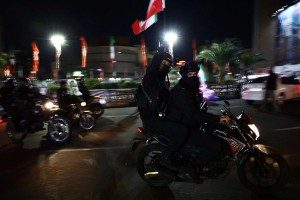
Supporters of the Islamic Republic wave Iranian flags during a nighttime rally.
Iran's nightly rallies by Islamic Republic loyalists have become platforms for opposing negotiations with Washington and targeting senior officials, drawing criticism over their political agenda, use of public resources and disruption to daily life in recent months.
The gatherings began in early March after the announcement that Supreme Leader Ali Khamenei had been killed in US and Israeli strikes. Supporters of the Islamic Republic took to streets and squares across the country and have continued gathering nightly.
Calls for revenge over Khamenei's killing and opposition to an agreement ending the war have become prominent features of the rallies, alongside attacks on officials involved in diplomatic efforts.
“A minority in the streets wants war, but the majority of people, who have no voice, just want to live their lives,” Mohammad-Ali Abtahi, a former first vice president under President Mohammad Khatami, said in an interview with Hamshahri television.
Abtahi's remarks circulated widely on social media and drew a backlash from supporters of the gatherings. Some Iranian media have also reported declining attendance, raising questions about the rallies' appeal beyond their most committed participants.
Khorasan newspaper, which is close to Parliament Speaker Mohammad-Bagher Ghalibaf, accused speakers of exploiting the gatherings for political score-settling.
“Turning an atmosphere of solidarity into an arena for political score-settling has not only reduced public participation but also endangered national cohesion,” the newspaper wrote.
During an online debate on the Azad platform, economist Mousa Ghaninejad challenged philosophy professor Bijan Abdolkarimi, who opposes negotiations with Washington, over the significance of the nightly crowds.
Ghaninejad argued that gathering in the streets did not make participants' positions correct and accused them of presenting themselves as the sole representatives of what was right while dismissing opposing views.
Protesters target senior officials
The rallies have increasingly targeted President Masoud Pezeshkian, Foreign Minister Abbas Araghchi and Ghalibaf, who is Iran's chief negotiator.
Placards have accused the officials of being too accommodating toward the enemy, with some demonstrators demanding their dismissal or resignation.
Organizers have also staged smaller daytime protests outside government and military institutions, extending their pressure beyond the nightly gatherings.
The conservative Jomhouri Eslami newspaper last week described the protests as unjustifiable, arguing that they threatened national interests and prevented Iran from “translating its military achievements into diplomatic gains.”
The newspaper wrote that the United States and Israel had infiltrated the gatherings, turning slogans against Washington and Israel into calls for the deaths of current and former Iranian officials.
It urged the judiciary and security agencies to intervene against those it accused of undermining national unity.
Khorasan also demanded judicial action after women wearing burial shrouds gathered outside the Armed Forces General Staff headquarters and accused military commanders of compromising with the enemy.
Khorasan urged the judiciary to take action against the protesters and organizers, as well as those it said had encouraged accusations of betrayal against military commanders and senior officials.
Public funding faces scrutiny
The rallies have also raised questions about the use of public resources to support political mobilization.
Rouydad24 news website last week described the gatherings as an “electoral campaign for the ultra-hardline faction,” questioning the use of public facilities to advance a particular group's political agenda.
The website highlighted the role of Tehran Mayor Alireza Zakani and his political allies in organizing and promoting the demonstrations.
It said no transparent financial information was available about their costs or the extent of direct funding by Tehran Municipality.
Residents complain of disruption
Beyond political infighting, residents have complained on social media about loudspeakers, traffic congestion and the nightly occupation of streets and public squares.
Some rally supporters have dismissed these objections, portraying participation as a wartime duty and criticism as disloyalty.
“The nightly gatherings are Iran's defensive shield, like air defenses, fighter jets and missiles whose noise we hear and fear, but they are on our side,” Kobra Asoupar, a journalist and defender of the nightly gatherings, wrote on X.
“If someone says during a war that we should not defend ourselves because we are being disturbed, that person is either an idiot or a traitor,” she added.
Smoke rises from the stern of a St. Kitts-flagged cargo vessel following what US Central Command says was a strike on Saturday to disable the vessel, which was trying to break the US blockade of Iran, at a location given as the Gulf of Oman, in this still image taken from video released November 7, 2026.
Iranian hardliners are urging a more confrontational response to a tightening US blockade, arguing that Tehran must raise the economic and military costs for Washington to prevent the pressure from becoming permanent.
Participants in a roundtable discussion titled “How to Break the Blockade?” broadcast on state television on Saturday, said the prospects for a political agreement with Washington had diminished. They argued that while the United States was maintaining its military readiness for a possible resumption of hostilities, its main strategy had shifted toward intensifying economic pressure on Iran.
Citing statements by President Donald Trump, participants also suggested that Washington might be moving away from direct military confrontation and efforts to restrict Iran's nuclear program toward a combination of economic pressure, security operations and attacks on Iranian infrastructure, potentially aimed at overthrowing the Islamic Republic.
Vahid Khazab, a military analyst appearing on the program, Be Vaght-e Iran, said Trump had "gone back from the nuclear issue to the subject of regime change — regime change that would put the country's resources under his control."
He said economic pressure, alongside security and military operations, would be the instruments used to pursue that objective.
Breaking the blockade becomes the priority
Trump's refusal to accept conditions Tehran insists must be met before any agreement with Washington to end the war, combined with the continuation of a neither-war-nor-peace situation and the widening economic blockade, put breaking the restrictions at the center of hard-liners' agenda.
They argue that Iran should respond by increasing pressure in the Strait of Hormuz and preventing a return to normal conditions in the region. Their proposed strategy involves continuing military operations to disrupt oil flows to international markets and increase economic pressure on the United States and Europe.
Despite repeated predictions by hardliners that oil prices would climb to $150 a barrel and cripple the American and European economies, crude prices have moved in the opposite direction in recent weeks, falling again slightly in Monday's trading.
Khazab described what he called "impact-oriented [military] operations" designed to prevent oil from passing through the Strait of Hormuz as a way to influence global oil markets and alter Washington's economic and political calculations. Such operations, he argued, would increase the costs of maintaining the blockade for the United States and its allies.
Several tankers have encountered incidents in the Persian Gulf and the Strait of Hormuz in recent days. In statements, Iran's Islamic Revolutionary Guard Corps (IRGC) and the Army have claimed that the vessels were "violating" ships that struck naval mines and caught fire.
On Sunday, the IRGC also claimed to have successfully carried out drone a attack against a US. radar installation at the Riffa helicopter base in Bahrain. In its statement, the force warned: "The Strait of Hormuz is closed, and any aggression by the American enemy will be met with an even harsher and more crushing response."
The attack appeared intended to signal that Tehran would not accept a prolonged neither-war-nor-peace situation or the consolidation of the blockade.
The argument for a more aggressive response has also appeared in commentary by prominent conservative figures.
Mohammad Imani, a member of the editorial board of the hardline Kayhan newspaper, wrote in an article published Saturday on the Nameh News website that Iranian officials should concentrate on "a plan to break the blockade and make it costly for the enemy," regardless of the extent of Tehran's engagement with mediators or the messages conveyed through them.
"Strikes against the enemy's vulnerabilities must certainly be carried out through a combination of methods to force it to retreat," he wrote.
Referring to recent threats by Mohsen Rezaei, secretary of Iran's Supreme National Security Council, and senior military commanders to expand the geographical scope of the conflict if the United States attacks, Imani argued that the more pressing question was no longer how Iran would respond to another American strike.
"The real and immediate issue today is not what our response would be if America attacks," he wrote. "The more important issue is that, after its failure in the war, its request for a ceasefire and its pretense of seeking an understanding, America has launched another game in the form of a naval, aerial and land blockade. Now it is Iran's turn to play."
Imani accused Washington of trying to disrupt Tehran's response through threats and diplomatic overtures, including sending intermediaries, so that Iran would refrain from taking what he described as a "corresponding and offensive" response, keeping Iran on the defensive.
He also argued that the United States wanted to distract Iranian officials from immediately planning and implementing "symmetric and asymmetric methods of breaking the blockade" by keeping Iranian decisionmakers occupied with mediators, the details of possible responses and the terms of a potential agreement.
An article published Saturday in Sobh-e No, a newspaper supportive of parliamentary speaker Mohammad-Bagher Ghalibaf, similarly argued that the current neither-war-nor-peace situation kept the threat of conflict hanging over Iran's politics and economy, allowing Washington to use the uncertainty as leverage.
"The end of the neither-war-nor-peace game will come when the threat can no longer be used as a permanent instrument for imposing one's will without incurring serious costs," the article said. "Sustainable deterrence will be achieved when war becomes costly for the other side and endless pressure proves fruitless."
Hossein Ghatib, a political commentator who publishes under a pseudonym on social media platform X, also warned against allowing the blockade to become normalized.
"The greatest danger for Iran is the normalization of the blockade and its transformation into the region's new status quo," he wrote. "If this situation becomes entrenched, the blockade will turn from a temporary measure into a permanent instrument for imposing political demands. Preventing such an outcome must be at the center of Iran's military strategy."
Warnings against further escalation
Not all commentators have endorsed a more confrontational approach. Some have warned that escalating tensions could leave Iran facing prolonged economic pressure without securing a political or military breakthrough.
Kourosh Ahmadi, a former Iranian diplomat, wrote in an article published Saturday in the reformist Shargh newspaper that Trump's recent statements indicating he did not currently intend to launch another full-scale war against Iran, as well as the removal of Vice President JD Vance from responsibilities related to negotiations with Tehran, should be taken seriously.
"Now we are left with a naval blockade, continued American pressure on our neighbors to close their land borders, and the possibility of limited and intermittent attacks on the southern coasts and islands in connection with the Strait of Hormuz," Ahmadi wrote.
He also pointed to the roughly $20 decline in oil prices, which he said appeared to be linked to reduced fears of war, as an important indication of the changing calculations.
"If the threat of war is completely ruled out — which has not yet happened — oil prices could fall below $90 a barrel," he wrote. "In that case, the United States would have no problem with the continuation of this neither-war-nor-peace situation."
Ahmadi concluded that the only hope was for both sides to show flexibility and allow negotiations to reach a conclusion.
An Iranian man fills his car at a gas station in Tehran on September 7, 2026.
Seven years after a fuel price rise set off one of the deadliest crackdowns in the Islamic Republic’s history, Iran is rationing gasoline more tightly, with lines at stations across the country, but it still dares not touch the subsidized price.
Esmail Saghab Esfahani, a vice president who heads the state energy efficiency agency, admitted this week that “we really have a supply problem.” He told Iranians they could no longer count on fuel stations to cover what they need, and should save part of their monthly ration before traveling.
“All the gasoline the government has, it has given to the people,” he said. “Nothing has been held back to supply more.”
On Thursday night, residents of Bandar Abbas, the main port on the Persian Gulf, blocked a road near a fuel station in the city’s Rajaei district with their cars, protesting long lines and empty pumps. Drivers on the Minab–Bandar Abbas route had protested earlier over the lack of fuel.
Price of gasoline is displayed on a fuel dispenser.
Seven years after ‘Bloody November’
Sunday marks seven years since the government announced, shortly after midnight on November 15, 2019, that gasoline prices would rise by 50 to 200 percent. Drivers who had paid 10,000 rials a liter would now pay 15,000 for their first 60 liters a month and 30,000 after that.
Protests broke out within hours and spread to more than 100 cities. Demonstrators blocked highways with their cars, burned banks and tore down images of Supreme Leader Ali Khamenei. On the second day, Khamenei told senior officials, “Do whatever it takes to end it,” Reuters later reported, citing people close to his inner circle.
The state cut off the internet for about a week, and security forces shot protesters with live ammunition, including from rooftops, in Mahshahr in the southwest and in cities across the country. Hundreds of people were killed and more than 7,000 arrested. Iranians call it “Bloody November,” or “Bloody Aban,” after the month in the Iranian calendar.
Those two prices, 15,000 and 30,000 rials, are still the two cheapest tiers today. In 2019 the cheaper one was worth about 12 cents. After seven years of inflation and a collapsing rial, it is worth about half a US cent.
The state has not risked a general price rise since. Each time economic pain has boiled over, it has turned on the state: fuel stations in Tehran were set on fire when rationing began in June 2007, and the uprising over the economic collapse in December 2025 ended in the January massacre.
That memory hangs over every decision. Sagheb Esfahani said this week that the price of the third tier would be reviewed every season, but that “a range of security, military and law enforcement bodies” had to give their opinion first. Government spokeswoman Fatemeh Mohajerani said the two cheapest tiers would not change.
Gasoline for half a cent
Each private car gets a monthly ration on its fuel card: 60 liters at 15,000 rials a liter, half a US cent; 50 liters at 30,000 rials, about one cent; and, since September 8, 50 liters at 100,000 rials, under four cents. A full month’s ration of 160 liters costs about 7.4 million rials, or $2.70.
What the government is doing instead of increasing prices is cutting access.
Until now, drivers who ran out of their ration could fill up with the station’s own “emergency” card at the third-tier price. On September 7, those station cards supplied 41 percent of all gasoline sold, about 59 million liters a day, the national fuel distribution company said.
Since November 1, station cards have been withdrawn in 11 provinces, almost all of them along Iran’s borders with Pakistan, Afghanistan, Turkmenistan, Iraq, Turkey and the Caucasus, plus the Persian Gulf coast, where officials say subsidized fuel is smuggled out. The plan began in Kerman, the first to lose the cards, before spreading.
Tehran, which burns about 20 million liters a day, as much as 15 other provinces combined, has been spared for now. There, each fill-up with a station card is tied to the car owner’s national ID instead. Drivers anywhere who need more than their ration are told to buy premium gasoline at about 1 million rials, or 37 cents, a liter, more than 60 times the cheapest rate.
Executive Vice President Mohammad Jafar Ghaempanah said the cards would be collected province by province within weeks, blaming smuggling.
“Several thousand Nissan pickups do nothing but collect fuel from different provinces and take it across the border,” he said, putting smuggling at 30 million liters a day. A liter of gasoline sells for about 2.6 million rials, or 96 cents, in Pakistan.
Former lawmaker Nezam al-Din Mousavi said about 90 percent of smuggled fuel was diesel, not gasoline. “Stop making excuses and say you are after price rises,” he said.
‘Neither the capacity nor the money to import’
Behind the measures is a supply gap that the war has made impossible to close.
Iran consumed about 133 million liters of gasoline a day on average through October, peaking at 144 million in September, while refineries produce between 112 and 135 million, according to official figures cited by Rouydad24.
Hossein Taeb, head of the Basij militia, said on Thursday that Iran still imports about seven million liters a day. The US naval blockade of Iran’s ports, in place since April, has made those imports harder and costlier, and refineries and fuel depots were damaged in the war.
“Every effort of the government is to match gasoline consumption with domestic production,” Ata Hosseinian, an economic and energy journalist, told Iran International. “There is neither the capacity nor the money to import gasoline.”
The government, he said, is applying the method it used for electricity and gas bills: a fixed cheap ration, and a much higher price above it, while station supplies are released “drip by drip.”
“People have to go to five stations to maybe get the cheaper gasoline at one of them after standing for hours,” he said.
“The Islamic Republic is threatening people with death so they’ll settle for a fever,” he said, citing a Persian saying. Once the fate of Hormuz and the blockade is settled, he expects the third-tier price to rise step by step, each season, toward 500,000 to 700,000 rials a liter, 18 to 26 cents.
‘Please stop talking’
The rationing has also split the establishment.
Within a day of Sagheb Esfahani’s remarks, First Vice President Mohammad Reza Aref ordered officials to stop commenting on gasoline, saying decisions would be announced only by the government spokeswoman or the national refining and distribution company.
A former lawmaker, Ahmad Amirabadi Farahani, posted a message to Sagheb Esfahani: “Doctor, please stop talking, stop giving interviews, stop getting on people’s nerves.”
The hardline daily Kayhan accused “a current” in the government of pursuing higher prices “by other methods,” called the two vice presidents’ remarks “provocative” and said they had fed “hostile media.”
“Regulatory and security bodies must step in as a deterrent,” it wrote. It also warned that without station cards, Iranians could not flee cities if war resumed, as many did during the 12-day and 40-day wars.
The hardline Farhikhtegan called the policy “a media game with society’s psyche in the middle of a war.”
‘What can you do with 110 liters a month?’
Online, the measures drew anger and ridicule.
“With the fuel use of domestic cars, what can you do with 110 liters a month?” one user wrote,. Another asked what the plan was for millions who drive into Tehran every day “to earn 350 or 400 million rials a month,” about $130 to $150, “and survive on bread and eggs.”
“The government’s message is that the real price of gasoline is 1.1 million rials,” a third wrote. At that price, a month’s ration of 160 liters would cost more than the minimum wage of about 166 million rials, or $61
Iraqi Prime Minister Ali al-Zaidi meets with Iranian Parliament Speaker Mohammad Bagher Ghalibaf in Baghdad, Iraq, August 19, 2026.
Iranian hardliners are demanding that Iraq take sides in Tehran's confrontation with Washington, criticizing Baghdad for restricting border crossings and flights under US pressure while seeking to keep the war out of its territory.
Iraq has closed or restricted several border crossings with Iran, including al-Sheeb-Chazabeh and Mandali-Sumar. The Mandali crossing was shut on Friday by order of the federal government and will remain closed until further notice.
Iraqi officials have described the restrictions as temporary, citing technical and security concerns and efforts to combat smuggling.
However, Foreign Minister Fuad Hussein acknowledged in a November 7 interview with Al Jazeera that Washington had formally asked Baghdad to close all but two of its land crossings with Iran. He said the United States continued to press for the closures, but warned that shutting all crossings would be difficult and would harm Iraq's economy, given the numerous official and unofficial routes along the border.
Air travel has also been affected. Iranian flights to Iraqi airports were largely suspended in late September after ground-handling companies refused to service Iranian aircraft because of the risk of exposure to U.S. secondary sanctions.
Following protests from Tehran and talks with Washington, Baghdad secured a limited exemption. From early October, Iranian airlines were permitted to operate up to 40 daily flights to Najaf International Airport, except Mahan Air, which is affiliated with Iran's Islamic Revolutionary Guard Corps (IRGC). Iraqi Airways also resumed flights between Najaf and several Iranian cities.
Direct Iranian flights remain largely limited to Najaf, while services to Baghdad, Erbil, Sulaymaniyah and Basra remain heavily restricted.
In a recent incident, an aircraft carrying Iran's national soccer team was reportedly denied permission to land at Basra airport, forcing the team to travel overland from Abadan.
‘A tougher response’
The restrictions have prompted criticism from Iranian commentators and hardliners, who accuse the Iraqi government of yielding to American pressure despite its economic and political ties with Tehran.
Speaking on a panel discussion broadcast on Iranian state television, Ebrahim Naddafzadeh, an analyst on Iraqi affairs, argued that Iraq had failed even to make a symbolic attempt to resist Washington's demands, despite what he described as its own interest in standing alongside Iran.
Naddafzadeh said Baghdad should stop describing itself as neutral and clarify whether it stood with Iran or the United States.
"Everyone says that Iran is the only country that benefits from Iraq's strength and stability. Well, then why don't you stand alongside Iran?" he asked.
Mehdi Azraqi, another guest on the Thursday-night program Be Vaght-e Iran, argued that American intervention in Iraq was not merely intended to counter Iranian influence. Washington's principal objective, he claimed, was to "control and set a ceiling on Iraq's development," because Iran also benefits from Iraq's economic progress.
Vahid Khazab, a political and military analyst, argued that Baghdad had demonstrated its ability to negotiate exemptions from American sanctions when its own interests were at stake.
Iraq imports electricity and natural gas from Iran to prevent serious domestic social and economic problems and has obtained U.S. waivers to continue those imports, he noted.
Khazab acknowledged that Washington has financial leverage over Baghdad through its control over arrangements for transferring Iraq's oil revenues. But he argued that this should not prevent Baghdad from negotiating exemptions, just as it had done to maintain its energy imports from Iran.
He added that Tehran could retaliate by suspending electricity exports to Iraq but was reluctant to take a measure that would shift the burden onto ordinary Iraqis.
Instead, Khazab suggested that Iran could revive its demand for compensation for the eight-year Iran-Iraq war. He argued that Iraq was obligated to pay reparations under United Nations resolutions.
"We don't want to seek compensation now, but we also have these levers," he said.
US ground operation?
Another source of concern in Tehran is the possibility that Iraqi territory could be used in a future US military operation against Iran.
Prime Minister Ali al-Zaidi has said Iraq will not allow its territory to be used to attack neighboring countries. However, the Iraqi newspaper Al-Mada reported on November 9 that al-Zaidi had informed Shiite political leaders of an alleged U.S. military plan to use Iraqi territory for a ground operation in southern Iran.
The report described several possible military scenarios and suggested that Washington's planning went beyond limited airstrikes or missile attacks against Iranian nuclear and military facilities.
Iran-aligned armed groups
Iranian hardliners are also calling for an active role by the “Islamic Resistance” current in Iraq in any future confrontation between Tehran and Washington.
Azraqi said Iraqi resistance groups had the capacity to enter a future conflict in support of Iran and take action within their capabilities against “certain targets in the region and American interests.”
The issue is particularly sensitive for al-Zaidi's government, which is seeking to bring Iran-aligned armed factions under state control. Several groups have resisted demands to surrender their weapons.
In his Al Jazeera interview, Hussein confirmed that Baghdad was negotiating with Iran-aligned factions to bring their weapons under government control and was also discussing the matter with Tehran.
He said al-Zaidi had reached understandings with four Iraqi armed groups on the issue, while emphasizing that the process should proceed through dialogue rather than force.
The Emirati outlet Eram News has also reported that al-Zaidi warned Shiite armed-group leaders against taking unilateral action that could draw Iraq into a confrontation between Iran and the United States.
According to the outlet, he warned that any group using Iraqi territory to attack American forces or interests and giving Washington a pretext for military action against Iran could face immediate legal prosecution. The government could also arrest the groups' leaders and declare a state of emergency.
Iraq seeks to mediate
While facing growing US pressure to curb its economic and security ties with Iran, Baghdad has also pursued diplomatic efforts to mediate between Tehran and Washington.
On Thursday, Hussein told France 24 that a US special envoy had asked Iraq to mediate in negotiations with Iran, adding that al-Zaidi's visit to Tehran had also been part of that effort.
Al-Zaidi made an unannounced visit to Tehran late last week, apparently on Friday, following discussions with US President Donald Trump and his special envoy for West Asian affairs, Tom Barrack.
Iraq's ambassador to Tehran and Iranian sources confirmed the visit and described it as part of Baghdad's diplomatic efforts to reduce regional tensions.
According to Iranian reports, al-Zaidi met with Iranian Parliament Speaker Mohammad-Bagher Ghalibaf, who heads Iran's negotiating team, and President Masoud Pezeshkian.
Iran's Tasnim news agency reported on November 9, citing informed sources, that al-Zaidi had failed to secure any outcome during the visit that would satisfy the Americans.
The visit was reportedly also seen as an opportunity for Baghdad to explain its position on restrictions along the Iranian border and allay Tehran's concerns.
Counterterrorism forces take part in a security drill in Tehran, Iran.
A proposal to merge Iran's Intelligence Ministry with the Revolutionary Guards' powerful intelligence organisation is gaining traction, reviving debate over the rivalry between the two agencies and the future of the country's security apparatus.
The issue has drawn renewed attention in the reformist newspaper Etemad, which is close to President Masoud Pezeshkian's administration.
In an article published Thursday, the newspaper examined proposals reportedly discussed in senior state consultations to consolidate the two agencies into a more unified and accountable intelligence structure.
Iran's Intelligence Ministry remains without a permanent chief nearly eight months after Esmail Khatib was killed in an Israeli strike in March, while parliament considers separate legislation to overhaul the ministry's leadership.
The two agencies have long operated alongside one another, with overlapping responsibilities and competing centres of authority.
A history of rivalry
Iran's intelligence apparatus encompasses several organisations, but the Intelligence Ministry and the Islamic Revolutionary Guard Corps (IRGC) Intelligence Organisation are its two most prominent institutions.
The ministry operates within the government, with its chief nominated by the president and approved by parliament. The IRGC's intelligence arm belongs to a military organisation operating under the supreme leader's command.
Their competing authority has occasionally produced disagreements over investigations and the treatment of detainees.
During the late 2010s, one prominent dispute involved environmental activists arrested by the IRGC Intelligence Organisation on espionage charges. Another concerned more than 50 people reportedly accused of spying for Israel.
In both cases, the Intelligence Ministry publicly challenged allegations advanced by the IRGC Intelligence Organisation.
Some former detainees subsequently told Iranian and Persian-language media outside the country that the ministry had apologised for their detention and offered compensation.
A sensitive debate
Writing in Etemad, journalist Mehdi Beik-Oghli examined longstanding concerns about overlapping mandates, institutional rivalries and legal accountability within Iran's intelligence system.
His analysis also explored the qualifications required for senior intelligence officials and the difficulties of maintaining separate security institutions with overlapping responsibilities.
Etemad is widely regarded as one of the newspapers closest to Pezeshkian's administration. Its proprietor, Elias Hazrati, serves as a senior government media adviser.
The article does not establish whether a merger has been formally proposed by the government or endorsed by senior decision-makers, but its publication brings a sensitive question about Iran's intelligence establishment into a prominent government-aligned newspaper.
Leadership vacuum
Iran's parliament is preparing to consider separate legislation that could fundamentally change the leadership structure of the Intelligence Ministry.
Parliamentary presidium spokesman Abbas Goudarzi said Tuesday that an urgent bill would remove the longstanding requirement for the intelligence minister to possess ijtihad, an advanced qualification in Islamic jurisprudence.
Since the ministry's establishment in 1984, all its permanent ministers have been clerics.
The proposed legislation would allow a non-cleric to take the position while establishing two new organisations within the ministry, responsible for internal security and ideological affairs.
Their directors would be appointed directly by Supreme Leader Mojtaba Khamenei, while the intelligence minister would continue to be nominated by the president and approved by parliament.
Goudarzi said the changes would help resolve the leadership vacancy following Khatib's death. The ministry has been run by an acting minister whose identity has not been publicly disclosed.
The proposed legislation has yet to receive parliamentary approval, and it remains unclear whether the eventual selection of a new minister would favour career intelligence officials or figures associated with the Revolutionary Guards.
While the parliamentary proposal would retain the ministry and alter its leadership arrangements, the merger discussion goes further, raising the possibility of consolidating institutions that have operated as competing centres of security authority for decades.
Neither proposal has been adopted, and no decision to merge the intelligence agencies has been announced.