A US Capitol Police officer patrols the east front of the US Capitol in Washington, US September 15, 2021.
Iran could carry out a radiological or chemical-weapons attack in the United States, but operational hurdles and retaliation risks make it unlikely, experts told Iran International following reports of plots targeting senior US officials.
The assessments followed a CNN report citing seven US officials who said intelligence indicated Iran was developing plans to potentially target senior Trump administration officials in Washington with a dirty bomb or chemical weapon.
"Dirty bomb is not typically what you would use to assassinate someone," said David Albright, a physicist and president of the Institute for Science and International Security.
Farzin Nadimi, a senior fellow at the Washington Institute specializing in Iran's military affairs, assessed the likelihood of an attack as "low to very low," citing operational difficulties and the prospect of US retaliation.
Two sources cited by CNN said the planning included specific locations and targets, although there was no evidence that Iranian leaders had decided to proceed. Officials differed over whether personnel were already in place.
The White House said there were "no credible threats to the homeland" at the time. President Donald Trump said Tuesday that Washington was investigating the information and taking the possibility seriously.
Iran denied the allegations, while Homeland Security Secretary Markwayne Mullin described the planning as "aspirational."
Iran's chemical-weapons history
Iran's history of acquiring and transferring unconventional weapons provides grounds for taking the warnings seriously, Behnam Ben Taleblu, senior director of the Foundation for Defense of Democracies' Iran Program, said.
"These are threats that do need to be taken seriously," Taleblu said. "Conversely, the intelligence leaks and the sources should also be scrutinized."
Taleblu cited Iran's past transfers of chemical weapons to Muammar Gaddafi's Libya.
US State Department compliance reports have identified Iran's failure to declare chemical-weapons transfers during the Libya-Chad war as a violation of the Chemical Weapons Convention.
A 2019 report cited chemical-filled artillery projectiles and aerial bombs transferred to Libya, alongside chemical mortar rounds assessed to be of Iranian origin found in Iraq, as evidence supporting Washington's assessment that Iran had filled and possessed chemical weapons.
A subsequent report identified Iran's pursuit of pharmaceutical-based agents for offensive purposes as another compliance violation.
Despite that history, Taleblu did not regard the latest warnings as necessarily signaling a change in Iran's military doctrine.
"I think this is a lot more of the same," he said.
Would a dirty bomb be effective?
The alleged assassination objective raises questions about the choice of weapon, particularly whether a radiological device would be effective against individual targets.
A dirty bomb combines conventional explosives with radioactive material. The US Centers for Disease Control and Prevention says its primary immediate danger generally comes from the explosion, although radioactive contamination can create additional health risks.
Such a device could force evacuations and spread fear, but would be less suited to killing a particular individual, Albright said.
"In terms of an assassination method, I wouldn't consider it very effective," he said.
Chemical agents could be more effective for targeting individuals, Albright argued, citing research published by his institute in 2024 identifying evidence of Iranian work on delivering pharmaceutical-based agents using drones.
Whether that work produced an operational capability or was connected to a specific US attack plan remained unclear.
"I think it's also important to keep in mind that the story said there was no imminent threat," Albright added.
Operational obstacles and retaliation risks
Beyond the choice of weapon, carrying out an attack would require access to materials, reliable personnel and the ability to evade US security measures.
Iranian intelligence services could potentially construct a crude radiological device if they obtained the necessary material inside the United States, Nadimi assessed.
"The likelihood I believe is low to very low, given the risks associated with such an action and the high possibility of retaliation," he said.
Questions about operational readiness also concerned Mark Fowler, a former CIA operations officer with extensive experience involving Iran, who questioned who was discussing the alleged attack and how far preparations had advanced.
"It's not clear to me that they actually have that in hand at this point," Fowler said, referring to the required materials.
CNN reported that Iranian communications suggested bomb-making materials were already inside the United States. Officials disputed the credibility of that information, although some considered it likely that materials had been positioned in advance.
Nadimi considered domestic acquisition theoretically possible, while Albright emphasized US accounting and security measures that make obtaining radioactive material more difficult.
A 2021 National Academies study identified vulnerabilities involving some civilian radioactive sources and warned that even relatively small radioactive releases could have lasting socioeconomic consequences.
The warnings could also strain US security resources even without an attack, Mike Pregent, a former intelligence officer who has testified before Congress about Iran's overseas terrorism networks, said.
"They've already got everybody spinning up on it," Pregent said.
Any radiological or chemical-weapons attack could also harden American public opinion against the Islamic Republic and provoke severe retaliation, Nadimi said.
The reported consideration of such an operation, however, "does not show a decision is made to act," he added.
Smoke rises on Iran's Qeshm Island after airstrikes attributed to the US military on Nov. 17, 2026.
US fighter jets struck a Revolutionary Guards missile launch site on Iran’s Qeshm Island on Tuesday after Iranian drones targeted Bahrain, in an exchange that threatened efforts to ease the conflict.
A US military official said American aircraft used precision munitions to hit the site, describing the strike as an act of self-defense.
“The strike was in response to IRGC aggression targeting US personnel and assets,” the official said. “US Central Command remains highly vigilant and fully postured to protect Americans across the region.”
Iranian provincial official Ahmad Nafisi said the attack on Qeshm caused no damage to residential or commercial areas or vital infrastructure.
Iranian media reported that US forces had hit an air defense missile launcher in the island’s Nariman area. The IRGC-affiliated Tasnim news agency reported that several projectiles had struck the island.
The strike came hours after the Guards said they had targeted a US radar system at Bahrain’s Isa Air Base in response to what they described as continued violations of Iranian airspace by US military drones.
The US military said the Iranian drones had been intercepted without damaging American equipment or injuring US personnel.
“Multiple Iranian one-way attack drones launched by the IRGC today towards Bahrain were intercepted without any damage to US equipment or injury to American personnel,” US Central Command said on X, adding that US and partner forces remained highly vigilant.
Iran’s army separately said it had shot down a LUCAS drone over the Strait of Hormuz using domestically developed air defenses. The US has not commented on the army’s claim.
Regional condemnation
US Secretary of State Marco Rubio discussed the Iranian attacks with Bahraini Foreign Minister Abdullatif bin Rashid Al Zayani, Bahrain’s Foreign Ministry said. Rubio condemned the attacks and reaffirmed Washington’s commitment to Bahrain’s security and that of its regional partners.
Saudi Arabia called for an immediate halt to Iranian attacks on countries across the region and urged that diplomacy be given a chance. Qatar also condemned the attacks on Bahrain, warning that their continuation marked a serious escalation that undermined efforts to ease tensions.
The Guards, meanwhile, issued a further warning to Bahrain.
Spokesman Hossein Mohebbi accused its government of cooperating in attacks on Iran and relying on a US “security bubble,” saying those policies would cast doubt on Bahrain’s survival in a new regional security order.
The exchange came as Qatar said it would meet Iranian officials to discuss proposals aimed at narrowing differences between Tehran and Washington.
It also followed Iranian Foreign Minister Abbas Araghchi’s visits to Pakistan and Oman, who have long been acting as mediators in Iran-US tensions.
Shipping under threat
The violence also coincided with further reports of vessels being hit around the Strait of Hormuz.
The UK Maritime Trade Operations agency said a vessel sustained a second strike about seven nautical miles north of Khasab, Oman, causing a fire. Its crew were unaccounted for, and the extent of the damage was unknown, the agency said, citing a maritime security agency.
Iran’s Guards Navy separately claimed that a supertanker carrying more than two million barrels of crude and a liquefied gas carrier had struck sea mines in the strait. Iran’s army also reported a mine strike on a tanker east of the waterway.
It was unclear whether the Iranian statements and the UKMTO alert referred to the same incidents.
The suspected honor killing of a 16-year-old Iranian schoolgirl has raised questions about her school's failure to protect her after she reportedly warned that her life was in danger, with authorities announcing the arrest of her father and school principal on Tuesday.
Sogand Sayadi died after leaving school with her father in Kermanshah, western Iran, prompting calls from teachers' organizations and human rights groups for an investigation into the circumstances surrounding her death.
Her father was detained on suspicion of assault and provisionally murder, while the school principal was arrested on suspicion of negligence, the judiciary-affiliated Mizan news agency reported, citing provincial chief prosecutor Hamidreza Karimi.
Investigators are examining possible murder or suicide, with forensic examinations continuing to determine the cause of death and any criminal responsibility, Karimi said.
Sayadi had reportedly warned school officials that her life would be in danger if she returned home with her father. Her body was discovered the following morning in the courtyard of her residential building.
Photographs published from her funeral also showed her father standing among mourners during the funeral prayer.
Accounts of violence at school and home
Officials at the school summoned Sayadi's father, Kioumars Sayadi, after learning about a matter involving her private life, the Hana Human Rights Organization reported Monday.
Accounts surrounding the case suggest the dispute concerned the teenager's romantic relationship with a boy, although the school principal denied that this prompted the decision to summon her father.
Sayadi's father severely beat her in front of classmates and repeatedly struck her head against a wall outside the school, Hana reported, citing its sources.
The violence continued at home, where her father threw her from the building, according to the organization.
Other accounts suggest the teenager fell from the fifth floor of the building.
Kermanshah's education department offered a different account of her departure from school, saying her father had visited to collect her academic records and arrange her transfer to Gilan-e Gharb, a town in western Iran.
The two left school around 9 a.m., the department said.
Sayadi lived with her stepmother and faced family disagreements, while apparently being pressured to return to her hometown, Jahangir Aghaei, the department's public relations director, said.
Teachers question school's responsibility
The Coordinating Council of Iranian Teachers' Trade Associations accused school officials of disregarding Sayadi's warnings and demanded accountability from the Education Ministry in a statement Monday.
The council called for an end to interference in students' private lives, stronger child protection mechanisms and the removal of laws that shield perpetrators of family violence.
Hana also demanded an independent investigation into the death and the possible responsibility of school staff.
Under Article 301 of Iran's Islamic Penal Code, fathers and paternal grandfathers are exempt from qisas, or retaliatory execution, for killing their children.
Femicide figures highlight wider problem
At least 84 women and girls were killed in Iran between March 21 and October 13, including 12 girls under 18, according to figures compiled from cases documented in media coverage.
Mourners gather for Sogand Sayadi's funeral in western Iran, with her father reportedly among those attending the funeral prayer.
In 75 cases, the perpetrators were known to the victims. Eight of the underage victims were killed by fathers, brothers or other blood relatives.
The figures reflect documented cases rather than the total number of killings.
Legislation intended to protect women against violence remains unapproved after more than 15 years of debate among Iranian government institutions.
Sayadi's death has intensified scrutiny of the responsibilities of schools and state institutions to protect girls facing threats within their families, particularly when warnings of possible violence are raised before a death occurs.
File photo: People queue to buy bread outside a bakery in Iran.
Bread rationing has been introduced without public notice in two Iranian provinces, triggering queues and disputes at bakeries, the hardline daily Kayhan reported, as government officials confirmed a nationwide bread purchase management system on Tuesday, November 17.
Kayhan, published under the supervision of a representative of Iran's Supreme Leader, reported that the restrictions had been introduced in Khuzestan province in southwestern Iran and Zanjan province in the northwest without informing bakers or consumers in advance.
The measures prompted residents to rush to bakeries and led to verbal confrontations, the newspaper reported.
Under the system described by Kayhan, each person receives a monthly allocation equivalent to approximately eight kilograms of subsidized flour, priced at 23,000 rials ($0.009) per kilogram.
Purchases exceeding the allocation are charged at the commercial rate of 126,500 rials ($0.047), more than five times the subsidized price, with the additional payments transferred to government accounts, Kayhan reported.
The newspaper questioned why the measures had been introduced without informing bakers or consumers and accused “elements within the government” of contributing to “public anxiety” through simultaneous changes affecting bread, gasoline and electronic food vouchers.
Local media had previously reported restrictions in Shadegan, Andimeshk, Omidiyeh and Zeydun in Khuzestan province, where daily bread allocations were set at between two and 2.5 loaves per person.
Purchases exceeding those amounts were priced at 131,500 rials ($0.049), according to the local reports.
The bread purchase management system is being implemented across Iran, but ordinary households face no restrictions on their daily purchases, Omid Jahannejadian, director-general of Khuzestan's Grain and Commercial Services Department, told the official IRNA news agency on Tuesday.
The program is intended to regulate subsidized flour consumption, prevent potential misuse and identify purchases exceeding normal household needs, Jahannejadian said.
Consumption thresholds are calculated using purchasing data collected over the past two years, taking account of differences between urban and rural areas.
The system calculates allocations at the household level, with purchases by family members counted toward a combined household allowance, Jahannejadian added.
File photo: A baker prepares traditional bread at a bakery in Iran.
In Zanjan province, Ali Eyvazi, director-general of the provincial Grain and Commercial Services Department, also confirmed that unusually large bread purchases would be charged at commercial rates.
Ordinary household purchases would not face higher prices, Eyvazi told IRNA.
The guidelines were issued on November 15, with the system subsequently updated at bakeries and flour mills.
Although the average monthly flour allocation per Iranian is approximately eight kilograms, applying an identical limit to every person without accounting for household circumstances and regional differences would be inaccurate, Eyvazi said.
The program was initially tested in Markazi province before authorities decided to expand its implementation to other provinces following an evaluation.
In a separate interview with the Mehr news agency, Eyvazi rejected descriptions of the measures as a two-tier bread pricing system, saying ordinary household consumption would remain unrestricted despite the introduction of purchasing thresholds.
Supermarkets must obtain bread from bakeries operating without government subsidies, while commercial purchases from subsidized bakeries must comply with the new rules, Eyvazi added.
Rising food costs put pressure on households
The introduction of bread purchase controls comes as Iranians face increasing difficulties affording basic food products.
Iran's minimum monthly base wage stands at about 166 million rials ($62), following a 60 percent increase in March. The cost of a basic monthly basket of goods for a working-class family had reached approximately 906 million rials ($337) by July, more than five times the minimum base wage, according to calculations cited by Iranian media.
Accounts sent to Iran International describe households turning to installment payments to purchase essential items, including bread, meat, chicken and eggs.
In a video showing a bakery queue in Tehran, one resident described shortages alongside rising prices and shrinking loaf sizes.
"Bread has become scarce, and we have to stand in line to buy it. At the same time, the loaves have become smaller and more expensive. Can someone tell us how we are supposed to feed our children?" the resident said.
Other citizens have described reductions in flour allocations and changes in the taste and color of bread.
Economic hardship is also affecting social relations as more households struggle to meet their basic needs, sociologist Hossein Ghazian told Iran International.
When survival becomes people's primary concern, competition increasingly replaces cooperation, potentially contributing to domestic violence, street confrontations and crime, Ghazian said.
The economic pressures can also contribute to depression, suicide, declining marriage and birth rates, and migration, reflecting diminishing confidence in the future, Ghazian added.
The nationwide bread controls introduce new purchasing thresholds for a staple food even as officials insist that ordinary household consumption will remain unaffected.
A mourner attends the funeral of a commander from Iraq's Kataib Hezbollah armed group who was killed in what they called a "Zionist attack" in the Syrian capital Damascus on Friday, during a funeral in Baghdad, Iraq September 22, 2024. REUTERS/Thaier Al-Sudani/File Photo Purchase Licensing Rights
Iraq’s attempt to reclaim a stronghold of Iran-backed militia could test Baghdad’s authority over armed factions while leaving much of Tehran’s influence over the country’s politics, security forces and economy intact, experts told Iran International.
Baghdad ordered troops on Monday to enter Jurf al-Sakher, south of the capital, following an investigation into suspected oil smuggling. The faction has been given until Friday to withdraw, according to a security source cited by AFP.
The move comes amid US pressure to rein in Iran-backed militias, but taking control of the town would not necessarily dismantle the political and financial networks that sustain their power.
“It’s going to be once again a theatrical show,” said Omar Mohammed, an Iraqi historian who documented life under Islamic State through his blog Mosul Eye.
Senior Iraqi officials told Reuters that Kataib Hezbollah had operated an oil-smuggling network for years, generating hundreds of millions of dollars since 2021. The US-designated terrorist organization, which has attacked American forces in the region, has long controlled Jurf al-Sakher, also known as Jurf al-Nasr, in Babil province south of Baghdad. Kataib Hezbollah denied the smuggling allegations, Anadolu reported.
Why Jurf al-Sakher matters
Mohammed described Jurf al-Sakher as a financial hub Iran has used to evade sanctions. He said the town’s location near roads linking Baghdad with Karbala and Anbar gives whoever controls it strategic leverage over the capital. He also pointed to the displacement of Sunni residents, whose prolonged exclusion has fueled sectarian tensions.
More than 100,000 people from Jurf al-Sakher and surrounding communities remain unable to return more than a decade after Iraqi forces retook the area from Islamic State in 2014, Shafaq News reported. Government committees have entered the area in recent months, but such visits have been unusual and required high-level security and political coordination, the outlet said.
Prime Minister Ali al-Zaidi “ordered the armed forces to enter” Jurf al-Sakher, government spokesman Haidar al-Aboudi told the Iraqi News Agency, adding that “a deadline has been set for the armed faction to exit the area.” A security source told AFP the deadline was Friday.
Al-Aboudi said investigators found evidence of pipeline tampering. Nine security and oil officials were dismissed following the investigation, Reuters reported.
Sources told The New Arab that fighting between Iraqi forces and Iran-backed factions was possible. A senior Iraqi official told the outlet that the government had deployed armored vehicles to the town’s outskirts.
The militias’ reach beyond the town
David Patrikarakos, a special correspondent for the Daily Mail and author of Nuclear Iran: The Birth of an Atomic State, recalled seeing a separate line of commercial trucks at a checkpoint outside Mosul when he reported from Iraq a few years ago. His local contacts told him the truck drivers had to pay Iran-backed militias a levy to enter the city.
Patrikarakos welcomed Baghdad’s attempt to push back but said the government had limited room to maneuver. He pointed to the factions’ political wings and their role in the Popular Mobilization Forces, a state-funded security body that formally answers to the prime minister. Some factions, he said, retain their own weapons, separate chains of command and ties to Iran.
“I think maybe the Iranian-backed militias will allow them some cosmetic gains, but there’s no way that Iran is going to allow its footprint in Iraq to disappear,” he told Iran International.
Patrikarakos said Tehran sees Iraq as part of its strategic depth and that Iran-backed factions could make limited concessions while retaining much of their power. He said clashes were possible and questioned whether the Iraqi government could prevail in an armed confrontation.
Mohammed, whose recent memoir is Mosul Eye: A Scholar’s Clandestine War Against ISIS, said al-Zaidi’s reach was limited by how deeply the militias were embedded in Iraq’s economy and politics. He cited their access to US dollars and what he described as their grip on commerce in Mosul. In his view, taking Jurf al-Sakher would leave much of that influence intact.
Even if al-Zaidi is sincere, Mohammed said, his government lacks the political will and institutional capacity to rein in the Iran-backed factions. “Militias are still in control,” he said.
US pressure puts al-Zaidi to the test
Former US Ambassador John Craig called Baghdad’s move “about 10 years overdue.” He said Washington was putting significant pressure on al-Zaidi and that the prime minister appeared to understand that Iraq’s stability depended on reining in Iran-backed militias.
Craig questioned whether Iraqi forces had the training and resources to push back against factions that have had years to entrench themselves. He said some doubt al-Zaidi’s independence from the militias and see the order as an effort to satisfy Washington. The prime minister’s actions, Craig said, would show how serious he was.
Al Arabiya, citing unnamed sources, reported that al-Zaidi left a meeting of the ruling Shiite Coordination Framework after disagreements over Jurf al-Sakher.
An Iranian delegation arrived in Baghdad on Monday for talks aimed at defusing the standoff, Al Arabiya reported, citing sources. The delegation was expected to meet Iraqi officials, Shiite Coordination Framework leaders and armed factions to prevent a military confrontation.
Some Coordination Framework leaders proposed replacing Kataib Hezbollah fighters with Popular Mobilization Forces units affiliated with Iraq's religious shrines as a compromise, according to the report.
Mohammed said the troop order gave Baghdad something to show Washington. He argued that sustained pressure from the United States and Iraq’s neighbors could push the government toward more substantive action.
A lasting crackdown, he said, would require political will, a clear strategy and institutions capable of carrying it out.
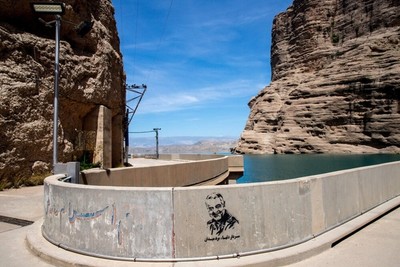
Dez Dam in Khuzestan province, southwestern Iran. (File photo: Amin Nazari/ISNA)
Iran’s extensive network of dams and water-transfer projects may have been built partly to support underground missile bases, the New York Times reported on Monday, citing experts who identified overlaps between water infrastructure and areas targeted in US-Israeli airstrikes.
Water and military experts told the newspaper that projects with no clear civilian justification could help sustain Iran’s underground military facilities. The report stressed, however, that the connection remains speculative.
Nima Shokri, a water security expert at Germany’s Hamburg University of Technology, said his team had tracked at least 533 dams across Iran. Examining a map of strikes on suspected military sites this year, he noticed that their locations closely resembled the pattern on his map of dams.
“It was always puzzling to me,” he told the Times. “Why were they building so many dams?”
The airstrikes prompted another question: “Why does it seem that wherever we have dams, there is a missile strike close by?”
Supplying the ‘missile cities’
Seven water and military experts interviewed by the newspaper said dams could provide the steady water and electricity supplies needed by sprawling military complexes.
Iran’s underground “missile cities” house facilities for producing, storing and launching missiles and drones, protected by tunnels dug deep beneath mountains.
Danny Citrinowicz, a former Iran analyst for Israeli military intelligence, said access to independent supplies would give Tehran “operational continuity.”
“Iran has a strong incentive to ensure that its missile complexes are not dependent on the broader national infrastructure for essential services,” he said.
One example examined by the newspaper was a large project transferring water from the Zagros mountains to Yazd.
Amir Aghakouchak, a water expert at the University of California, Irvine, said March airstrikes and reporting about a major missile facility in the area led him to suspect that the project “may have been influenced, at least in part, by military considerations.”
Shokri cautioned that many dams serve essential civilian needs in a country facing water shortages, providing drinking water, irrigation and electricity.
“Any potential military role should not overshadow these functions,” he said.
Civilian infrastructure in military planning
Iran International reported in March on a leaked 33-page directive attributed to the Revolutionary Guards’ missile command that appeared to make civilian locations part of a structured system for concealing and supporting missile operations.
The document, supplied by the hacktivist group Edalat-e Ali, identified industrial facilities, sports centers, sheds and warehouses as potential cover positions. Its criteria included keeping equipment out of view of surrounding buildings and ensuring surveillance cameras were absent or could be switched off.
A separate Iran International investigation compiled accounts of security and military forces moving personnel, weapons and equipment into at least 70 civilian sites across 17 provinces, including 34 schools.
Iran International geolocated visual evidence from seven locations, all schools.
In September, Tehran Governor Mohammad-Sadegh Motamedian called for schools used by other state bodies to be returned before the academic year began. He did not identify the institutions involved or say how many schools remained occupied.
Iranian officials have denied using civilians as shields and accused Israel and the United States of targeting civilian infrastructure.
Questions over conservationists’ arrests
The Times report also explored whether proximity to concealed military sites could help explain the Guards’ arrests of wildlife conservationists in 2018. It established no definitive connection.
Morad Tahbaz, a founder of the Persian Wildlife Heritage Foundation who spent more than five years in prison, recalled interrogators’ fixation on his team’s work protecting rare wild sheep in Hormozgan province.
“They were incredibly sensitive about that area,” he said.
The newspaper reported that US strikes hit the province’s Tarom Protected Area on July 14, killing a wildlife ranger’s family. Washington said it was targeting military infrastructure and coastal defenses. Military expert Farzin Nadimi told the Times the location was near a suspected underground missile base.
“I think it is possible that the Guards saw anyone doing fieldwork near these sites, even wildlife conservationists, as a potential security threat,” environmental analyst Nik Kowsar told the newspaper.