• العربية
  • فارسی
Brand
  • Iran Insight
  • Politics
  • Economy
  • Analysis
  • Special Report
  • Opinion
  • Podcast
  • Iran Insight
  • Politics
  • Economy
  • Analysis
  • Special Report
  • Opinion
  • Podcast
  • Theme
  • Language
    • العربية
    • فارسی
  • Iran Insight
  • Politics
  • Economy
  • Analysis
  • Special Report
  • Opinion
  • Podcast
All rights reserved for Volant Media UK Limited
volant media logo
EXCLUSIVE

Iran developing unconventional warheads for ballistic missiles, sources say

Dec 29, 2025, 00:30 GMT+0Updated: 22:28 GMT+0
Iran's Zolfaghar short-range solid fuel ballistic missile on display at an exhibition of IRGC Aerospace military equipment

Iran's Islamic Revolutionary Guard Corps (IRGC) is developing biological and chemical warheads for the country's long-range ballistic missiles, informed military sources told Iran International on Sunday.

The IRGC Aerospace Force is working on the unconventional warheads for ballistic missiles as it transfers missile launchers to eastern regions of Iran, the sources said.

The sources, who requested anonymity due to the sensitivity of the matter, said these activities have accelerated in recent months and are being pursued amid rising regional tensions and Tehran’s concerns about the possibility of another direct confrontation with Israel and the United States.

Israeli Prime Minister Benjamin Netanyahu is in Florida to meet the US president on Monday, when he plans to brief Donald Trump on options for potential future strikes against Iran, amid concerns that Tehran is rebuilding ballistic missile production facilities and repairing air defenses damaged during a brief war in June.

Iran International’s sources say these programs are largely carried out under the supervision of the IRGC Aerospace Force and include optimizing ballistic missiles to carry chemical and biological agents, as well as upgrading the associated command-and-control systems.

The Revolutionary Guard, anticipating scenarios of large-scale conflict, is building capabilities that, in the view of the Islamic Republic’s decision-makers, would serve as a “complementary deterrent factor” alongside Iran’s conventional missile program, one source said.

The pursuit of chemical and biological warheads comes six months after Iran’s foreign minister described his country as “the largest victim of chemical weapons in modern history,” citing Saddam Hussein’s chemical attack on Sardasht in western Iran, which, according to OPCW documentation, killed more than 100 people in a large-scale mustard gas assault.

Asked about the contradiction, one source told Iran International, “The Iranian leadership views potential Israeli and American attacks as a threat to its very existence and intends, in the event of a conflict, to significantly raise the cost for the opposing side.”

There is a perception at the highest decision-making levels of the Islamic Republic that “the use of unconventional weapons can be justified in situations of existential threat," the source added.

Last week, Iran International reported that Western intelligence agencies had identified “unusual” activities by the IRGC Aerospace Force and had increased monitoring and surveillance of these movements.

Sources said intelligence services were tracking command-and-control signals as well as deployments and logistical movements linked to the force.

'Drastic change in Mideast deterrence balance'

Military analysts told Iran International that if these reports are confirmed, the development of chemical and biological warheads could drastically alter the region’s deterrence balance and trigger broad international reactions.

The deployment of such weapons would face widespread global condemnation and could pave the way for additional sanctions and intensified pressure on Tehran.

Tehran has consistently denied any effort to acquire unconventional weapons and has declared itself committed to its international obligations.

Over recent years, Iran has steadily increased the range, accuracy, and variety of its ballistic missiles, a program that has been one of the main sources of concern for Western countries and regional states.

Most Viewed

Iran negotiators ordered to return after internal rift over Islamabad talks
1
EXCLUSIVE

Iran negotiators ordered to return after internal rift over Islamabad talks

2
INSIGHT

Iran's digital economy battered by prolonged blackout

3
ANALYSIS

US blockade enters murky phase as tankers spoof signals and buyers hesitate

4
ANALYSIS

Why the $100 billion Hormuz toll revenue is a myth

5

US tightens financial squeeze on Iran, warns banks over oil money flows

Banner
Banner

Spotlight

  • Hardliners push Hormuz ‘red line’ as US blockade tests Iran’s leverage
    INSIGHT

    Hardliners push Hormuz ‘red line’ as US blockade tests Iran’s leverage

  • Ideology may be fading in Iran, but not in Kashmir's ‘Mini Iran'
    INSIGHT

    Ideology may be fading in Iran, but not in Kashmir's ‘Mini Iran'

  • War damage amounts to $3,000 per Iranian, with blockade set to add to losses
    INSIGHT

    War damage amounts to $3,000 per Iranian, with blockade set to add to losses

  • Why the $100 billion Hormuz toll revenue is a myth
    ANALYSIS

    Why the $100 billion Hormuz toll revenue is a myth

  • US blockade targets Iran oil boom amid regional disruption
    ANALYSIS

    US blockade targets Iran oil boom amid regional disruption

  • Iran's digital economy battered by prolonged blackout
    INSIGHT

    Iran's digital economy battered by prolonged blackout

•
•
•

More Stories

Iran launches three satellites from Russia in joint Soyuz mission

Dec 28, 2025, 13:19 GMT+0

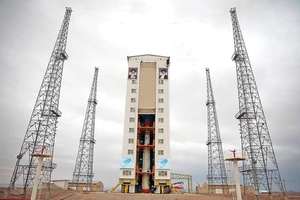
Iran on Sunday launched three domestically built satellites into low Earth orbit aboard a Russian Soyuz rocket, deepening space cooperation between Tehran and Moscow in a program Western governments say draws on technologies applicable to long-range missiles.

The satellites were placed into orbit from Russia’s Vostochny Cosmodrome in a multi-payload launch that Iranian officials described as the country’s seventh satellite mission carried out using Russian launch vehicles.

“These satellites were designed and manufactured by Iranian scientists, and both government bodies and the private sector have been involved,” Iran’s ambassador to Russia, Kazem Jalali, said in remarks published ahead of the launch.

“Two of the satellites belong to the government and one belongs to the private sector, and our knowledge-based companies and universities are active in this field.”

Jalali said Iran had continued to advance its space capabilities despite international pressure. “Despite all the threats and sanctions that exist, we have something to say in this field.”

Iran’s space agency chief, Hassan Salarieh, said the launch reflected what he described as Iran’s standing among a small group of countries with end-to-end space capabilities.

“Iran is among 10 or 11 countries in the world that simultaneously possess the capability to design and build satellites, launch vehicles and the infrastructure for launching, receiving data and processing images,” he said.

Salarieh said Iran aimed to expand both the number and precision of its satellites. “What is necessary for us is increasing the number of satellites, improving their accuracy and quality, and developing different classes of satellites,” he said.

  • Iran set to orbit three satellites in joint launch from Russia

    Iran set to orbit three satellites in joint launch from Russia

  • Iran plans first launch from Chabahar space center as three satellites near liftoff

    Iran plans first launch from Chabahar space center as three satellites near liftoff

Iranian media identified the satellites as Paya, also known as Tolou-3, Zafar-2, and a prototype satellite called Kowsar-1.5. The spacecraft were launched alongside a large cluster of mainly Russian satellites into a sun-synchronous low Earth orbit.

Paya (Tolou-3), built by the Iranian Space Agency, is Iran’s heaviest Earth-observation satellite to date, weighing about 150 kilograms.

Iranian officials say it is capable of producing black-and-white images with a resolution of about five meters and color images with a resolution of around 10 meters, and is intended for applications including agriculture, water management, environmental monitoring and disaster assessment.

Zafar-2, developed by Iran University of Science and Technology, is also an Earth-observation satellite designed for mapping, environmental monitoring and tracking natural hazards.

Kowsar-1.5 combines imaging and internet-of-things capabilities and is aimed primarily at agricultural and farm-monitoring uses, Iranian officials say.

Jalali described Iran’s space cooperation with Russia as extensive and said Moscow’s experience had played a key role.

“Russia is advanced in the space field, including satellites, launch vehicles and satellite launches, and we have been able to transfer part of the technology and work together,” he said.

He also described the Soyuz rocket as highly reliable. “Before Russia’s relations with the West deteriorated, many Western satellites were launched using Soyuz,” Jalali said.

The launch also carried Russian Earth-observation satellites, internet-of-things platforms and university-built spacecraft, according to launch data, as well as satellites from partner countries including Belarus, Kuwait and Montenegro.

Iran says its space program is civilian and focused on scientific and economic goals, but Western governments argue that satellite launch technology overlaps with systems used to develop intercontinental ballistic missiles.

Iran says it is in full-scale war with US, Israel and Europe

Dec 27, 2025, 15:32 GMT+0

Iran’s president said on Saturday the country is facing a full-scale confrontation with the United States, Israel, and Europe, describing the pressure campaign against Tehran as more complex and damaging than the Iran–Iraq war.

“In my view, we are in an all-out war with the United States, Israel, and Europe; they do not want our country to stand on its own feet,” Masoud Pezeshkian said in an interview with the Supreme Leader’s official website.

He said the current war is worse than the Iraq war in the 1980s. “If one understands it properly, this war is far more complex and more difficult than that war.”

“In the war with Iraq, the situation was clear; they fired missiles, and it was clear where we would strike back. But here, they are now besieging us in every respect, putting us under pressure and in tight corners, creating problems—economically, culturally, politically, and in terms of security.”

Pezeshkian made the comments on the eve of Israeli Prime Minister Benjamin Netanyahu's trip to the United States, where he plans to brief President Donald Trump on options for potential future strikes against Iran, amid concerns that Tehran is rebuilding ballistic missile production facilities and repairing air defenses damaged during the June conflict, according to NBC News.

Israel has told the United States that the recent Iranian missile drills may conceal preparations for a potential strike, Axios reported last Sunday, one day after Iran International reported unusual Iranian air activity spotted by Western intelligence agencies.

Israeli Chief of Staff Eyal Zamir raised the issue directly with Brad Cooper, head of US Central Command, warning that recent missile movements could serve as a cover for a surprise operation against the Jewish state.

Pezeshkian said on Saturday that Iran is "stronger than during the 12‑day war" with Israel in terms of equipment and manpower. "If the enemy chooses confrontation, they will naturally face a more decisive response."

In June, Israel carried out airstrikes and covert operations against Iranian military and nuclear sites, killing more than 1,000 people including senior officials and nuclear scientists.

Iran retaliated by launching hundreds of missiles and drones at Israel, killing at least 33 people, among them an off-duty soldier.

The United States helped Israel intercept Iranian attacks and later joined the Israeli campaign, bombing three Iranian nuclear facilities on June 22.

Israel says it killed senior IRGC Quds Force commander in Lebanon

Dec 25, 2025, 15:35 GMT+0

The Israeli military said on Thursday it killed a senior operative in Iran’s Revolutionary Guards Quds Force (IRGC-QF) in a joint operation with the country's intelligence agency in northeast Lebanon.

“In a joint operation by the IDF and the Shin Bet, Hussein Mahmoud Marshad al-Jawhari, a key operative in the Operations Unit of the Iranian Quds Force, was eliminated,” the Israel Defense Forces (IDF) said in a statement posted on X.

"(al-Jawhari) operated under the Iranian Revolutionary Guards and was involved in terror activities directed by Iran against the State of Israel and security forces," the statement added.

The IDF said he was involved in “advancing terrorist attack plans against the State of Israel in the Syria–Lebanon arena.”

It added that al-Jawhari was a key operative in Quds Force’s Unit 840, which the IDF described as “the unit that directs and is responsible for Iranian terrorist activity against the State of Israel.”

The Quds Force, the external arm of Iran’s Revolutionary Guards, conducts overseas operations to support allied groups and advance Tehran’s strategic interests.

Lebanon’s state news agency had earlier reported that two people were killed when an Israeli drone struck a vehicle near the Syrian border.

A report by Israel Hayom, citing Israeli officials, said al-Jawhari was killed alongside another operative, identified as Majed Qansoua.

A US-backed ceasefire agreed last November halted more than a year of fighting between Israel and Iran-backed Lebanese group Hezbollah and called for the group to disarm.

Both Israel and Hezbollah have since accused each other of violating the ceasefire.

Israel has been carrying out strikes in Lebanon on an almost daily basis, which it says are aimed at preventing Hezbollah from rebuilding.

Iran, a longtime sponsor of Hezbollah, has rejected international and domestic calls for the group to disarm, arguing that continued Israeli actions justify its armed presence.

Second anti-Taliban commander killed in Iran in under four months

Dec 25, 2025, 09:15 GMT+0

A second former Afghan security commander opposed to the Taliban has been killed in Iran in under four months, raising concerns among Afghan ex-military figures living in the country.

On Wednesday, former Afghan police general Ikramuddin Sari was shot dead by masked assailants near his home in Tehran, according to sources close to him.

He was attacked alongside an associate near their residence in southern Tehran and died while being transferred to hospital, the sources told Afghanistan International.

Sari, a former police commander in Baghlan and Takhar provinces, fled to Iran after the Taliban returned to power in 2021. Reports in recent months had suggested Iranian police had detained and questioned him, though no official explanation was given.

Former Afghan police general Ikramuddin Sari
100%
Former Afghan police general Ikramuddin Sari

Taliban's 'extraterritorial assassinations'

The killing follows the September shooting of Maroof Ghulami, a political and military figure close to veteran anti-Taliban leader Ismail Khan. He was killed by gunfire in the religious city of Mashhad.

People close to both men have blamed the Taliban for their deaths, according to Afghanistan International.

The attacks, an Afghan military source said, signal the start of what he described as Taliban “extraterritorial assassinations,” adding that the group has repeatedly threatened to target opponents abroad.

Senior Taliban official Mohammad Nabi Omari has previously said the group could kill opponents outside Afghanistan “with as little as 500 Pakistani rupees,” while Saeed Khosti, a former spokesperson for the de facto Taliban Ministry of Interior, warned two years ago that hundreds of volunteers were ready to target critics overseas.

Iranian authorities have remained publicly silent on Sari’s killing. Tehran has also provided no detailed update on the investigation into Ghulami’s death.

Iranian police said in September they arrested three suspects in that case but later released two, offering no clarity on affiliations.

A source familiar with the investigation told Afghanistan International that the remaining suspect was a Taliban operative, a comment not confirmed by Iranian authorities.

Calls for accountability

Sari, originally from Kapisa province, was regarded as a professional officer who served as police commander in Nuristan, Baghlan and Takhar, and as an adviser to Afghanistan’s interior ministry.

In Iran, he acted as an informal representative for former Afghan soldiers, advocating for their rights, opposing deportations and openly criticizing the Taliban.

The National Resistance Front of Afghanistan (NRF), led by Ahmad Massoud, called on Iran to conduct a “transparent, serious and independent” investigation, describing Sari’s killing as a “targeted terrorist act.”

Former Afghan police general Ikramuddin Sari
100%
Former Afghan police general Ikramuddin Sari

The Jamiat-e Islami Afghanistan, led by Salahuddin Rabbani, also condemned the killing and urged Iranian authorities to identify those responsible.

Iran, which has handed Afghanistan’s embassy in Tehran and the consulate in Mashhad to the Taliban, has faced growing criticism for failing to protect Afghan dissidents on its soil even as it seeks closer ties with the Taliban-led administration.

Next war with Israel would not end in 12 days, Guards-linked daily warns

Dec 25, 2025, 08:54 GMT+0

Israel lacks the capacity to fight a prolonged war with Iran, an Iranian daily affiliated with the Islamic Revolutionary Guards Corps wrote, saying that any renewed conflict would be far costlier and longer than a previous 12-day confrontation.

“Israel does not have the capacity for an intense war of attrition or for confronting a major power like Iran, and it is clear that another war would not end in 12 days as the previous one did,” Javan wrote in an analysis on Wednesday.

The 12-day war between Iran and Israel in June 2025 was a brief but intense conflict. It began with extensive Israeli airstrikes on Iranian military and nuclear facilities.

The United States became militarily involved mid‑conflict. On June 22, US Air Force and Navy forces carried out coordinated strikes on three Iranian nuclear facilities – Natanz, Fordow and Isfahan – in an operation codenamed Operation Midnight Hammer, using B‑2 bombers and submarine‑launched missiles, marking the first US offensive against Iranian territory in decades. Iranian forces fired missiles at US assets in Al Udeid Air Base in Qatar, after those strikes.

The conflict ended with a US and Qatari-mediated ceasefire, but it caused significant casualties, infrastructure damage.

Israeli rhetoric, the paper said, has shifted from threats of decisive victory to language of caution and warnings about the costs of renewed conflict.

Air strikes, according to Javan, failed to halt what it called Iran’s “distributed and self-sufficient” military production. The paper also argued that the previous fighting severely strained Israel’s multilayer missile defense systems.

  • Israel fears public rhetoric on Iran raise risk of unintended war - Ynet

    Israel fears public rhetoric on Iran raise risk of unintended war - Ynet

  • Guards say Israel’s war plan faltered over failure to stir unrest in Iran

    Guards say Israel’s war plan faltered over failure to stir unrest in Iran

  • No alternative to reform in Iran, former president says

    No alternative to reform in Iran, former president says

  • Tehran commentariat seek to calm war fears as markets jitter

    Tehran commentariat seek to calm war fears as markets jitter

“Israeli officials are now openly speaking of the ‘real threat’ posed by Iran’s missiles and warning that without preventive action Iran could reach annual production of thousands of missiles,” the paper said.

Focus shifts from battlefield to society

Javan framed the change in tone as evidence that the military option has lost credibility, writing that the inability to control the consequences of war has weakened Israel’s long-standing doctrine of absolute military superiority.

Rescuers work at the site of a damaged building, in the aftermath of Israeli strikes, in Tehran, Iran, June 13, 2025.
100%
Rescuers work at the site of a damaged building, in the aftermath of Israeli strikes, in Tehran, Iran, June 13, 2025.

“War in the contemporary world is not merely a military confrontation, but a test of social capacity, political cohesion and national resilience,” the paper wrote, arguing that internal divisions, political strains and reliance on external support limit Israel’s ability to endure a prolonged conflict.

The article concluded that future confrontation will be shaped as much by narratives and domestic resilience as by missiles and air defenses.