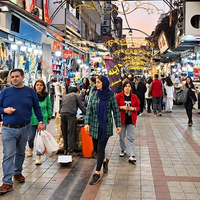
A man stands along a street in Tehran after rainfall, with clear skies and snow-covered mountains in the background, November 9, 2026
More than 70% of respondents to an Iran International survey on household finances said they had either reduced food purchases or postponed medical treatment to cope with rising prices, illustrating the difficult choices facing families struggling with Iran's economic crisis.
The survey, conducted between October 30 and November 3, 2026, collected responses from 404 people, alongside personal accounts of mounting debt, unpaid wages, depleted savings and the psychological toll of financial hardship.
Of the 374 respondents who answered a question about coping with rising prices, 230, or 61%, said they had reduced food purchases, particularly meat and dairy products. Another 177, or 47%, reported postponing medical treatment or medication.
A total of 142 respondents had done both, while 265, or 71%, had taken at least one of these measures over the previous year. Cutting spending on recreation, clothing and education was even more common.
The survey was voluntary and conducted among Iran International's audience, rather than a randomly selected sample of the population. Its findings therefore cannot be considered representative of Iranians as a whole.
‘Can’t afford potatoes’
One participant, who identified themselves as a Social Security pensioner, described receiving 32 million tomans a month, of which 25 million went on rent, five million on loan repayments, 1.2 million on building charges and 200,000 on electricity.
That left just 600,000 tomans for other monthly expenses.
“I don't have money for potatoes and onions,” the pensioner wrote.
The respondent also described having diabetes but being unable to afford medical appointments or medication.
Another participant described the cost of sending three children to school.
“My first-grader went to school with a schoolbag his brother used several years ago and the shoes he wore for Nowruz,” the parent wrote.
“I sewed his coat and trousers myself to save a little money so I could buy them school supplies … Thank God I have children who are content with little. They understand.”
In another message, a respondent described buying barbari bread for 25,000 tomans one day and 40,000 the next. The participant said a local baker had warned that flour was running out and production might stop if more supplies did not arrive.
Food prices have risen particularly sharply as the rial's collapse drives up costs across the economy.
Official figures showed food and beverage prices in September were more than 120% higher than a year earlier, compounding the impact of years of inflation, US sanctions and economic mismanagement.
‘Living in name only’
The survey also examined employment and the number of income earners in each household.
Of the 387 participants who reported their number of jobs, 177, or 46%, said they held one job. Another 95, or 25%, reported two jobs, while 23, or 6%, held three or more.
In total, 118 respondents, or 30.5%, held at least two jobs. Another 92, or 24%, said they had no income-generating employment.
A separate question found that 47% of respondents lived in households with only one income earner, while 6% said nobody in their household earned an income.
For some, even holding multiple jobs was not enough to cover basic expenses.
One participant, the sole income earner in their household, said they worked two jobs but had fallen behind on rent and three loan installments, had unpaid electricity and gas bills, and had not received their wages for a month.
“I borrowed about 60 million tomans from people, and I haven't been able to pay back even one million,” the respondent wrote. “Our life is only a life in name.”
Another participant, who reported holding three or more jobs, said their motorcycle had been taken and they could not afford to retrieve it. The respondent had also reduced food purchases and postponed medical treatment or medication.
A worker living with a spouse and three children described similar pressures despite holding two jobs.
“I can't manage even the simplest things,” the worker wrote, adding that low wages and unemployment had made “anger and arguments an inseparable part of life.”
The war has added to an already weak labour market, damaging factories and infrastructure, disrupting trade and forcing businesses to scale back or close.
US sanctions and restrictions on banking and imports have further constrained businesses, while years of underinvestment and mismanagement have left the economy poorly equipped to absorb the shocks.
‘Getting poorer before my eyes’
As rising prices eroded purchasing power, many respondents reported relying on resources accumulated in better times or taking on new financial obligations.
Of the 374 people who answered the question about coping with inflation, 171 reported spending savings and 86 said they had sold possessions.
After accounting for overlap between the two groups, 200 respondents, or 53.5%, had used at least one of these measures. Another 128 had borrowed money, while 97 had postponed rent or bill payments.
Nearly two-thirds of respondents to the question reported taking at least three different measures to cope with rising prices over the previous year. Almost 30% had taken five or more.
The questionnaire did not measure how much money respondents had borrowed, the value of possessions sold or the amount of savings spent. But drawing on savings and selling assets can provide only temporary relief, leaving households with fewer resources to withstand future financial shocks.
The rial has lost more than half its value against the dollar over the past year. The war and US blockade of Iranian ports have sharply curtailed oil exports and government revenues, intensifying pressures on an economy already weakened by sanctions and systemic corruption.
One respondent began a message with a direct appeal: “If you can, please help me a little.”
The participant said their workshop had closed, leaving them without income for six months. They had three children and reported that nobody in the household earned an income, describing the circumstances as “the hardest moments of my life.”
Another participant, who was employed and lived in a household with two income earners, said: “I can see myself getting poorer before my eyes.”
The psychological toll
The financial pressures described by participants were accompanied by widespread anxiety and pessimism about the future.
Of 398 people who answered a question about their household finances over the previous year, 375, or 94%, said their situation had worsened. Three-quarters described the deterioration as severe.
Expectations for the coming year were similarly bleak, with 91% anticipating further financial deterioration. Separately, 90% said inflation and economic uncertainty had significantly affected their psychological well-being, including their sleep and peace of mind.
The prolonged conflict with the United States and Israel has deepened uncertainty over jobs, prices and access to essential goods, while repeated disruptions to everyday life have compounded the strain of years of economic instability.
One participant described being unable to afford dental treatment despite holding two jobs and living in a household with two income earners.
Another message described medical treatment that had been interrupted for three years. The respondent said they suffered from depression, had been dismissed from a government job because of illness-related absences and were living with an ailing mother in a household without an income.
“I'm exhausted right now, and I'm writing this while crying,” the message said.
Another participant, the sole income earner in a household with a disabled daughter, said they worked two jobs but had still postponed medical treatment or medication and sold possessions.
Among the 142 respondents who had both reduced food purchases and postponed treatment or medication, 135 reported a significant or very significant psychological impact.
Three participants expressed thoughts of suicide or a wish to die in their written messages. The questionnaire was not designed to clinically assess depression or suicide risk, and the prevalence of such conditions cannot be determined from these accounts.
Little hope of improvement
The survey also examined the relationship between respondents' experiences over the previous year and their expectations for the future.
Of those who described the previous year as having been much worse, nearly 85% expected similarly severe deterioration in the coming year.
Respondents reporting greater financial hardship also tended to describe more severe psychological distress and to have adopted more measures to cope with rising prices.
These findings show an association between financial hardship, psychological pressure and pessimism about the future among respondents, but do not establish cause and effect.
Prospects for recovery remain clouded by the unresolved confrontation with Washington, continuing sanctions and the damage inflicted on Iran's productive capacity.
Even an end to the fighting would leave the country confronting longstanding structural problems, including corruption, weak investment and economic mismanagement.
One participant wrote: “I wish tomorrow wouldn't come,” explaining that they expected each new day to bring greater hardship.
The survey was conducted among Iran International's audience from October 30 to November 3, 2026, and received 404 voluntary responses. Not all participants answered every question, and percentages were calculated from valid responses. Personal accounts were drawn from written messages submitted by respondents and reviewed without identifying information.
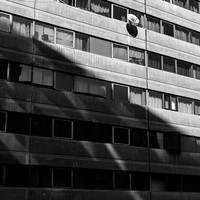
The facade of a residential building in the Ekbatan complex in western Tehran, November 6, 2026
I was at a gathering of about a dozen friends in Tehran on Thursday night. It was hilariously tragic to watch a bunch of slightly tipsy people at each other's throats over an election in which none of us had a vote but whose outcome could profoundly affect our lives.
We spent much of the evening arguing about Democrats and Republicans, Donald Trump and Benjamin Netanyahu, and whether the election of Muslim politicians in America was something to celebrate or fear.
“Imagine being told ten years ago that a man with a name like Abdul El-Sayed would become a United States senator,” one friend said. “You’d ask them what drug they were on.”
“Oh, come on,” another protested. “You think America is turning into another Iran because they've elected a progressive senator or mayor who happens to be a Muslim?”
The greatest strength of American democracy, he argued, was that voters could throw out leaders who made a mess of things, or at least take away some of their power.
Quite a few shook their heads. “The trouble is,” one said, “once political Islam gets into power, you can't necessarily get rid of it with another election.”
It was an argument familiar to anyone who has spent time around politically engaged Iranians, but there was something almost comical about hearing it unfold in a Tehran living room.
We were worrying about whether American democracy could survive the election of a Muslim politician while living in a country where our own ability to choose those who govern us has been contested for decades.
The conversation grew louder when someone admitted she was disappointed by the Democratic gains. She had been hoping that Trump and Netanyahu might finally bring about the end of the Islamic Republic.
“The Democrats will make a deal with the mullahs, and we'll be stuck with this lot for another 50 years,” she said.
Her brother was having none of it: “You seriously think Trump and Netanyahu went to war because they care about you and me? All they ever wanted was to force the regime to give them what they came for. Then they’ll walk away. And it’ll be us and the mullahs all over again.”
I have heard versions of this disagreement many times. Some people still hope that outside pressure might accomplish what years of protest have failed to achieve. Others find that hope almost unbearable, particularly after seeing what war has done to the country and how little it has changed the lives of those who survived it.
What struck me, though, was how easily everyone moved between these positions, sometimes contradicting themselves, sometimes laughing at arguments they had made quite seriously only minutes earlier. Nobody seemed especially interested in convincing anyone else.
“I don't even know why you're burning calories over this,” said one of the two friends who had barely spoken until then. “We don't even know if we'll have enough money to pay next month's rent. To hell with the American elections.”
That took some of the energy out of the argument. We could disagree all night about American politics, but there was rather less to disagree about when it came to paying the rent.
And what was the point of discussing that anyway, one friend said bitterly, as though talking about our problems might somehow make them go away.
Perhaps that is what a year of protests, crackdowns, war and unrelenting financial anxiety have done to us. We do talk about politics all the time. But most of us have stopped expecting much from it.
There was a time when conversations like this came with confident predictions. The regime would fall, a deal would be reached, sanctions would be lifted, or another protest would finally change everything. But we’ve stopped making promises about the future, even to ourselves.
None of us in that room had an answer to the question of how we would afford another month, let alone what the American elections might mean for us. But at least we could argue about the latter without having to check our bank balances.
“Avoid the pain if you can” seems to be how we hang on these days. “Take it one breath at a time.”
People wearing Halloween masks gather on a street in Tehran during celebrations on October 30, 2026.
Two bookstores on Tehran's Iranshahr Street were reportedly sealed Saturday, days after security forces cracked down on Halloween gatherings in the popular cultural hub, drawing criticism on Iranian social media.
Dey Bookstore and Arsa Book House, located opposite each other, were shut down, journalist Yaghma Fashkhami wrote on X. Dey also announced that it would remain closed until further notice and could not deliver or dispatch books this week.
Dey was previously sealed in October 2023 during a crackdown on businesses accused of violating mandatory hijab regulations.
Book-focused YouTuber Melika Ghanami linked the closures to recent pro-government gatherings on Iranshahr Street.
"Just yesterday or the day before, they flooded Iranshahr Street carrying flags. Now we're hearing that Dey Bookstore and Arsa Book House have been sealed too. It seems every corner of Tehran where there's even a little life is going to be taken away from us somehow," she wrote on X.
Since the outbreak of war in February, supporters of the Islamic Republic have held nighttime rallies in Tehran and other cities. More recently, Iranshahr Street itself has hosted pro-government gatherings, with images circulating of participants waving Islamic Republic flags.
Halloween crackdown
The closures come after security forces dispersed Halloween gatherings on Iranshahr Street on October 30. Police blocked the street near Artists Park before Basij members and plainclothes security personnel moved in to disperse the crowd. Witnesses told Iran International that people were beaten and detained and nearby cafes were forced to close.
The operation also affected families visiting Artists Park, who were ordered to leave. "It was like the protests. They were running after people and shouting, 'Disperse!'" one eyewitness told Iran International.
The witness also reported seeing people carrying Islamic Republic flags in another part of the street.
The operation followed a directive by Iran's Chamber of Guilds banning Halloween celebrations in public venues and businesses and warning cafes, restaurants and other establishments of closure and legal action for hosting or advertising such events.
Journalist and translator Emily Amraee criticized the bookstore closures in a post on X, linking them to the authorities' response to Halloween celebrations.
"Halloween has really gotten under their skin. They've gone crazy and started shutting down bookstores and cafes and sealing them off. The cultural renaissance is in full swing, dear Mohsen!" she wrote.
Amraee's reference was directed at musician Mohsen Namjoo, who returned to Iran in August after nearly two decades abroad and has since made public remarks defending the Islamic Republic's handling of cultural and social life, describing the changes he sees in Iran as a "cultural renaissance."
Concerns over public spaces
Hardline supporters of the Islamic Republic who advocate mandatory hijab had previously criticized women for appearing without hijab on Iranshahr Street and called on authorities to take action in social media posts.
Sociologist, translator and urban studies researcher Iman Vaghefi criticized what he described as a broader campaign against public spaces.
"The destruction of street furniture on Sanai Street, the attack on Iranshahr Street, the closure of bookstores and cafes, the prosecution of sports clubs, the deployment of morality patrols in smaller cities — these are different but interconnected parts of a planned assault on the foundations of collective urban life," he wrote on X.
"Under the pretext of war, they are targeting the destruction of shared public spaces."
Journalist Saeed Barabadi, organizer of the independent visual arts project Chizha (Things), also questioned the timing of a municipal initiative called Iranshahr Markets.
"At the same time, and quite coincidentally, the municipality has launched a project called 'Iranshahr Markets,'" he wrote on X.
"So it's not just about dispersing people from a street that, rightly or wrongly, has become a gathering place. The point is that the same name, Iranshahr, must be attached to the project so everyone knows who builds and who profits."
Road workers inspect a muddy road damaged by flooding in Iran.
Severe weather and flooding across Iran have killed four people, injured 11 and cut off access to 190 villages, with emergency teams responding to widespread damage, officials said on Sunday.
Severe weather and flooding across Iran have killed four people, injured 11 and cut off access to 190 villages, with emergency teams responding to widespread damage, officials said on Sunday, November 8.
Two of the fatalities were caused by lightning strikes in Khuzestan province, national emergency services spokesman Mojtaba Lashgari told ISNA.
Lashgari said the 11 injuries were recorded in Kohgiluyeh and Boyer-Ahmad, Khuzestan and Bushehr provinces since November 6.
The storms also caused fallen trees and electricity poles, road closures, traffic accidents, building damage and temporary disruptions to water, power and telephone services, he added.
Flooding isolates villages
Heavy rainfall cut off access to 190 villages in Lorestan province, while damage to gas distribution lines and electricity infrastructure disrupted supplies to several communities, Mehr news agency reported.
Borujerd Governor Ghodratollah Valadi said six villages in the county faced flooding risks, with an evacuation ordered in Tang-e Mohammad Hajji because of the threat of landslides.
In Aligudarz, flooding along the Zez River stranded nomadic communities and destroyed much of their livestock and property, Tasnim news agency reported.
Rescue workers also evacuated seven women and children trapped by flooding in Lordegan.
Floodwaters reached Chelchelak village in Khuzestan and inundated streets in Suq, Kohgiluyeh and Boyer-Ahmad province.
Heavy rain flooded streets in Bushehr and Bandar Genaveh on Sunday, while footage showed the Qom River overflowing.
Emergency response continues
The Kandovan road between Karaj and Chalus experienced six floods within 48 hours, with road crews clearing mud and debris to reopen affected sections.
In Tehran province, water levels rose in the Kan River, with floodwaters flowing through its riverbed. Tehran emergency services said no injuries had been reported from rainfall or flooding in the province's mountainous areas.
National Crisis Management Organization spokesman Omid Mohtarami said around 1,600 people had received direct emergency assistance.
Mohtarami said 18,000 operational teams were working in flood-affected areas, with another 8,000 support teams on standby.
Red weather warnings remained in effect in several provinces, with maritime red alerts issued for Gilan and Mazandaran for Monday, November 9.
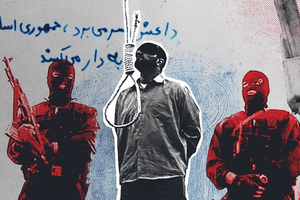
Iranians expressed anger and grief over the execution of three protesters and new death sentences against others, criticizing the United States and the international community for their response in messages sent to Iran International.
Iran's judiciary announced on November 8 that Hassan Divband, Hamid Kazemi and Reza Zanganeh, three people arrested during the January protests in Karaj, had been executed.
The executions came alongside reports of additional death sentences against protesters in the northeastern city of Mashhad.
Abolfazl Sedaghat, 20, Matin Farnian and Vahid Khedrikhah were sentenced to death on charges of moharebeh, or "waging war against God," in a joint case, according to the human rights organization HRANA.
Death sentences were also issued against Ali Zaghi and Ilya Akbari, bringing the number of protesters sentenced to death in the so-called Shandiz case to six, according to earlier reporting.
'We can no longer bear the news of executions'
"We woke up this morning to the news that three more innocent young men had been executed. I can no longer bear hearing about executions," a resident of Isfahan wrote to Iran International.
The executions prompted messages of grief and anger from people across Iran, many expressing concern about the future of younger generations.
"Every morning when we wake up, we are confronted with news of our beloved children being killed. You have taken life away from us," a Tehran resident wrote, addressing Iranian authorities.
Another from Dezful urged fellow Iranians to consider the future facing their children.
"Look at your beloved child. How can you bring yourself to leave the Islamic Republic as their inheritance? How can you bear to leave your child in line for execution and torture?" the citizen wrote.
Another, referring to discussion of possible US strikes on Iran's energy infrastructure, said the country's infrastructure was not their primary concern.
This citizen argued that the Islamic Republic's continued rule was destroying the country's infrastructure every day, from electricity and water supplies to the lives of its young people.
Questioning US response and call for continued solidarity
Several messages sent to Iran International criticized Washington's response to the executions, with some directly addressing US President Donald Trump.
"Do the human rights-defending Democrats in America not see all these crimes in Iran?" one asked, referring to the executions in Karaj.
Another described the executions as retaliation by the Islamic Republic against the Iranian people and questioned Trump's response.
"The oppressive system of the Islamic Republic cannot reach your soldiers, so it takes revenge on the Iranian people through executions. Isn't it time to fulfill your promise?" reads a message.
Other messages emphasized solidarity among Iranians and the importance of continuing efforts to seek justice for those executed.
A resident of Bandar Abbas expressed grief over the executions while thanking Iranians abroad for organizing demonstrations.
"One eye mourns the brave compatriots who lose their lives at the gallows every day, while the other sheds tears for the remarkable gatherings of compassionate Iranians who, despite all their difficulties, put their homeland first," the resident wrote.
A Tehran resident described the three executed protesters as "three stars whose names will live forever" and expressed determination to continue their cause.
"Victory is certain," the audience wrote.
Amnesty International warns over use of death penalty
Iranian authorities have intensified their crackdown in recent months through widespread summonses and arrests, lengthy prison sentences and a sharp increase in executions.
The growing use of capital punishment has also drawn criticism from international human rights organizations.
Iranian authorities are using the death penalty as a tool to suppress dissent, Diana Eltahawy, Amnesty International's deputy regional director, warned on October 13.
“The arbitrary executions of these five young men serves as another chilling reminder of how the Iranian authorities weaponize the death penalty to render the cost of dissent so high that it terrorizes the population into silence and deters further mass uprisings challenging their repressive decades-long rule,” she said.
The latest executions and death sentences have renewed expressions of grief and anger among Iranians, with messages to Iran International reflecting both frustration over the international response and determination to continue seeking justice for those killed.
A severely damaged car following a collision with a truck on a road in Iran, with an ambulance at the scene.
More than 78,500 people have died in road accidents in Iran over four years, yet the government is seeking to delay new vehicle safety standards despite repeated warnings about the quality of domestically manufactured cars.
Road accidents killed 10,357 people in the first six months of the current Iranian calendar year, ILNA news agency reported on Sunday, November 8, citing figures released a day earlier by Iran's Forensic Medicine Organization.
The figure was down just 0.4 percent from 10,401 deaths during the same period last year.
Another 224,220 people injured in road accidents were referred to forensic medical centers during the six-month period, an increase of 10.8 percent from a year earlier.
Industry minister seeks delay in safety standards
Poor-quality vehicles, unsafe roads and ineffective public education are among the main causes of Iran's road safety crisis, according to critics who say authorities have failed to address the underlying problems.
Traffic police chief Teymour Hosseini has previously urged the Ministry of Industry and the National Standards Organization to improve vehicle safety, arguing that higher traffic fines alone cannot reduce fatalities without safer roads, better-equipped cars and stronger enforcement.
However, Industry Minister Mohammad Atabak asked First Vice President Mohammad Reza Aref in a letter dated November 6 to postpone the implementation of new vehicle safety standards by at least one year.
Atabak cited foreign currency shortages, the country's emergency conditions and automakers' inability to invest in developing and redesigning vehicle platforms as reasons for the request.
If approved, the postponement would allow manufacturers to continue production under existing regulations, delaying an increase in mandatory vehicle standards from 85 to 122 requirements, along with new fuel consumption rules.
The proposed delay comes despite repeated warnings about vehicle safety and the country's persistently high road death toll.
"People die in road accidents because of their poor driving, and it has nothing to do with the quality of domestically manufactured cars," Mostafa Mirsalim, a member of Iran's Expediency Council, said on November 8.
Emergency responders attend the scene of a road accident involving a damaged car on a highway in Iran at night.
Mirsalim also described criticism linking domestic vehicle quality to road fatalities as unfair accusations against automakers.
Road accidents kill 78,510 in four years
Annual figures from Iran's Forensic Medicine Organization show that road deaths rose from 16,778 in the year ending March 2022 to 19,490 in the year ending March 2023.
Fatalities reached 20,045 in the year ending March 2024, the highest figure in the five-year period, before falling to 19,435 in the year ending March 2025 and rising again to 19,540 in the year ending March 2026.
Together, road accidents killed 78,510 people between March 2022 and March 2026, with annual deaths exceeding 19,000 throughout the four-year period.
Iran launched a national "No to Accidents" campaign in 2025 to reduce traffic fatalities, but ILNA questioned whether short-term initiatives could address the scale of the problem.
"It is unrealistic to expect that short-term campaigns and general recommendations can contain a crisis rooted in a combination of human, technical, infrastructural and managerial factors," ILNA wrote.
The news agency called for measurable targets and deadlines for the institutions responsible for road safety, including the Ministry of Roads, the Road Maintenance and Transportation Organization, municipalities and emergency medical services.
Young adults account for largest share of deaths
People aged 18 to 24 accounted for the largest share of road fatalities during the first six months of the current Iranian year, with 1,868 deaths, representing 18 percent of the total.
Another 1,555 victims were aged 30 to 39, while 1,514 were between 40 and 49 years old.
The fatalities also included 455 children aged 10 or younger.
Health Minister Mohammad Reza Zafarghandi described the roughly 20,000 annual road deaths as one of Iran's demographic challenges on June 16. Zafarghandi had previously said that 26 percent of road accident deaths were preventable.
The high number of young victims also raises questions about the government's population policies, which emphasize increasing birth rates and supporting infertility treatment.
"Population growth policies cannot be limited to encouraging childbirth and supporting infertility treatment. Preserving the lives of people already living in the country is equally important," ILNA wrote.