• العربية
  • فارسی
Brand
  • Iran Insight
  • Politics
  • Economy
  • Analysis
  • Special Report
  • Opinion
  • Podcast
  • Live TV
  • Iran Insight
  • Politics
  • Economy
  • Analysis
  • Special Report
  • Opinion
  • Podcast
  • Live TV
  • Theme
  • Language
    • العربية
    • فارسی
  • Iran Insight
  • Politics
  • Economy
  • Analysis
  • Special Report
  • Opinion
  • Podcast
  • Live TV
All rights reserved for Volant Media UK Limited
volant media logo

Indian cargo vessel sinks after being attacked in Yemeni waters

Aug 4, 2026, 17:50 GMT+1Updated: 20:57 GMT+1

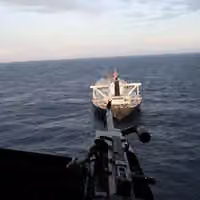
The Indian cargo vessel MSV Faize Noore Oliya capsized and sank after being hit by a projectile near Yemeni waters, India’s shipping minister said on Tuesday.

All 14 seafarers aboard, including 13 Indians, were safely rescued by the Yemeni Coast Guard and taken to the Port of Mokha, the minister said.

Most Viewed

US rules out Iran truce extension as Tehran official sets new deadline
1

US rules out Iran truce extension as Tehran official sets new deadline

2

Canada deports former Iranian official linked to 2019 protest crackdown

3
OPINION

For Iranian journalists, exile can last a lifetime

4

Iran weighs attacks on military targets in Europe – FT

5
INSIGHT

Forced to serve in the IRGC, now fighting to stay in Canada

Banner
Banner
Banner

Spotlight

  • Luxury Tehran property asking prices surpass Munich and Sydney

    Luxury Tehran property asking prices surpass Munich and Sydney

  • For Iranian journalists, exile can last a lifetime
    OPINION

    For Iranian journalists, exile can last a lifetime

  • Seven months on, January protests still shape Iranians’ lives
    VOICES FROM IRAN

    Seven months on, January protests still shape Iranians’ lives

  • Forced to serve in the IRGC, now fighting to stay in Canada
    INSIGHT

    Forced to serve in the IRGC, now fighting to stay in Canada

  • Iran’s ‘infiltration’ bill sparks backlash over sweeping reach

    Iran’s ‘infiltration’ bill sparks backlash over sweeping reach

  • To survive maximum pressure, Iran kept pumping and broke its oil company
    ANALYSIS

    To survive maximum pressure, Iran kept pumping and broke its oil company

•
•
•

More Stories

Why Afghans still risk death to reach Iran

Aug 4, 2026, 17:34 GMT+1
•
Negar Mojtahedi
100%
The father, a 35-year-old driver with his Afghan family, sits with his young daughter in a pickup van.

"Take care of my sons." Those were the final words of Hayatullah, an Afghan migrant who used his phone to record what would become the last moments of his life in the scorching desert as he tried to reach Iran.

"Pray for me. Mother, I'm dying," he said, pleading with his loved ones to look after his sons, especially Habib.

Hayatullah was among 14 Afghan migrants who died attempting to reach Iran, Afghan officials said, weeks after the vehicle carrying them broke down and they continued the journey on foot.

Why would anyone risk one of the world's deadliest migration routes to reach Iran?

The country is grappling with economic crisis and widespread repression. It has carried out one of the region's largest deportation campaigns against Afghan migrants and offers little prospect of permanent legal status.

"It's not about a choice between safety and danger," Yasin Samim, an Afghan governance and development analyst, told Iran International. "It's about what type of danger."

Samim said conditions inside Afghanistan had become so severe that many people continued to flee despite knowing the risks awaiting them in Iran.

"The fact that they come to Iran shows the severity of the situation and conditions in Afghanistan," he said. "The reasons they leave Afghanistan have not changed."

With the Taliban's return to power, legal pathways to Iran have become increasingly restricted, forcing many low-income Afghans into the hands of smugglers.

"Granting a visa has become a deal of the black market," Samim said, adding that visas can reportedly cost between $1,000 and $1,200—far beyond the reach of many Afghan families.

"The combination of poverty, unemployment and repression leaves people with no alternative," he said. "That is the only choice they have."

Those who cannot afford legal routes often attempt the crossing through Nimruz, one of the main transit corridors into Iran for irregular migration.

The route has become synonymous with one of the deadliest migration paths into the country. Migrants cross vast stretches of unforgiving desert where temperatures regularly exceed 45°C (113°F).

If smugglers abandon them or their vehicle breaks down—as happened in this case—survival quickly becomes a race against dehydration. Many die before reaching help. Others face robbery, exploitation or detention before ever reaching Iran.

Iran has long hosted one of the world's largest Afghan populations despite offering few permanent rights to those who settle there. Before its mass deportation campaign in 2025, an estimated four million Afghans lived in the country, including registered refugees, documented migrants and undocumented workers.

Yet many remained in legal limbo despite spending years—or even decades—in Iran. Children born in Iran to Afghan parents are not automatically granted Iranian citizenship, and for most there is no realistic pathway to becoming Iranian citizens.

"Iran has shut down legal pathways for Afghans in recent years," Omid Memarian, senior Iran analyst at DAWN told Iran International. "Because so many pathways have been blocked, they have to take much riskier ways to be smuggled from Afghanistan to Iran.”

That means the chance of being exploited is higher, Memarian added, and their rights are more likely to be violated.

Tighter restrictions appear to have little bearing on Afghans' calculations. It has only pushed them onto more perilous routes across deserts such as Nimruz, where extreme heat could quickly turn a journey into a death sentence.

"For them, the question is not, 'Let's go to the best ideal country.' The question is, 'Let us get out of here.' ... It's about survival," Memarian told Iran International.

Iran International reached out to the United Nations High Commissioner for Refugees (UNHCR) for comment.

A spokesperson referred us to a statement issued last month warning that Afghanistan is ill-equipped to absorb the growing number of returnees.

The agency said more than six million Afghans have returned since 2023, while nearly half the country's population already depends on humanitarian aid.

It called for returns to be safe, voluntary and dignified, warning that mass deportations risk deepening one of the world's worst humanitarian crises.

Iran's president met Mojtaba Khamenei in the back seat of a car

Aug 4, 2026, 14:26 GMT+1
•
Mojtaba Pourmohsen
100%
Iranian President Masoud Pezeshkian

Iranian President Masoud Pezeshkian was taken to a secret Tehran location and allowed only minutes in a dark, tinted-window car with a man presented as Supreme Leader Mojtaba Khamenei, sources familiar with the episode told Iran International.

Pezeshkian could not see the man beside him and later asked whether the voice he had heard had really belonged to the supreme leader, according to the sources.

Their account of the only known meeting between Pezeshkian and the Islamic Republic’s third supreme leader differs sharply from the version the president has told in public.

In mid-May, Pezeshkian told a gathering of trade association representatives that he had spent two and a half hours with the new leader “in a cordial atmosphere.” Iran International’s sources said the encounter lasted only a few minutes, after which the president was asked to leave.

The meeting itself was a concession extracted under pressure. Khamenei's office agreed to it only after repeated requests from Pezeshkian and his threat to resign, the sources said, and the president was informed that, contrary to standard practice, he would not be received at the leader's usual residence.

Instead, his security detail delivered him to an undisclosed location somewhere in Tehran. There he was taken from his own vehicle and seated in the back of a commercial car with tinted windows, where, apparently, Khamenei was already waiting. The spot was dark enough that the two men could not see each other, and Khamenei's guards did not permit a handshake. The conversation was carried entirely by voice.

The treatment reportedly angered Pezeshkian, who regarded it as humiliating. According to individuals in the president's office, he later asked whether the person beside him had in fact been the supreme leader, since he had only heard a voice in the dark.

It is unclear whether the remark was an expression of anger or genuine doubt. Pezeshkian has since requested a second meeting, this time at the leader's residence. The request has so far been denied.

A leader nobody sees

The president's uncertainty lands in a country that has neither seen nor heard its new ruler. In the roughly five months since the Assembly of Experts selected Mojtaba Khamenei to succeed his father, not a single audio recording or video of him has been released.

The silence has become a subject inside Iran's own state-aligned press. On Sunday, the website of the Hamshahri newspaper published a short video claiming that foreign intelligence services could trace any audio recording of the new leader and locate his hideout by measuring acoustic energy, analyzing the frequency signature of the electrical grid and examining background noise. The video added that spy agencies could analyze vocal-tract resonances to determine the extent of his injuries or anxiety, a claim that fed rather than calmed speculation about his condition.

The world's assessments diverge just as sharply. Three weeks ago, US President Donald Trump put the odds that Mojtaba Khamenei had been killed at 90 percent. Israel's prime minister recently said he is alive.

Even the government's own senior figures do not tell one story. "I have not seen Mojtaba Khamenei during this period, and only a limited number of people have met with him," Foreign Minister Abbas Araghchi said in a July interview with the online program The Story of the War. One day later, Pezeshkian said in a speech that the number of meetings with the leader had increased.

A resignation he cannot repeat

The strain between the president and the leader's office has since spilled into the open. In a video circulated on social media on Monday, Mohammad Bagher Kharrazi, a Khamenei family relative by marriage, said the new leader has formally warned that Pezeshkian's next resignation, after 28 threats or attempts, will be his last.

  • Khamenei warns Pezeshkian next resignation will be accepted, in-law says

    Khamenei warns Pezeshkian next resignation will be accepted, in-law says

"He declared it officially," Kharrazi said, "and that is why they packed up, turned down the wick, and stopped threatening to resign."

The warning matches Iran International's earlier reporting. A knowledgeable source said in late May that Pezeshkian had sent a formal letter to the leader's office asking to step down, a resignation driven by what the president described as the Revolutionary Guards' complete control over the running of the country.

A president who cannot resign, then, serves a leader he cannot see. Five months into the new reign, Mojtaba Khamenei remains unseen, unheard and unrecorded, a ruler his own president has met exactly once, in the dark, and still cannot be certain he has met at all.

Tehran records heaviest damage in latest war, municipal report shows

Aug 4, 2026, 10:06 GMT+1
100%
A heavily damaged residential building in Tehran following the 40-day war with the United States and Israel.

Tehran sustained the heaviest damage of any Iranian province during the 40-day conflict with US and Israel, with more than 50,000 homes damaged and the capital accounting for 650 reported strikes, according to a municipal report published on Monday.

The figures, presented at a public event hosted by the University of Tehran's Faculty of Urban Planning, offer the most detailed breakdown yet of damage across the capital following the conflict.

The report says District 4 in northeastern Tehran recorded the highest number of strikes, followed by District 21 in the west, District 1 in the north and District 22 in the northwest.

"The number of strikes in District 4 alone exceeded the combined total recorded in some provinces," Hossein Nouhi, a certified construction expert in Tehran's municipality, said during the event.

  • War damage amounts to $3,000 per Iranian, with blockade set to add to losses

    War damage amounts to $3,000 per Iranian, with blockade set to add to losses

According to the report by Tehran Municipality's Urban Planning and Architecture Department, District 4 was hit 90 times, District 21 Tehran sustained 62 strikes, District 1 recorded 57 and District 22 recorded 55. District 17 in southwestern Tehran was the least affected, with three reported strikes.

Housing damage

The municipality said 50,849 residential units across Tehran sustained damage ranging from broken windows and doors to complete destruction.

Around 40,000 homes required minor repairs, about 8,900 suffered more extensive architectural damage, 415 buildings required structural reinforcement or reconstruction and 2,042 homes were completely destroyed and must be rebuilt, according to the report.

District 4 recorded the largest number of damaged residential units with 7,948, followed by District 2 with 4,037, District 15 with 3,490, District 11 with 3,432, District 21 with 3,205 and District 7 with 3,196.

100%
Smoke rises over Tehran following a strike during the 40-day war with the United States and Israel.

The report also found that District 7 had the highest number of completely destroyed homes, with 429 units, followed by District 4 with 325 and District 11 with 248.

Estimated economic and environmental costs

Nouhi put the country's economic losses from the 40-day conflict at an estimated $280 billion, excluding psychological impacts and the cost of restoring industrial production. He argued that the conflict highlighted the need to require shelters in new high-rise developments.

  • Iran economists say war is turning malaise into crisis

    Iran economists say war is turning malaise into crisis

Separately, geologist Mehdi Zare’ estimated that military strikes generated around 10 million metric tons of debris across affected urban areas by August 1. He said the waste includes concrete, steel, glass, asbestos and industrial pollutants that could create long-term environmental and public health risks.

Zare’ also said the demolition and cleanup process released millions of tons of greenhouse gases, adding to the environmental impact of the conflict.

Aramco sidesteps Hormuz as Iran crisis cuts flows to a tenth

Aug 4, 2026, 09:34 GMT+1
100%
General view of Saudi Aramco's Ras Tanura oil refinery and oil terminal in Saudi Arabia.

Saudi Aramco is routing crude around the Strait of Hormuz via its East-West pipeline as the Iran-related crisis has cut shipping through the strait to a tenth of pre-conflict levels, Chief Executive Amin Nasser said on Tuesday.

"The ongoing geopolitical crisis continues to aggravate the biggest supply shock in history," Nasser said, as the Saudi oil giant reported a 42% jump in second-quarter profit.

"We continue to optimize the flexibility of the East-West pipeline," Nasser said.

The pipeline gives Saudi Arabia an alternative route for crude exports, carrying oil from the kingdom's main producing areas in the east to the Red Sea and away from the Strait of Hormuz.

Nasser said Aramco had "managed risks effectively for some time" and that the Saudi government was also working to address risks to oil shipments.

"The government is tackling this risk and that has never limited our option to go through Bab el-Mandab," he said.

Aramco's East-West pipeline and global inventories have helped ease the supply shock caused by the crisis, lowering the net loss to around 1.8 billion barrels, Nasser said.

Strait losses mount weekly

"Current trade flows through the Strait of Hormuz are at a tenth of pre-conflict levels and the world will continue to lose more than 100 million barrels for each week the strait is closed," Nasser said.

The world has lost more than 2.6 billion barrels of oil destined for a number of critical industries as a result of the crisis, he said.

An average of 11 million barrels per day of liquids supply had been removed, while Asia's crude oil imports fell by around 6 million barrels per day at the peak of the crisis, Nasser said.

"If the strait were open today it would take up to 18 months at an average rate of 2.1 million barrels a day to replenish depleted inventories," he said.

Nasser also warned that pressure was building elsewhere in the global energy system, saying the global refining system was "stretched heavily."

"There is a disconnect between futures and physical markets," Nasser said, pointing to strong refining margins that reflected tightness in refined products.

"If refineries were to suffer any major unplanned or prolonged shutdown the global energy supply system could face more severe pressure," he said.

Nasser said Aramco continued to hope for "a resolution that restores normal shipping and stabilizes the market," but warned that a recovery would not be immediate.

"Normalization will take time," he said.

Trump's U-turn reopens Tehran's political faultline

Aug 4, 2026, 04:50 GMT+1
•
Maryam Sinaiee
100%
A pilgrim carries a banner bearing the image of Iran's Supreme Leader Ali Khamenei during Arbaeen processions in Iraq, July 29, 2026

Donald Trump's decision to abandon a planned large-scale military strike against Iran has accelerated regional diplomatic efforts to revive US-Iran negotiations, while deepening political divisions inside Tehran over engagement with Washington.

President Donald Trump's decision to call off a planned large-scale military strike against Iran has once more exposed a key political faultline in Tehran between advocates of diplomacy and those urging the country to prepare for another war.

President Masoud Pezeshkian moved quickly to defend renewed engagement with Washington, portraying the memorandum of understanding (MoU) not as his own initiative but as the collective decision of Iran's security establishment.

Calling it "the product of the collective wisdom of the members of the Supreme National Security Council," he described the agreement as "the cornerstone of Iran's future foreign relations."

The backlash was immediate. The leadership board of the Assembly of Experts dismissed hopes of an agreement with Washington as futile and urged authorities to take legal action against what it called "voices of surrender."

Although the statement did not mention the government by name, it was widely interpreted as an indirect rebuke of Pezeshkian's diplomatic approach.

Hardline lawmaker Mahmoud Nabavian echoed the criticism, arguing that renewed calls for negotiations amounted to rescuing a weakened enemy.

"After the heavy blows inflicted by the Resistance Front, higher energy prices, dwindling strategic reserves and mounting domestic political pressure in the United States, unfortunately some people in Iran are once again seeking negotiations for various reasons, including rescuing the enemy," he wrote.

"They should know that such negotiations will never be accepted by the loyal and resilient people of Iran."

Uncertainty persists

Trump announced on Sunday that Washington was now pursuing two parallel agreements with Tehran: one to reopen the Strait of Hormuz and another addressing Iran's nuclear program. He said direct negotiations would begin on Monday.

That timetable remains uncertain. Pakistani officials say no date or venue has yet been finalized, with Islamabad and Doha among the leading candidates to host the talks.

Pakistani Foreign Minister Ishaq Dar has invited Araghchi to visit Islamabad "at the earliest opportunity," while diplomatic sources told Al Hadath television that Pakistan is preparing formal invitations for both Araghchi and Parliament Speaker Mohammad-Bagher Ghalibaf as mediation efforts continue.

Araghchi, meanwhile, spent Monday speaking with regional officials, including Pakistan's army chief, Asim Munir, Saudi Foreign Minister Faisal bin Farhan, Omani Foreign Minister Badr Albusaidi and Iraqi Foreign Minister Fuad Hussein.

Tehran says negotiations with Oman over arrangements in the Strait of Hormuz are approaching their final stage.

Why diplomacy returned

The renewed diplomatic push also reflects the limits of Washington's military options, analysts say.

Farzin Nadimi, a senior fellow at The Washington Institute, told Iran International that Trump faces a strategic dilemma because the available military options either risk triggering a much broader regional conflict or are unlikely to produce decisive results.

A campaign capable of fundamentally weakening the Islamic Republic would require a much larger operation, potentially including ground forces—an option Trump has consistently sought to avoid, Nadimi said.

Historian Shahram Kholdi said Trump's decision reflected not only Iranian threats against regional infrastructure but also Gulf Arab security concerns, consultations led by Saudi Crown Prince Mohammed bin Salman and progress in Qatari mediation efforts.

Together, the assessments suggest that both Washington and Tehran have entered another round of diplomacy not because either side believes the underlying conflict has been resolved, but because the alternatives remain costly.

Public skepticism

For many Iranians, Trump's decision has reduced the immediate risk of war without easing the uncertainty that has dominated daily life for months.

Social media users described a growing sense of limbo as repeated cycles of military threats and diplomatic reversals continued to disrupt daily life and fuel inflation.

One user wrote that the United States had returned to "sanctions, maritime pressure and Trump's empty rhetoric," leaving ordinary Iranians trapped in uncertainty.

Another complained that the recurring cycle of "war, negotiations, war, negotiations" was "destroying people's lives," arguing that prices rise after every military escalation but never fall when tensions ease.

Another user criticized Trump's inconsistent approach, writing that he "neither fights decisively nor truly makes peace," arguing that the current state of "neither war nor peace" hurts ordinary Iranians more than anyone else.