President Donald Trump's decision to call off a planned large-scale military strike against Iran has once more exposed a key political faultline in Tehran between advocates of diplomacy and those urging the country to prepare for another war.
President Masoud Pezeshkian moved quickly to defend renewed engagement with Washington, portraying the memorandum of understanding (MoU) not as his own initiative but as the collective decision of Iran's security establishment.
Calling it "the product of the collective wisdom of the members of the Supreme National Security Council," he described the agreement as "the cornerstone of Iran's future foreign relations."
The backlash was immediate. The leadership board of the Assembly of Experts dismissed hopes of an agreement with Washington as futile and urged authorities to take legal action against what it called "voices of surrender."
Although the statement did not mention the government by name, it was widely interpreted as an indirect rebuke of Pezeshkian's diplomatic approach.
Hardline lawmaker Mahmoud Nabavian echoed the criticism, arguing that renewed calls for negotiations amounted to rescuing a weakened enemy.
"After the heavy blows inflicted by the Resistance Front, higher energy prices, dwindling strategic reserves and mounting domestic political pressure in the United States, unfortunately some people in Iran are once again seeking negotiations for various reasons, including rescuing the enemy," he wrote.
"They should know that such negotiations will never be accepted by the loyal and resilient people of Iran."
Uncertainty persists
Trump announced on Sunday that Washington was now pursuing two parallel agreements with Tehran: one to reopen the Strait of Hormuz and another addressing Iran's nuclear program. He said direct negotiations would begin on Monday.
That timetable remains uncertain. Pakistani officials say no date or venue has yet been finalized, with Islamabad and Doha among the leading candidates to host the talks.
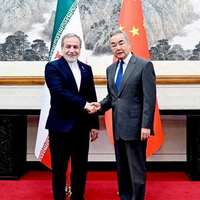
Pakistani Foreign Minister Ishaq Dar has invited Araghchi to visit Islamabad "at the earliest opportunity," while diplomatic sources told Al Hadath television that Pakistan is preparing formal invitations for both Araghchi and Parliament Speaker Mohammad-Bagher Ghalibaf as mediation efforts continue.
Araghchi, meanwhile, spent Monday speaking with regional officials, including Pakistan's army chief, Asim Munir, Saudi Foreign Minister Faisal bin Farhan, Omani Foreign Minister Badr Albusaidi and Iraqi Foreign Minister Fuad Hussein.
Tehran says negotiations with Oman over arrangements in the Strait of Hormuz are approaching their final stage.
Why diplomacy returned
The renewed diplomatic push also reflects the limits of Washington's military options, analysts say.
Farzin Nadimi, a senior fellow at The Washington Institute, told Iran International that Trump faces a strategic dilemma because the available military options either risk triggering a much broader regional conflict or are unlikely to produce decisive results.
A campaign capable of fundamentally weakening the Islamic Republic would require a much larger operation, potentially including ground forces—an option Trump has consistently sought to avoid, Nadimi said.
Historian Shahram Kholdi said Trump's decision reflected not only Iranian threats against regional infrastructure but also Gulf Arab security concerns, consultations led by Saudi Crown Prince Mohammed bin Salman and progress in Qatari mediation efforts.
Together, the assessments suggest that both Washington and Tehran have entered another round of diplomacy not because either side believes the underlying conflict has been resolved, but because the alternatives remain costly.
Public skepticism
For many Iranians, Trump's decision has reduced the immediate risk of war without easing the uncertainty that has dominated daily life for months.
Social media users described a growing sense of limbo as repeated cycles of military threats and diplomatic reversals continued to disrupt daily life and fuel inflation.
One user wrote that the United States had returned to "sanctions, maritime pressure and Trump's empty rhetoric," leaving ordinary Iranians trapped in uncertainty.
Another complained that the recurring cycle of "war, negotiations, war, negotiations" was "destroying people's lives," arguing that prices rise after every military escalation but never fall when tensions ease.
Another user criticized Trump's inconsistent approach, writing that he "neither fights decisively nor truly makes peace," arguing that the current state of "neither war nor peace" hurts ordinary Iranians more than anyone else.