• العربية
  • فارسی
Brand
  • Iran Insight
  • Politics
  • Economy
  • Analysis
  • Special Report
  • Opinion
  • Podcast
  • Iran Insight
  • Politics
  • Economy
  • Analysis
  • Special Report
  • Opinion
  • Podcast
  • Theme
  • Language
    • العربية
    • فارسی
  • Iran Insight
  • Politics
  • Economy
  • Analysis
  • Special Report
  • Opinion
  • Podcast
All rights reserved for Volant Media UK Limited
volant media logo
INSIGHT

New strikes expose Tehran’s battle between diplomacy and revenge

Behrouz Turani
Behrouz Turani

Iran International

Jul 8, 2026, 18:07 GMT+1
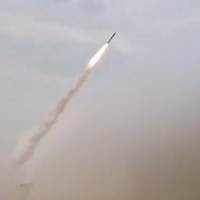
A screen grab from a video released by IRGC-linked Tasnim purporting to show a missile launched toward US bases in the region, July 7, 2026

Iran’s attacks on vessels near the Strait of Hormuz and subsequent strikes on US bases in the region have exposed a widening battle inside Tehran between those trying to preserve diplomacy with Washington and those pushing for confrontation.

The escalation began Monday night with attacks on commercial navigation near Hormuz, continued Tuesday, and was followed Wednesday morning by strikes on US positions after CENTCOM forces hit more than 80 targets in southern Iran.

Tehran claimed it had struck 85 targets, all of them US interests.

Inside Iran, hardline media quickly framed the confrontation as proof that the June MoU with Washington had failed—or that it had only served to expose US intentions.

The Tehran municipal daily Hamshahri argued that the MoU was not a concession but proof Washington had recognized Iran’s missile capabilities and regional leverage.

It said the latest maritime confrontation showed any attempt by the US or its allies to impose terms during the 60-day implementation period would risk disruption of global energy routes.

Other hardline outlets, including Kayhan, went further.

Writing with vindicated fury, editor Hossein Shariatmadari declared that the “60-day diplomatic mirage” had vanished exactly as he predicted, calling the US strikes proof of “Washington’s innate treachery and structural inability to honor any MoU.”

More than a military confrontation, the attacks appear to reflect a growing divide among Iranian decision-makers: those seeking to advance an agreement with Washington and those who argue that only direct revenge against US President Donald Trump and Israeli Prime Minister Benjamin Netanyahu would be sufficient.

Over the past month, radical hardliners in Tehran—who portrayed their own survival and the system’s survival as victory over the United States—have sharply criticized President Massoud Pezeshkian for signing the MoU with Washington.

They argued that before the agreement, Trump was under pressure from politicians and markets, and that Iran could have extracted better terms.

While the anger surrounding Khamenei’s funeral cannot be dismissed, the divide between Tehran’s hardliners and pragmatists appears to be a major factor behind the renewed confrontation that followed Trump’s conciliatory comments about allowing a peaceful funeral for the man he had ordered killed.

Whatever the precise trigger, the escalation has strengthened the hand of hardliners.

Social-media videos from the funeral in Tehran showed radicals throwing stones at Foreign Minister Abbas Araghchi and chanting slogans against Pezeshkian.

On Wednesday, ultraconservative MP Hamid Rasai called for a missile strike on Trump’s residence during his visit to Ankara for a NATO meeting, while fellow hardliner Mahmoud Nabavian said Muslims worldwide were expected to attack Trump the way Salman Rushdie was attacked.

Trump said he had always known he was a target for “nasty Iranians,” adding that if they had nuclear weapons, they would certainly use them.

On Wednesday, Hamshahri went further, arguing that strikes on US assets in Kuwait and Bahrain demonstrated that the cost of confrontation would not remain limited to Iranian territory.

The paper said Washington’s move to revoke Iran’s oil-export waivers amounted to total economic warfare and justified an equivalent response: closing the Strait of Hormuz.

“If Iran cannot openly sell its crude, no state in the region will be permitted to export energy,” it warned.

Kayhan urged the Pezeshkian administration to abandon the June framework, restrict maritime access and shift to what it called an unrestricted defensive doctrine under the guidance of the new Supreme Leader, Mojtaba Khamenei.

Meanwhile, figures including parliamentary National Security Committee spokesman Ebrahim Rezai and Mojtaba Khamenei’s military adviser Mohsen Rezai declared Iran’s readiness for combat.

Chief of staff of the armed forces Habibollah Sayyari also warned against any ground operation.

“If the enemy deploys forces to the Iranian shores, their troops will enter a hell that has no exit,” Sayyari said—a remark widely circulated online, with critics joking that it unintentionally described conditions inside the Islamic Republic itself.

Most Viewed

The end of one-man rule? Iran tests life after Khamenei
1
ANALYSIS

The end of one-man rule? Iran tests life after Khamenei

2

Revenge rhetoric dominates Khamenei funeral despite US talks push

3
INSIGHT

Khamenei funeral struggles to stay on script

4

Commercial ships hit near Strait of Hormuz as Iran-US talks stall

5
ANALYSIS

Potential state TV shakeup tests Iran’s willingness to rein in hardliners

Banner
Banner
Banner

Spotlight

  • New strikes expose Tehran’s battle between diplomacy and revenge
    INSIGHT

    New strikes expose Tehran’s battle between diplomacy and revenge

  • Hamas gives up Gaza government, but not Iran ties
    ANALYSIS

    Hamas gives up Gaza government, but not Iran ties

  • Khamenei funeral lays bare deep political divisions in Iran

    Khamenei funeral lays bare deep political divisions in Iran

  • Alleged IRGC plot sought woman to burn kosher shop, German court hears

    Alleged IRGC plot sought woman to burn kosher shop, German court hears

  • Iran's costly farewell for supreme leader draws backlash
    VOICES FROM IRAN

    Iran's costly farewell for supreme leader draws backlash

  • Iran’s energy growth slows to a crawl as demand races ahead
    INSIGHT

    Iran’s energy growth slows to a crawl as demand races ahead

•
•
•

More Stories

Khamenei funeral lays bare deep political divisions in Iran

Jul 8, 2026, 09:23 GMT+1
•
Maryam Sinaiee
100%
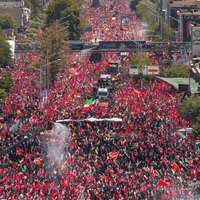
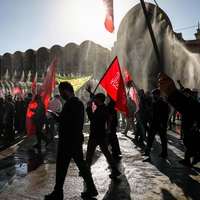
Participants in Ali Khamenei's funeral in Tehran are carrying red flags symbolizing vengeance. July 6, 2026

Ali Khamenei's funeral was intended to project national unity, but hardline attacks on the president and Iran's negotiators, the absence of former presidents, and renewed calls for revenge exposed deep divisions within Iran's political establishment.

The funeral processions in Tehran and Qom were overshadowed by hardline supporters chanting slogans against President Masoud Pezeshkian and Foreign Minister Abbas Araghchi, a sign of growing tensions over the government's diplomatic course.

Videos circulating on social media showed Pezeshkian being escorted through crowds by his security detail as mourners shouted "Death to the compromiser." Another video captured an even more hostile reception for Araghchi, with chants including "Death to the traitor," and "Shameless."

Yousef Pezeshkian, the president’s son and adviser, condemned the incident, writing: "If anger is directed against our own forces, targets Muslim unity and undermines domestic cohesion, it means we have become a tool in the enemy's hands and opened a window of hope for it to inflict further blows."

The attacks prompted strong criticism from reformists as well as some conservatives who support parliamentary speaker Mohammad-Bagher Ghalibaf's cooperation with the government and negotiations with the United States.

Conservative journalist Mohammad Mohajeri criticized senior officials, particularly Supreme National Security Council Secretary Mohammad-Bagher Zolghadr and some members of the Supreme National Security Council, for remaining silent. "Their silence is itself creating an even greater sedition."

Reformist journalist Ali Asghar Shafieian argued that the slogans damaged Iran's national interests. "On the day of the funeral, when even critics wore black out of respect for Iran and its leader, slogans against the state's decision to end the war and against negotiators seeking sanctions relief dealt a blow to national dignity and security."

Notable absences

The funeral also drew attention for the absence of former presidents Mohammad Khatami and Hassan Rouhani, despite official expectations that the ceremonies would showcase unprecedented national solidarity. Former foreign minister Mohammad-Javad Zarif was also absent, while images showed former president Mahmoud Ahmadinejad attending the public procession.

Authorities have not explained whether the former officials chose not to attend or were prevented from doing so.

Unlike Pezeshkian, Ghalibaf, and Hassan Khomeini – the grandson of Islamic Republic founder Ruhollah Khomeini – attended only the tightly controlled farewell ceremony at Tehran's Mosalla rather than the public street procession.

Political analyst Ahmad Zeidabadi argued that the hostile atmosphere explained the absences. "[The behaviour of] those who ignored the sanctity of the funeral by insulting the president and foreign minister clearly explains why figures such as Mohammad Khatami and Hassan Rouhani did not attend."

He added: "If they showed no mercy even to Pezeshkian, who enjoyed Khamenei's full trust and respect, it is obvious what they would have done had Khatami or Rouhani appeared."

The reformist-leaning website Rouydad24 described the absence of former presidents as "not merely a ceremonial issue, but the loss of an opportunity to demonstrate political consensus at one of the country's most sensitive moments."

Calls for revenge dominate messaging

During the mourning ceremonies, some participants repeatedly called for retaliation against the United States, Israel, and particularly US President Donald Trump, whom they blamed for Khamenei's death. Many mourners carried red flags symbolizing vengeance.

One supporter wrote: "Officials, do you see these flags of revenge? People will be calmed by revenge against the enemy – not by negotiations."

Hardline journalist Parisa Nasrabadi argued: "Avenging the martyred leader is a decisive step toward restoring lost deterrence, a duty to prevent future assassinations of leaders, and an absolute necessity to protect the position of Iran's young leader."

Hossein Shariatmadari, editor of the hardline Kayhan newspaper, called on the government to officially declare Trump and even the pilots allegedly involved in Khamenei's killing worthy of death wherever they are found, and proposed offering a bounty for anyone who kills Trump.

Another commentary published by Tabnak argued that the massive turnout and chants demonstrated that Iranian authorities had "no option but to exact retribution against the killers of the martyred leader."

Was the funeral a referendum?

Several pro-government figures portrayed the turnout as a public referendum endorsing the Islamic Republic.

Lawmaker Jafar Ghaderi described it as "the revolution's largest popular referendum," arguing that the government should now respond by addressing economic concerns and rewarding public loyalty.

Zeidabadi challenged the analogy, writing: "It would be good to explain exactly what this referendum is about and in which law a 'street referendum' is defined."

A social media user similarly argued that authorities have long portrayed public gatherings as proof of popular endorsement without specifying either the subject of the alleged referendum or its legal basis.

Foreign influencers welcomed

The funeral also featured several foreign journalists and pro-Iran commentators, including American media personality Jackson Hinkle, The Grayzone editor Max Blumenthal, and British journalist and blogger Bushra Sheikh, all of whom are known for criticizing Western policy toward Iran. Their presence was widely celebrated by government supporters online.

A widely shared video showed Hinkle standing on a stage in Tehran’s Enghelab Square, leading mourners in chants of “Death to Zionists,” “Death to Israel” and “Death to America,” with the crowd repeating the slogans after him.

US ends Iran's brief oil opening after Hormuz tanker attacks

Jul 7, 2026, 23:55 GMT+1
100%
Ships sail near the Strait of Hormuz, where tanker attacks on Tuesday prompted the United States to revoke a short-lived authorization for Iranian oil sales.

For just over two weeks, Iran had something it had not held in decades: a US authorization opening the way for the sale of its oil. On Tuesday, after tanker attacks near the Strait of Hormuz, Washington took it back.

The US Treasury Department revoked the June 21 general license that had allowed the production, delivery and sale of Iranian-origin crude oil and petroleum products, reversing a rare sanctions relief measure at the center of Washington’s negotiations with Tehran.

OFAC said the new license, effective July 7, allows existing transactions to be wound down until July 17 but bars new purchases or loading of Iranian-origin crude oil and petroleum products from Tuesday.

For Tehran, the 60-day license was more than a technical waiver. It briefly reopened a channel to international oil markets after decades of US pressure on Iran’s energy exports, allowing sales including to China as Washington tried to keep diplomacy alive.

The move came hours after the United Kingdom Maritime Trade Operations (UKMTO) said three tankers were attacked near the Strait of Hormuz on Tuesday, prompting the regional maritime threat level to be raised to “severe.”

A US official said Iran’s actions in the Strait of Hormuz were “wholly unacceptable” to the United States and would be met with consequences, Reuters reported Tuesday.

Among the vessels targeted was the Qatari tanker Al Rakayat, which Doha said was attacked while transiting near the Strait of Hormuz. Qatar summoned Iran’s charge d’affaires in Doha to protest the targeting of the tanker.

In response, Iranian Foreign Ministry spokesperson Esmaeil Baghaei urged Qatar to “avoid any action” that would contradict the memorandum of understanding between Tehran and Washington.

Baghaei said Tuesday that under Clause 5 of the memorandum, the Islamic Republic was committed to taking the necessary measures for the future management of the Strait of Hormuz and providing maritime services.

He said some commercial vessels had used routes not coordinated with Iran while turning off or manipulating AIS tracking systems, which he said created risks of collision, environmental harm and disruption to Iran’s efforts to facilitate safe passage through the strait.

Persian Gulf states including Saudi Arabia, Qatar, Bahrain and the United Arab Emirates condemned the attacks, calling them a threat to international navigation, regional stability and energy supplies.

Inside Iran, Mohsen Rezaei, a former IRGC commander-in-chief and current military adviser to Supreme Leader Mojtaba Khamenei, said the United States would doom negotiations with Iran to failure.

“Those opposed to the talks should wait, because the Americans themselves will derail these negotiations,” Rezaei said Tuesday.

Nezamoldin Mousavi, an Iranian hardline politician and former head of the IRGC-affiliated Fars News Agency, wrote on X that after Washington revoked the Iran oil sanctions waiver, Iran had “no card left” except closing the Strait of Hormuz.

He urged lawmakers to approve a three-urgency bill next week to leave the NPT.

The escalation comes as the coffin of slain Supreme Leader Ali Khamenei has arrived in Iraq but has yet to be buried, leaving eyes once again fixed on the Strait of Hormuz.

Potential state TV shakeup tests Iran’s willingness to rein in hardliners

Jul 7, 2026, 19:04 GMT+1
•
Behrouz Turani
100%
Iran's state broadcaster's chief Peyman Jebelli (left) and his cultural deputy Vahid Jalili, the brother of hardline politician Saeed Jalili

The looming end of Payman Jebelli’s term as head of Iran’s state broadcaster has become a political test of whether the country’s new leadership is prepared to rein in hardliners accused of hijacking public media.

Iranians frustrated with years of one-sided, hardline coverage by the Islamic Republic of Iran Broadcasting, or IRIB, are increasingly watching the possible leadership change as an early sign of whether the system intends to correct course.

Radical anti-diplomacy factions have long used IRIB, whose chief is directly appointed by the supreme leader, to undermine pragmatist efforts toward a breakthrough with Washington.

That pressure continued even during the weeklong funeral ceremonies for former Supreme Leader Ali Khamenei, when hardline voices on state television kept attacking attempts to shift the country away from wartime confrontation.

As Jebelli’s five-year term nears its end, criticism of his tenure and his ultraconservative Paydari Party allies has moved from reformist circles into more mainstream political commentary.

Jebelli and his cultural deputy Vahid Jalili, the brother of senior conservative politician Saeed Jalili, are widely regarded by critics as key figures behind IRIB’s hardline editorial line, particularly its hostility toward the government’s diplomatic and postwar agenda.

Many Iranians and media analysts now view a possible shakeup at the broadcaster as a signal of whether Iran’s new leadership is willing to curb unilateral rhetoric and restore a degree of institutional balance to state media.

A commentary on the moderate news site Asr-e Iran, headlined “Countdown to the Start of Changes in the IRIB,” said the political fallout over the broadcaster’s recent censorship of Parliament Speaker Mohammad Bagher Ghalibaf had reached senior levels of the establishment.

  • Iran parliament cries censorship after Ghalibaf interview cut short

    Iran parliament cries censorship after Ghalibaf interview cut short

According to the report, the incident is no longer being treated as a routine editorial or executive mistake, but as a threat to national security and internal cohesion at a sensitive moment of postwar realignment.

The outlet said a political “countdown” had begun behind closed doors, pointing to a possible restructuring aimed at ending radical factions’ grip over the state’s most powerful media platform.

Asr-e Iran argued that IRIB had crossed a major political red line by turning a partisan media dispute into a broader governance crisis. It said a publicly funded broadcaster could not be allowed to become “the private clubhouse of an extremist faction” defying what it described as the official consensus of the governing branches.

The commentary said the current management model at IRIB had become an internal obstacle to the state’s strategic direction and called for a purge of the broadcaster’s leadership.

'IRIB deepens state-society divide'

Earlier this week, the pro-reform daily Arman-e Melli also described IRIB’s abrupt censorship of relatively moderate figures, including Ghalibaf, as evidence of a deeper institutional crisis within Iran’s political elite.

The paper accused IRIB’s leadership of being “hijacked by a narrow, radical faction allied with hardline rejectionists” and said the broadcaster was using public media to suppress even official state narratives when they conflicted with factional interests.

By censoring the head of the legislative branch at a time when he is seeking to move the country from wartime footing toward economic reconstruction, the daily argued, IRIB had openly damaged the appearance of internal unity.

Arman-e Melli said the broadcaster had deepened the divide between the state and society and shown that it could not tolerate even the official narrative of a conservative parliament speaker.

In a separate commentary in the same paper, reformist figure Hassan Rasouli offered a broader critique of factional infighting, arguing that public dissent by hardline elements weakens the state’s leverage in international negotiations.

Rasouli called for a temporary freeze on factional rivalry, saying domestic media platforms should serve as pillars of administrative cohesion during a critical geopolitical transition. He argued that projecting strategic stability abroad requires protecting the executive branch from internal sabotage at home.

The debate over IRIB comes as Iran’s new leadership faces growing scrutiny over whether promised or anticipated institutional changes will materialize.

Earlier this week, Judiciary Chief Gholamhossein Mohseni Ejei was reinstated, disappointing many Iranians, particularly human rights advocates who had hoped for change.

If Jebelli and his team are also reinstated at IRIB, public frustration is likely to deepen and reinforce the perception that the system remains unwilling to reform its most unilateral and hardline institutions.

Khamenei funeral struggles to stay on script

Jul 7, 2026, 04:14 GMT+1
•
Behrouz Turani
100%
A child places a picture of Ali Khamenei among handwritten messages left by mourners on a memorial wall set up during funeral ceremonies in Tehran, July 5, 2026

The weeklong funeral ceremonies for Iran’s slain Supreme Leader Ali Khamenei have been mired in chaotic planning, last-minute changes and political controversy.

Even state-aligned media hinted at organizational problems during one of the Islamic Republic’s most significant public ceremonies in decades, while social media reflected sharp divisions over the scale and meaning of the events.

The problems began almost immediately. Although state media had repeatedly announced that ceremonies would begin on Saturday, July 4, organizers abruptly moved the start forward by one day after realizing that foreign dignitaries had already arrived in Tehran on July 3 because of confusion over invitations.

A major disruption involved the movement of the coffins.

IRGC commander Hassan Hassanzadeh, who oversaw parts of the ceremony, initially announced that designated trucks would carry them from the east toward the west of Tehran, where they would be airlifted to Qom and later transferred to Iraq.

Hours after the scheduled start, state television reported that the plan had been reversed and the coffins would instead move from west to east.

Hassanzadeh later apologized to people who had gathered in eastern Tehran, according to IRGC-linked Fars News, explaining that the change was necessary because the “very large and early presence of people” and the closure of roads made the original route impossible.

Earlier reports also cited concerns that some bridges along the route might not withstand the weight of the crowds, potentially causing a catastrophe.

Hundreds of users on X and Telegram complained that they had arrived in eastern Tehran as early as 5 a.m. on organized tours, unaware of the change.

Critics noted that such logistical issues could have been assessed before the ceremony.

Questions were also raised about official crowd estimates, with social-media users comparing images of gatherings at Tehran’s Grand Mosalla with historic mass events such as the 72,000-person Freddie Mercury concert at Wembley Stadium in 1985.

Some questioned official claims that “millions” had attended the funeral.

Online narratives on X and Telegram were sharply divided.

Pro-government accounts and some Western commentators amplified footage showing a “festival-like” atmosphere outside the Grand Mosalla, with electronic religious music and free drinks.

Others inside Iran expressed frustration over state-mandated disruptions to daily life, rising economic concerns and heavy security measures during a period of national uncertainty.

Reports also emerged of pressure to mobilize participation.

Tehran residents described receiving orders from trade and real-estate unions requiring businesses including gyms, offices and parts of the Grand Bazaar to remain closed.

Basij members reportedly warned some shopkeepers that failing to comply could result in their stores being sealed.

In provinces such as Hamedan, charitable organizations were allegedly pressured to contribute funds, while restaurants in industrial towns near Tehran were reportedly ordered to prepare thousands of free meals for mourners or face closure.

Despite these pressures, videos circulated online appearing to show government officials—including Tehran’s mayor—being served expensive meals from well-known restaurants, while many participants received simple lunches such as egg sandwiches.

Media outlets also noted that the 12-hour procession through Tehran to Mehrabad Airport—and the subsequent transfer of the body to Qom, Najaf, Karbala and finally Mashhad for burial—created immense logistical challenges.

Analysts have compared the extreme caution surrounding Khamenei’s burial to memories of Ayatollah Khomeini’s chaotic 1989 funeral, when crowds overwhelmed security, tore the burial shroud and forced officials to remove the body by helicopter.

But for many observers, the most striking aspect of the ceremonies has been the political messaging.

Aggressive slogans, posters targeting US officials and widespread displays of red flags symbolizing revenge have dominated parts of the funeral.

Critics said the tone appeared at odds with Tehran’s diplomatic calendar, with Iranian officials expected to meet US counterparts next week for talks aimed at reaching a broader agreement and easing Iran’s economic crisis.

The end of one-man rule? Iran tests life after Khamenei

Jul 7, 2026, 02:04 GMT+1
•
Negar Mojtahedi
100%
Senior Iranian officials attend the funeral of slain supreme leader Ali Khamenei. From left to right: foreign minister Abbas Araghchi, parliament speaker and lead negotiator Mohammad Bagher Ghalibaf, chief justice Gholamhossein Mohseni Eejei, and president Masoud Pezeshkian, July 4, 2026

As Iran adjusts to life after Ali Khamenei, a question once considered unthinkable is moving into the open: is the role of Supreme Leader itself being redefined?

For nearly half a century, the Islamic Republic has rested on one central principle: the Supreme Leader has the final word.

Presidents, parliament, the judiciary and the military could disagree. Institutions could compete. Factions could fight. But ultimately, Iran’s Supreme Leader settled the argument.

That assumption now appears shaken—and is being openly questioned from inside the system itself.

The debate began with what appeared to be a dispute over the government’s memorandum with the United States.

Vice President for Executive Affairs Mohammad-Jafar Ghaempanah argued that Supreme Leader Mojtaba Khamenei’s views were subject to institutional review rather than automatic implementation.

“If every opinion expressed by the Leader were implemented without question, there would be no need for institutions such as Parliament or the Supreme National Security Council,” Ghaempanah said.

Ultra-hardliners accused Ghaempanah of attacking the doctrine of Velayat-e Faqih, or Guardianship of the Islamic Jurist, arguing that he had reduced the Supreme Leader’s judgment to the level of other officials.

“It’s a very new thought,” said Patrick Clawson, deputy director for research at the Washington Institute for Near East Policy, “the idea that the Supreme Leader is not the one who makes the final decision.”

Clawson cautioned against overstating Ghaempanah’s personal influence. Although he holds the title of vice president, the position functions largely as a presidential adviser rather than one of Iran’s principal decision-makers.

The significance, he said, lies not with the messenger but with the idea itself.

“There has always been some collective element,” Clawson said. “But the Supreme Leader has been the final decision-maker.”

The suggestion that institutional decisions might themselves become definitive, without requiring the Leader’s final approval, would represent “a very new and different way of doing things,” he added.

Historian Arash Azizi said the controversy reflects a deeper problem.

“The Islamic Republic's constitutional design has had a tension or a contradiction built into it from the beginning,” Azizi said, arguing that the office of Supreme Leader was built around a “philosopher-king” model: an unelected cleric standing above politics and resolving disputes between competing institutions.

Under Ali Khamenei, that contradiction largely disappeared.

“He effectively turned Iran into an autocracy ... a personalistic system really, where his final word just carried the ultimate weight,” Azizi said.

But no successor, he argues, was likely to inherit that degree of authority.

“It had long been clear that there would be no smooth succession,” Azizi said. “It had also long been clear that it is much more likely that the future of leadership in the Islamic Republic would be less clerical and more collective.”

According to Azizi, that transition had already begun before Ali Khamenei’s death.

Following the 12-day war, he argued, day-to-day authority increasingly shifted toward the Supreme National Security Council, where Iran’s major institutions, including the presidency, judiciary, IRGC and intelligence services, are represented.

In that context, Ghaempanah’s remarks become more than a defense of negotiations with Washington.

They suggest the office of Supreme Leader itself may be evolving from the unquestioned source of authority into one power center among several.

If that trend continues, Azizi believes the constitutional framework itself may eventually need to change.

“I believe that in the next few years, they'll change the constitution and perhaps get rid of the position of Supreme Leader, merge it with the president, or fundamentally change the constitution of the Islamic Republic.”

Janatan Sayeh, a research analyst at the Foundation for Defense of Democracies, sees another force behind the shift.

“No one had undermined the Supreme Leader's role like this,” he said.

“The military establishment does not feel the need to appease the clergy as much as they used to,” Sayeh added.

Rather than replacing the office of Supreme Leader, Sayeh argues, the Islamic Revolutionary Guard Corps benefits from preserving it as a source of religious and constitutional legitimacy while real power increasingly flows through security institutions.

“Ideally they want a Velayat-e Faqih that's IRGC-dominated and not influenced by the clergy,” he said.

The government insists Ghaempanah’s comments have been distorted and that he never challenged the Supreme Leader’s authority.

Yet the debate his remarks unleashed reveals something almost unimaginable under Ali Khamenei.

For decades, Iran’s institutions competed beneath a single unquestioned authority. Today, the competition increasingly appears to be over that authority itself.

Whether power ultimately settles with the Supreme National Security Council, the IRGC or another coalition of political elites remains uncertain.

The deeper question is whether the office of Supreme Leader, as it functioned under Ali Khamenei, can survive the man who defined it.