• العربية
  • فارسی
Brand
  • Iran Insight
  • Politics
  • Economy
  • Analysis
  • Special Report
  • Opinion
  • Podcast
  • Iran Insight
  • Politics
  • Economy
  • Analysis
  • Special Report
  • Opinion
  • Podcast
  • Theme
  • Language
    • العربية
    • فارسی
  • Iran Insight
  • Politics
  • Economy
  • Analysis
  • Special Report
  • Opinion
  • Podcast
All rights reserved for Volant Media UK Limited
volant media logo
ANALYSIS

The end of one-man rule? Iran tests life after Khamenei

Negar Mojtahedi
Negar Mojtahedi

Iran International

Jul 7, 2026, 02:04 GMT+1
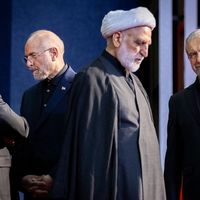
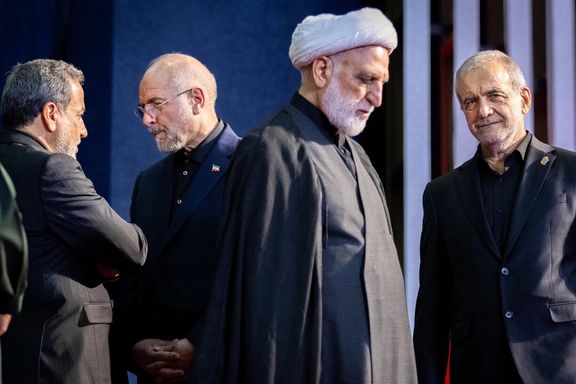
Senior Iranian officials attend the funeral of slain supreme leader Ali Khamenei. From left to right: foreign minister Abbas Araghchi, parliament speaker and lead negotiator Mohammad Bagher Ghalibaf, chief justice Gholamhossein Mohseni Eejei, and president Masoud Pezeshkian, July 4, 2026

As Iran adjusts to life after Ali Khamenei, a question once considered unthinkable is moving into the open: is the role of Supreme Leader itself being redefined?

For nearly half a century, the Islamic Republic has rested on one central principle: the Supreme Leader has the final word.

Presidents, parliament, the judiciary and the military could disagree. Institutions could compete. Factions could fight. But ultimately, Iran’s Supreme Leader settled the argument.

That assumption now appears shaken—and is being openly questioned from inside the system itself.

The debate began with what appeared to be a dispute over the government’s memorandum with the United States.

Vice President for Executive Affairs Mohammad-Jafar Ghaempanah argued that Supreme Leader Mojtaba Khamenei’s views were subject to institutional review rather than automatic implementation.

“If every opinion expressed by the Leader were implemented without question, there would be no need for institutions such as Parliament or the Supreme National Security Council,” Ghaempanah said.

Ultra-hardliners accused Ghaempanah of attacking the doctrine of Velayat-e Faqih, or Guardianship of the Islamic Jurist, arguing that he had reduced the Supreme Leader’s judgment to the level of other officials.

“It’s a very new thought,” said Patrick Clawson, deputy director for research at the Washington Institute for Near East Policy, “the idea that the Supreme Leader is not the one who makes the final decision.”

Clawson cautioned against overstating Ghaempanah’s personal influence. Although he holds the title of vice president, the position functions largely as a presidential adviser rather than one of Iran’s principal decision-makers.

The significance, he said, lies not with the messenger but with the idea itself.

“There has always been some collective element,” Clawson said. “But the Supreme Leader has been the final decision-maker.”

The suggestion that institutional decisions might themselves become definitive, without requiring the Leader’s final approval, would represent “a very new and different way of doing things,” he added.

Historian Arash Azizi said the controversy reflects a deeper problem.

“The Islamic Republic's constitutional design has had a tension or a contradiction built into it from the beginning,” Azizi said, arguing that the office of Supreme Leader was built around a “philosopher-king” model: an unelected cleric standing above politics and resolving disputes between competing institutions.

Under Ali Khamenei, that contradiction largely disappeared.

“He effectively turned Iran into an autocracy ... a personalistic system really, where his final word just carried the ultimate weight,” Azizi said.

But no successor, he argues, was likely to inherit that degree of authority.

“It had long been clear that there would be no smooth succession,” Azizi said. “It had also long been clear that it is much more likely that the future of leadership in the Islamic Republic would be less clerical and more collective.”

According to Azizi, that transition had already begun before Ali Khamenei’s death.

Following the 12-day war, he argued, day-to-day authority increasingly shifted toward the Supreme National Security Council, where Iran’s major institutions, including the presidency, judiciary, IRGC and intelligence services, are represented.

In that context, Ghaempanah’s remarks become more than a defense of negotiations with Washington.

They suggest the office of Supreme Leader itself may be evolving from the unquestioned source of authority into one power center among several.

If that trend continues, Azizi believes the constitutional framework itself may eventually need to change.

“I believe that in the next few years, they'll change the constitution and perhaps get rid of the position of Supreme Leader, merge it with the president, or fundamentally change the constitution of the Islamic Republic.”

Janatan Sayeh, a research analyst at the Foundation for Defense of Democracies, sees another force behind the shift.

“No one had undermined the Supreme Leader's role like this,” he said.

“The military establishment does not feel the need to appease the clergy as much as they used to,” Sayeh added.

Rather than replacing the office of Supreme Leader, Sayeh argues, the Islamic Revolutionary Guard Corps benefits from preserving it as a source of religious and constitutional legitimacy while real power increasingly flows through security institutions.

“Ideally they want a Velayat-e Faqih that's IRGC-dominated and not influenced by the clergy,” he said.

The government insists Ghaempanah’s comments have been distorted and that he never challenged the Supreme Leader’s authority.

Yet the debate his remarks unleashed reveals something almost unimaginable under Ali Khamenei.

For decades, Iran’s institutions competed beneath a single unquestioned authority. Today, the competition increasingly appears to be over that authority itself.

Whether power ultimately settles with the Supreme National Security Council, the IRGC or another coalition of political elites remains uncertain.

The deeper question is whether the office of Supreme Leader, as it functioned under Ali Khamenei, can survive the man who defined it.

Most Viewed

Tailored Quran verses at Khamenei funeral spark diplomatic debate
1

Tailored Quran verses at Khamenei funeral spark diplomatic debate

2
ANALYSIS

Iran buries Khamenei as fight over his power continues

3
INSIGHT

Iran’s energy growth slows to a crawl as demand races ahead

4

Cattle feeding on hospital waste expose risks at Iran landfill

5
VOICES FROM IRAN

Iran's costly farewell for supreme leader draws backlash

Banner
Banner
Banner

Spotlight

  • The end of one-man rule? Iran tests life after Khamenei
    ANALYSIS

    The end of one-man rule? Iran tests life after Khamenei

  • Iran's costly farewell for supreme leader draws backlash
    VOICES FROM IRAN

    Iran's costly farewell for supreme leader draws backlash

  • Iran’s energy growth slows to a crawl as demand races ahead
    INSIGHT

    Iran’s energy growth slows to a crawl as demand races ahead

  • Iran buries Khamenei as fight over his power continues
    ANALYSIS

    Iran buries Khamenei as fight over his power continues

  • Behind the funeral: Khamenei’s coffin becomes stage for Iran’s wounded power
    ANALYSIS

    Behind the funeral: Khamenei’s coffin becomes stage for Iran’s wounded power

•
•
•

More Stories

Revenge rhetoric dominates Khamenei funeral despite US talks push

Jul 6, 2026, 22:56 GMT+1
Revenge rhetoric dominates Khamenei funeral despite US talks push
100%
Mourners carry an anti-Trump banner at the funeral ceremonies for Iran's slain supreme leader Ali Khamenei, Tehran, July 5, 2026

Calls for revenge and threats targeting US President Donald Trump and other American public figures featured prominently during Ali Khamenei’s funeral procession in Tehran on Monday, as mourners demanded retaliation for the slain Supreme Leader’s killing.

Participants carried placards resembling assassination target lists, with red crosshairs superimposed on the faces of several US and pro-Israel figures.

Those pictured included Trump, Republican Senator Lindsey Graham, conservative commentator Ben Shapiro, activist Laura Loomer, Israeli-American billionaire Miriam Adelson, Foundation for Defense of Democracies chief Mark Dubowitz, investor Peter Thiel and others.

The placards read: “Sooner or later, your heads will roll.”

Participants also hanged an effigy of Trump, while others carried a large banner reading “Kill Trump – $100 Million Iranian Bounty” in front of the vehicle carrying Khamenei’s coffin.

A video published online showed Islamic Republic supporters throwing stones at a poster of Trump before tearing it apart.

In another video from the procession, mourners chanted: “We don't want a deal, we want Trump's head,” underscoring the contrast between public calls for revenge and the Islamic Republic’s parallel ceasefire and negotiation track with Washington.

The IRGC-affiliated Fars News Agency separately published footage showing supporters waving red flags and calling for revenge over Khamenei’s killing, reinforcing the retaliation theme that ran through the procession.

A large English-language poster depicting Trump and Israeli Prime Minister Benjamin Netanyahu as wanted men was also displayed among the crowds, featuring threats including “There will be blood” and “Kill Trump” alongside images of the two leaders marked with crosshairs.

Iranian officials and pro-government figures have repeatedly called for revenge over Khamenei’s killing, while insisting that retaliation is separate from the country’s ceasefire and negotiation process.

Inside Tehran’s metro system, Islamic Republic supporters chanted slogans against negotiations with the United States, including: “We did not give martyrs to make peace, or to praise the murderer Trump.”

Another group chanted: “Death to the foreign-backed Pahlavi,” referring to exiled prince Reza Pahlavi, who has called for the end of the Islamic Republic.

The funeral, staged as a mass display of loyalty to the Islamic Republic’s slain leader, became a platform for threats against US and Israeli figures and against Iranian opposition figures abroad.

British couple remain on hunger strike in Tehran prison, rights group says

Jul 6, 2026, 18:00 GMT+1
British couple remain on hunger strike in Tehran prison, rights group says
100%

British nationals Craig and Lindsay Foreman remain on hunger strike in Tehran’s Evin prison and have been denied adequate medical care, essential medicine and family phone calls, US-based rights group HRANA reported on Monday.

The report said Lindsay Foreman had not received a medical checkup for about 10 days and was suffering from dizziness, body tremors, severe weakness and more than 14 kg of weight loss. Craig Foreman had lost about 16 kilograms, it added.

HRANA cited an informed source as saying the couple had recently been allowed phone contact with their lawyer but remained barred from speaking to their family, children and each other.

The source said pressure on the couple intensified after interviews with BBC World in which they discussed executions in Iran.

Craig and Lindsay Foreman were sentenced to 10 years in prison in February on espionage charges, which they deny.

The couple were first detained in the southeastern city of Kerman, where they spent 30 days in solitary confinement before being transferred to Tehran, the family has said, adding that, they had entered Iran with valid visas, a licensed guide and a cleared itinerary.

Iran's costly farewell for supreme leader draws backlash

Jul 6, 2026, 14:01 GMT+1
•
Saba Heidarkhani
Iran's costly farewell for supreme leader draws backlash
100%
Supreme Leader Ali Khamenei's funeral procession in Tehran on July 5, 2026.

The Islamic Republic's state funeral for Ali Khamenei has drawn criticism over its attendance, the extensive public resources devoted to the event and what many Iranians described as an unsuccessful attempt to project political strength, following the burial ceremony.

Images and videos from Tehran's prayer ground complex prompted widespread discussion among Iranians, with many saying attendance fell short despite an extensive state mobilization effort.

Messages sent to Iran International argued authorities relied on government employees, security forces, organized transportation, free meals and public holidays to maximize turnout, yet still failed to fill the designated venue.

For many, the relatively sparse gathering represented more than a logistical disappointment. They viewed it as evidence of a widening gap between the establishment and society, arguing the Islamic Republic could no longer convincingly stage large public displays of popular support.

  • Funeral expenses deepen anger over Ali Khamenei's week-long burial

    Funeral expenses deepen anger over Ali Khamenei's week-long burial

Several citizens contrasted the official portrayal of the funeral as a demonstration of national unity with what they described as a subdued public response after nearly five decades of clerical rule.

Symbolism meets economic hardship

Many reactions focused on the economic contrast between the scale of the ceremony and the financial pressures facing ordinary Iranians.

Iranians questioned the use of public resources for an elaborate state funeral at a time when inflation, declining purchasing power and rising living costs continue to dominate daily life.

Several described households that have reduced or eliminated meat and other protein from their diets, arguing that spending on ceremonial events appeared disconnected from the country's economic realities.

Others said successive crises – including war, sanctions, regional isolation and economic decline – had not altered what they viewed as the system's priority of funding state institutions and political messaging ahead of public welfare.

Contradictory political messaging

Another frequently discussed issue involved videos circulating on social media showing participants symbolically pelting an image of US President Donald Trump with stones during the funeral events.

Supreme Leader Ali Khamenei's funeral procession in Tehran on July 5, 2026.
100%
Supreme Leader Ali Khamenei's funeral procession in Tehran on July 5, 2026.

Some citizens highlighted what they saw as a contradiction between anti-US demonstrations and expectations that Iranian and US officials could resume negotiations in the near future.

They argued that confrontational domestic messaging has repeatedly existed alongside diplomatic engagement, reflecting what they described as two parallel tracks in the Islamic Republic's foreign policy.

Questions over the cost

No official estimate has been released for the total cost of the funeral and burial ceremonies.

Nevertheless, many messages attempted to estimate the overall expenditure by citing security deployments, temporary infrastructure, transportation, accommodation, food distribution, ceremonial preparations and construction work carried out along the procession route.

Some suggested the total bill could approach $800 million, although no official evidence has been presented to support that figure.

  • Behind the funeral: Khamenei’s coffin becomes stage for Iran’s wounded power

    Behind the funeral: Khamenei’s coffin becomes stage for Iran’s wounded power

The estimate prompted comparisons with recent funerals for other world leaders.

Several people pointed to the funeral of Elizabeth II in 2022, which the British government estimated cost around £162 million – roughly $200 million at contemporary exchange rates. The event included days of public lying-in-state, thousands of police and military personnel, extensive international participation and worldwide television coverage.

Others referred to the funerals of Omani Sultan Qaboos bin Said and Kuwaiti Emir Sabah Al-Ahmad Al-Jaber Al-Sabah, both of which followed Islamic tradition with relatively swift burial ceremonies. Although no comprehensive official costs were released, participants noted those events appeared considerably more modest despite taking place in wealthy Persian Gulf monarchies.

Debate over public priorities

Many also drew comparisons with the Islamic Republic's longstanding criticism of the lavish celebrations marking the 2,500th anniversary of the Persian Emire under the Pahlavi dynasty.

They questioned why authorities that had long condemned those celebrations as wasteful were now directing substantial public funds toward a funeral ceremony during a period of economic hardship.

Supreme Leader Ali Khamenei's funeral procession in Tehran on July 5, 2026.
100%
Supreme Leader Ali Khamenei's funeral procession in Tehran on July 5, 2026.

Several messages further said that the system has never devoted comparable financial and organizational resources to national celebrations such as Nowruz, Yalda Night or Chaharshanbe Suri, despite their broad cultural significance.

For many, the debate surrounding the funeral extended beyond attendance or cost. They said the ceremony reflected broader concerns about state priorities, economic management and political legitimacy.

Rather than reinforcing the image of a confident political system, citizens argued the funeral underscored the difficulties facing a regime confronting deep economic challenges and declining public trust, even as it sought to present the burial of its longtime leader as a demonstration of continuity and authority.

Iran keeps Ejei as judiciary chief, preserving hardline course

Jul 6, 2026, 11:42 GMT+1
•
Naeimeh Doostdar
Iran keeps Ejei as judiciary chief, preserving hardline course
100%
Iran's Judiciary Cheif Gholamhossein Mohseni Ejei

Gholamhossein Mohseni Ejei was recently reappointed as judiciary chief for another five-year term, reinforcing the Islamic Republic’s security-focused judicial system and offering an early indication of how Supreme Leader Mojtaba Khamenei intends to manage power.

The appointment, issued under Article 157 of Iran’s constitution, leaves one of the Islamic Republic’s longest-serving judicial and intelligence figures at the head of an institution that has played a central role in prosecuting dissent, overseeing political cases and implementing the state’s domestic security policies.

Mohseni Ejei, 69, has spent more than four decades moving between the Revolutionary Courts, the Intelligence Ministry and the judiciary, making him one of the few senior officials with experience across all three pillars of Iran’s security establishment.

Unlike many first-generation clerics who rose through purely religious institutions, Mohseni Ejei also earned a master's degree in private international law. That legal education, however, has done little to shape his public image, which has instead been defined by security cases, political prosecutions and harsh judicial policies.

  • Mass arrests, intensifying crackdown sweep Iran amid attacks

    Mass arrests, intensifying crackdown sweep Iran amid attacks

His rise began during the 1980s, when he served as an investigator in the case against Mehdi Hashemi, the brother-in-law of the late Grand Ayatollah Hossein Ali Montazeri. The prosecution helped weaken Montazeri's political standing before he was removed as the designated successor to the Islamic Republic's founder, Ruhollah Khomeini.

That early role established Mohseni Ejei as an official closely associated with politically sensitive investigations, forced confessions and cases that blurred the boundary between judicial procedure and national security.

Security insider

Official biographies highlight his studies at the Haqqani Seminary and his involvement in prominent corruption prosecutions during the 1990s, including cases involving businessman Fazel Khodadad and former Tehran mayor Gholamhossein Karbaschi.

His career expanded further when he became intelligence minister under President Mahmoud Ahmadinejad before being dismissed in 2009. He was subsequently appointed prosecutor general, later became first deputy judiciary chief and assumed the judiciary's top post in 2021.

The combination of intelligence, prosecutorial and judicial experience has made Mohseni Ejei one of the Islamic Republic's most trusted officials for handling politically sensitive files involving opposition figures, corruption allegations and national security matters.

Supporters portray him as an experienced administrator familiar with every layer of Iran's judicial system. Critics argue his career reflects the increasing integration of intelligence agencies and the courts, turning judicial institutions into instruments for enforcing political control.

Mohseni Ejei has also maintained an unusually low public profile outside official duties. Unlike many senior Iranian politicians, he rarely projects a personal image or family life through the media, appearing primarily in court proceedings, official meetings and state broadcasts.

'The man who bites'

Among many Iranians, Mohseni Ejei's public reputation extends beyond his judicial decisions.

One of the most enduring stories surrounding him dates to 2004, when journalist Isa Saharkhiz accused Mohseni Ejei of throwing a cube-sugar bowl and biting his shoulder during a dispute at a meeting of Iran's Press Supervisory Board. The account became one of the defining anecdotes associated with his public image.

His international profile, however, has been shaped more by human rights concerns than by personal controversies.

The United States Department of the Treasury sanctioned Mohseni Ejei in September 2010 over his role in serious human rights abuses following Iran's disputed 2009 presidential election. The sanctions placed him alongside other senior Iranian security officials accused of involvement in post-election repression.

The European Union also imposed human rights sanctions on him, citing his role in unfair trials and severe prison and death sentences against political activists and protesters.

Judiciary under scrutiny

During his first term as judiciary chief, Mohseni Ejei said wants to promote themes including judicial reform, anti-corruption efforts and reducing court delays.

Judiciary Chief Gholamhossein Mohseni Ejei, recently appointed to a new five-year term, attends a ceremony alongside President Masoud Pezeshkian (left) and Parliament Speaker Mohammad Bagher Ghalibaf (center).
100%
Judiciary Chief Gholamhossein Mohseni Ejei, recently appointed to a new five-year term, attends a ceremony alongside President Masoud Pezeshkian (left) and Parliament Speaker Mohammad Bagher Ghalibaf (center).

Human rights organizations, however, have argued the judiciary became more deeply involved in suppressing political opposition, particularly following the 2022 Woman, Life, Freedom protests triggered by the death of Mahsa Amini in morality police custody.

Mohseni Ejei publicly defended death sentences imposed on some protesters after those demonstrations.

Amnesty International said in September 2025 that Iran had executed more than 1,000 people that year, describing it as the highest annual total recorded by the organization in at least 15 years. The group said authorities had increasingly relied on capital punishment following the Woman, Life, Freedom protests.

The Iran Human Rights annual report recorded at least 1,639 executions during 2025, saying more than 93% were never officially announced and that Revolutionary Courts handed down 852 execution sentences during the year.

Following the recent conflict involving Israel and the United States, rights groups have also accused Iranian authorities of accelerating political prosecutions under wartime conditions.

Amnesty International said in May 2026 that Iranian authorities had intensified mass arrests, expedited trials and politically motivated executions, documenting at least 42 executions on political charges since late February after proceedings it described as unfair.

  • Amnesty says Iran drove global surge in executions in 2025

    Amnesty says Iran drove global surge in executions in 2025

Mohseni Ejei's reappointment follows days of speculation that Iran's new leadership might replace him to demonstrate a change of direction. Instead, retaining him suggests continuity rather than restructuring at the judiciary.

The decision shows that, at least in the early phase of Mojtaba Khamenei's leadership, judicial authority will remain closely aligned with Iran's security institutions, reinforcing a model in which the courts continue to play a central role in maintaining political control rather than signaling a broader opening of the country's legal system.

Iran buries Khamenei as fight over his power continues

Jul 5, 2026, 23:35 GMT+1
Iran buries Khamenei as fight over his power continues
100%

As Iran holds week-long funeral ceremonies for Ali Khamenei, the political dynamics unfolding behind the scenes point to a striking reality: the succession question that dominated elite politics for more than a decade did not end with his death.

The rapid elevation of his son Mojtaba within ten days was intended to close that chapter. Instead, with the new Supreme Leader still absent from public view, it appears to have opened a new one.

Roughly twenty messages attributed to Mojtaba Khamenei since his succession have failed to convince many Iranians that he is truly exercising power.

Efforts by officials and supporters to prove his presence have often been contradictory, deepening rather than resolving the uncertainty.

Read the full article here.