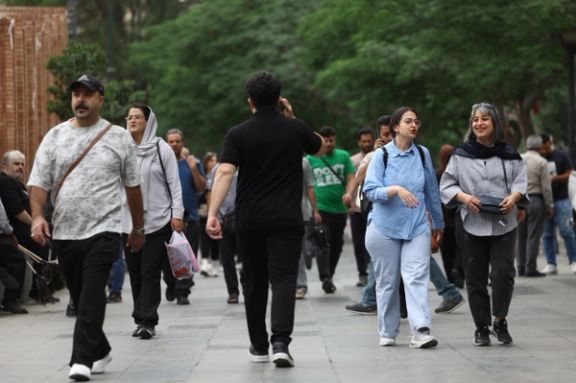
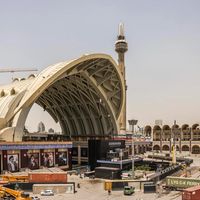
People walk in Tehran Bazaar, in Tehran, Iran, May 16, 2026.
The comment section under an Iran post can look like a national mood but under a blackout well into its third month, it is often something narrower: a space shaped by whitelisted access, economic privilege, cyber operations and fear.
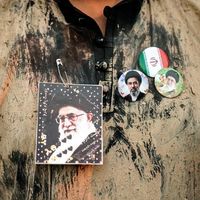
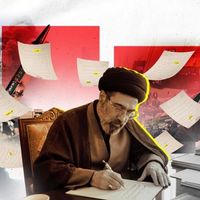
Iran’s streets and comment sections increasingly project the same official mood: unity, defiance and loyalty. Nighttime rallies supply the images – flags, portraits, organized crowds. Online, many Iran-related posts draw a parallel chorus of praise for the Islamic Republic, celebration of its military posture and attacks on critics, often alongside tributes to slain Supreme Leader Ali Khamenei and his still-unseen successor, Mojtaba Khamenei.
What the screen does not show is the pool of people removed before the argument even begins.
As Iran’s internet blackout pushes deeper into its third month, the question is no longer only what people are saying online.
It is who still has the connection, the permission, the protection or the incentive to say it.
A government-organized public wedding ceremony in Tehran, May 18, 2026
A public square with missing people
The latest crisis did not begin with one switch. During the January uprising, internet access was cut on January 8 and remained fully restricted until January 28. After US-Israeli strikes began on February 28, authorities imposed a new shutdown that has now moved toward its third month.
A normal comment section, however flawed, allows some collision between competing voices. A blackout changes the sample.
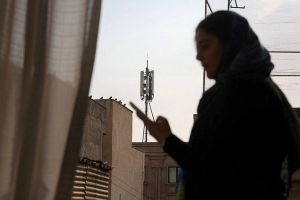
Many ordinary users are pushed onto restricted domestic services. Others ration expensive workarounds. Some businesses cannot reach customers. Students lose access to material. Families abroad struggle to maintain daily contact. At the same time, state-aligned users, approved institutions and privileged accounts remain visible on global platforms.
The asymmetry has not been hidden. In March, Iran’s government said it was providing special internet access to select users capable of promoting its messaging online. A government spokeswoman did not use the term “white SIM cards,” but said connectivity was being offered to “those who can better deliver the message.”
That is the controlled sample: not a country speaking freely, but a narrower population still able to speak outward.
Narrative laundering
The most revealing development is not only who receives access. It is what some people are asked to do to regain it.
Some Iranians whose SIM cards or internet access had been blocked over alleged online activity against the Islamic Republic said they were told to submit handwritten pledges, provide guarantors and publish pro-government content to restore access.
The notices asked for home and work addresses, bank account information, images of bank cards and links to social media accounts. They also instructed recipients not to publish content deemed harmful to the country’s “psychological, social or political security.”
Some were told to publish at least 20 posts supporting the Islamic Republic and send screenshots as proof.
The posts were not to be uploaded all at once. They had to be spaced out so the activity would appear natural.
Others were ordered to attend nighttime government rallies, photograph themselves carrying flags or images of the Supreme Leader, and provide identification documents from guarantors who would accept responsibility for any future “criminal activity.”
The detail about timing is small, but it carries the whole design. The aim is not merely loyalty. It is loyalty made to look organic.
This is where the street and the screen meet. Organized rallies produce images of public unity. Selective internet access and coerced posting can carry the same choreography into comment sections, reply chains and social platforms.
The state does not need every supportive post to be fake. It needs a system in which supportive voices are easier to see, dissenting voices are harder to hear, and some frightened users learn that getting back online may require a public performance of loyalty.
The access ladder
Iran’s internet is no longer simply available or unavailable. It has been sorted.
At the top are so-called white SIM cards, widely understood as privileged lines that allow largely unrestricted access for trusted insiders and state-aligned users. Below them are paid and limited services such as “Internet Pro,” presented by officials as a business necessity but described by many Iranians as a class-based system of digital inequality.
Reporting on material circulating among users described a four-level structure: white SIM cards, paid Internet Pro, costly VPN access and, for the majority, a restricted domestic network.
The economic filter is severe. Average monthly income in Iran is at around $100 to $200, while the minimum wage is typically below $100. Even official Internet Pro packages and VPN routes can be unaffordable, and black-market access has reportedly pushed prices far higher.
Access also carries political exposure. For those who can afford a connection, the risk is not only cost but traceability. A user may be able to post, but with the knowledge that the same system can block a SIM card, summon a guarantor, demand a pledge or turn an online comment into a legal file.
The older machine
Iranian state-linked online influence operations long predate the current blackout. Microsoft has reported that Iranian cyber-enabled influence activity has been a consistent feature of at least the last three US election cycles.
In January, the Foundation for Defense of Democracies identified what it described as a likely regime-linked influence operation on X during protests, using coordinated accounts to delegitimize dissent, intimidate protesters and reinforce official narratives.
The report said the network included at least 289 accounts posting identical Persian-language content, with behavior suggesting a hybrid of automation and human operation.
But the current phase adds a more intimate layer. Foreign influence operations impersonate a public from a distance. Domestic coercion can pressure the public itself.
The old shorthand of “bots” misses the range of actors now shaping the visible online picture: automated accounts, organized cyber operators, loyalists with privileged access, state-linked media networks, paid voices, and users pushed to perform approval to recover ordinary tools of daily life.
The silence around the noise
The missing side of Iran’s online debate is not abstract.
It is the online seller without customers, the student without class materials, the programmer without contracts, the family unable to make a routine call abroad, and the person with disabilities cut off from services or communities that made daily life more manageable.
Against that background, pro-government comment floods do not prove a national mood. They show that some people still have access, some have protection, some have instructions, and many others have been priced out, cut off or made cautious by fear.
There are genuine supporters of the Islamic Republic. But a system that restricts millions, grants selective access, monitors users, blocks SIM cards and tells some people to space out loyalty posts cannot produce a clean reading of public opinion.
When a government cuts off the people and leaves the microphone to loyalists, the comment section stops being a public square.
It becomes part of the stage.
The real story is not only in the roar under the post. It is in the conditions that made so many others unable to answer back – and in the citizens told that to return to the internet, they must first praise the power that cut them off.
US president Donald Trump speaks to reporters in Washington D.C., May 18, 2026
President Donald Trump’s claim that he postponed a planned military strike on Iran has deepened uncertainty in Tehran, where officials and analysts remain divided over whether Washington is bluffing, buying time or preparing for another round of strikes.
Trump said Monday he had postponed an attack planned for Tuesday, before warning the United States remained ready to hit Iran hard.
Kazem Gharibabadi, Iran’s deputy foreign minister for legal and international affairs, wrote on X that “the United States says it has temporarily halted an attack on Iran to give diplomacy a chance, while simultaneously speaking of readiness for a large-scale strike at any moment. This means calling a threat an opportunity for peace.”
He added that the Islamic Republic was prepared to confront “any military aggression” and that “surrender has no meaning” for Iran.
Mohsen Rezaei, an adviser to Iran’s supreme leader and former commander of the Revolutionary Guards (IRGC), accused Trump of setting and then canceling military deadlines in an attempt to force Iran into submission. He warned that Iran’s armed forces would “force America into retreat and surrender.”
Gharibabadi later told members of parliament that Iran’s latest proposal to Washington included demands such as recognition of Iran’s right to uranium enrichment, lifting the US naval blockade, releasing frozen Iranian assets and ending sanctions. He did not provide details about Washington’s response.
Iranian digital outlet Avash Media cited “a source close to the negotiating team” as claiming that Washington had accepted some Iranian conditions, including ending regional conflicts and establishing a reconstruction fund.
On Tuesday, Vice President JD Vance said Washington and Tehran had made “a lot of progress” in talks and that neither side wanted to see a return to war.
Jalal Sadatian, a regional affairs analyst, told the website Fararu that the comments should be viewed “within the framework of the current Iran-US relationship, which is in a phase marked by political attrition and pressure tactics.”
“There is a perception in Tehran that the United States, for now, is using military threats more for political leverage than because it is truly ready for war,” he said.
“Tehran’s calculation is that if it makes major concessions now under maximum pressure, this model could later expand to issues such as missile capabilities and regional influence,” Sadatian added. “Therefore, Iran’s current policy is a combination of restraint, maintaining readiness and continuing protracted negotiations.”
Reformist journalist Ahmad Zeidabadi questioned Trump’s credibility, writing that if the US president’s account was accurate, then “one must seriously doubt the minimum level of rational calculation in him.”
“Does Trump not know what historic catastrophe restarting the war would bring to the entire Persian Gulf region?” Zeidabadi asked. “Was he planning to resume war without consulting allied leaders?”
Still, several analysts and conservative media outlets warned that the possibility of military escalation remains high.
The conservative newspaper Khorasan, which is close to parliament speaker Mohammad Bagher Ghalibaf, argued that Washington may seek to “unlock negotiations through a limited but effective strike.”
Ehsan Movahedian, a professor of international relations at Allameh Tabataba’i University, told Fararu that “the probability of war in the coming days is very high,” adding that even if conflict does not erupt next week, “that does not mean the danger has disappeared.”
Some Iranian political and media figures argued that the postponement may have had little to do with regional interventions and more to do with operational difficulties.
Ali Gholhaki, a commentator close to Ghalibaf, wrote that “the reason for delaying the attack on Iran appears to be something other than requests from Arab leaders; the United States and Israel are still not certain they can strike their key targets.”
Journalist Davoud Modarresian suggested Pakistani Interior Minister Mohsin Naqvi’s extended visit to Iran could be linked to intelligence-gathering efforts.
“Under the pretext of sending messages, they may be trying to track and identify the locations of leaders and commanders,” he wrote.
The competing narratives surrounding the latest US-Iran standoff have become so stark that even basic questions—who is deterring whom, who wants talks and who fears escalation—now produce entirely different answers depending on which capital is speaking.
On Tuesday, Trump again underscored the volatility of the standoff, saying the United States “may have to give them another big hit” and claiming Tehran was “begging” for a deal.
Khabar Online journalist Mohammad Aref Moezzi described the current dynamic as a familiar “neither war nor peace” scenario: sustained pressure and confrontation without a clear decision to escalate into full conflict or pursue a comprehensive agreement.
Both sides, he argued, still believe they can force concessions without paying the cost of war.
People walk by an anti-US mural in Tehran, Iran, May 18, 2026
The competing narratives surrounding the latest US-Iran standoff have become so stark that even basic questions—who is deterring whom, who wants talks and who fears escalation—now produce entirely different answers depending on which capital is speaking.
On Monday, President Donald Trump said he had halted plans to attack Iran following requests from Qatar, Saudi Arabia, the UAE “and some others in the region.”
The same day, Iran’s state television claimed Trump had backed down from threatening military action “at least five times in recent weeks” because he feared Iran’s “firm response.”
On Tuesday, Trump again underscored the volatility of the standoff, saying the United States “may have to give them another big hit” and claiming Tehran was “begging” for a deal.
Rahman Ghahramanpour, a Middle East politics expert, told Tehran-based Khabar Online that both Tehran and Washington increasingly see the confrontation as a “competition over resilience,” with each believing renewed brinkmanship could strengthen its negotiating position.
Khabar Online journalist Mohammad Aref Moezzi described the current dynamic as a familiar “neither war nor peace” scenario: sustained pressure and confrontation without a clear decision to escalate into full conflict or pursue a comprehensive agreement.
Both sides, he argued, still believe they can force concessions without paying the cost of war.
For Iran’s leadership, the overriding objective remains survival and persuading Washington to abandon any notion of regime change.
Ghahramanpour argues that Tehran is trapped in a struggle for survival while Washington faces what he calls a “credibility trap.” The United States wants a visible strategic victory; the Islamic Republic increasingly treats simple endurance as success.
Despite striking numerous military targets in Iran, Washington has yet to achieve a major political breakthrough. In the United States, particularly amid partisan rivalries, that is often framed as a failure for Trump. In Iran, the same reality is presented as proof the Islamic Republic withstood American pressure.
He also noted that many in Israel believe Trump’s presidency may represent the best opportunity to secure full US cooperation against Iran, adding to pressure for a more decisive confrontation before political circumstances change.
The widening gap between Iranian and American perceptions has effectively frozen negotiations.
Although some hardliners in Tehran advocate pre-emptive action, the government appears unwilling to be seen as the side that starts a war.
Washington, meanwhile, continues tightening sanctions and maintaining pressure while also signaling that military action remains an option if diplomacy stalls.
Another Iranian scholar, Ali Asghar Zargar, told Fararu on Tuesday that neither side benefits from the current deadlock.
He described the standoff as a mix of attrition, geopolitical rivalry and competing political narratives in which Iran remains under heavy pressure while the United States has yet to achieve its core objectives.
Zargar also argued that Washington cannot realistically use the Strait of Hormuz as a unilateral pressure tool given the global dependence on the waterway, warning that the longer the impasse continues, the greater the risk of escalation or miscalculation.
What increasingly unites both Iranian and American analysts is the sense that the current stalemate may be unstable, and that neither side has yet found a credible path out of it.
Iran’s state broadcaster is facing criticism after airing programs in which presenters and government supporters handled rifles and other weapons on camera, with critics saying the displays blurred wartime messaging with intimidation at home.
Iranian state television channels have in recent days broadcast multiple programs featuring members of the Revolutionary Guards (IRGC), often with their faces covered, demonstrating the use of light and heavier weapons.
The televised demonstrations included Kalashnikov rifles, PK machine guns and shoulder-fired RPG launchers.
The channels also showed footage of women, men, teenagers and young people learning how to use and disassemble weapons in mosques and nighttime gatherings organized by government supporters.
Participants shown in the broadcasts said they had volunteered “to defend the country” and “the system.”
One of the most criticized broadcasts aired on Ofogh TV under the title “War Headquarters.”
In the program, after receiving instruction from an IRGC member, the presenter pointed a weapon toward an image displaying the flag of the United Arab Emirates and fired at it.
Relations between Iran and the UAE, long one of Iran’s largest trading partners, have sharply deteriorated following the recent regional conflict.
Reports indicate that the UAE has expelled many Iranian nationals in recent months.
The reformist newspaper Sazandegi wrote: “Shooting at the flag of a neighboring country has left public opinion shocked and astonished.”
A reader commenting on the Rouydad24 news website wrote: “Television presenters firing at the UAE flag on state TV have handed Iran’s enemies a perfect excuse for Iranophobia. Perhaps the shooting segment itself was orchestrated by infiltrators or a fifth column.”
In another televised segment, an IRGC member demonstrated shooting techniques using an unloaded Kalashnikov while aiming at an image of Israeli Prime Minister Benjamin Netanyahu displayed on a studio wall.
After him, the presenter pointed the weapon toward the forehead of US President Donald Trump and said: “I hope these bullets will one day hit their target.”
State broadcaster defends the programs
Officials from Iran’s state broadcasting organization, IRIB, defended the scenes.
Mohsen Bormahani, deputy head of IRIB, told the IRGC-affiliated Tasnim News Agency: “In wartime conditions, and in a country simultaneously engaged in struggle against all the powers and oppression in the world, it is natural for the national media to adopt a wartime posture.”
Bormahani said familiarizing young people and the general public with weapons helped them “become acquainted with the concepts of jihad, resistance, and defense, and strengthen their sense of responsibility and readiness within the framework of religious, cultural, Iranian, and Islamic values.”
He said the appearance of television hosts carrying weapons served as “a reminder of these teachings to the public.”
Hassan Abedini, political deputy of IRIB, separately told Mehr News Agency that the displays were symbolic and intended to project military readiness among government-backed war volunteers.
Media criticism and public anxiety
Several Iranian media outlets sharply criticized the broadcasts and warned that they could create widespread feelings of insecurity.
Rouydad24 wrote: “Broadcasting weapons training on television, in a country that already has an army, the IRGC, security forces, the Basij, and millions of men with mandatory military training, raises a troubling question more than it demonstrates ‘strength’: who exactly are these training programs intended for, and what situation are people being prepared for?”
The outlet added: “If the country’s official television suddenly starts teaching the general public how to use weapons, the question arises whether such an action unintentionally conveys the message that the official guarantors of security are no longer sufficient.”
Rouydad24 warned that the broadcasts presented “a future in which ordinary citizens must prepare themselves for the collapse of order – a situation where weapons have left the barracks and people are forced to defend their homes and streets themselves. This is precisely the image governments usually try never to convey to society.”
The conservative news website Khabar Online also criticized the broadcaster, writing that IRIB may have intended to signal to foreign enemies that “all segments of the nation are ready for battle,” or to project unity at home.
But it said media experts viewed the approach as poor judgment.
Warnings about psychological harm
Khabar Online warned that the broadcasts reproduced “guerrilla and paramilitary imagery that belongs in barracks, not on national television.”
It added: “Seeing a television presenter holding an assault rifle not only fails to create a sense of security, but also intensifies feelings of insecurity, anxiety, and war trauma among the public, especially children and vulnerable groups.”
The reformist newspaper Sazandegi also warned that the episode had raised serious concerns for the psychological security of society and the country’s international image.
It wrote: “Promoting militarism in general television programming creates a tense and anxious atmosphere in society. The proper place for displays of military power is training grounds and official parades, not the live studio of a nationwide television channel with a cultural and social mission.”
Critics see message to opponents
Some critics said the televised weapons displays appeared aimed less at a foreign enemy than at political opponents inside the country, amid growing public frustration and economic strain.
Iranian sociologist Hossein Ghazian told Iran International that the broadcasts symbolized political repression and were intended to pressure critics into silence while also justifying economic hardships through a wartime atmosphere.
One commenter on Rouydad24, referring to the deadly crackdown on protests in January, wrote: “This criminal cult is preparing for the massacre of defenseless and unarmed ordinary people, just like before, and dark days are certainly ahead. Otherwise, with these worn-out Kalashnikovs, against whom are they planning to fight? Are they going to fight F-35s, F-18s, and F-22s with these?”
Europol said on Monday that 14,200 posts and links tied to Iran’s Islamic Revolutionary Guards (IRGC) had been targeted in a coordinated operation against online terrorist material.
The operation, led by Europol’s EU Internet Referral Unit, involved 19 countries and focused on content used to spread propaganda, recruit supporters and raise funds.
The material, Europol said, appeared across social media, streaming services, blogs and websites in several languages, including Persian, English, Arabic, French and Spanish.
The content, it said, included AI-generated videos glorifying the IRGC, political messaging, calls for revenge over Iran's Supreme Leader Ali Khamenei and material linked to allied groups including Hezbollah, Houthis, Hamas and Palestinian Islamic Jihad.
Europol said the IRGC’s main X account, which had more than 150,000 followers, was withheld in the EU, while thousands of other links had been removed or were under review.
Investigators also identified cryptocurrency transactions used to support online operations, Europol said.