Iranian exile novel shortlisted for International Booker Prize
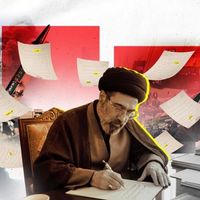
Shida Bazyar’s “The Nights Are Quiet In Tehran,” a novel tracing one Iranian family across four decades of revolution, exile and resistance, is among six books shortlisted for the 2026 International Booker Prize.
The novel, translated from German by Ruth Martin, begins after Iran’s 1979 revolution and follows different family members, including a revolutionary father, a literature-loving mother, a daughter visiting Iran for the first time and a son drawn into politics by the 2009 Green Movement.
Prize organizers described the book as a moving novel about oppression, resistance and the desire for freedom.
The International Booker Prize is awarded annually to a book translated into English and published in the UK or Ireland.
“Taiwan Travelogue” by Yáng Shuāng-zǐ, translated from Mandarin Chinese by Lin King, won the 2026 International Booker Prize.
The other shortlisted books were “She Who Remains” by Rene Karabash, “The Witch” by Marie NDiaye, “On Earth As It Is Beneath” by Ana Paula Maia, and “The Director” by Daniel Kehlmann.
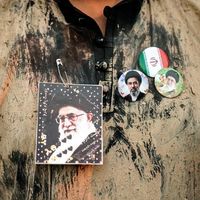
Silhouette of a women carrying an Iranian flag during a state-sponsored rally in Tehran, May 18, 2026
Even as Tehran engages in hardheaded diplomatic maneuvering with Washington, it is advancing a parliamentary proposal offering a €50 million reward for President Trump’s killing.
The ruling establishment, they argue, is trying to project strength after weeks of military and political pressure while using the prospect of talks not as a concession but as another arena of confrontation.
“The Iranian regime is trying to, in their own mind, basically say that we are on par,” Dr. Shahram Kholdi, a Middle East historian, told Iran International. “Even if you're not on par with Trump, we are actually beating him at all levels.”
The proposed bounty, he said, should be read partly as psychological warfare against Trump.
“This award to be passed as a piece of legislation by the Islamic Republic Parliament is effectively part of that psychological war that the Islamic Republic thinks it has to unleash upon Trump,” Kholdi said.
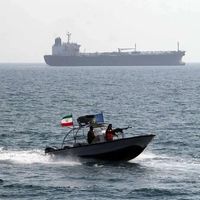
But the rhetoric is unfolding alongside more concrete threats. Tehran has also signaled it could disrupt navigation through the Persian Gulf and the Strait of Hormuz, while pro-government voices have floated attacks on satellite infrastructure, including systems such as Starlink.
'Not rational'
That combination of assassination rhetoric, military pressure and possible diplomacy may appear irrational from the outside. Kholdi argues the problem is that Washington is not dealing with a conventional negotiating actor.
“The problem with these people is that they think … if they behave sanely and rationally, that's insane and irrational,” he said. “That’s the kind of actor Trump is dealing with … The art of the deal does not work with an irrational actor.”
Dr. Eric Mandel, founder of the Middle East Political Information Network (MEPIN), framed the issue as a clash of political cultures and timelines. Western governments may look at the damage inflicted on Iran’s military and industrial infrastructure and conclude Tehran should be searching for a way out. The regime may see the same moment very differently.
“This is a perfect opportunity to realize they don't think like us,” Mandel said.
From Tehran’s perspective, he argued, the fact that the regime has survived is itself a form of victory.
“The Iranians think we have survived. We have survived and that means we are victorious,” he said. “We could outlast the Americans and eventually they're going to have to acquiesce to us.”
The time factor
That survival-first mindset helps explain why Tehran may threaten Trump while still leaving room for talks. In Mandel’s view, negotiations, ceasefires and delays all serve a purpose: they buy time.
“The Iranians got a ceasefire. They rebuilt, they rearm, they dug out missiles that were buried because they know that the longer they can either prolong negotiations, the longer they have ceasefires, that they believe that time will eventually make them the winner here,” he said.
This is why the apparent contradiction may not be a contradiction at all. The threats signal defiance. The talks buy time. The survival narrative sustains the regime internally.
Former State Department appointee Shayan Samii said Tehran’s assassination rhetoric may also backfire by strengthening Washington’s case for escalation.
“These numbskulls in Tehran don't understand that by the mere fact of just saying we want to assassinate the President of the United States—mind you, the sitting President of the United States—we're not talking about a national security threat anymore,” Samii said. “We're talking about a government apparatus coming under attack.”
That, he said, could allow the United States to frame any military response not simply as regional intervention, but as self-defense.
“They can tell the world these guys wanted to assassinate our president, we're not going to sit by,” Samii said.
'Military readiness'
Samii also rejected the idea that Trump’s latest delay should be read mainly as a response to pressure from Persian Gulf Arab states. He said the timing was more likely tied to military planning and target selection.
“It has nothing to do with the request of the Arab countries of the Persian Gulf region,” he said. “It has everything to do with machinations and military readiness and coming up with a solution for the targets that they want to hit.”
The danger, analysts say, is that both sides may be using time for very different purposes. Trump may be waiting for better military and economic conditions. Tehran may be trying to stretch the crisis into a war of attrition.
“They think that they are going to run the United States out of the stamina,” Kholdi said.
For Mandel, that gap in thinking is central to the crisis. American politics operates on elections, markets and public pressure. The Islamic Republic, he said, operates with a far longer and harsher sense of time.
“We're dealing with, trying to say from so many different angles, the calculus that they're making is so different than what ours is,” he said.
That difference may be what makes the current moment especially volatile. Tehran appears to believe threats increase leverage. Washington increasingly risks viewing those same threats as proof diplomacy cannot work.
File photo shows workers toil on the 2Africa undersea cable project carried out by France’s Alcatel Submarine Networks in Amanzimtoti, South Africa on Feb. 7, 2023.
Long viewed as merely an oil chokepoint, the Strait of Hormuz is now emerging as a digital flashpoint, after Iran floated “protection fees” for subsea fiber-optic cables crossing the waterway in a move experts warn could give Tehran new leverage.
Ebrahim Zolfaghari, spokesperson for Iran's military command center, wrote on X last week: “We will impose tolls on internet cables.”
Media outlets close to the IRGC have also said companies such as Google, Microsoft, Meta and Amazon must comply with the Islamic Republic’s laws, and that cable-owning companies must pay permit fees for cables to pass through.
Subsea cables carry the overwhelming majority of the global internet and financial traffic, connecting Europe, Asia and the Persian Gulf through a vast underwater network that powers everything from banking systems and cloud computing to government communications and energy markets.
The risk is no longer theoretical. Alcatel Submarine Networks, the world’s largest cable-laying company, has already paused subsea cable repair operations in the Persian Gulf after issuing force majeure notices tied to growing security risks in the region.
“The undersea network of undersea cables, it's not just important, it’s absolutely critical – trillions of dollars of financial transactions take place through these cables,” said Tom Sharpe, who served 27 years as a Royal Navy officer commanding four warships.
“It’s the internet, which of course if enough of that collapses can have a devastating effect," he said.
While these networks are global, experts say the Persian Gulf is uniquely vulnerable because there are fewer redundant cable routes compared to regions like the Atlantic.
“When you go to other places in the world, let’s say the [Persian] Gulf, there are far fewer, and therefore that redundancy becomes less and less, and therefore the vulnerability goes up,” Sharpe explained.
Iranian lawmakers discussed plans last week that could target submarine cables linking Persian Gulf littoral states to Europe and Asia. Iranian state-linked media have also floated proposals requiring foreign operators to comply with Iranian licensing laws and pay fees for maintenance and repair access.
The proposals appear to be part of a broader effort by Iranian hardliners to test how far Tehran can extend its authority over infrastructure crossing the Persian Gulf, even when that infrastructure is privately owned or tied to foreign governments.
Escalate, test, adjust
Sharpe believes Tehran is following a familiar escalation model — gradually testing international reactions before potentially taking more aggressive steps.
“I think, look, it seems to me at the moment we’re in the sort of inject uncertainty phase. Let’s see what the markets do. Let’s see how the companies react. Let’s see what insurers do,” Sharpe said. “They escalate. They test. They adjust.”
According to Sharpe, the strategy mirrors tactics previously employed by Russia around undersea infrastructure and later adapted by the Houthis in the Red Sea.
“They’re very good at escalation management,” he added. “They don’t go straight to the nuclear option and start just snipping cables.”
Charlie Brown, Senior Advisor at United Against Nuclear Iran, who specializes in maritime sanctions enforcement and the tracking of illicit shipping, said the issue extends far beyond internet access alone because submarine cables often cross multiple jurisdictions and are owned by consortiums involving companies and governments from around the world.
“This goes beyond merely the cable itself and the data on it,” Brown told Iran International. “These are cross-jurisdictional issues that affect many people in many different jurisdictions.”
New toll booth under the sea
Brown described the Islamic Republic’s approach as resembling a mafia-style protection racket aimed at controlling — rather than immediately destroying — critical underwater infrastructure.
“Yeah, it’s very interesting. I mean, so this ends up showing that it’s a money-making racket threatening. So it’s basically a gangster move,” Brown said.
“The IRGC is trying to extend their control to include things on the seabed that don’t belong to them,” he added.
Experts say global internet infrastructure has enough redundancy to prevent a total communications collapse, but warn the bigger risk is the normalization of payments to Tehran.
Max Meizlish, Senior Research Analyst for the Center on Economic and Financial Power at Foundation for Defense of Democracies, sees the cable issue as an extension of Iran’s broader attempts to exert control over the Strait of Hormuz.
“I think that this is just another instance of the Iranian regime putting in place essentially a shakedown in the strait,” Meizlish said.
Since the war began, he said, hardline factions within the Islamic Revolutionary Guard Corps (IRGC) have increasingly pushed to expand Tehran’s leverage over both maritime and digital chokepoints.
“We see slowly Iran extending its sphere of influence,” Meizlish said. “The IRGC hardliners want to come out of this conflict actually from a position of relative strength.”
A warning to Washington
Much of what happens next may ultimately depend on enforcement. Existing US sanctions prohibit dealings with the IRGC, meaning companies that pay such fees could expose themselves to secondary sanctions.
But if enforcement weakens, Meizlish warns, firms may gradually begin viewing payments to Tehran as simply another cost of operating in the region.
“Already it’s come out within the shipping sector,” Meizlish told Iran International. “Some ships have made these payments. We’ve seen traffic go through the Tehran toll booth.”
“If the US doesn’t step up pressure and actually actively enforce these sanctions, then some firms will determine that maybe in their risk-based approach, they can go ahead and do this,” he said.
A student attends an online class through Iran’s government-backed Shad platform after schools shifted to remote learning during wartime closures.
Millions of Iranian students saw remote schooling disrupted by internet outages and failures on the state-run online education platform during more than two months of school closures, renewing criticism of Iran’s virtual education system.
An opinion piece published by Etemad newspaper on Tuesday described widespread frustration among students, parents and teachers over the poor performance of the government-backed Shad platform, which authorities rely on for remote education during emergencies.
Schools across Iran have remained closed since the US-Israeli strikes, forcing students back into virtual classrooms years after the country’s first large-scale experiment with online education during the COVID-19 pandemic.
The article argued that many of the same problems identified during the pandemic – including low speed, weak server capacity and repeated outages – remain unresolved despite years of experience with remote learning.
Iran launched the Shad network during the coronavirus outbreak to create a unified national education system after schools shut down nationwide. But users quickly reported technical shortcomings, leading many schools and teachers to rely on alternative messaging and video applications to continue classes.
Although in-person education resumed after the pandemic, the report said authorities failed to significantly improve the platform’s infrastructure despite repeated school disruptions caused by weather conditions, air pollution and energy shortages in recent years.
Internet restrictions deepen problems
The recent conflict and tensions have added new pressure because restrictions on international internet access have reduced the availability of foreign platforms previously used as alternatives during outages.
Domestic applications have also struggled under the surge in traffic from millions of users attempting to access online classes simultaneously, leaving many lessons interrupted or inaccessible.
Teachers have continued trying to keep classes running despite the limitations, often reducing instruction to brief reviews or postponing major lessons until normal schooling resumes.
A student studies at home during online classes in Iran as schools remain closed and lessons continue through the government-backed Shad platform amid ongoing disruptions.
The mounting complaints recently prompted Iran’s State Inspectorate Organization to warn the government that the Shad platform requires updated and sufficient infrastructure to secure public satisfaction.
The oversight body said Shad remains the only widely accepted national platform for virtual education among teachers, students and parents, making its reliability critical during emergencies.
The article argued that online education cannot replace face-to-face teaching, particularly in deprived and remote regions where internet access and digital devices remain uneven.
University students face separate pressures
The disruptions have also extended into higher education. While universities have said to continue courses online, the closure of student dormitories has created financial and logistical difficulties for working students who must remain in their university cities.
Students displaced from dormitories have increasingly turned to low-cost temporary accommodation, raising safety and financial concerns for families.
The report concluded that repeated national emergencies have shown Iran still lacks a reliable and accessible virtual education system capable of sustaining learning during prolonged disruptions.
Two years after former president Ebrahim Raisi’s helicopter vanished in fog, Iran has lost far more than a president: its succession plan, regional shield, aura of safety and confidence that time was on its side.
On May 19, 2024, a helicopter carrying Raisi disappeared in the mountains of Iran’s East Azarbaijan province. The final Iranian inquiry blamed bad weather, dense fog and atmospheric conditions, not sabotage.
But the image was too powerful to ignore: a leadership convoy moving through poor visibility, losing sight of itself, then trying to project a state still in control.
That is the better way to read Raisi’s death – as metaphor, not conspiracy.
The crash did not change Iran because Raisi ruled Iran. He did not. Real power sat above him, with Supreme Leader Ali Khamenei, the Revolutionary Guard, the security state and the regional networks Tehran had built over decades.
Raisi mattered because he showed how continuity was supposed to look. He was loyal, hardline, severe and predictable; a figure once widely discussed as a possible successor to Khamenei.
Raisi was not the Islamic Republic’s future. He was its rehearsal for a future that never arrived.
In May 2024, the system still seemed to have a succession plan, a regional shield and the patience to wait out its enemies. Two years later, almost every pillar that made Tehran look untouchable has been tested or broken.
No sanctuary
The countdown had already begun on October 7, 2023.
Hamas’s attack on Israel opened a war that pulled Iran’s wider network into motion: Hezbollah in Lebanon, militias in Iraq and Syria, the Houthis in Yemen. For years, this was Tehran’s doctrine of strategic depth.
After October 7, that depth became a target map.
By April 2024, Iran and Israel had moved from shadow war into direct confrontation. Then, one month later, Raisi’s helicopter fell out of the fog.
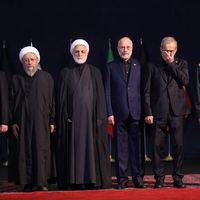
The state answered with the familiar theater of mourning: coffins, black flags, portraits, clerics and commanders. The message was continuity.
But after Raisi, the funerals began to tell another story. One by one, they marked not continuity, but exposure: a system losing the people, places and networks that had made it feel protected.
Former Supreme Leader Ali Khamenei leading the funeral prayer at the coffin of Ebrahim Raisi and other officials killed in the crash
His death forced a snap election. Masoud Pezeshkian, a reformist in tone, won the presidency after a first round marked by record-low turnout. The system gained a softer face, but not a new center of power.
Then came the first great humiliation of the post-Raisi era.
Ismail Haniyeh, Hamas’s political leader, came to Tehran for Pezeshkian’s inauguration. Hours later, he was killed in the Iranian capital.
This was not only the killing of a Hamas leader. It was a message that even the patron’s capital was no sanctuary.
That became the sentence for what followed.
In September 2024, Hezbollah’s pagers and radios exploded across Lebanon and Syria, turning the group’s own communications into weapons against it. Days later, Hassan Nasrallah was killed in Beirut.
A movement built on secrecy and underground command had been pierced from inside and struck from above.
Then Hamas leader in Gaza Yahya Sinwar was killed. Hamas remained, Hezbollah remained, the slogans remained. But the axis was bleeding leaders, territory, routes and confidence.
The deeper break came in Syria.
Bashar al-Assad’s fall in December 2024 was not just the loss of another Islamic Republic's ally. It damaged the geography of Iranian power: the route to Hezbollah, the Mediterranean opening, and the Qasem Soleimani-era claim that weak states could be turned into Iranian depth.
Israel struck Iranian nuclear and military sites during the 12-Day War. The United States then hit the most fortified parts of the nuclear program.
For years, nuclear ambiguity had been Tehran’s shield. In 2025, it became a battlefield.
Outside pressure then met the inside front.
The protests that erupted in late 2025 and early 2026 were driven by economic collapse, repression and the old demand for a different political order. By January 8 and 9, the state answered with mass violence and an internet shutdown.
The Islamic Republic could still shoot, jail and terrify. But it could no longer persuade enough of its own people that it had a future.
Even shocks beyond the Middle East began to feel part of the same weather. The US capture of Venezuelan President Nicolás Maduro in January 2026 mattered less as an Iran story than as an atmosphere: another anti-American ruler, once protected by sovereignty and distance, suddenly exposed.
Then, on February 28, 2026, the war reached the institution at the heart of the Islamic Republic’s power: the supreme leadership.
Ali Khamenei was killed in US-Israeli strikes. For a state built around velayat-e faqih, this was not only the death of a ruler. It was the breaking of an aura.
Mojtaba Khamenei was named Supreme Leader days later. The appointment was meant to project continuity. Instead, it made the Islamic Republic look smaller, more closed and more dynastic.
The revolution born against monarchy had passed its highest office from father to son in wartime.
The funeral that has not happened
And then came the strangest funeral of all: the one that could not settle itself.
Iran postponed Khamenei’s state funeral. Months later, even his burial remained unclear. For a Shiite revolutionary state that has always known how to turn death into power, the delay was astonishing.
The republic of funerals had lost command of its most important ritual.
The old model had four layers. At home, fear contained society. In politics, elections gave the state a civilian mask. In the region, proxies kept enemies away from Iran’s borders. At the strategic level, missiles, nuclear ambiguity and the Strait of Hormuz made the cost of attack seem unknowable.
Since Raisi’s crash, every layer has been damaged.
Fear has produced revolt. Elections have exposed emptiness more than legitimacy. Regional depth has been penetrated. Syria has fallen away. Hezbollah and Hamas have been battered. The supreme leader’s office has lost its aura of untouchability.
Hormuz remains Iran’s strongest card. But it also shows the trap. The strait gives Tehran leverage over oil, shipping and global markets; it also keeps Iran at the center of a crisis it cannot easily end.
This is not the story of a regime that has already fallen. The Islamic Republic still has prisons, missiles, commanders and a long memory for survival.
But it is also not the story Tehran wants to tell.
Two years ago, Raisi’s death was wrapped in the language of martyrdom and continuity. The state said nothing vital had been lost.
Yet what followed revealed how little room the Islamic Republic had left for error.
The crash did not start the chain. October 7 had already started the clocks. But Raisi’s death gave the years after it their image: fog, poor visibility, a convoy losing contact, and a state insisting the road ahead was clear.
Two years later, Iran is still falling through that fog.
The question is no longer whether the Islamic Republic can survive another crisis. It has survived many.
The question is whether it can survive the loss of the things that made survival possible: distance, fear, succession, sanctuary and the belief that time was on its side.
File photo shows a dentist treating a patient at a clinic in Iran, where rising inflation and declining purchasing power have made dental care increasingly unaffordable for many families.
Dental treatment costs in Iran have surged in recent months, with industry officials warning that inflation and rising import costs are pushing basic care beyond the reach of many households.
Prices for some dental implants have nearly doubled over the past few months, according to Farid Hashemnejad, head of the Iranian Dental Technicians Association, who said clinics and laboratories are struggling to absorb mounting costs while maintaining service quality.
“Some implant procedures that previously cost around 300 million rials (around $165) are now almost twice as expensive,” Hashemnejad told Rouydad24 on Monday. “In some areas, raw material prices have risen by up to 100%.”
Dental care in Iran has long received limited support from the social security system, leaving most patients to cover major treatment costs themselves. The latest increases add pressure to households, already grappling with years of inflation and declining purchasing power.
Hashemnejad said imported materials used in dentistry and dental laboratories have become significantly more expensive in recent months, although severe shortages have not yet fully emerged because clinics are still relying on older inventories.
“So far, serious shortages are not being felt because existing stock is still being used,” he said. “But with some items becoming more difficult to obtain, more problems may appear in the coming months.”
Iran, he said, remains heavily dependent on imported dental materials sourced mainly from China, along with Turkey, Japan, South Korea and several European countries.
While domestic production has improved in recent years, Hashemnejad said Iranian-made materials still cannot fully replace imported products across specialized fields.
“We would also prefer to depend less on imports, but the reality is that most of the materials we need are still imported,” he said.
File photo from a dental clinic in Iran, where soaring prices and economic pressure have left many unable to afford routine dental treatment.
According to Hashemnejad, prices for some imported materials used in removable dental treatments and laminate procedures have risen between 80% and 90%, while resin and acrylic materials used in prosthetic work have also recorded sharp increases.
Patients shift toward lower-cost care
The rise in prices is also changing treatment choices, with many patients abandoning implant-based procedures or internationally recognized brands in favor of cheaper alternatives.
“Naturally, when costs increase, the number of patients also declines,” Hashemnejad said. “This directly affects clinics and dental laboratories.”
He warned that continued price increases could eventually push part of the population out of the dental care market entirely, creating further strain for healthcare providers already facing weaker demand and higher operating costs.