Iran cuts oil output as US blockade strains storage - BBG
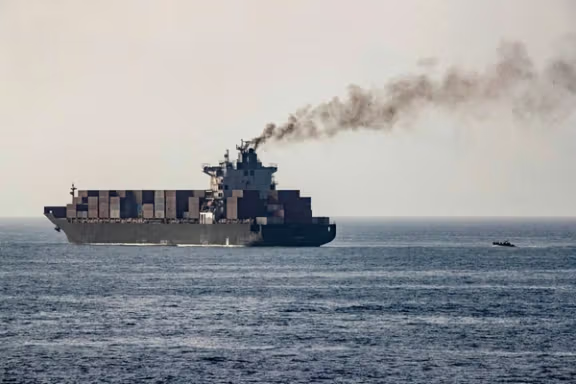
US forces patrol near the Iranian-flagged cargo ship M/V Touska after it was boarded and seized by US forces at a location given as the Arabian Sea.
Iran has begun curbing oil production as the US naval blockade tightens around its oil trade, with exports plunging, storage filling and tankers gathering near the country’s main export hub, Bloomberg reported.
The blockade, which took effect on April 13, has left Tehran trying to manage a pressure campaign aimed at its most important source of revenue. Bloomberg said the war has entered a stalemate, with Washington betting that lost oil revenue will force Iran to yield and Tehran betting it can outlast the economic pain and keep global energy prices elevated.
A senior Iranian official told Bloomberg that Tehran is proactively reducing crude output to stay ahead of storage limits rather than waiting for tanks to fill completely. The official said the move could affect as much as 30% of Iran’s oil reservoirs, but argued the risks were manageable because Iranian engineers have years of experience idling and restarting wells under sanctions.
“We have enough expertise and experience,” said Hamid Hosseini, a spokesman for the Iranian Oil, Gas and Petrochemical Products Exporters’ Association. “We’re not worried.”
Bloomberg said Iran’s oil sector had remained resilient before the blockade, producing about 3.2 million barrels a day in March, with exports close to prewar levels. But the current blockade is different from earlier sanctions pressure because the US is physically trying to block waters around the Strait of Hormuz, stranding tens of millions of barrels at sea.
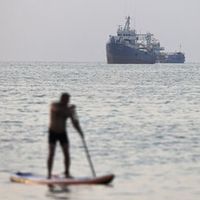
Since the blockade began, Iran has increasingly turned to floating storage. Bloomberg said aging and in some cases derelict tankers have gathered near Kharg Island, Iran’s main export terminal in the Persian Gulf.
US Treasury Secretary Scott Bessent said this week that Kharg Island was “soon nearing capacity,” warning that the pressure could cost Iran about $170 million a day in lost revenue and force Tehran toward negotiations.
“It looks like there’s been a significant slowdown in production,” Antoine Halff, co-founder and chief analyst at Kayrros, said on a conference call. “There is stress in the system.”
If storage fills completely, Iran would have little choice but to cut production by the amount it can no longer export. Based on prewar domestic consumption of about 2 million barrels a day, Bloomberg said that could leave fields operating at roughly half their potential.
Iran could try to move some oil overland to Turkey, Pakistan, Afghanistan and Uzbekistan, Hosseini said, but he put that capacity at only 250,000 to 300,000 barrels a day.
Other options, including rail shipments of some oil products to China, may be difficult and less economical. Bloomberg added that Chinese “teapot” refineries rely on discounted crude and thin margins, while the U. Treasury has also imposed new sanctions on individuals and networks tied to Iran’s “shadow banking” system, including buyers linked to those refineries.
Analysts said Iran still has tools to keep parts of the system running. Vortexa estimates Iran has access to 65 million to 75 million barrels of floating storage capacity, equivalent to roughly 37 very large crude carriers, both inside and outside the blockade.
That capacity may buy Tehran time, but how much depends on how strictly the US enforces the blockade.
Claire Jungman, director of maritime risk and intelligence at Vortexa, told Bloomberg that Iran’s use of floating storage, ship-to-ship transfers and older tankers means its system has not fully broken.
“This allows flows to continue in the near term, even under tighter enforcement,” she said. “We would frame this as a constrained but functioning system, rather than a full disruption.”
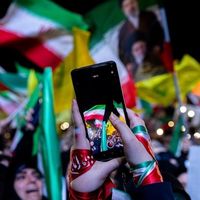
People hold Islamic Republic and Revolutionary Guards flags during a pro-government rally in Tehran, Iran, April 29, 2026.
The most important question in Tehran may also be the one least possible to answer with confidence: who is making decisions?
Months before Ali Khamenei was killed, Masoud Pezeshkian warned of the danger that would follow if anything happened to the supreme leader. “Then we would fight among ourselves,” he said. “Israel would not even need to come.” That warning now reads less like a passing warning than a map of the crisis facing Tehran.
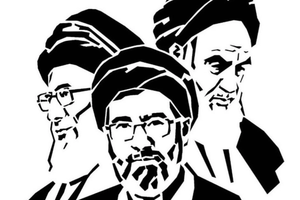
Since the killing of Ali Khamenei and the wartime rise of his son Mojtaba, Iran’s system has not collapsed. Nor has it become transparent. What appears to have emerged is a less centralized, more militarized and more opaque order: its old arbiter is gone, its new leader is unseen, and rival camps are testing how far they can move without breaking the Islamic Republic they all want to preserve.
No one outside Iran’s innermost circle can know exactly who is making decisions. But the visible signs point to a system divided more over tactics than survival. The familiar split between “hardliners” and “moderates” may capture some real tensions, but it can also serve as a useful false dichotomy – for Tehran, for foreign governments and, most dangerously, against the Iranian public.
For ordinary Iranians, the question is not whether one faction speaks more softly than another. The deeper point is that the same system still controls war, repression, public life and the limits of political choice. The names may shift; the method endures.
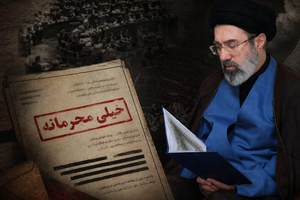
On paper, Mojtaba Khamenei is Iran’s Supreme Leader. In practice, he has not yet performed the role his father played for decades: appearing publicly, speaking directly, ending factional arguments and signaling the final line of the state.
That absence matters, but it should not be overstated. Mojtaba may still be consulted or asked to formally approve decisions. The more important point is that power appears to have moved into a harder-to-see structure: a security-led order shaped by overlapping circles that compete, cooperate and distrust one another.
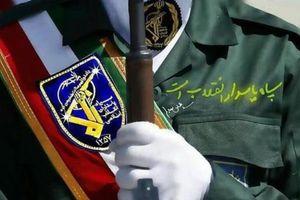
The Guards blocked presidential appointments, including Pezeshkian’s effort to name a new intelligence minister, while Ahmad Vahidi, the IRGC commander and a central figure in the current security order, insisted that sensitive posts be selected and managed directly by the Guards under wartime conditions.
Sources also said Pezeshkian repeatedly sought an urgent meeting with Mojtaba but received no response, while a “military council” of senior IRGC officers enforced a security cordon around the new Supreme Leader and prevented government reports from reaching him.
But the IRGC should not be treated as one simple faction. Almost every major actor in the current crisis has some link to the Guards, the war generation, the security apparatus or the Supreme Leader’s office. The useful distinction is not “IRGC versus civilians,” but the different circles now competing over how the system survives.
One circle is the older intelligence-security network around Mojtaba. It includes figures such as Hossein Taeb, the former head of the IRGC Intelligence Organization, and Mohammad Ali Jafari, the former IRGC commander. Mojtaba’s old ties to the Habib Battalion from the Iran-Iraq War matter because they helped create personal links with men who later rose through intelligence, security and repression structures. This is less a formal faction than a network of trust built over decades.
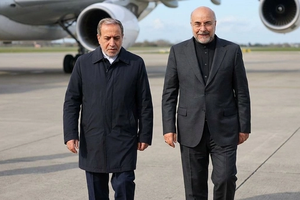
Another circle is closer to the negotiation-facing track. It includes Pezeshkian, Parliament Speaker Bagher Ghalibaf, and Foreign Minister Abbas Araghchi.
Their relative openness to talks may make them more flexible tactically, but not “moderates” in any democratic sense. They operate inside the Islamic Republic’s security logic. But they have been more visibly tied to keeping a diplomatic channel open with Washington and trying to turn pressure into some form of agreement.
A third circle appears closer to direct military and security decision-making. Vahidi is the key figure here, followed by Mohammad Bagher Zolghadr, a former senior IRGC commander now heading the Supreme National Security Council.
Other security-state figures – including former police chief Esmail Ahmadi Moghaddam, former defense minister Amir Hatami, police chief Ahmadreza Radan and judiciary chief Gholam-Hossein Mohseni-Ejei – are often seen as closer to this coercive order than to the negotiation-facing track.
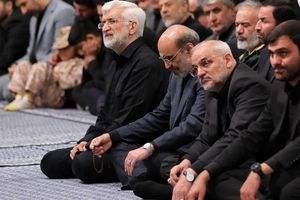
A fourth circle is the ideological pressure camp around Saeed Jalili, the former nuclear negotiator and ultrahardline security figure; Hamid Rasaei, Amirhossein Sabeti and Mohammad Nabavian, hardline lawmakers; and Sadegh Mahsouli, a key patron of the Paydari current. This camp is especially hostile to talks with Washington. Its role in the current crisis is to define compromise as betrayal, attack negotiators and claim to defend the Supreme Leader’s red lines.
These are not clean factions. Their members overlap, and their positions can shift. All appear invested in the survival of the Islamic Republic. What differs is their method: tactical negotiation, coercive escalation, ideological discipline, or some combination of the three.
The best reading is not a name, but a map of relationships.
The dispute over talks with the United States has made those networks visible.
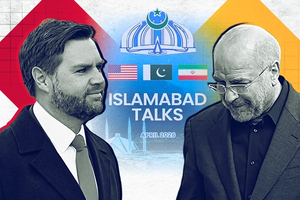
Iran International reported on April 10 that senior officials were divided over the authority of the delegation set to negotiate with Washington in Islamabad.
Sources said Vahidi wanted to curb the authority of Ghalibaf, the parliament speaker and former IRGC commander who had led the negotiating team, and Araghchi, the foreign minister. Vahidi also wanted Zolghadr included in the team and sought to prevent any negotiation over Iran’s missile program.
The dispute widened as the talks faltered. Sources told Iran International on April 23 that a delegation was ready to leave for further talks when a message from Mojtaba’s inner circle ruled out discussion of nuclear issues and reprimanded the foreign ministry team over earlier negotiations. Araghchi warned that attending under such constraints would serve no purpose.
A day later, sources said Ghalibaf stepped down as head of the negotiating team after being reprimanded for trying to include the nuclear issue in talks. Araghchi then traveled to Islamabad alone to deliver Tehran’s proposal, which was later rejected by Trump, according to media reports.
The latest signs point to an even messier picture. Two sources familiar with the matter told Iran International that Pezeshkian and Ghalibaf are now seeking Araghchi’s removal, accusing him of acting less like a cabinet minister and more like an aide to Vahidi. The sources said Araghchi had coordinated with the IRGC commander over the past two weeks without properly informing the president.
That is an important turn. It suggests the rift is not simply between “negotiators” and “hardliners.” Even figures associated with the diplomatic track are accusing one another of serving the security command.
The public signs have been just as revealing. Ghalibaf defended indirect talks after hardline critics accused him of betrayal and even hinted at a coup. He framed diplomacy not as retreat, but as another front in the conflict – a way to turn military gains into political outcomes.
Iran International later learned that Ghalibaf went further in a private meeting, describing figures including Jalili and Sabeti as extremist militia-like actors who would destroy Iran. He accused them of using state television and mobilized hardline supporters to intensify opposition to negotiations.
Tasnim, a news agency linked to the IRGC, republished an editorial mocking maximalist demands for a deal, including full sanctions removal and a comprehensive ceasefire with Iran’s regional allies, as a fantasy akin to expecting a “magic beanstalk.” Raja News, close to Jalili’s camp, accused Tasnim of weakening the Supreme Leader’s red lines and repeating the path that led to the nuclear deal it calls “pure damage.”
Tasnim removed the article but hit back sharply, accusing Raja News of sowing division and helping complete Trump’s project in Iran. It also referred to arrests over “suspicious movements to undermine sacred unity.”
That language is not routine factional criticism. It shows a fight inside the revolutionary camp over who gets to define loyalty, who can speak for the leader, and who will be blamed if talks fail or concessions become unavoidable.
The rift is real, but it should not be mistaken for an opening.
It is not a contest between democrats and authoritarians. It is not proof that Iran has a liberal faction waiting to be empowered. It is not even a simple split between the IRGC and the civilian state, because the so-called civilian figures operate inside a system shaped by the Guards, the Supreme Leader’s office and the security state.
The split is between factions of the Islamic Republic arguing over how best to preserve the system.
From Washington, Marco Rubio made a similar point. “They’re all hardliners in Iran,” the US secretary of state told Fox News. But he drew a distinction between hardliners who understand they still have to run a country and an economy, and those “completely motivated by theology.”
Rubio described the president, foreign minister, parliament speaker and other political officials as hardliners too, but said they also know that “people have to eat” and that the government has to pay salaries. The harder core, he said, includes the IRGC, the Supreme Leader and the council around him. “Unfortunately,” Rubio added, “the hardliners, with an apocalyptic vision of the future, have the ultimate power in that country.”
Trump has used harsher language, saying Iran’s government is “seriously fractured” and that its leaders are struggling to figure out who is in charge. Those remarks should be read both as Washington’s assessment and as part of its pressure campaign.
Tehran answered with a unity slogan that unintentionally made the same point. “There are no hardliners or moderates in Iran; we are all ‘Iranian’ and ‘revolutionary,’” Pezeshkian wrote on X. He added that with “full obedience to the Supreme Leader,” Iran would make the “criminal aggressor” regret its actions.
The same line was then posted by Ghalibaf, Araghchi, Mohseni-Ejei and other senior officials. It was meant to deny division. But for many Iranians, the phrase “Iranian and revolutionary” says something else too: inside the Islamic Republic, political difference still ends where loyalty to the revolution begins.
The better reading is that the Islamic Republic is divided over tactics, not survival; and more militarized, not more moderate. That is where the trap begins: a real rift can still serve a false choice.
A woman wears a badge with a picture of Iran’s new Supreme Leader, Mojtaba Khamenei, during a rally in Tehran, Iran, April 29, 2026.
The false choice: bad, worse and the politics of leverage
The “hardliner versus moderate” frame has always served more than one audience.
For foreign diplomats, it offers a familiar temptation: make a deal with the less bad side before the worse side takes over. For the Islamic Republic, it offers a warning: give us concessions, because the alternative is chaos or escalation. For Iranians, it narrows politics to a suffocating choice: accept this faction, or suffer that one.
Iran’s internal divisions may be real, but the Islamic Republic has long benefited from presenting politics as a choice between bad and worse – a choice that narrows the imagination of both Iranian society and foreign diplomats.
That is the false dichotomy at the center of the current crisis.
The rift is real: there are disputes over talks, nuclear red lines, the negotiating team and how much to concede. But the rift is also distorted: Pezeshkian, Araghchi and Ghalibaf may be more negotiation-facing than Jalili or Nabavian, but they are not outside the system.
And the rift can be useful. A negotiator can point to hardliners to seek concessions. A hardliner can accuse a negotiator of betrayal to raise the cost of compromise. The state can deny division in public while allowing enough ambiguity to make foreign governments wonder who can deliver a deal.
When no one clearly owns the decision, no one clearly owns the consequences. Talks can be authorized, denied, resumed and scrapped. A delegation can be sent, restrained, reprimanded and replaced. The people are then told not to ask who is responsible, because the country is at war and unity is sacred.
Whether spontaneous, managed, or both, the Islamic Republic has repeatedly turned internal factionalism into a political instrument. The public is asked to choose between bad and worse; foreign governments are asked to negotiate with bad to avoid worse.
What the rift does – and does not – change
The immediate consequence is both diplomatic and domestic. Talks become harder to arrange, harder to interpret and harder to trust, while Iranians remain exposed to decisions made by a system they cannot hold accountable.
This does not mean Iran cannot negotiate. It means any deal must survive several internal tests: the security core’s calculation, Mojtaba Khamenei’s formal blessing or silence, ideological backlash, state media narratives and the regime’s fear of looking weak to its own base.
The challenge may not be that Tehran cannot send a negotiator, but that no envoy can easily bind the system behind him.
For Iranians, however, the debate over who rules Tehran is not an abstract puzzle. It is lived through decisions made behind walls: war, economic pressure, repression, the threat of crackdowns on any renewed protest movement, and the shrinking space for public life.
The rival circles now visible in Tehran may disagree over tactics, but they all operate inside a system built to preserve itself before it answers to society.
The Islamic Republic may be less centralized than before, but that does not make it more accountable. It may be more divided in public, but that does not make it more open. It may need diplomacy, but that does not make its negotiators representatives of the people.
The internal map has shifted. The old supreme leader is gone. The new one is unseen. Security networks appear stronger. The ideological camp is louder. Negotiators are more exposed. Rival circles are more willing to wound each other in public.
But for the Iranian people, the core fact has not changed enough. They are still being asked to live with the consequences of decisions they cannot see, made by men who compete for power while agreeing on the survival of a system that denies the public any real power.
Canada's Prime Minister Mark Carney and Foreign Minister Anita Anand
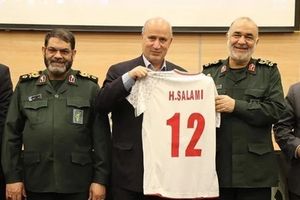
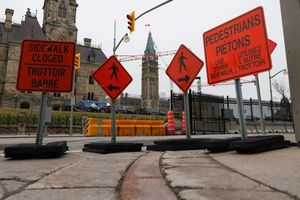
The Canadian opposition has accused the government of bypassing its own rules after Iran International reported that an IRGC-linked Iranian football official was granted special permission to enter the country despite being inadmissible.
Iran International’s reporting was followed by political backlash in Ottawa, international coverage and Mehdi Taj being turned back within hours of landing in Canada.
Speaking to Iran International’s Eye for Iran, Melissa Lantsman, deputy leader of Canada’s Conservative Party, said the case raised serious questions about who approved Mehdi Taj’s entry and why.
“We need to know who did it, when it happened, how it happened, why it happened, and why it’s never going to happen again,” Lantsman said.
Taj, president of Iran’s football federation, had been expected to travel to Vancouver for the FIFA Congress on April 30 at the Vancouver Convention Center.
Iran International previously reported that Taj was issued a Temporary Resident Permit, or TRP, a tool that allows Canadian authorities to admit a person who would otherwise be barred under immigration law.
Canada listed the IRGC as a terrorist entity in 2024, making people linked to the force inadmissible. Taj has longstanding ties to the Islamic Republic’s security establishment and previously served as an intelligence commander in the IRGC in Isfahan.
Lantsman said the permit showed that the issue was not simply a screening failure.
“Somebody actively made this decision to circumvent our own rules,” she said.
“I can’t believe that I work in a place with a minister who would issue a terrorist a permit.”
Taj was able to board a flight to Canada and land in Vancouver. He was sent back within hours, after Iran International’s reporting on the case had already become public.
That sequence has become central to the political fallout in Ottawa. Critics say the government acted only after the case drew public attention, while ministers have declined to discuss details, citing privacy rules.
Lantsman rejected that explanation in the podcast interview.
“We don’t give privacy to terrorists,” she said. “There is no privacy to people who are inadmissible to our country.”
Opposition MPs pressed ministers to explain how a person barred under Canada’s own rules received permission to enter the country.
At Thursday’s meeting of the Standing Committee on Public Safety and National Security in Ottawa, Conservative MP Frank Caputo asked Immigration Minister Lena Diab how a person deemed inadmissible had been granted entry.
Caputo said “the rule of law demands transparency” and asked “who gave him a visa,” saying Iran International’s reporting had brought the case to public attention.
Prime Minister Mark Carney declined to comment on Taj’s case, citing privacy laws, but defended the government’s position on the IRGC.
“Members of the [Iranian] Revolutionary Guard rightly have been prohibited from entering this country and they will not enter this country,” he said.
Foreign Affairs Minister Anita Anand suggested the permit may have been granted and later revoked, saying her understanding was that “there is a revocation of the permission” and that “it was unintentional.”
Lantsman said that response only deepened the need for answers.
“If they unintentionally gave him a permit, then we need to know how that happened and why it happened,” she said. “And if the unintentionality of it was about the revocation, that’s even worse.”
The controversy has turned a single immigration decision into a broader political test of Canada’s handling of officials tied to the Islamic Republic.
Although Canada has formally banned the IRGC, Temporary Resident Permits allow authorities to override inadmissibility in certain cases. Taj’s case has raised questions about how such exceptions are approved and what safeguards exist when national security concerns are involved.
The controversy also comes as anger continues over the Islamic Republic’s crackdown on protests in January, with the IRGC at the center of the state response. Rights groups and Iranian activists have described the violence as among the deadliest episodes in modern Iranian history.
At least three Iranian footballers have been killed during the unrest. Ali Karimi, Iran’s former national team captain, has criticized FIFA’s silence and called on the organization to condemn the killing of athletes and speak out against the crackdown.
Lantsman said the opposition has submitted formal questions in Parliament and would continue pressing the government for details.
“This cannot happen,” she said. “We’re going to continue to keep the pressure on.”
The case has also drawn wider attention beyond Canada. The New York Times, USA Today, Agence France-Presse and The Canadian Press have covered the incident, citing Iran International’s reporting.
For Lantsman, the central issue remains who approved the permit and why.
“Somebody in Canada, somebody very high up in the ministry, decides that it’s in public interest of Canada to have this person here,” she said.
The government has yet to publicly identify who authorized the permit, why it was issued, or what measures are being taken to prevent a similar case.
Iran’s leadership is hardening its stance on the Strait of Hormuz, framing the waterway as a strategic and non-negotiable asset amid rising tensions and US pressure.
Statements have intensified following a message for National Persian Gulf Day attributed to Supreme Leader Mojtaba Khamenei.
In the message, he described the strait as a “strategic asset” and outlined a vision for the region’s future as “a future without America,” emphasizing the importance of “Iranian management of the strait.”
Parliament speaker Mohammad Bagher Ghalibaf signaled the shift most clearly, linking current policy to both strategic doctrine and historical precedent.
“Today as well, by exercising management over the Strait of Hormuz, Iran will ensure that it and its neighbors enjoy the valuable prospect of a future free from the presence and interference of America,” he wrote on X.
In a separate English-language post, he mocked the feasibility of a US naval blockade, sharing a map of the United States and arguing that even drawing walls from coast to coast would still fall short of Iran’s total border length.
“If you build two walls, one from New York to the West Coast and another from Los Angeles to the East Coast, the total length will still be about 1,000 kilometers shorter than Iran’s borders,” he wrote. “Good luck blockading a country with those borders.”
The tougher messaging comes as Washington pursues a strategy of sustained economic pressure, including a naval blockade aimed at restricting Iran’s oil exports. The Strait of Hormuz—through which roughly a fifth of global oil supply passes—has become the central point of confrontation in the standoff.
Reports from US media suggest the Trump administration is seeking international backing for a maritime coalition to secure shipping routes, while also rejecting Iranian proposals to reopen the strait as part of interim negotiations.
Masoud Foroughi, deputy managing editor of the conservative newspaper Farhikhtegan, described Khamenei’s message as more than routine rhetoric, calling it a “strategic signal” and arguing that it rejects the idea—raised by some in Tehran—that the strait could be used as a bargaining chip.
Other officials struck an even harder line. Deputy parliament speaker Ali Nikzad said the strait “must not return to its previous state,” while describing it as Iran’s “atomic bomb”—a remark underscoring its perceived strategic leverage.
Friday prayer leaders reinforced the message. Ahmad Alamolhoda, the Supreme Leader’s representative in Khorasan-e Razavi, said negotiations with the United States amount to surrender and argued that control over the strait allows Iran to “deal with the world” without talks.
In Tehran, interim Friday prayer leader Mohammad-Javad Haj Ali-Akbari said the Persian Gulf and the Strait of Hormuz are not only non-negotiable but will operate under a “new legal regime” shaped by Iran and regional partners.
Yet the rhetoric has not been entirely uniform, and diplomatic contacts have not entirely ceased.
Iran’s state news agency IRNA reported that Tehran submitted a new proposal to the United States via a Pakistani intermediary this week, underscoring the dual track of pressure and limited engagement.
President Masoud Pezeshkian also struck a more measured tone, warning against the continuation of a blockade while reaffirming Iran’s commitment to freedom of navigation and maritime safety—except for hostile countries.
“Any effort to impose a naval blockade or maritime restrictions in the Persian Gulf is contrary to international law and a threat to the interests of regional nations and global peace and stability,” he said, adding that responsibility for any insecurity would lie with the United States and Israel.
Even as some voices warn of the risks of prolonged confrontation, the dominant message from Tehran’s political, clerical and media circles is that control over the strait is a red line rather than a negotiating tool.
That stance suggests that, despite mounting economic and military pressure, Tehran is seeking to redefine the Strait of Hormuz not as leverage—but as a fixed pillar of its regional strategy.
Rising prices for essential goods, inflation above 73%, and a surging dollar amid a fragile “no war, no peace” environment, US naval pressure, and political divisions have heightened concerns among some officials about internal instability.
Iran’s Parliament Speaker Mohammad Bagher Ghalibaf warned in a radio message on Wednesday that the United States had entered a new phase of the war to weaken Iran from within, or even make it collapse, through economic pressure, media campaigns, and a naval blockade.
Ghalibaf’s warning reflected a broader concern among political observers inside Iran that a prolonged naval blockade could impose escalating costs and, over time, prove more damaging than a direct military conflict.
Economic dissatisfaction is increasingly visible across media and social networks. Even before the recent conflict, rising economic pressures—reflected in the sharp increase in the dollar—had already driven days of protests and an exceptionally bloody crackdown in cities across the country. Those pressures have since intensified.
International affairs analyst Ali Bigdeli described the social climate in an interview with Khabar Online: “People are in an exhausting situation. At the societal level, signs of fatigue and restlessness are completely evident.”
He warned that a US naval blockade could be more dangerous than war itself and argued that authorities should move quickly toward negotiations with Washington, showing flexibility—even if that means temporarily halting parts of Iran’s nuclear program. “Ultimately, if no concessions are given to the United States, more complex internal social and political consequences may arise,” he added.
One reader commented: “I constantly have the feeling that people might pour into the streets soon—because of rising prices, internet shutdowns, and unemployment. Send this article to Mr. Ghalibaf so they move faster on reaching a deal; otherwise, things could turn.”
Risk of losing core supporters
Among government supporters, the current ceasefire period is described as a “war of resilience.” However, some warn that worsening economic conditions could erode the loyalty of core supporters—often referred to by conservatives as “The Street”—who backed the Islamic Republic during the conflict, while undecided “gray” segments of society may shift toward opposition.
Conservative figure Ali Gholhaki wrote that the war has entered a new phase, pointing to sharp increases in car prices, surging housing costs despite security risks, and rising currency and gold prices as signs of negative developments:
“The economic phase of the war is an essential part of the war itself. A new plan must be devised before the ‘street’ is lost!”
A user on X expressed similar concerns: “These days my fear is that the patience of the gray class will run out and, God forbid, we may experience another street conflict—even with revolutionary supporters present.”
Post-war economy under pressure
The fears are being amplified by a series of post-ceasefire indicators showing pressure spreading from prices and currency markets to employment.
According to the Statistical Center of Iran, the consumer price index rose 5% in Farvardin (March–April) compared to the previous month, reaching 73.5% year-on-year—over five percentage points higher than figures reported by the Central Bank of Iran earlier this week.
After a period of relative stability with the dollar below 1,600,000 rials, the exchange rate in the informal market rose to around 1,820,000 rials on April 30. While fears of renewed conflict played a role, rising inflation is also a key driver, analysts say.
Unemployment has surged sharply. A deputy labor minister said the 40-day war left 2 million people jobless. However, labor activist Hamid Haj Esmaeili estimates that including informal sectors and digital platforms, the real figure could be between 3 and 4 million.
The war has also disproportionately affected women’s employment. Zahra Behrouz Azar recently stated that nearly one-third of unemployment insurance claims filed over the past 40 days were submitted by women. Given their lower participation in formal employment, she described the figure as significant, noting it indicates a higher rate of women exiting the labor market—many of whom are heads of households.
According to new estimates by the International Monetary Fund, Iran’s economy is expected to contract by 6.1% due to the war, potentially leading to further unemployment and deepening poverty.
Expanding poverty and social risks
As inflation and unemployment rise, more Iranians are falling below the absolute poverty line. The head of Iran’s Welfare Organization reported in January that the population living in absolute poverty has doubled since 2018, reaching 44% (around 35 million people), with an additional 4 million experiencing extreme poverty.
Economic analyst Majid Goudarzi warned that if current trends continue, Iran could face “a combination of widespread unemployment, declining purchasing power, and rising poverty that will be very difficult to manage.”
People inspect the site of a residential building damaged by a strike, amid the US-Israeli conflict with Iran, in Karaj, Iran, April 3, 2026.
Dozens of residents in Tehran displaced by a 40-day war with the US and Israel said municipal authorities ordered them to vacate temporary hotel housing despite unsafe homes and limited aid, according to interviews published by Etemad newspaper on Thursday.
Several of those affected said they were told to leave by the end of the week after calls from Tehran’s crisis management body, even though official inspections had deemed their homes uninhabitable.
“I was told I had to leave the hotel by the end of the week, even though my home is unsafe and I have nowhere to go,” one resident said, describing a call from a municipal official who noted reconstruction had not begun due to lack of funds.
People inspect the site of a residential building damaged by a strike, amid the US-Israeli conflict with Iran, in Karaj, Iran, April 3, 2026.
Unsafe homes, no rental support
A resident, who lived in a seventh-floor apartment damaged by a nearby missile strike in March, described shattered windows and debris that rendered both the unit and building access unusable. Emergency services later confirmed the structure was unsafe.
Despite this, the resident said no rental assistance or deposit support had been offered. “They told me I should find housing myself because there is no budget,” the resident added.
Other displaced residents reported receiving similar instructions. Many said they lacked the financial means to rebuild or secure new housing, leaving them at risk of homelessness.
Under earlier municipal pledges, affected households were to receive temporary accommodation, rental support, and reconstruction assistance.
Updated figures increased aid for household goods to 4 billion rials (about $2,200), rental deposits to 20 billion rials (about $11,000), and monthly rent support to 400 million rials (about $220).
However, residents said these commitments have not been consistently fulfilled.
Average income in Iran is around $150 to $200 per month, while the minimum wage is typically below $100.
Civilians react on a street as tensions rise during the US–Israeli conflict with Iran, with one man speaking on the phone while others look on in concern.
Delays and conditions on compensation
Some families whose homes were destroyed said they were instructed to pay for basic household items upfront and submit receipts for reimbursement, which could take up to 10 months.
Others said even smaller grants had limited impact. One resident who received 2.5 billion rials (about $1,400) said it was insufficient to replace essential items such as a refrigerator, stove, and bedding.
“We lost everything in the strike and could not even recover clothes,” the resident said. “With that money, we could only buy a few basic items.”
In some cases, families forced to leave hotels reported moving into improvised spaces. One household said they had lived for months in a 30-square-meter storage room after being unable to afford rent.
Residents with damaged vehicles described similar difficulties in seeking compensation. Several said they were told by representatives of insurance that earlier claims from a previous conflict in June had not yet been settled.
“They told me there is no timeline for paying these damages,” one vehicle owner said after visiting an insurance office.
Official figures show that thousands of vehicles and tens of thousands of residential units were damaged in the 40-day conflict, adding to earlier destruction from a previous 12-day escalation in June.
A man inspects a car buried under rubble inside a damaged building following strikes during the US–Israeli conflict with Iran.
City council response highlights gaps
A spokesperson for Tehran’s city council acknowledged reports of inconsistencies and said cases of forced eviction without support should be reviewed.
“This should not happen, and if such cases exist, they must be followed up,” Alireza Nadali said, adding that municipal policy ties the end of hotel stays to securing alternative housing.
The official also pointed to the scale of damage and budget constraints, adding that assistance programs were introduced voluntarily and may face delays.
At the same time, the council emphasized that reconstruction responsibilities differ depending on the level of damage and local planning rules, which has led to varied outcomes across districts.
The accounts raise questions about the oversight role of the city council and the implementation of municipal commitments. Residents interviewed said many promises remained unfulfilled months after the initial damage.
Efforts to obtain direct comment from municipal crisis officials were unsuccessful, according to the report.