• العربية
  • فارسی
Brand
  • Iran Insight
  • Politics
  • Economy
  • Analysis
  • Special Report
  • Opinion
  • Podcast
  • Iran Insight
  • Politics
  • Economy
  • Analysis
  • Special Report
  • Opinion
  • Podcast
  • Theme
  • Language
    • العربية
    • فارسی
  • Iran Insight
  • Politics
  • Economy
  • Analysis
  • Special Report
  • Opinion
  • Podcast
All rights reserved for Volant Media UK Limited
volant media logo
INSIGHT

Tehran hardens stance on Hormuz as ‘non-negotiable’

Maryam Sinaiee
Maryam Sinaiee

Iran International

May 2, 2026, 07:31 GMT+1

Iran’s leadership is hardening its stance on the Strait of Hormuz, framing the waterway as a strategic and non-negotiable asset amid rising tensions and US pressure.

Statements have intensified following a message for National Persian Gulf Day attributed to Supreme Leader Mojtaba Khamenei.

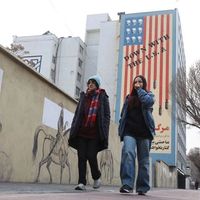
In the message, he described the strait as a “strategic asset” and outlined a vision for the region’s future as “a future without America,” emphasizing the importance of “Iranian management of the strait.”

Parliament speaker Mohammad Bagher Ghalibaf signaled the shift most clearly, linking current policy to both strategic doctrine and historical precedent.

“Today as well, by exercising management over the Strait of Hormuz, Iran will ensure that it and its neighbors enjoy the valuable prospect of a future free from the presence and interference of America,” he wrote on X.

In a separate English-language post, he mocked the feasibility of a US naval blockade, sharing a map of the United States and arguing that even drawing walls from coast to coast would still fall short of Iran’s total border length.

“If you build two walls, one from New York to the West Coast and another from Los Angeles to the East Coast, the total length will still be about 1,000 kilometers shorter than Iran’s borders,” he wrote. “Good luck blockading a country with those borders.”

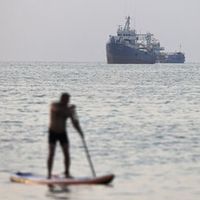
The tougher messaging comes as Washington pursues a strategy of sustained economic pressure, including a naval blockade aimed at restricting Iran’s oil exports. The Strait of Hormuz—through which roughly a fifth of global oil supply passes—has become the central point of confrontation in the standoff.

Reports from US media suggest the Trump administration is seeking international backing for a maritime coalition to secure shipping routes, while also rejecting Iranian proposals to reopen the strait as part of interim negotiations.

Masoud Foroughi, deputy managing editor of the conservative newspaper Farhikhtegan, described Khamenei’s message as more than routine rhetoric, calling it a “strategic signal” and arguing that it rejects the idea—raised by some in Tehran—that the strait could be used as a bargaining chip.

Other officials struck an even harder line. Deputy parliament speaker Ali Nikzad said the strait “must not return to its previous state,” while describing it as Iran’s “atomic bomb”—a remark underscoring its perceived strategic leverage.

Friday prayer leaders reinforced the message. Ahmad Alamolhoda, the Supreme Leader’s representative in Khorasan-e Razavi, said negotiations with the United States amount to surrender and argued that control over the strait allows Iran to “deal with the world” without talks.

In Tehran, interim Friday prayer leader Mohammad-Javad Haj Ali-Akbari said the Persian Gulf and the Strait of Hormuz are not only non-negotiable but will operate under a “new legal regime” shaped by Iran and regional partners.

Yet the rhetoric has not been entirely uniform, and diplomatic contacts have not entirely ceased.

Iran’s state news agency IRNA reported that Tehran submitted a new proposal to the United States via a Pakistani intermediary this week, underscoring the dual track of pressure and limited engagement.

President Masoud Pezeshkian also struck a more measured tone, warning against the continuation of a blockade while reaffirming Iran’s commitment to freedom of navigation and maritime safety—except for hostile countries.

“Any effort to impose a naval blockade or maritime restrictions in the Persian Gulf is contrary to international law and a threat to the interests of regional nations and global peace and stability,” he said, adding that responsibility for any insecurity would lie with the United States and Israel.

Even as some voices warn of the risks of prolonged confrontation, the dominant message from Tehran’s political, clerical and media circles is that control over the strait is a red line rather than a negotiating tool.

That stance suggests that, despite mounting economic and military pressure, Tehran is seeking to redefine the Strait of Hormuz not as leverage—but as a fixed pillar of its regional strategy.

Most Viewed

Pezeshkian, Ghalibaf seek Araghchi’s ouster over 'subservience' to Guards
1
EXCLUSIVE

Pezeshkian, Ghalibaf seek Araghchi’s ouster over 'subservience' to Guards

2
INSIGHT

Economics may decide outcome of Iran-US standoff

3
INSIGHT

How the Taliban tilted toward Iran during wartime tensions

4

US forms new coalition to secure Hormuz, asks partners to join

5

Tehran residents face eviction from hotels after war damage

Banner
Banner

Spotlight

  • Tehran hardens stance on Hormuz as ‘non-negotiable’
    INSIGHT

    Tehran hardens stance on Hormuz as ‘non-negotiable’

  • Iran war cannot end with Revolutionary Guards still in control
    OPINION

    Iran war cannot end with Revolutionary Guards still in control

  • Economics may decide outcome of Iran-US standoff
    INSIGHT

    Economics may decide outcome of Iran-US standoff

  • Ottawa on defensive after Iran football chief linked to IRGC entered Canada
    EXCLUSIVE

    Ottawa on defensive after Iran football chief linked to IRGC entered Canada

  • Soaring prices push medicine beyond Iranians' reach

    Soaring prices push medicine beyond Iranians' reach

  • Tehran is pricing out its daughters
    TEHRAN INSIDER

    Tehran is pricing out its daughters

•
•
•

More Stories

Iran faces internal instability fears as US blockade tests regime loyalists

May 1, 2026, 19:33 GMT+1
•
Maryam Sinaiee

Rising prices for essential goods, inflation above 73%, and a surging dollar amid a fragile “no war, no peace” environment, US naval pressure, and political divisions have heightened concerns among some officials about internal instability.

Iran’s Parliament Speaker Mohammad Bagher Ghalibaf warned in a radio message on Wednesday that the United States had entered a new phase of the war to weaken Iran from within, or even make it collapse, through economic pressure, media campaigns, and a naval blockade.

Ghalibaf’s warning reflected a broader concern among political observers inside Iran that a prolonged naval blockade could impose escalating costs and, over time, prove more damaging than a direct military conflict.

Economic dissatisfaction is increasingly visible across media and social networks. Even before the recent conflict, rising economic pressures—reflected in the sharp increase in the dollar—had already driven days of protests and an exceptionally bloody crackdown in cities across the country. Those pressures have since intensified.

International affairs analyst Ali Bigdeli described the social climate in an interview with Khabar Online: “People are in an exhausting situation. At the societal level, signs of fatigue and restlessness are completely evident.”

He warned that a US naval blockade could be more dangerous than war itself and argued that authorities should move quickly toward negotiations with Washington, showing flexibility—even if that means temporarily halting parts of Iran’s nuclear program. “Ultimately, if no concessions are given to the United States, more complex internal social and political consequences may arise,” he added.

One reader commented: “I constantly have the feeling that people might pour into the streets soon—because of rising prices, internet shutdowns, and unemployment. Send this article to Mr. Ghalibaf so they move faster on reaching a deal; otherwise, things could turn.”

Risk of losing core supporters

Among government supporters, the current ceasefire period is described as a “war of resilience.” However, some warn that worsening economic conditions could erode the loyalty of core supporters—often referred to by conservatives as “The Street”—who backed the Islamic Republic during the conflict, while undecided “gray” segments of society may shift toward opposition.

Conservative figure Ali Gholhaki wrote that the war has entered a new phase, pointing to sharp increases in car prices, surging housing costs despite security risks, and rising currency and gold prices as signs of negative developments:

“The economic phase of the war is an essential part of the war itself. A new plan must be devised before the ‘street’ is lost!”

A user on X expressed similar concerns: “These days my fear is that the patience of the gray class will run out and, God forbid, we may experience another street conflict—even with revolutionary supporters present.”

Post-war economy under pressure

The fears are being amplified by a series of post-ceasefire indicators showing pressure spreading from prices and currency markets to employment.

According to the Statistical Center of Iran, the consumer price index rose 5% in Farvardin (March–April) compared to the previous month, reaching 73.5% year-on-year—over five percentage points higher than figures reported by the Central Bank of Iran earlier this week.

After a period of relative stability with the dollar below 1,600,000 rials, the exchange rate in the informal market rose to around 1,820,000 rials on April 30. While fears of renewed conflict played a role, rising inflation is also a key driver, analysts say.

Unemployment has surged sharply. A deputy labor minister said the 40-day war left 2 million people jobless. However, labor activist Hamid Haj Esmaeili estimates that including informal sectors and digital platforms, the real figure could be between 3 and 4 million.

The war has also disproportionately affected women’s employment. Zahra Behrouz Azar recently stated that nearly one-third of unemployment insurance claims filed over the past 40 days were submitted by women. Given their lower participation in formal employment, she described the figure as significant, noting it indicates a higher rate of women exiting the labor market—many of whom are heads of households.

According to new estimates by the International Monetary Fund, Iran’s economy is expected to contract by 6.1% due to the war, potentially leading to further unemployment and deepening poverty.

Expanding poverty and social risks

As inflation and unemployment rise, more Iranians are falling below the absolute poverty line. The head of Iran’s Welfare Organization reported in January that the population living in absolute poverty has doubled since 2018, reaching 44% (around 35 million people), with an additional 4 million experiencing extreme poverty.

Economic analyst Majid Goudarzi warned that if current trends continue, Iran could face “a combination of widespread unemployment, declining purchasing power, and rising poverty that will be very difficult to manage.”


Tehran residents face eviction from hotels after war damage

May 1, 2026, 10:06 GMT+1

Dozens of residents in Tehran displaced by a 40-day war with the US and Israel said municipal authorities ordered them to vacate temporary hotel housing despite unsafe homes and limited aid, according to interviews published by Etemad newspaper on Thursday.

Several of those affected said they were told to leave by the end of the week after calls from Tehran’s crisis management body, even though official inspections had deemed their homes uninhabitable.

“I was told I had to leave the hotel by the end of the week, even though my home is unsafe and I have nowhere to go,” one resident said, describing a call from a municipal official who noted reconstruction had not begun due to lack of funds.

People inspect the site of a residential building damaged by a strike, amid the US-Israeli conflict with Iran, in Karaj, Iran, April 3, 2026.
100%
People inspect the site of a residential building damaged by a strike, amid the US-Israeli conflict with Iran, in Karaj, Iran, April 3, 2026.

Unsafe homes, no rental support

A resident, who lived in a seventh-floor apartment damaged by a nearby missile strike in March, described shattered windows and debris that rendered both the unit and building access unusable. Emergency services later confirmed the structure was unsafe.

Despite this, the resident said no rental assistance or deposit support had been offered. “They told me I should find housing myself because there is no budget,” the resident added.

  • War damage amounts to $3,000 per Iranian, with blockade set to add to losses

    War damage amounts to $3,000 per Iranian, with blockade set to add to losses

Other displaced residents reported receiving similar instructions. Many said they lacked the financial means to rebuild or secure new housing, leaving them at risk of homelessness.

Under earlier municipal pledges, affected households were to receive temporary accommodation, rental support, and reconstruction assistance.

Updated figures increased aid for household goods to 4 billion rials (about $2,200), rental deposits to 20 billion rials (about $11,000), and monthly rent support to 400 million rials (about $220).

However, residents said these commitments have not been consistently fulfilled.

Average income in Iran is around $150 to $200 per month, while the minimum wage is typically below $100.

Civilians react on a street as tensions rise during the US–Israeli conflict with Iran, with one man speaking on the phone while others look on in concern. (undated)
100%
Civilians react on a street as tensions rise during the US–Israeli conflict with Iran, with one man speaking on the phone while others look on in concern.

Delays and conditions on compensation

Some families whose homes were destroyed said they were instructed to pay for basic household items upfront and submit receipts for reimbursement, which could take up to 10 months.

Others said even smaller grants had limited impact. One resident who received 2.5 billion rials (about $1,400) said it was insufficient to replace essential items such as a refrigerator, stove, and bedding.

“We lost everything in the strike and could not even recover clothes,” the resident said. “With that money, we could only buy a few basic items.”

In some cases, families forced to leave hotels reported moving into improvised spaces. One household said they had lived for months in a 30-square-meter storage room after being unable to afford rent.

  • War-hit homeowners feel abandoned as Iran’s reconstruction aid fades

    War-hit homeowners feel abandoned as Iran’s reconstruction aid fades

Insurance payouts also stalled

Residents with damaged vehicles described similar difficulties in seeking compensation. Several said they were told by representatives of insurance that earlier claims from a previous conflict in June had not yet been settled.

“They told me there is no timeline for paying these damages,” one vehicle owner said after visiting an insurance office.

Official figures show that thousands of vehicles and tens of thousands of residential units were damaged in the 40-day conflict, adding to earlier destruction from a previous 12-day escalation in June.

A man inspects a car buried under rubble inside a damaged building following strikes during the US–Israeli conflict with Iran. (undated)
100%
A man inspects a car buried under rubble inside a damaged building following strikes during the US–Israeli conflict with Iran.

City council response highlights gaps

A spokesperson for Tehran’s city council acknowledged reports of inconsistencies and said cases of forced eviction without support should be reviewed.

“This should not happen, and if such cases exist, they must be followed up,” Alireza Nadali said, adding that municipal policy ties the end of hotel stays to securing alternative housing.

The official also pointed to the scale of damage and budget constraints, adding that assistance programs were introduced voluntarily and may face delays.

At the same time, the council emphasized that reconstruction responsibilities differ depending on the level of damage and local planning rules, which has led to varied outcomes across districts.

  • War leaves its mark on Iran's cultural heritage

    War leaves its mark on Iran's cultural heritage

Oversight concerns emerge

The accounts raise questions about the oversight role of the city council and the implementation of municipal commitments. Residents interviewed said many promises remained unfulfilled months after the initial damage.

Efforts to obtain direct comment from municipal crisis officials were unsuccessful, according to the report.

Economics may decide outcome of Iran-US standoff

Apr 30, 2026, 22:31 GMT+1
•
Behrouz Turani

The next phase of the Iran–US standoff may be decided not on the battlefield, but by how much economic pressure each side can withstand.

What remains unclear is how that pressure will play out. Will rising fuel prices and market instability in the United States push President Donald Trump toward compromise, or will Iran’s mounting economic strain force Tehran to accept US demands?

"Iran's economy is a disaster. So we'll see how long they hold out," Trump told reporters on Thursday.

In both Iran and the US, political messaging already points toward eventual claims of victory. For ordinary Iranians, however, the only positive outcome is one where their livelihood improves.

Ali Asghar Zargar, a political science professor in Tehran, describes the current moment as “as dangerous as the war itself.” Speaking to the reform-leaning Fararu website, he warned that “when diplomacy collapses, the likelihood of military action increases.”

Still, he noted that despite the lack of progress, “the path to dialogue has not been completely closed.”

Zargar characterized the current state of half-active diplomacy as a safety valve slowing the slide toward open conflict. But he cautioned that “an error on either side can trigger a clash at any moment,” pointing to the volatility of the situation in the Strait of Hormuz.

The two-week ceasefire between Tehran and Washington expired last week, with no clear indication that talks will resume soon.

Iranian diplomatic activity, particularly Foreign Minister Abbas Araghchi’s recent visits to Pakistan, Oman and Russia, has fueled speculation about both renewed negotiations and the possibility of further escalation.

Some Iranian analysts believe another round of US and Israeli strikes cannot be ruled out.

Israeli Defense Minister Israel Katz said on Thursday that Iran has suffered “very severe blows” over the past year and warned that further action may be needed “to ensure the achievement of our goals.”

Also on Thursday, Iran’s parliament speaker and lead negotiator Mohammad Bagher Ghalibaf said Tehran could use its position over the Strait of Hormuz to reshape regional dynamics and reduce US influence.

“Iran, by exercising control over the Strait of Hormuz, will ensure that it and its neighbors enjoy the precious blessing of a future free from the presence and interference of America,” he wrote on X.

Abbas Abdi, a reformist commentator who had largely avoided domestic political writing in recent months, returned this week with a stark assessment: “We are in an exceptional situation where everything is about survival.”

He argued that Iran needs a new framework that prioritizes ending the war above all else.

The economic cost of the standoff is already significant on both sides. Opposition to the war and its financial consequences has grown in the United States, while Trump has claimed Iran is “losing $500 million a day” under the U.S. blockade of the Strait of Hormuz.

As Tehran and Washington test each other’s resilience, distrust continues to deepen. A Fararu analysis described the situation as one of “active suspension”: relations are neither moving toward full confrontation nor showing any clear path to agreement.

For now, both sides appear to be probing how much pressure the other can endure without breaking. But the longer that calculation continues, the greater the risk that economic strain—and a single misstep—could tip the balance toward escalation rather than compromise.

Pezeshkian, Ghalibaf seek Araghchi’s ouster over 'subservience' to Guards

Apr 30, 2026, 19:15 GMT+1

Iran's president and parliament speaker are seeking Foreign Minister Abbas Araghchi’s removal, accusing him of following the Revolutionary Guard chief’s instructions in nuclear talks without informing the president, two sources familiar with the matter told Iran International.

President Masoud Pezeshkian and Speaker Mohammad Bagher Ghalibaf believe Araghchi has in recent weeks acted less as a cabinet minister tasked with implementing government policy and more as an aide to Ahmad Vahidi, the commander of the Revolutionary Guards, the sources said.

According to the sources who are familiar with ongoing discussions between the heads of Iran's executive and legislative branches, Araghchi has acted over the past two weeks without informing Pezeshkian, in full coordination with Vahidi and based on his directives.

The situation has caused deep dissatisfaction for Pezeshkian, who has told people close to him that he will dismiss Araghchi if it continues, the sources said.

Reports of divisions among Islamic Republic officials had previously emerged. On March 28, reports pointed to serious disagreements between Pezeshkian and Vahidi, the Revolutionary Guards commander who is now said to be the most powerful figure in the force.

Informed sources told Iran International at the time that the dispute stemmed from “the handling of the war and its destructive consequences for people’s livelihoods and the country’s economy.”

Three days later, Iran International received reports that Pezeshkian was frustrated at being placed in a “complete political deadlock” and that he had even been stripped of the authority to appoint replacements for government officials killed during the war.

According to that report, Vahidi is said to have explicitly declared that, because of the critical wartime situation, all key and sensitive managerial posts must, until further notice, be directly selected and run by the Revolutionary Guards.

Ghalibaf-led negotiations

On April 27, a group of lawmakers aligned with hardline politician Saeed Jalili declined to sign a parliamentary statement backing Iran’s negotiating team led by Ghalibaf, despite broad support from 261 other MPs.

The statement expressed confidence in the negotiating delegation. However, several prominent hardline figures—including Mahmoud Nabavian, Mohammad Taghi Naqadali, Morteza Aghatehrani, Amirhossein Sabeti, Hamid Rasaei, Ruhollah Izadkhah and Meysam Zohourian—did not sign the statement.

Nabavian was one of the members of the Iranian delegation led by Ghalibaf who attended the first round of Islamabad talks with the United States.

Three days before the statement was published, Iran International reported, citing informed sources in Iran, that Ghalibaf had resigned as head of Iran's negotiating team after being reprimanded over efforts to include the nuclear energy issue in talks.

That report said Araghchi, ahead of his latest trip to Pakistan to deliver the Islamic Republic’s message to Pakistani officials, was seeking to take over leadership of the negotiations following Ghalibaf’s departure.

Araghchi finally visited Islamabad on April 24 alone and handed over Tehran's proposal, which was later rejected by the US president, according to media reports.

How the Taliban tilted toward Iran during wartime tensions

Apr 30, 2026, 10:27 GMT+1

Taliban leaders and affiliated figures voiced support for Iran after Israeli strikes in June 2025 and later US threats, signaling a limited and conditional alignment despite longstanding disputes with Tehran.

Despite a history of sectarian and political friction, recent statements from Taliban officials point to an alignment with the Islamic Republic during a period of heightened regional confrontation.

Differences over border clashes, water rights from the Hirmand (Helmand) River and the treatment of Afghan refugees remain unresolved.

Continue reading