• العربية
  • فارسی
Brand
  • Iran Insight
  • Politics
  • Economy
  • Analysis
  • Special Report
  • Opinion
  • Podcast
  • Iran Insight
  • Politics
  • Economy
  • Analysis
  • Special Report
  • Opinion
  • Podcast
  • Theme
  • Language
    • العربية
    • فارسی
  • Iran Insight
  • Politics
  • Economy
  • Analysis
  • Special Report
  • Opinion
  • Podcast
All rights reserved for Volant Media UK Limited
volant media logo

Iran war will continue until rights secured, military adviser says

Apr 1, 2026, 21:28 GMT+1

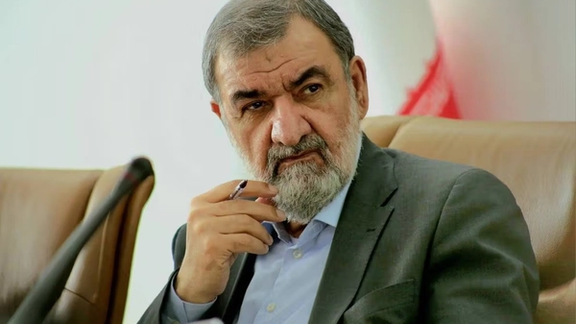
Mohsen Rezaei, a military adviser to Iran's Supreme Leader Mojtaba Khamenei, said Iran would not stop the war until it secures what he described as its rights and deters its enemies.

“Until we make the enemy regret and obtain our definite rights, we will not let it go,” the former Revolutionary Guards commander said.

He added that the end of the war depended on the supreme leader and the Iranian people and warned the United States against assuming it could act and then leave the region without consequences.

Rezaei also questioned the idea of negotiations or a ceasefire, saying: “What does it mean to talk about negotiations and a ceasefire in these conditions?”

Most Viewed

Ghalibaf defends Iran-US talks amid hardline backlash
1
INSIGHT

Ghalibaf defends Iran-US talks amid hardline backlash

2
VOICES FROM IRAN

Bread shortages, soaring prices strain households in Iran, residents say

3
INSIGHT

Iran diplomacy wobbles as factions compete to avoid looking soft on US

4
ANALYSIS

The politics of pink: how Iran uses cuteness to rebrand violence

5
ANALYSIS

From instability to influence: Pakistan’s pivotal role in US-Iran diplomacy

Banner
Banner

Spotlight

  • Is Iran entering its Gorbachev moment?
    INSIGHT

    Is Iran entering its Gorbachev moment?

  • Iran crackdown reaches cemeteries as graves of slain protesters defaced
    EXCLUSIVE

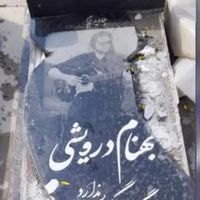
    Iran crackdown reaches cemeteries as graves of slain protesters defaced

  • Iran diplomacy wobbles as factions compete to avoid looking soft on US
    INSIGHT

    Iran diplomacy wobbles as factions compete to avoid looking soft on US

  • The politics of pink: how Iran uses cuteness to rebrand violence
    ANALYSIS

    The politics of pink: how Iran uses cuteness to rebrand violence

  • Bread shortages, soaring prices strain households in Iran, residents say
    VOICES FROM IRAN

    Bread shortages, soaring prices strain households in Iran, residents say

  • Ghalibaf defends Iran-US talks amid hardline backlash
    INSIGHT

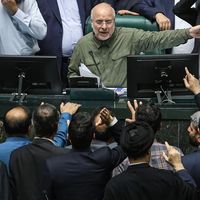
    Ghalibaf defends Iran-US talks amid hardline backlash

•
•
•

More Stories

UAE says media claims on Iranian residents inaccurate

Apr 1, 2026, 21:28 GMT+1

Claims about the residency status of the Iranian community in the United Arab Emirates are inaccurate, the foreign ministry said on Wednesday, adding that Iranian residents remain a respected part of the country’s diverse social fabric.

“In light of what has been circulated of inaccurate media claims regarding the residency status of the Iranian community, the United Arab Emirates reassures residents that its institutional approach is based on solid foundations of approved procedures and frameworks,” the ministry said.

“These ensure the safety and well-being of all members of society, without exception,” it added.

The ministry said the UAE would continue to strengthen “a safe and stable environment based on the rule of law,” ensuring “the protection of the rights of all residents” and reflecting its “established values of tolerance and coexistence.”


War tests Iran’s Dubai trade lifeline

Apr 1, 2026, 21:23 GMT+1
•
Dalga Khatinoglu

The war pitting the United States and Israel against Iran is being fought across airspace and shipping lanes, but one of its most consequential economic effects may be unfolding elsewhere: the fragile commercial relationship between Tehran and the United Arab Emirates.

A series of recent economic measures taken by the UAE following Iranian attacks on Emirati infrastructure has exposed how deeply Iran’s external trade depends on Dubai’s role as a financial and logistical gateway.

The steps—ranging from restrictions on Iranian nationals to disruptions in financial and trade channels—highlight both the extent of interdependence between the two economies and the vulnerabilities that accompany it.

Iran’s consulate in Dubai confirmed that more than 1,200 Iranians were repatriated through indirect routes via Armenia and Afghanistan after direct travel links were suspended.

More consequential than these immediate measures, however, is the disruption of bilateral trade flows. The UAE is Iran’s second-largest trading partner after China and serves as a critical gateway for imports.

No container ships have been seen crossing from Emirati ports to Iran since the start of the conflict, according to Rebecca Gerdes, an analyst at data company Kpler.

According to official data, Emirati exports to Iran rose from about $5.2 billion in 2018—when the United States withdrew from the nuclear deal—to roughly $23 billion in recent years, accounting for more than one-third of Iran’s total imports.

Iran’s non-oil exports to the UAE have also grown, rising from $5.7 billion to nearly $8 billion.

Data from Kpler, seen by Iran International, indicates that Iran exports about 160,000 barrels per day of fuel oil (mazut) to the UAE, along with smaller volumes of other petroleum products such as LPG.

Services trade constitutes another vital channel. Iran imports roughly $23 billion in services annually—including logistics, engineering, insurance and trade facilitation—of which the UAE accounts for about 22 percent.

A substantial portion of this economic relationship also operates outside formal channels. Iran is estimated to import more than $20 billion worth of smuggled goods each year, much of it routed through the UAE.

Dubai has also served as a key node for currency exchange networks, document falsification related to oil shipments and other mechanisms used to circumvent international sanctions. Iranian exchange houses have played a central role in facilitating these activities.

Recent reports suggest that dozens of exchange operators with alleged links to Iran’s Islamic Revolutionary Guard Corps have been detained in the UAE as tensions escalated. While the full scope of these actions remains unclear, they point to a broader effort by Emirati authorities to tighten enforcement and limit illicit financial flows.

Iran’s recent military actions have targeted multiple locations in the UAE, including Fujairah—the country’s only oil export terminal outside the Strait of Hormuz—raising concerns about energy security and trade continuity.

A recent Goldman Sachs report warned that a prolonged closure of the Strait of Hormuz could reduce the UAE’s GDP by as much as 6 percent in April alone, underscoring the broader regional economic risks posed by the conflict.

Yet the same dynamics also expose Iran’s vulnerabilities. The UAE’s role as a commercial, financial and logistical hub makes it difficult to replace in the short term.

Few countries possess the infrastructure, geographic proximity and established trade networks required to replicate Dubai’s function in Iran’s economic ecosystem.

Whether the UAE’s response becomes a decisive pressure point for Iran will depend on both the duration and the breadth of the restrictions.

In the short term, disruptions to trade, finance and logistics are likely to raise costs and complicate supply chains for Iranian importers. Over the longer term, sustained constraints could push Tehran to diversify routes and partners, though replacing the UAE’s role would be neither quick nor straightforward.

For now, the trajectory of tensions suggests that friction with the UAE may emerge as one of the most consequential external challenges to Iran’s trade architecture long after the current conflict subsides.
Ex-president calls for reforms, says Iran should prepare honorable end to war

Apr 1, 2026, 21:10 GMT+1

Former President Hassan Rouhani called for reforms in policymaking and said Iran should prepare for an honorable end to the war, while continuing resistance.

“Alongside heroic resistance, we must be prepared to bring the war to an honorable end in the interest of the country and the people,” he said.

Addressing the Supreme National Security Council, he said it should urgently place different scenarios for continuing or ending the war into the legal decision-making process.

“Preserving the country and the system requires immediate fundamental reforms in policymaking; the people have made their position clear to the authorities,” he said.

Rouhani also said it was necessary to coordinate national resources to prevent attacks on the Persian Gulf islands and maintain control of the Strait of Hormuz.

Two Iranian political prisoners at risk of execution, group warns

Apr 1, 2026, 20:39 GMT+1

Two Iranian political prisoners, Vahid Baniamerian and Abolhassan Montazer, have been held incommunicado at an undisclosed location since March 29, the Iran Human Rights NGO (IHRNGO) said.

The group said authorities have not disclosed their whereabouts following the executions of four co-defendants and have also withheld the bodies of those executed from their families.

IHRNGO called for urgent international action, warning the two men were at imminent risk of execution.

“Holding prisoners incommunicado at undisclosed locations, secret executions and the withholding of bodies, amounts to enforced disappearance and constitutes a serious breach of fundamental human rights,” said Mahmood Amiry-Moghaddam, director of the organization, adding that they are at imminent risk of execution.

US, UAE presidents discuss regional developments

Apr 1, 2026, 19:55 GMT+1

The UAE President Mohamed bin Zayed Al Nahyan and US President Donald Trump discussed regional developments and their impact on maritime security and the global economy, the Emirati news agency WAM reported.

“The two sides also discussed the continued Iranian terrorist aggression targeting the UAE and other countries in the region, including attacks on civilians and civilian infrastructure, noting that it constitutes a violation of sovereignty and international law and undermines regional security and stability,” read the report.