The Burj Khalifa building peaks through the skyline as the sun sets over Dubai, United Arab Emirates, September 9, 2023.
The war pitting the United States and Israel against Iran is being fought across airspace and shipping lanes, but one of its most consequential economic effects may be unfolding elsewhere: the fragile commercial relationship between Tehran and the United Arab Emirates.
A series of recent economic measures taken by the UAE following Iranian attacks on Emirati infrastructure has exposed how deeply Iran’s external trade depends on Dubai’s role as a financial and logistical gateway.
The steps—ranging from restrictions on Iranian nationals to disruptions in financial and trade channels—highlight both the extent of interdependence between the two economies and the vulnerabilities that accompany it.
Iran’s consulate in Dubai confirmed that more than 1,200 Iranians were repatriated through indirect routes via Armenia and Afghanistan after direct travel links were suspended.
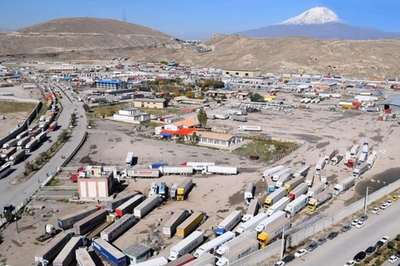
More consequential than these immediate measures, however, is the disruption of bilateral trade flows. The UAE is Iran’s second-largest trading partner after China and serves as a critical gateway for imports.
No container ships have been seen crossing from Emirati ports to Iran since the start of the conflict, according to Rebecca Gerdes, an analyst at data company Kpler.
According to official data, Emirati exports to Iran rose from about $5.2 billion in 2018—when the United States withdrew from the nuclear deal—to roughly $23 billion in recent years, accounting for more than one-third of Iran’s total imports.
Iran’s non-oil exports to the UAE have also grown, rising from $5.7 billion to nearly $8 billion.
Data from Kpler, seen by Iran International, indicates that Iran exports about 160,000 barrels per day of fuel oil (mazut) to the UAE, along with smaller volumes of other petroleum products such as LPG.
Services trade constitutes another vital channel. Iran imports roughly $23 billion in services annually—including logistics, engineering, insurance and trade facilitation—of which the UAE accounts for about 22 percent.
A substantial portion of this economic relationship also operates outside formal channels. Iran is estimated to import more than $20 billion worth of smuggled goods each year, much of it routed through the UAE.
Dubai has also served as a key node for currency exchange networks, document falsification related to oil shipments and other mechanisms used to circumvent international sanctions. Iranian exchange houses have played a central role in facilitating these activities.
Recent reports suggest that dozens of exchange operators with alleged links to Iran’s Islamic Revolutionary Guard Corps have been detained in the UAE as tensions escalated. While the full scope of these actions remains unclear, they point to a broader effort by Emirati authorities to tighten enforcement and limit illicit financial flows.
Iran’s recent military actions have targeted multiple locations in the UAE, including Fujairah—the country’s only oil export terminal outside the Strait of Hormuz—raising concerns about energy security and trade continuity.
A recent Goldman Sachs report warned that a prolonged closure of the Strait of Hormuz could reduce the UAE’s GDP by as much as 6 percent in April alone, underscoring the broader regional economic risks posed by the conflict.
Yet the same dynamics also expose Iran’s vulnerabilities. The UAE’s role as a commercial, financial and logistical hub makes it difficult to replace in the short term.
Few countries possess the infrastructure, geographic proximity and established trade networks required to replicate Dubai’s function in Iran’s economic ecosystem.
Whether the UAE’s response becomes a decisive pressure point for Iran will depend on both the duration and the breadth of the restrictions.
In the short term, disruptions to trade, finance and logistics are likely to raise costs and complicate supply chains for Iranian importers. Over the longer term, sustained constraints could push Tehran to diversify routes and partners, though replacing the UAE’s role would be neither quick nor straightforward.
For now, the trajectory of tensions suggests that friction with the UAE may emerge as one of the most consequential external challenges to Iran’s trade architecture long after the current conflict subsides.
Iran’s economy is entering the new fiscal year under the weight of a profound wartime shock, with inflation reaching levels not seen in decades and essential goods becoming increasingly unaffordable for much of the population.
Official figures released at the end of fiscal year 1404 (March 2026) show annual inflation at 50.6 percent, according to data compiled by government bodies including the parliament’s Research Center. Prices rose 5.6 percent in March alone.
But economists say the headline figure understates the severity of the crisis. The more revealing measure—point-to-point inflation—shows how sharply living costs have risen over the past year.
Government statistics indicate that prices in March 2026 were 71.8 percent higher than a year earlier, a surge that has sharply eroded household purchasing power. In major cities such as Tehran, the increase is believed to be even higher, particularly for food.
The shock has unfolded as weeks of US and Israeli strikes have disrupted economic life across the country. In Tehran, where many residents have temporarily left the city, large parts of the capital’s commercial activity have slowed sharply.
Many businesses remain closed and those who have stayed behind often limit their movements, wary of being caught in unpredictable air strikes.
Attacks on what the attackers describe as “regime infrastructure” have also begun to hit the industrial economy more directly. Recent strikes on major steel production facilities—among the country’s most important industrial employers—have disrupted supply chains and raised fears of wider job losses in manufacturing regions.
For working-class and rural families, the situation is especially acute. Following the removal of preferential exchange rates (arz-e tarjihi), monthly food inflation has climbed above 100 percent, turning basic nutrition into the central economic struggle for many households.
Economists say national averages obscure the depth of the crisis. In some food categories, the real cost of living has effectively doubled, with price increases reaching as high as 150 percent.
Labor activists told the Iranian Labor News Agency (ILNA) that the government’s electronic commodity coupon system—introduced to cushion the impact of rising prices—covers only a small portion of what they describe as the “worker’s basket” of essential goods.
The government-linked Workers’ House has called for a return to direct distribution of staples such as rice, cooking oil and sugar, similar to the rationing system used during the Iran-Iraq war in the 1980s.
Workers in high-risk industries such as construction say the government has suspended its contribution to social-security insurance quotas, leaving many without coverage as workplace accidents increase amid wartime damage to infrastructure.
In mining regions such as Tabas in northeastern Iran, thousands of workers are reportedly unable to retire because employers—under financial strain during the war—cannot pay the required 4 percent premium for jobs classified as “hard and hazardous.”
Economists and labor advocates say the government must urgently introduce targeted relief.
Proposals include special allowances for workers covered by labor law to offset soaring food prices, as well as legal intervention by the judiciary and the Social Security Organization to allow workers in hazardous occupations to retire even if employers cannot currently meet their contribution requirements.
Without such measures, analysts warn, the country risks a deeper erosion of living standards at a moment when the economic effects of war are already reshaping everyday life.
A heated online dispute over photographs showing civilian victims of strikes in Iranian cities has exposed both the deep mistrust many Iranians feel toward official information and a widening rift among the public itself over how to interpret images emerging from the war.
As photos of wounded civilians circulated widely on social media, some users accused photographers and authorities of staging scenes for propaganda, claiming that individuals depicted in widely shared images were actors and that injuries, dust and distress visible in the photos had been artificially created using makeup and staged scenes.
The accusations spread quickly across Persian-language social media, with skeptics pointing to perceived similarities between people appearing in images linked to separate incidents as supposed evidence.
Even the Persian-language account of Israel’s foreign ministry weighed in on the controversy by reposting one of the disputed images and writing: “If they call the Gaza filmmaking industry ‘Pallywood’, what do they call this?”
But the claims were soon challenged by fact-checkers and other users, and in some cases the accusations were later withdrawn.
Iran’s independent fact-checking platform Factnameh said a review of several of the controversial images found no evidence supporting claims that they had been staged or taken at different times and locations as alleged.
“Given the presence of debris and victims, the idea that actors were staged in such a scene is highly unlikely,” the platform said, noting that the individuals in the images show clear differences in facial features and body structure despite some similarities.
Mehdi Ghasemi, one of the photographers whose work came under scrutiny, rejected the allegations and defended his work.
“I’m 47 years old, and it’s been 33 years since I received my first documentary photography award, and I haven’t taken a single reconstructed or manipulated frame,” he wrote on X.
One user who had asserted that a woman in a widely circulated photograph was an actress later deleted the post and issued an apology after acquaintances identified the woman and her husband as real individuals whose home had been destroyed in the strikes.
The controversy has unfolded amid tight wartime restrictions on reporting and photography in Iran.
Critics argue that permits to document sensitive scenes are tightly controlled and often granted only to photographers seen as aligned with the authorities, making independent documentation of chaotic strike sites difficult.
Combined with broader limits on information flow during the conflict, those restrictions have left social media as one of the primary arenas for competing narratives about events on the ground.
The dispute reflects how deeply distrust of official narratives has taken root in Iranian society after decades of censorship and propaganda. In such an environment, even genuine documentation can quickly become the subject of suspicion.
“The issue is exactly like the story of the boy who cried wolf,” one user wrote online.
“When a government lacks legitimacy to this extent and has always chosen to lie at every step, eventually no one believes the truth either. Now factor in cutting off communication channels on top of that, and you end up with the situation we are in.”
For others, however, the rush to dismiss images of civilian suffering as staged propaganda risks deepening divisions at a moment when the war itself is already reshaping daily life across the country.
The arrest of dozens of IRGC-linked money changers in the United Arab Emirates is one of the most serious blows yet to Tehran’s sanctions-evasion network, laying bare how heavily the Islamic Republic has depended on Dubai as an economic lifeline.
Sources familiar with the matter told Iran International that UAE authorities detained dozens of money changers tied to financial entities linked to Iran’s Revolutionary Guards, shut down associated companies and closed their offices.
The crackdown follows days of mounting regional tensions and comes after other measures targeting Iranian nationals, including visa revocations and tighter travel restrictions through Dubai.
For years, Dubai has served as Iran’s main offshore financial artery, where oil proceeds, petrochemical revenues and rial conversions were turned into dollars, dirhams and euros beyond the reach of the country’s battered domestic banking system.
“This is going to be a real problem for Tehran because Dubai was an economic lung for the Iranian regime,” Jason Brodsky of United Against Nuclear Iran told Iran International.
“That is economic pressure and diplomatic isolation in a way that the UAE is able to employ against the Iranian regime, and it will have a very considerable impact.”
'Most critical hub'
According to Miad Maleki, a former senior US Treasury sanctions strategist and now a senior fellow at FDD, the UAE is not just one sanctions-evasion hub among many.
“The UAE is the single most critical jurisdiction in the Iranian regime’s sanctions-evasion architecture,” Maleki said.
Dubai’s exchange houses have long given the IRGC and the Quds Force access to the hard currency needed to finance proxy groups including Hezbollah, Hamas, the Houthis and militias in Iraq.
The detention of trusted IRGC-linked money changers threatens networks that took years to build.
“These trust-based sarraf (money changer) relationships, bank accounts and corporate structures are not quickly replaceable,” Maleki said.
He added that even exchange houses untouched by the crackdown were now likely to think twice before processing Iran-linked transactions, sharply raising both the cost and the risk of doing business with the Guards.
The pressure comes as Iran’s domestic economy is already under severe strain.
Foreign reserves, once estimated at around $120 billion in 2018, had fallen below $9 billion by 2020, leaving Iran increasingly reliant on offshore currency channels.
Mohammad Machine-Chian, a senior economic journalist at Iran International, said the UAE remains Iran’s most important economic conduit after China.
“The UAE is Iran’s most critical economic lifeline after China,” he said.
He said Dubai’s free zones host hundreds of Iranian-linked shell companies used to mask oil and petrochemical sales, launder proceeds and channel hard currency back to Tehran.
Bilateral trade has hovered between $16 billion and $28 billion in recent years, with Iranian non-oil exports alone reaching roughly $6 billion to $7 billion annually, according to Machine-Chian.
A sustained crackdown could cost Tehran tens of billions of dollars in revenue streams while severing what he described as Iran’s “USD cash lifeline.”
Dubai has also functioned as a transit point for illicit Iranian funds moving onward to North America, including transfers routed to the United States and Canada through correspondent banking and hawala networks.
As Maleki put it, “Dubai is the washing machine: Iranian oil proceeds and rial conversions go in, sanitized dirham and dollar transactions come out.”
From diplomacy to backlash
Beyond the financial damage, analysts say the crackdown reflects a broader political rupture between Tehran and the Persian Gulf states.
Brodsky said Iran’s attacks on neighboring countries had transformed the strategic environment in the region.
“The relationship between Iran and the GCC countries is not going to go back to the way it was before Operation Epic Fury,” he said.
Where Persian Gulf states had once pushed for diplomacy, Iran’s retaliation has instead driven them closer to Washington and Israel.
For years, Tehran sought to encircle Israel in what it called a “ring of fire” through regional proxies.
Now, Brodsky said, the Islamic Republic has reversed that dynamic.
“They wanted to encircle Israel in a ring of fire,” he said. “Now they are basically encircling themselves in a ring of fire because they’ve been angering their neighbors with all of their attacks.”
He said that reversal could carry long-term consequences, including deeper Persian Gulf-Israel security coordination and new openings for the Abraham Accords.
“The missile threat and drone threat have become paramount in this conflict,” Brodsky said. “That could drive these countries even closer to the US and Israel.”
'Collapse within weeks'
The UAE crackdown comes as signs of mounting economic distress are mounting inside Iran.
Sources previously told Iran International that President Masoud Pezeshkian had warned senior officials that without a ceasefire, the economy could face collapse within weeks.
Across major cities, ATMs have been running short of cash, banking services have faced intermittent disruptions and government workers have reported months of delayed salary payments.
With inflation in essential goods already above 100 percent before the war, the loss of Dubai’s financial channels could deepen the regime’s crisis.
For Tehran, the arrests in the UAE are more than a financial disruption.
They may signal that one of Iran’s most dependable external pressure valves is starting to close.
The death of 11-year-old Alireza Jafari, the first known child recruit killed during the Iran war, underscores what rights advocates describe as a governing doctrine that places regime survival above civilian protection amid mounting wartime pressure.
Jafari, a fifth-grade student, was killed at a military checkpoint in Tehran during US and Israeli airstrikes targeting military sites, according to Hengaw, a Norway-based Kurdish human rights organization that monitors abuses in Iran.
In an interview with the state-affiliated Hamshahri newspaper, the boy’s mother said that because of a “shortage of personnel,” his father had taken him to the checkpoint. He was later killed in a drone strike while stationed there.
The Basij Organization confirmed that the 11-year-old died “while on duty” at a checkpoint on Artesh Highway as a result of the strike.
Why he was sent remains difficult to verify. In Iran’s tightly controlled information environment, families often speak under pressure, with state scrutiny and the threat of reprisals limiting candor.
The case comes as officials with the Islamic Revolutionary Guard Corps have openly acknowledged lowering the minimum age for war-related support roles to 12.
Rahim Nadali, a cultural official with the Guards in Tehran, said in remarks aired on state media that an initiative called For Iran was recruiting participants for patrols, checkpoints and logistics.
“Given that the age of those coming forward has dropped and they are asking to take part, we lowered the minimum age to 12,” he said, adding that 12- and 13-year-olds could now take part if they wished.
The state-backed recruitment drive makes Jafari’s death more than an isolated case. Together with precedent from the Iran-Iraq war, it suggests children even younger than the officially stated minimum may also be drawn into the war effort.
For rights advocates, the case reveals both a propaganda strategy and a manpower crisis inside a weakened state.
“They want to recruit these young people, use them as a kind of human shield. Because if they attack these kids, they start saying, ‘Oh look, they attack kids,’ and that’s what they’re doing,” said Shiva Mahbobi, a former political prisoner and London-based human rights advocate.
The child was placed at a military checkpoint even as the regime knew such sites were active targets of Israeli strikes, underscoring the degree to which minors were knowingly exposed to lethal risk.
A recruitment poster for Iran's Basij militia. It says people should inquire at their local mosque for further details.
Analysts say the reliance on minors also points to deeper strain within the regime’s security structure. After months of domestic unrest, wartime losses and reported cracks within some IRGC ranks, including defections, the state appears increasingly short on trusted personnel for checkpoint and support roles.
“They have actually called upon younger people to come and tried to recruit them. It shows they are preparing for a battle where they know they will need many more forces,” Mahmood Amiry-Moghaddam of the Norway-based Iran Human Rights organization told Iran International.
“It also shows they are not in a good condition. They are struggling for their survival.”
“They have only one principle, which is holy to them, and that’s to preserve the establishment," he added.
Through his human rights organization, Amiry-Moghaddam has documented cases from the January crackdown in which the regime placed weapons in the hands of minors and sent them to fire on protesters, exploiting the hesitation many civilians feel when confronted by a child.
A holy pledge: preserve the regime
The use of children in conflict, rights groups say, is not new. It reflects a longer doctrine in which vulnerable lives are used to offset military weakness and preserve the state.
“The Islamic Republic used a large number of child soldiers during the war with Iraq. They also sent Afghan children to fight in Syria,” said Shahin Milani, executive director of the Iran Human Rights Documentation Center.
“Given the pressure they are under, it is not surprising that they have resorted to using minors to man checkpoints. Perhaps they want to keep their trained fighters for more critical roles. Since it came to power in 1979, the Islamic Republic has relied on sacrificing its soldiers to compensate for technological inferiority.”
That logic, rights defenders argue, crosses from military expediency into deliberate political calculation.
“Hiding behind children is not new. The Islamic Republic used children in the war with Iraq as well, brainwashing them with propaganda and giving them keys to heaven," said Roya Boroumand, co-founder and executive director of the Abdorrahman Boroumand Center.
The move comes despite Iran’s obligations under the Convention on the Rights of the Child, which prohibits the use of children in military activities. Iran signed the treaty on September 5, 1991 and ratified it on July 13, 1994.
For Boroumand, the use of minors reflects a governing doctrine in which human life is subordinated to state survival.
“They are disposable and instruments for a higher purpose. In this case, the loss of children’s lives increases the political cost of war for their enemies. So rather than protecting and evacuating them to safe shelters, they deliberately expose them to danger,” she said.
So far, UNICEF has not publicly condemned the Islamic Republic’s stated policy of recruiting children into war-related support roles. Iran International has reached out to UNICEF’s communications team for comment.
The rise of Mojtaba Khamenei is not an unexpected deviation within the Islamic Republic—it is the logical outcome of a system carefully engineered over nearly four decades by Ali Khamenei.
What appears, at first glance, as a dynastic shift is in fact the continuation of an ideological and institutional project: the consolidation and reproduction of Khameneism.
The central argument is straightforward: Mojtaba Khamenei does not represent a new phase in the Islamic Republic. He represents the success of a long-term process of “rail-laying”—a deliberate restructuring of power that ensures continuity regardless of who formally occupies the position of Supreme Leader. In this sense, the system no longer depends on individual authority; it reproduces a predefined ideological and political logic.
This transformation was made possible by the way Ali Khamenei maximized the latent capacities of the Islamic Republic’s constitutional framework. The constitution already concentrates extraordinary power in the office of the Supreme Leader. However, Khamenei did not merely operate within these limits—he expanded and operationalized them. Over 37 years, he systematically turned flexible or ambiguous mechanisms into rigid and enforceable structures, embedding his ideological preferences into the institutional fabric of the state.
One of the clearest examples of this process is the evolution of the Supreme Council of the Cultural Revolution. This body, notably absent from the constitution, was gradually transformed under Khamenei into a central pillar of ideological control. What began as a mechanism for purging universities in the early years of the revolution became a highly structured institution with dozens of sub-councils, extending its reach across education, culture, media, and social policy. It evolved into a powerful instrument for shaping and policing societal norms—without ever requiring formal constitutional legitimacy. This is Khameneism in practice: the ability to formalize control without formal law.
A similar trajectory can be observed in the transformation of the Guardian Council. Originally conceived as a supervisory body overseeing legislation and elections, it was reengineered into a decisive mechanism for controlling political outcomes. Through expanded vetting powers and systematic disqualification of candidates, the council moved from oversight to orchestration. Over time, it became capable not only of influencing elections but effectively determining their results in advance. This shift—from supervision to engineering—was not incidental; it was a key step in institutionalizing Khameneism.
These developments were not isolated. They formed part of a broader strategy to eliminate unpredictability from the system. Independent political actors were sidelined, reformist currents neutralized, and institutional autonomy steadily eroded. What emerged was a tightly controlled ecosystem in which all meaningful levers of power—political, judicial, cultural, and economic—were aligned with a single ideological framework.
Within this context, the emergence of Mojtaba Khamenei as a central figure becomes comprehensible. His lack of traditional religious credentials or broad political legitimacy is not a contradiction—it is a consequence of the system’s evolution. Years of institutional engineering, including the careful management of the Assembly of Experts and the systematic removal of potential obstacles, made such a transition possible. The “selection” process itself reflects the culmination of Khamenei’s long-term restructuring: a system in which outcomes are preconfigured rather than contested.
More importantly, Mojtaba’s rise demonstrates that Khameneism has achieved a critical threshold—it can now sustain itself without its original architect. The ideology has been embedded so deeply within the system that any successor, regardless of personal inclination, is compelled to operate within its parameters. The structure dictates the outcome.
This is why the question of leadership succession is, in many ways, secondary. Whether it is Mojtaba Khamenei or another figure, the current institutional configuration leaves little room for deviation. The mechanisms of control, the networks of power, and the ideological priorities—particularly the emphasis on regime preservation, anti-Western positioning, and hostility toward Israel even at significant national cost—are all structurally entrenched.
Khameneism, therefore, is no longer simply an ideology associated with one leader. It is a system of governance—self-reinforcing, expansive, and resistant to change. The Islamic Republic has, through decades of deliberate restructuring, lost its capacity to generate alternative political paths from within.
In this sense, Mojtaba Khamenei is not the beginning of a new chapter. He is the continuation of a trajectory that has been decades in the making.
And perhaps more significantly, this continuity underscores a deeper reality: the Islamic Republic has reached a point where change from within has become structurally improbable. The very mechanisms designed to preserve the system have also eliminated its flexibility.
Khameneism, as both ideology and structure, may ultimately define not only how the system survives—but how it ends. It sustains the Islamic Republic by centralizing power, eliminating dissent, and enforcing ideological conformity across all institutions. Yet those same mechanisms steadily erode the foundations of long-term stability: public trust, institutional adaptability, and economic resilience. A system built to prevent deviation becomes incapable of reform; a state designed to suppress a crisis becomes dependent on perpetual coercion to manage it.
In this sense, Khameneism transforms survival into a self-consuming process. Each cycle of repression narrows the regime’s options further, raises the cost of governance, and deepens the gap between state and society. The tools that once ensured control—security dominance, ideological rigidity, and exclusion of alternative voices—gradually become liabilities, locking the system into a path where it can neither evolve nor retreat.
As a result, Khameneism may determine not only the durability of the Islamic Republic, but also the form of its eventual breakdown: not a sudden collapse, but an accumulated exhaustion. A system that endures by sacrificing its capacity to renew itself ultimately reaches a point where continuation itself becomes unsustainable.