• العربية
  • فارسی
Brand
  • Iran Insight
  • Politics
  • Economy
  • Analysis
  • Special Report
  • Opinion
  • Podcast
  • Iran Insight
  • Politics
  • Economy
  • Analysis
  • Special Report
  • Opinion
  • Podcast
  • Theme
  • Language
    • العربية
    • فارسی
  • Iran Insight
  • Politics
  • Economy
  • Analysis
  • Special Report
  • Opinion
  • Podcast
All rights reserved for Volant Media UK Limited
volant media logo

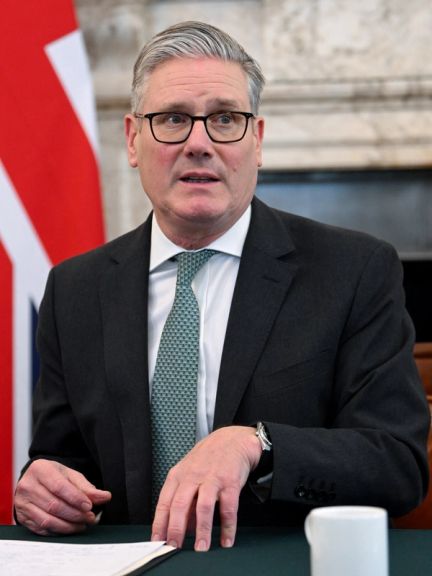
Starmer says UK will not be drawn into Iran conflict, calls for closer EU ties

Apr 1, 2026, 10:37 GMT+1

British Prime Minister Keir Starmer said Britain will not be drawn into the Iran conflict and called for closer ties with the European Union as the war drives an energy crisis.

“We will not be drawn into this conflict,” Starmer said in an address to the nation.

He added that “our long term national interest requires closer partnership with our allies in Europe and with the European Union,” warning the war would “impact the future of the UK” as energy costs rise.

Most Viewed

Ghalibaf defends Iran-US talks amid hardline backlash
1
INSIGHT

Ghalibaf defends Iran-US talks amid hardline backlash

2
INSIGHT

Iran diplomacy wobbles as factions compete to avoid looking soft on US

3
VOICES FROM IRAN

Bread shortages, soaring prices strain households in Iran, residents say

4
ANALYSIS

The politics of pink: how Iran uses cuteness to rebrand violence

5

Scam messages seek crypto for ships’ safe passage through Hormuz, firm warns

Banner
Banner

Spotlight

  • Diplomacy tolls at Hormuz as conflict returns to its doorstep
    OPINION

    Diplomacy tolls at Hormuz as conflict returns to its doorstep

  • Opposition to US talks grows in Tehran as ceasefire deadline nears
    INSIGHT

    Opposition to US talks grows in Tehran as ceasefire deadline nears

  • Tehran moderates see ‘no deal–no war’ limbo as worst outcome
    INSIGHT

    Tehran moderates see ‘no deal–no war’ limbo as worst outcome

  • The future has been switched off here
    TEHRAN INSIDER

    The future has been switched off here

  • Lights out, then gunfire: Witnesses recount Mashhad protest crackdown
    VOICES FROM IRAN

    Lights out, then gunfire: Witnesses recount Mashhad protest crackdown

  • Is Iran entering its Gorbachev moment?
    INSIGHT

    Is Iran entering its Gorbachev moment?

•
•
•

More Stories

Trump considers US withdrawal from NATO - The Telegraph

Apr 1, 2026, 10:05 GMT+1

US President Donald Trump said he is considering pulling the United States out of NATO, calling the alliance a “paper tiger” and citing frustration with allies over the Iran conflict.

“I am strongly considering” leaving NATO, Trump said in an interview with the Telegraph, adding the move was “beyond reconsideration.”

“I was never swayed by NATO. I always knew they were a paper tiger,” he said.

Trump linked his stance to the lack of allied support in operations related to Iran and the Strait of Hormuz, where disruptions have hit global energy flows.

He also said the war could end soon, telling reporters separately the United States “will be leaving [Iran] very soon” and that military action could end within “two or three weeks.”

Argentina designates Iran’s Revolutionary Guards as a terrorist organization

Apr 1, 2026, 09:02 GMT+1

Argentina has designated Iran’s Islamic Revolutionary Guard Corps a terrorist organization, broadening a years-long effort by Buenos Aires to hold Tehran and its proxies responsible for the deadliest attacks in the country’s history.

In a statement issued on Tuesday, President Javier Milei’s office said Argentina had added the IRGC to its public registry of individuals and entities linked to terrorism and its financing, a move that allows financial sanctions and operational restrictions.

“The National Government has declared the Islamic Revolutionary Guard Corps (IRGC) a terrorist organization,” the statement said.

Argentina tied the decision directly to the 1992 bombing of the Israeli Embassy in Buenos Aires, which killed 29 people and wounded more than 200, and the 1994 bombing of the AMIA Jewish community center, which killed 85 people and wounded more than 300.

“The Republic of Argentina was the victim of two of the most serious terrorist attacks in history, perpetrated in the 1990s by the operational arm of the IRGC in the region, the Hezbollah organization,” the statement said.

It added that judicial investigations and intelligence work had found that both attacks were “planned, financed and executed with the direct participation of senior officials of the Iranian regime and operatives of the Revolutionary Guard.”

The announcement also renewed attention on Ahmad Vahidi, the IRGC chief commander and former Iranian defense minister, who has long been sought by Argentine authorities over the AMIA case.

Argentina said Interpol red notices had been issued for several Iranian citizens, “among them former Defense Minister Ahmad Vahidi, who was recently appointed to lead the IRGC.”

The move goes beyond Argentina’s earlier designation of the Quds Force, the IRGC’s extraterritorial arm responsible for operations abroad.

A State Department cable earlier this month showed Secretary of State Marco Rubio had instructed US diplomats to press foreign governments to designate both groups as terrorist organizations.

Milei’s office cast the decision not only as a security measure, but as a moral and political one.

“The President Javier Milei hopes that this decision will settle a historic debt of more than 30 years with the families of the victims,” the statement said.

It added that his government remained committed to “recognizing terrorists for what they are.”

Milei’s statement ended in broader ideological terms, saying the government was determined to align Argentina with “Western civilization” while confronting those “who want to destroy it.”
UAE weighs role in force to reopen Strait of Hormuz - WSJ

Apr 1, 2026, 08:46 GMT+1

The United Arab Emirates is preparing to support efforts to reopen the Strait of Hormuz by force and is reviewing how it could take part militarily, according to Arab officials cited by The Wall Street Journal.

The report said the UAE is pressing for a UN Security Council resolution authorizing action to reopen the waterway and has urged the United States and military powers in Europe and Asia to form a coalition to do so. Bahrain is sponsoring the draft resolution, with a vote expected on Thursday.

According to the report, the UAE is considering roles including mine-clearing and other support services, and has also argued that the United States should seize strategic islands in the strait, including Abu Musa.

The UAE Foreign Ministry, in a statement cited by the newspaper, pointed to international resolutions condemning attacks on its cities and the closure of the strait, and said there was “broad global consensus that freedom of navigation in the Strait of Hormuz must be preserved.”

The report said the UAE’s position marks a major change in policy after weeks of Iranian missile and drone attacks that have hit the country’s infrastructure, disrupted air traffic and tourism, and shaken confidence in its image as a regional safe haven.

Even if a UN resolution fails, the report said, Persian Gulf officials believe the UAE would still be ready to join the war effort. But analysts cited by the newspaper warned such a step could draw the Emirates deeper into conflict with Iran and expose it to further attacks.

Iranian lawmaker says Tehran will not let go of Trump

Apr 1, 2026, 07:56 GMT+1

Ali Nikzad, deputy speaker of Iran’s parliament, said on Wednesday that the Islamic Republic would not let go of Donald Trump until it had taken “revenge for the blood” of Muslims around the world.

He added that the Strait of Hormuz would “never reopen” and said no negotiations had taken place and none would take place.

Nikzad also warned that if the attacks continued, “we will leave no fuel source for the enemy.”

Israel says attacks on Iran have been ‘deep and systematic’

Apr 1, 2026, 06:53 GMT+1

Israeli military chief Eyal Zamir said on Wednesday that Israel’s strikes on the Islamic Republic had been “deep and systematic.”

“We achieved a combined and deadly success that, alongside the attacks of our American partners, delivered a severe blow to Iran. We destroyed a large part of their chain of command, seriously damaged their command-and-control capabilities as well as their weapons production capacity, reduced their ability to launch missiles at Israeli citizens, and created unprecedented freedom of action for the Israeli military in Iranian skies and in other arenas,” Zamir said.

In a separate summary marking the end of the first month of the war, the Israeli military said it had carried out more than 800 offensive air force sorties using around 16,000 munitions, killed more than 2,000 members of Iran’s military and command structure, and struck more than 4,000 targets.

It said the opening blow of the operation, which it described as unforgettable, included the killing of Supreme Leader Ali Khamenei and about 40 other senior officials in less than a minute.

It added that simultaneous strikes were also carried out on the intelligence ministry and the defense council, and that the largest operational flight in Israeli air force history was launched on the same day.

The Israeli military said the opening phase of the operation, dubbed “Bereshit” – the first word of the Torah typically translated as "In the beginning" – involved around 200 fighter jets, hundreds of munitions and about 500 targets, and that it secured air superiority in Iran within 24 hours.

It also said it targeted a secret Revolutionary Guards meeting at a hotel in Beirut in the second week of the war, killing five senior commanders from the Guards’ Lebanon and Palestine corps, branches of the Quds Force.

According to the statement, several other key figures in the Islamic Republic were targeted in the third and fourth weeks of the war.