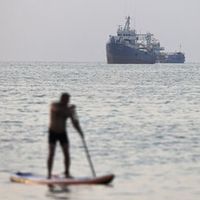
Despite being only about five miles long, the island serves as the main hub for Iran’s crude oil exports and hosts military assets around the Strait of Hormuz.
Recent US strikes targeting military infrastructure on the island – while deliberately sparing its oil facilities – have underscored Kharg’s importance at the intersection of energy markets, maritime security and regional military strategy.
Iran’s oil lifeline
Kharg Island is the backbone of Iran’s crude oil export system. Energy analysts estimate that roughly 90% of the country’s crude exports pass through terminals on the island, making it one of the most critical pieces of economic infrastructure for the Islamic Republic.
Tanker tracking data shows that in 2025 the island handled about 96% of Iran’s crude exports, equivalent to roughly 1.54 million barrels per day out of a national total of about 1.6 million barrels per day.
The scale of Kharg’s infrastructure dwarfs other Iranian export facilities. The island’s loading terminals were originally designed to handle up to seven million barrels per day and can service eight or nine supertankers at once. More than 50 crude storage tanks on the island can hold over 34 million barrels.
Most of the crude shipped from Kharg arrives via pipelines from mainland oil fields in southern Iran rather than being produced on the island itself.
Other export facilities operate on a far smaller scale. Lavan Island can process roughly 200,000 barrels per day, with storage capacity of about 5.5 million barrels. Sirri Island provides around 4.5 million barrels of storage. The energy hub at Assaluyeh handles gas condensate rather than crude oil, meaning it does not function as a major oil export terminal.
Iran has also attempted to create alternative export routes outside the Persian Gulf. A terminal under development at Jask, on the Gulf of Oman, has a projected capacity of about one million barrels per day, but storage capacity there is only about two million barrels, far below the scale of Kharg.
For this reason, Kharg is widely considered to be the centerpiece of Iran’s crude export system. Much of the infrastructure and export data referenced here has also been highlighted in recent analysis by sanctions and financial analyst Miad Maleki on X.
A military hub in the Persian Gulf
Kharg Island is not only an economic asset but also an important military location.
Access to the island is tightly restricted and guarded by Iran’s Islamic Revolutionary Guards Corps (IRGC). The IRGC Navy maintains a presence there, including the 112th Zolfaghar Surface Combat Brigade, a unit operating fast-attack boats designed for asymmetric naval warfare in the Persian Gulf.
These vessels are typically equipped with anti-ship missiles, rockets and naval mines, allowing them to threaten commercial shipping or larger naval vessels operating nearby.
Military infrastructure around the island includes coastal missile launchers, radar systems, surveillance networks and drone facilities used to monitor activity across the northern Persian Gulf.
Iran’s regular navy, known as the Army Navy, also operates in the broader Bushehr–Kharg region, using helicopters and boats for maritime patrols and potential mine-laying operations.
Together, the IRGC Navy and the conventional navy maintain a presence that could pose risks to shipping lanes during periods of conflict.
The Strait of Hormuz factor
Kharg’s strategic importance is closely tied to the Strait of Hormuz, located southeast of the island.
The narrow maritime passage connects the Persian Gulf to the Gulf of Oman and the wider Indian Ocean. About 20% of the world’s oil supply passes through this chokepoint every day.
Tankers carrying crude from Saudi Arabia, Iraq, Kuwait, Qatar and the United Arab Emirates all transit the strait before reaching global markets.
Although Iran itself contributes only 3–4% of global oil supply, its geographic position along the Strait of Hormuz gives it the ability to threaten a far larger portion of global energy flows.
Iran’s naval doctrine emphasizes the use of asymmetric tactics, including naval mines, fast-attack boats and anti-ship missiles.
Iran is believed to possess between 2,000 and 6,000 naval mines. Even a limited number could disrupt maritime traffic in the narrow waterway. Military analysts note that clearing mines is a slow and complex process requiring specialized ships, drones and helicopters.
Why the US struck Kharg
The United States early Saturday targeted military assets on Kharg Island as part of a broader campaign aimed at protecting maritime traffic in the Strait of Hormuz.
US President Donald Trump said American forces struck military targets on the island while deliberately avoiding its oil infrastructure.
“Moments ago, at my direction, the United States Central Command executed one of the most powerful bombing raids in the history of the Middle East and totally obliterated every military target in Iran’s crown jewel, Kharg Island,” Trump wrote in a post on Truth Social.
Trump said the operation specifically avoided damaging oil facilities.
“Our weapons are the most powerful and sophisticated that the world has ever known but, for reasons of decency, I have chosen not to wipe out the oil infrastructure on the island,” he wrote.
The strikes targeted military equipment including missile boats, speedboats, launchers, drones and coastal batteries associated with Iranian forces stationed there.
The strategy appears aimed at removing threats to minesweeping operations rather than disrupting global oil supply.
Commercial tankers cannot be safely escorted through the Strait of Hormuz while facing missile, drone and mine threats from nearby Iranian bases. Neutralizing these capabilities allows specialized naval vessels and drones to begin clearing mines from shipping lanes.
Trump warned that the decision to spare Kharg’s oil facilities could change if Iran interferes with maritime traffic.
“Should Iran, or anyone else, do anything to interfere with the free and safe passage of ships through the Strait of Hormuz, I will immediately reconsider this decision,” he wrote.
Oil exports continue despite strikes
Despite the military strikes, oil operations on Kharg appear to have continued.
Shipping data indicates that tankers have continued loading crude from the island’s terminals. One very large crude carrier (VLCC) was reported to have completed a two-million-barrel loading shortly after the strikes.
Satellite imagery showing flames on the island does not necessarily indicate damage to oil facilities. Gas flaring, a routine process used in oil operations, occurs regularly on Kharg and can appear as fires in satellite images.
Kharg has also demonstrated resilience in past conflicts. During the Iran-Iraq War in the 1980s, Iraqi forces repeatedly bombed the island and destroyed several storage tanks. Despite the damage, Iran continued exporting more than 1.5 million barrels of oil per day.
More than six decades after exports began there in 1960, Kharg Island remains both Iran’s primary energy gateway and a key strategic point in the security architecture of the Persian Gulf.
As long as a large share of the world’s oil continues to pass through the Strait of Hormuz, the small island will remain one of the most consequential pieces of infrastructure in the region.