No doubt Iran wants nuclear bomb, Putin told Bush in 2001
Former US president George W. Bush (left) and Russian President Vladimir Putin sit in an electric micro-car before the official start of the G8 summit outside of St Petersburg July 15, 2006.
Russian President Vladimir Putin told US President George W. Bush in 2001 that Iran was seeking nuclear weapons but that Moscow would not assist Tehran in acquiring sensitive technologies, according to a newly released memorandum of their first face-to-face meeting.
“There is no doubt they want a nuclear weapon. I’ve told our people not to tell them such things,” Putin said during a restricted session with Bush on June 16, 2001, referring to Iranian inquiries directed at Russian experts, according to the declassified memorandum of conversation.
The remarks appear in notes taken during a one-on-one meeting at Brdo Castle in Slovenia, held shortly after Bush took office, and come amid broader discussions between the two leaders on missile proliferation, non-proliferation and Iran’s regional role.
Putin told Bush that Iranian specialists were pressing Russian experts on what the memo described as “sensitive matters,” but said he had ordered Russian officials not to share information related to nuclear weapons or missile technology.
“I will restrict missile technology to Iran,” Putin said, according to the document, while acknowledging that some Russian actors were interested in profiting from cooperation with Tehran.
Bush, for his part, raised concerns that weapons transfers to Iran could threaten both US and Russian security.
A sample of the document
The memo shows the US president sought Moscow’s cooperation on non-proliferation, warning that Iranian access to advanced weapons or delivery systems would be destabilizing.
The exchange also touched on US policy toward Tehran. When Putin suggested Washington might be moving toward improved relations with Iran, Bush rejected that notion.
“That’s not true. Congress makes that completely impossible now,” Bush said, pointing to legislative constraints on any normalization of US-Iran relations even at the start of his presidency.
Putin countered that European states, including Germany, were expanding financial ties with Iran, mentioning a credit line extended by Berlin and arguing that trade in conventional weapons was treated by some countries as a commercial matter.
The document shows that Iran featured repeatedly in the discussion as a proliferation concern alongside North Korea, with Putin portraying Moscow’s engagement with Tehran as constrained by history, geography and security pressures on Russia’s southern borders.
The memorandum was produced as part of a US government record of the meeting and later released through the National Security Archive following a Freedom of Information Act request.
Israeli strike scenario in 2005 and Natanz as a potential target
A separate memorandum of conversation dated September 16, 2005 depicts Bush and Putin discussing how Iran’s enrichment and reprocessing capabilities could be redirected toward a weapons program, and how escalating disputes could narrow options toward military action.
In that Oval Office meeting, US officials stressed that the core concern was not civilian nuclear power but Iran’s ability to master the fuel cycle.
“Our concern is Iran’s ability to reprocess and enrich,” Secretary of State Condoleezza Rice said, adding that such capabilities “would be dangerous and could be turned to a military program.”
Putin argued that an immediate referral of Iran’s file to the UN Security Council could push Tehran to accelerate its program, warning that pressure could reduce outside visibility and control.
“Our concern is that immediate referral will lead Iran to take the North Korean route,” Putin said.
He then raised the question of military action and the uncertainties surrounding it: “If they are indeed striving for nuclear weapons, then we will have lost control over what is happening in Iran. Then we need to do something. What? Strike? Who does that? Where? What targets? Are you sure of the information you have?”
Bush told Putin he saw diplomacy as the priority but said military action could not be fully ruled out, and he framed Israel as the actor most likely to consider a strike if it judged Iran was nearing a nuclear capability.
“The military option stinks, but we can’t take it off the table,” Bush said. “If Sharon feels he needs to strike Iran, all hell will break loose,” he added referring to then prime minister Ariel Sharon.
In the same 2005 conversation, Bush explicitly mentioned Iran’s Natanz enrichment site as a possible Israeli target while emphasizing Washington was not selecting targets on Israel’s behalf. “If they think there’s enriching at Natanz, that’s one. But we aren’t doing the targeting for Israel.”
The 2005 memo also reflects proliferation concerns tied to external networks. Putin pointed to evidence suggesting Pakistani-origin material had been found in Iranian centrifuges, and Bush referenced discussions with then Pakistani President Pervez Musharraf about transfers linked to Abdul Qadeer Khan’s network.
“As far as I understand, they found uranium of Pakistani origin in the centrifuges,” Putin said, to which Bush responded that it involved undeclared material and constituted a violation: “Yes, the stuff the Iranians forgot to tell the IAEA about. That’s a violation.”
Bush happy with Russia’s fuel-for-no-enrichment approach
A third memorandum, dated April 6, 2008, shows Iran continuing to feature in US-Russian talks in the context of nuclear cooperation safeguards, alleged illicit procurement, and the question of Iranian enrichment.
In that meeting in Sochi, Rice told Putin the United States had focused on resolving what she described as a sensitive issue involving Iran, including concerns about illicit assistance. “We needed to resolve an issue with Iran,” Rice said.
Putin said, “Everything is under control there. Sometimes there are instances of cooperation they're trying to pursue in a clandestine manner that's not apparent to the government. We will find them and they will be punished.”
When Bush asked where the questionable activity was occurring, Rice answered directly: “Arak.”
Putin said Russian authorities were monitoring for unauthorized cooperation driven by profit motives. “There are people willing to earn a bit of money on this, but we identify those cases,” Putin said.
The 2008 memo also shows Bush praising Moscow’s approach of providing nuclear fuel for civilian power while pressing Tehran not to enrich domestically – an argument intended to test whether enrichment was needed for energy or indicative of weapons intent.
Bush described it as a practical non-proliferation framework: “Russia says, ‘Here’s the fuel, therefore you don’t need to enrich. If you do, it shows you don’t want civil nuclear power, you want more,’” Bush said.
Putin, recounting his own discussions with Iranian officials, questioned the timing of Iranian enrichment given long construction timelines for reactors, including Russia’s work at Bushehr. “You won’t complete a new plant for 15 years, so why are you building up enrichment now?” Putin said.
A screengrab from footages released by Iran's state media on December 24, purporting to show an oil tanker seized in the Persian Gulf
Iran’s Revolutionary Guards said on Wednesday they had seized a tanker in the Persian Gulf carrying millions of litres of smuggled fuel, in the latest maritime interception announced by Tehran in the strategic waterway.
The vessel was stopped in a “highly coordinated operation,” according to the IRGC-linked Tasnim citing senior navy commander Mohammad Gholamshahi.
“The tanker was carrying 4 million litres of smuggled fuel and was intercepted as it attempted to leave Iran’s territorial waters,” Gholamshahi said, adding that the ship had a crew of 16 non-Iranian nationals and was stopped before leaving Iranian waters.
Iranian officials did not disclose the vessel’s flag, ownership or destination.
The Guards said the crew had been detained and that the case had been referred to judicial authorities for further investigation, with additional inquiries under way to identify networks linked to the smuggling operation.
Iran periodically announces the seizure of vessels accused of fuel smuggling, a trade driven by heavily subsidised domestic fuel prices and compounded by sanctions that restrict formal energy exports.
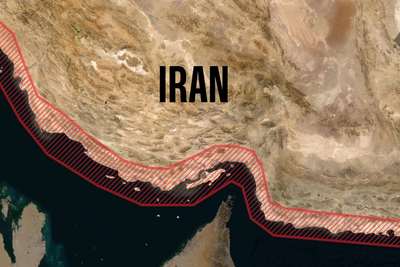
The latest seizure comes amid heightened regional tensions, with Tehran repeatedly warning that it could restrict or close the Strait of Hormuz, the narrow maritime chokepoint linking the Persian Gulf to global markets, in response to military action.
About a fifth of the world’s oil supply passes through the strait, making any disruption a major concern for global energy markets.
Gholamshahi asserted that the cargo of the seized tanker had been transferred from smaller boats and was intended to be offloaded to larger ships outside the Persian Gulf.
A satellite image of Iran's nuclear facilities and Natanz, showing clear marks of impact, June 2025
Iran will not yield to international pressure to allow renewed inspections of nuclear sites hit by the United States in June, the head of the country’s atomic agency said on Wednesday.
Rejecting what he described as political coercion following the attacks, Mohammad Eslami accused the United Nations’ nuclear watchdog of facilitating such strikes.
“Political and psychological pressure—and irrelevant follow-ups demanding renewed inspections of bombed facilities, effectively completing the enemy’s operation—are unacceptable and will receive no response,” Eslami told reporters in Tehran.
His remarks followed a sharply divided meeting of the United Nations Security Council on Tuesday, where Iran and its allies, Russia and China, clashed with the United States and European powers over the future of Iran’s nuclear program and the legal status of sanctions.
The session highlighted widening gaps not only over inspections, but also over whether diplomacy itself remains viable.
‘Zero enrichment’
Speaking for Washington, Morgan Ortagus, a counselor at the US mission to the United Nations, said the United States remained open to formal negotiations, but only under strict conditions.
“We’d like to make it clear to the entire world that the United States remains available for formal talks with Iran, but only if Tehran is prepared for direct and meaningful dialogue,” she said, adding that “there can be no enrichment inside of Iran.”
Iran’s envoy to the United Nations, Amir Saeed Iravani, pushed back, saying Tehran would not accept talks premised on surrendering what it views as its legal rights.
“We appreciate any fair and meaningful negotiation,” he said, “but insisting on a zero-enrichment policy is contrary to our rights as a member of the NPT.”
Strikes’ impact
One unresolved issue fueling international concern is the fate of roughly 400 kilograms of highly enriched uranium that Iran accumulated before the strikes.
Iranian officials say the material is buried under rubble at bombed sites—a claim that has intensified calls from the International Atomic Energy Agency for access and verification.
Tehran counters that any military attack on safeguarded nuclear facilities fundamentally alters the basis for cooperation.
“It must be made clear what response is required if a military attack is carried out against a nuclear industry that is registered with and monitored by the IAEA,” Eslami said, adding that Tehran would ignore calls for oversight until that question is settled.
President Donald Trump has repeatedly asserted that the June strikes “obliterated” Iran’s nuclear infrastructure.
Some US lawmakers and independent analysts have questioned the extent of the damage, however, noting that Iran may have preserved key elements of its program.
Iran’s Supreme Leader Ali Khamenei visits an exhibition of missile and drone systems operated by the Aerospace Force of the Islamic Revolutionary Guard Corps in Tehran, 2023.
Iran’s Supreme Leader approved the development of compact nuclear warheads for ballistic missiles in October, reversing years of restraint after Iran’s June war with Israel, the Italian Institute for International Political Studies said in a report on Wednesday.
“Our sources in Tehran now tell us that, in October, Khamenei decided to give the green light to the development of compact warheads for ballistic missiles,” the report said.
The report said Khamenei had previously blocked any move to enrich uranium to weapons-grade levels or to develop deliverable nuclear warheads, despite pressure from within Iran’s security establishment, particularly the Revolutionary Guards.
It said the June conflict with Israel marked a turning point, exposing weaknesses in Iran’s air defenses and allied forces, while highlighting the limits of its missile arsenal in a prolonged conflict.
“The only true deterrent that could save the Iranian regime in the event of a conflict against Israel and its US allies would be nuclear weapons,” the report said.
Enrichment still capped, for now
“At the same time, however, Khamenei would still not have authorised uranium enrichment beyond 60%,” the report said, adding that rumors persist of an undisclosed enrichment effort at a covert site not declared to the International Atomic Energy Agency.
It said Iran appears to be prioritizing warhead design over enrichment to reduce the risk of exposure to military strikes.
The report said that even if Iran chose to move quickly on enrichment, developing a deliverable warhead would take far longer.
“While enrichment to 90% would require only a few weeks if there were still enough working centrifuges, compact warheads remain a far more complex challenge,” it said, citing Pakistan’s experience in the 1990s, when years of testing and design work were needed before a viable compact warhead was achieved.
Iran’s focus on compact warheads is tied to its medium- and long-range missile force, which the report said proved decisive in forcing a ceasefire with Israel in June, even as Israel destroyed a significant number of Iranian missiles and launchers.
Recent contradictory reports over possible missile activity in Iran, later denied by state television, underscore the sensitivity around the country’s missile program and its role in deterrence.
The report said Iran could seek external assistance to shorten the timeline for developing compact warheads, noting persistent rumors within the Revolutionary Guards of cooperation with North Korea.
“Even access to previously tested warhead schematics would represent a major shortcut,” it said, while adding that cooperation beyond missile technology remains impossible to verify.
Iran has long said its nuclear program is peaceful and defensive, while Western governments accuse Tehran of keeping open the option of developing nuclear weapons.
Iran’s Revolutionary Guards said they will hold a military drill on Thursday and Friday in Tehran province, warning residents they may hear loud sounds during the exercise.
“Any sounds of explosions or gunfire heard during these two days will be related to the drill and will be fully controlled,” Ghorban Valizadeh said, according to Mehr news agency. He urged residents to remain calm.
Valizadeh, commander of the Sayyed al-Shohada Guards unit in Tehran province, said the exercise, known as “Beit al-Moqaddas 16,” will include staged scenarios and will be carried out by ground units.
He said the drill is held every year under the same name by ground forces of the Revolutionary Guards in different parts of the country, framing it as a standard exercise rather than a new development.
The Guards’ ground forces are tasked with homeland defense and the suppression of internal threats.
The announcement follows contradictory reports earlier this week after an IRGC-aligned outlet reported missile tests over several Iranian cities, including Tehran, Isfahan and Mashhad. State television later denied that any missile launches had taken place, saying circulating images were not linked to a test.
Israel’s Prime Minister Benjamin Netanyahu said on Monday that Israel was aware Iran was conducting military exercises and was making preparations.
Defense analyst Farzin Nadimi told Iran International that the reported drills could be read as a signal, saying the Guards were showing they could carry out coordinated military activity across different parts of Iran.
Iranian officials have repeatedly said the country’s military activities are defensive. Earlier this week, Foreign Ministry spokesperson Esmaeil Baghaei said Iran’s defense capabilities were not open to discussion.
Former Iran's foreign minister Javad Zarif, File photo
Mohammad Javad Zarif’s latest Foreign Affairs article follows a familiar pattern in his narrative: recasting Tehran’s militarization and domestic repression as reactive responses to external pressure rather than deliberate internal choices.
Zarif argues that relations between Iran and the United States have long been trapped in a cycle of “securitization,” in which each side responds defensively to the other’s actions.
The Islamic Republic, he writes, has been “forced” to prioritize military spending over development because of attacks by Iraq, Israel, and the United States.
The argument downplays Iran’s own role in shaping that trajectory.
Contrary to Zarif’s account, the theocracy’s turn toward securitization gained pace in the aftermath of the Iran–Iraq war, particularly under the late President Ali Akbar Hashemi Rafsanjani, who helped embed the military in politics and the economy as a pillar of postwar reconstruction and state survival.
But Zarif shifts responsibility for Iran’s unbalanced development outward.
Western pressure, not decisions taken by Iran’s leadership, is blamed for a system in which missile programs expanded while welfare sectors such as housing, employment, and healthcare stagnated.
The implication is that Iran’s strategic priorities were imposed rather than chosen.
Zarif further suggests that reduced pressure from Washington would lead Tehran to de-escalate. Yet this claim sits uneasily with his own account of events following the 2015 nuclear deal.
One of the achievements Zarif frequently cited was the lifting of sanctions not only on Iran’s nuclear program but also on arms-related restrictions, including sanctions on Iran Air, allowing the airline to modernize its fleet.
By Zarif’s own account, however, the easing of sanctions did not lead to restraint.
In a 2021 interview with the economist Saeed Leylaz, Zarif acknowledged that Iran Air flights were used by the Islamic Revolutionary Guard Corps to transfer weapons to Syria, with such flights increasing sharply after the nuclear deal. When Zarif raised concerns with Qassem Soleimani, the then-commander of the Quds Force, he said Soleimani replied that “Iran Air is safer.”
Zarif later described this dynamic as the “dominance of the battlefield over diplomacy,” an admission that key decisions about militarization were made within Iran’s power structure, not imposed from abroad.
Indeed, the period following the nuclear deal saw expanded investment in missile programs and a deepening of Iran’s regional proxy network, financed in part by newly available resources.
Yet in the Foreign Affairs article, Zarif presents increased uranium enrichment and the repression of domestic protest as reactions to Western pressure—once again shifting responsibility for violent crackdowns repression away from the rule in Tehran.
“The external securitization of Iran has fed into a parallel dynamic at home,” he writes, “as the state adopted a stricter approach in dealing with domestic social challenges, responding to these challenges with tighter restrictions.”
A similar pattern appears in Zarif’s account of Iran’s role in Syria.
In the same 2021 interview, he suggested that Iran’s direct military involvement followed a visit by Soleimani to Moscow, framing the escalation as the product of Russian strategy to undermine the nuclear deal rather than a decision taken by Iran’s leadership.
The role of Supreme Leader Ali Khamenei and Iran’s own security institutions is largely absent from this narrative.
The tendency to externalize responsibility extends to other areas as well.
After the nuclear deal, the release of several dual nationals and the unfreezing of Iranian assets raised expectations of de-escalation. Instead, a new wave of arrests of dual nationals followed, a pattern widely seen as deliberate leverage rather than a response to external pressure.
Zarif’s article also describes Israeli strikes in June 2025 as “unprovoked,” without reference to decades of official Iranian rhetoric calling for Israel’s destruction or the expansion of armed proxy groups along Israel’s borders.
The broader context of the current confrontation—including Hamas’s October 7, 2023 attack on Israel, praised by Iranian officials—is notably absent.
Iran has had multiple opportunities to break the cycle Zarif describes, from the early years after the revolution to the post-nuclear-deal period. Each time, its leadership made choices that reinforced militarization and repression rather than curbing them.
The question raised by Zarif’s essay is not whether external pressure mattered—but why internal agency continues to be written out of the story.