Iranian nuclear scientists made covert visit to Russia for laser tech - FT
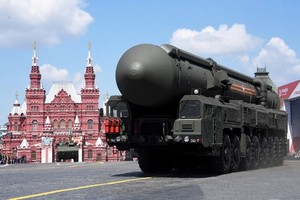
A Russian Yars intercontinental ballistic missile system drives during the Victory Day Parade in Red Square in Moscow, Russia, June 24, 2020.
Iranian scientists linked to its defense establishment made a second covert trip to Russia last year as part of what the United States says is an effort to obtain dual-use technologies with potential nuclear weapons applications, the Financial Times reported on Tuesday.
The previously undisclosed visit, held between November 7 and 11, 2024, involved physicists and engineers travelling on consecutively numbered diplomatic passports and meeting Russian institutes connected to military research, the report said, citing documents it obtained and corroborated through corporate filings, sanctions records, leaked travel data and other correspondence.
According to the report, the exchanges form part of a broader pattern of contact between Russian military-linked research centers and Iran’s Organization of Defensive Innovation and Research (SPND), a Defense Ministry body long sanctioned by Washington for alleged work on nuclear weapons design.
Jim Lamson, a senior research associate at the James Martin Center for Nonproliferation Studies and a former CIA analyst, told the FT the evidence indicated that Iran’s defense-linked scientists were “seeking laser technology and expertise that could help them validate a nuclear weapon design without conducting a nuclear explosive test.”
Tehran maintains its nuclear program is entirely peaceful, and Moscow has publicly opposed the Islamic Republic obtaining a nuclear weapon.
The delegation met Laser Systems, a Russian company under US sanctions that develops equipment for both civilian and classified military use.
The November 2024 mission followed an earlier set of meetings revealed in August, which showed that a Vienna-linked procurement network involving DamavandTec – and using diplomatic passports issued by Iran’s foreign ministry – had arranged introductions between Iranian nuclear scientists and Russian companies with defense and intelligence ties.
Academic and institutional records reviewed by the FT showed the men who travelled were not DamavandTec employees but researchers from Shahid Beheshti University, Islamic Azad University of Kashan and Malek Ashtar University of Technology, an institution under US and EU sanctions for its role in nuclear-related activity.
The FT said the visit had been framed in invitations as an opportunity for technological collaboration, though the scope of any technology transfer between the two sides remains unclear.
The findings come against the backdrop of years of Western allegations that SPND operates covert procurement networks in Europe and Asia to source dual-use equipment.
An investigation by Iran International in 2025 documented a Vienna-based hub tied to SPND-linked front firms purchasing neutronics-related and other sensitive components with potential applications in nuclear weapons design.
Washington has sanctioned more than 30 SPND scientists and multiple affiliated entities, saying the organization oversees “dual-use research and development activities applicable to nuclear weapons and nuclear weapons delivery systems.”
In 2024, Iran’s parliament formally recognized SPND under Iranian law, placed it under the authority of the Supreme Leader and exempted its budget from parliamentary oversight.
Google-owned security firm Mandiant reported on Tuesday that Iran-linked UNC1549 breached Middle East aerospace, aviation and defense organizations in a campaign from late 2023 to October 2025.
“The operation represents a notable technical advancement for the group, which introduced two previously undocumented custom backdoors: TWOSTROKE, a lightweight Windows implant written in C++ that supports command execution, file operations, screenshot capture and various persistence methods,” Google-owned firm said.
“The other is DEEPROOT, a cross-platform backdoor developed in ‘Go’ language crossed platform that works on both Linux and Windows systems, enabling shell commands and file transfers,” the report added.
Attackers gained initial access primarily through spear-phishing emails containing tailored job recruitment lures aimed at defense and aviation professionals, as well as through supply-chain compromises involving trusted third-party software vendors and virtual desktop infrastructure providers, Mandiant reported.
“Once inside victim networks, UNC1549 (aka Nimbus Manticore/Tropical Scorpius) deployed additional tools including SIGHTGRAB for screenshots and CRASHPAD for credential harvesting and data staging,” Mandiant said. “Command-and-control traffic was routed through compromised Microsoft Azure tenant accounts to blend with legitimate cloud activity and avoid detection.”
Mandiant said with high confidence that the activity supports Iranian state interests focused on strategic intelligence collection.
Sensitive data was exfiltrated from compromised networks, though the specific content and affected countries have not been disclosed.
The United States and three European allies urged Tehran to immediately restore its cooperation with the UN nuclear watchdog in a draft resolution they submitted to the IAEA Board of Governors which will meet later this week in Vienna.
"Iran must ... provide the (International Atomic Energy) Agency without delay with precise information on nuclear material accountancy and safeguarded nuclear facilities in Iran," they wrote in the draft submitted on Tuesday.
The United States and its allies also demanded Tehran grant the Agency "all access it requires to verify this information," according to the draft resolution which diplomats cited by Reuters said is highly likely to be passed.
The IAEA board "calls upon Iran to act strictly in accordance with" the IAEA Additional Protocol "and to fully implement this measure without delay", the resolution added.
Iran's deputy foreign minister Kazem Gharibabadi warned earlier on Tuesday that an agreement Tehran signed with the UN nuclear watchdog in September would be compromised by the US-European IAEA resolution.
The Cairo deal allowed the IAEA to resume inspections at all declared Iranian nuclear facilities including those damaged in Israeli and US strikes in June.
But after the three European powers restored UN sanctions on Iran in late September through the so-called snapback mechanism, Iranian officials said the reimposed sanctions would “certainly halt” the deal.
Iran’s nuclear chief Mohammed Eslami said on Sunday that US and Israeli strikes on its civilian nuclear facilities during the June conflict had damaged the credibility of the UN nuclear watchdog, accusing the IAEA of failing to condemn the attacks.
Iran has yet to allow UN inspectors to visit nuclear sites hit by the Israeli and US airstrikes, the IAEA said in a confidential report last Wednesday, saying verification of Tehran’s enriched uranium “long overdue.”
“The Agency’s lack of access to this nuclear material in Iran for five months means that its verification is long overdue,” the IAEA said in a report to member states seen by Reuters.
"It is critical that the Agency is able to verify the inventories of previously declared nuclear material in Iran as soon as possible in order to allay its concerns ... regarding the possible diversion of declared nuclear material from peaceful use," the agency quoted the IAEA report as saying.
The Vienna-based nuclear watchdog has not been able to confirm the amount of enriched uranium in Iran’s possession since June, when Israeli and US strikes hit its main enrichment sites at Natanz, Isfahan and Fordow during the 12-day conflict.
Before the attacks, inspectors had verified about 440 kilograms of uranium enriched to 60 percent purity—enough, if further refined, for roughly 10 nuclear weapons under IAEA criteria.
Iran’s continued breaches of its nuclear obligations will remain on the agenda at the upcoming quarterly meeting of the International Atomic Energy Agency Board of Governors, a German foreign ministry spokesperson told Iran International.
"The reports of the IAEA Director General speak for themselves, as they highlight Iran’s ongoing violations of its key obligations. This particularly concerns the still-unclarified whereabouts of the stocks of highly enriched uranium," the spokesperson said.
Last week, in a confidential report cited by Reuters, the IAEA said Iran has yet to allow UN inspectors to visit nuclear sites hit by Israeli and US airstrikes in June, adding that the verification of Tehran’s enriched uranium is “long overdue.”
“The Agency’s lack of access to this nuclear material in Iran for five months means that its verification is long overdue,” the IAEA said in the report to member states.
Under its obligations as a party to the Nuclear Non-Proliferation Treaty, Iran must submit a detailed report on the status of the bombed facilities “without delay,” but has yet to do so, the IAEA added. Only after such a report is received can inspectors return to the damaged sites.
The spokesperson added that the E3 — Germany, France and the United Kingdom — have repeatedly raised their concerns on Iran's violations publicly and they were the reason the troika triggered the so-called snapback of sanctions.
The E3 triggered the snapback mechanism under the UN Security Council Resolution 2231 which led to the restoration of UN sanctions on Iran in late September.
European states are expected to discuss a draft resolution critical of Iran at the IAEA Board of Governors meeting later this week.
According to the spokesperson, no specific agenda item is planned on the implementation of UN Security Council Resolution 2231, but Berlin said the issue will still be addressed based on reporting from the IAEA director general and the UN resolutions that re-entered into force following the snapback mechanism.
European countries and the United States have called for renewed talks between Washington and Tehran, but Iran says it will not renounce domestic uranium enrichment or discuss its missile program and its support for regional armed groups.
"Germany, together with its E3 partners France and the United Kingdom, continues to advocate for a diplomatic solution to the Iranian nuclear program," the spokesperson added.
Earlier this month, IAEA chief Rafael Grossi said although the June attacks on Iran's Natanz, Isfahan and Fordow nuclear sites “severely damaged” the country's nuclear program, the country retains the knowledge and material “to manufacture a few nuclear weapons."
Before the attacks, inspectors had verified about 440 kilograms of uranium enriched to 60 percent purity—enough, if further refined, for roughly 10 nuclear weapons under IAEA criteria.
Iranian officials, including Iran's foreign minister Abbas Araghchi, have repeatedly said the enriched uranium is buried "under rubble" left from the June strikes.
Tehran denies seeking a bomb but Western powers and Israel doubt its intentions.
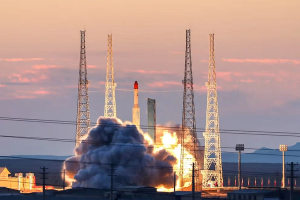
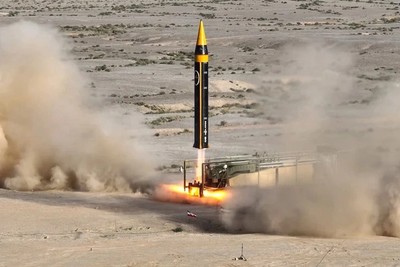
Iran said on Tuesday it will soon launch three Earth-observation satellites and carry out the first test launch from its new Chabahar space center, signaling a further expansion of its space program amid Western concerns over the dual-use nature of Iranian rocket technology.
Hassan Salarieh, head of the Iranian Space Agency, told a media event in Semnan that the Zafar-2, Paya and the second batch of Kosar imaging satellites are ready for launch.
He said Iran’s space sector had advanced to the point where “satellites with one-meter and sub-five-meter imaging resolution are now under construction.”
Salarieh said the first experimental launch from the Chabahar Space Center – a coastal site under development in Iran’s southeast – will take place next year.
“Chabahar is becoming one of the most important launch centers in West Asia,” he said, adding that its construction began in 2023 and that the site is designed to support heavier, liquid-fuel launch vehicles.
His comments come as Iran accelerates work on Chabahar’s second development phase. In April, the agency said the facility would eventually handle semi-heavy liquid-fuel rockets and serve as Iran’s main space gateway, with a geographic position suited for placing satellites into sun-synchronous and geostationary orbits.
Salarieh said Iran had also signed its first private-sector contracts for satellite constellations, including the narrow-band Kosar system intended for emergency data transfer, and highlighted recent milestones such as the launch of private-built satellites on a Russian rocket, the successful 2023 flight of the solid-fuel Sorayya launcher, and the deployment of the Nahid-2 communications satellite in 2025.
Iran has long said its space program is civilian and scientific, though Western governments argue that technologies used for orbital launches can advance long-range ballistic missile capabilities.
President Masoud Pezeshkian has said Iran’s missile and space work supports national deterrence, while Defense Minister Aziz Nasirzadeh has said Tehran could eventually offer launch services to allied states.
Salarieh said domestic expertise had raised Iran’s launch capacity to “several hundred kilograms” and that efforts in propulsion, solid-fuel and liquid-fuel systems had advanced in parallel over the past three years.
Iran’s space program has picked up pace since the 2009 launch of the Omid satellite, with universities and state-linked research centers producing a series of experimental spacecraft.
In 2023 and 2024, Iran also carried out multiple sub-orbital tests, launched reconnaissance satellites via foreign rockets and unveiled new satellite buses and transfer stages, including the Saman-1 upper stage designed for higher-altitude orbits.
Salarieh said the government sees space as a strategic industry with economic, security and industrial implications. “We have strong human capital and significant infrastructure,” he said. “The development of space capability will continue rapidly.”
A deputy Iranian foreign minister said that although numerous channels exist for exchanging messages with the United States, very few of those communications are substantial enough to build on, arguing that Washington is still not ready for a results-oriented negotiation.
Saeed Khatibzadeh, deputy foreign minister and head of the ministry’s political studies center, told CNN that Iran’s nuclear program “cannot be shut down,” adding that infrastructure had been damaged in recent conflicts but the program rests on “domestically developed knowledge spread across the country.”
He added US officials must abandon the idea of leveraging diplomacy to achieve goals they failed to secure through military pressure.
“We cannot enter a negotiation that is doomed to fail and ultimately becomes a pretext for another war. If the other side accepts the logic of negotiation – meaning give-and-take – sets aside certain illusions, and stops trying to use political and diplomatic tools to obtain what it could not achieve through a military campaign, then we can move forward within the framework outlined by the Supreme Leader.”
Khatibzadeh said Iran remains prepared to avoid further escalation in the region but warned that the country “is not an easy target,” citing the 12-day conflict with Israel earlier this year. “Iran is the oldest continuous living civilization on Earth,” he said. “The only language we respond to is the language of respect and equal-footing dialogue.”
Asked about US demands over Iran’s nuclear activities, he said international law makes clear that Tehran is entitled to the full range of peaceful nuclear rights as a member of the Non-Proliferation Treaty and under IAEA oversight.
“Iran will not accept being treated as an exception,” he said. “Ideas such as halting enrichment entirely or restricting Iran’s basic rights are unacceptable.”
Prospect of another war
Khatibzadeh said Iran had already begun rebuilding its defensive posture after the ceasefire.
“The other side is preparing for another war,” he said. “Every legitimate defensive capability must be strengthened. No country compromises on its national security and Iran is no exception.”
He added that Iran’s goal remains to prevent another conflict. “We are trying to change the strategic calculations in Tel Aviv and Washington,” he said. “We are ready for any adventure they may attempt, but we are doing everything to avoid war.”
He rejected suggestions that Iran’s missile strikes during the conflict were ineffective.
“They claimed Iran could not respond,” he said. “They censored the reality and said our missile penetration rate was 10%, then later 30–40%. The truth is much higher. With our advanced missiles we were able to penetrate multiple defense layers and strike wherever and whenever we chose.”
Khatibzadeh said Iran maintains multi-layered relations with Russia and a strategic partnership with China, and would continue cooperation with both countries.
He also dismissed speculation that Iran might reassess its position on nuclear weapons. “We are members of the NPT and the IAEA. Even after hostile actions by the Trump administration and the bombing of peaceful nuclear facilities, we did not leave the NPT,” he said. “Our nuclear program is peaceful and supported by the Leader’s fatwa.”