• العربية
  • فارسی
Brand
  • Iran Insight
  • Politics
  • Economy
  • Analysis
  • Special Report
  • Opinion
  • Podcast
  • Iran Insight
  • Politics
  • Economy
  • Analysis
  • Special Report
  • Opinion
  • Podcast
  • Theme
  • Language
    • العربية
    • فارسی
  • Iran Insight
  • Politics
  • Economy
  • Analysis
  • Special Report
  • Opinion
  • Podcast
All rights reserved for Volant Media UK Limited
volant media logo

Iran's Revolutionary Guards say it seized oil tanker in Persian Gulf

Dec 24, 2025, 15:55 GMT+0Updated: 22:30 GMT+0
A screengrab from footages released by Iran's state media on December 24, purporting to show an oil tanker seized in the Persian Gulf

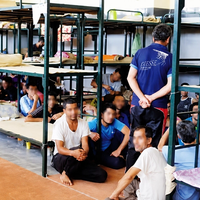
Iran’s Revolutionary Guards said on Wednesday they had seized a tanker in the Persian Gulf carrying millions of litres of smuggled fuel, in the latest maritime interception announced by Tehran in the strategic waterway.

The vessel was stopped in a “highly coordinated operation,” according to the IRGC-linked Tasnim citing senior navy commander Mohammad Gholamshahi.

“The tanker was carrying 4 million litres of smuggled fuel and was intercepted as it attempted to leave Iran’s territorial waters,” Gholamshahi said, adding that the ship had a crew of 16 non-Iranian nationals and was stopped before leaving Iranian waters.

Iranian officials did not disclose the vessel’s flag, ownership or destination.

The Guards said the crew had been detained and that the case had been referred to judicial authorities for further investigation, with additional inquiries under way to identify networks linked to the smuggling operation.

Iran periodically announces the seizure of vessels accused of fuel smuggling, a trade driven by heavily subsidised domestic fuel prices and compounded by sanctions that restrict formal energy exports.

The latest seizure comes amid heightened regional tensions, with Tehran repeatedly warning that it could restrict or close the Strait of Hormuz, the narrow maritime chokepoint linking the Persian Gulf to global markets, in response to military action.

About a fifth of the world’s oil supply passes through the strait, making any disruption a major concern for global energy markets.

Gholamshahi asserted that the cargo of the seized tanker had been transferred from smaller boats and was intended to be offloaded to larger ships outside the Persian Gulf.

Most Viewed

Iran negotiators ordered to return after internal rift over Islamabad talks
1
EXCLUSIVE

Iran negotiators ordered to return after internal rift over Islamabad talks

2
INSIGHT

Iran's digital economy battered by prolonged blackout

3
ANALYSIS

US blockade enters murky phase as tankers spoof signals and buyers hesitate

4
ANALYSIS

Why the $100 billion Hormuz toll revenue is a myth

5

US tightens financial squeeze on Iran, warns banks over oil money flows

Banner
Banner

Spotlight

  • Hardliners push Hormuz ‘red line’ as US blockade tests Iran’s leverage
    INSIGHT

    Hardliners push Hormuz ‘red line’ as US blockade tests Iran’s leverage

  • Ideology may be fading in Iran, but not in Kashmir's ‘Mini Iran'
    INSIGHT

    Ideology may be fading in Iran, but not in Kashmir's ‘Mini Iran'

  • War damage amounts to $3,000 per Iranian, with blockade set to add to losses
    INSIGHT

    War damage amounts to $3,000 per Iranian, with blockade set to add to losses

  • Why the $100 billion Hormuz toll revenue is a myth
    ANALYSIS

    Why the $100 billion Hormuz toll revenue is a myth

  • US blockade targets Iran oil boom amid regional disruption
    ANALYSIS

    US blockade targets Iran oil boom amid regional disruption

  • Iran's digital economy battered by prolonged blackout
    INSIGHT

    Iran's digital economy battered by prolonged blackout

•
•
•

More Stories

Khamenei gives green light to compact nuclear warheads - report

Dec 24, 2025, 12:08 GMT+0

Iran’s Supreme Leader approved the development of compact nuclear warheads for ballistic missiles in October, reversing years of restraint after Iran’s June war with Israel, the Italian Institute for International Political Studies said in a report on Wednesday.

“Our sources in Tehran now tell us that, in October, Khamenei decided to give the green light to the development of compact warheads for ballistic missiles,” the report said.

The report said Khamenei had previously blocked any move to enrich uranium to weapons-grade levels or to develop deliverable nuclear warheads, despite pressure from within Iran’s security establishment, particularly the Revolutionary Guards.

It said the June conflict with Israel marked a turning point, exposing weaknesses in Iran’s air defenses and allied forces, while highlighting the limits of its missile arsenal in a prolonged conflict.

“The only true deterrent that could save the Iranian regime in the event of a conflict against Israel and its US allies would be nuclear weapons,” the report said.

Enrichment still capped, for now

“At the same time, however, Khamenei would still not have authorised uranium enrichment beyond 60%,” the report said, adding that rumors persist of an undisclosed enrichment effort at a covert site not declared to the International Atomic Energy Agency.

It said Iran appears to be prioritizing warhead design over enrichment to reduce the risk of exposure to military strikes.

The report said that even if Iran chose to move quickly on enrichment, developing a deliverable warhead would take far longer.

“While enrichment to 90% would require only a few weeks if there were still enough working centrifuges, compact warheads remain a far more complex challenge,” it said, citing Pakistan’s experience in the 1990s, when years of testing and design work were needed before a viable compact warhead was achieved.

  • Iran's buoyant missile arsenal vexes Israel, analysts say

    Iran's buoyant missile arsenal vexes Israel, analysts say

  • Iran has built missile power beyond pre-war levels, foreign minister says

    Iran has built missile power beyond pre-war levels, foreign minister says

  • Iranian nuclear scientists made covert visit to Russia for laser tech - FT

    Iranian nuclear scientists made covert visit to Russia for laser tech - FT

Missiles at core of deterrence

Iran’s focus on compact warheads is tied to its medium- and long-range missile force, which the report said proved decisive in forcing a ceasefire with Israel in June, even as Israel destroyed a significant number of Iranian missiles and launchers.

Recent contradictory reports over possible missile activity in Iran, later denied by state television, underscore the sensitivity around the country’s missile program and its role in deterrence.

The report said Iran could seek external assistance to shorten the timeline for developing compact warheads, noting persistent rumors within the Revolutionary Guards of cooperation with North Korea.

“Even access to previously tested warhead schematics would represent a major shortcut,” it said, while adding that cooperation beyond missile technology remains impossible to verify.

Iran has long said its nuclear program is peaceful and defensive, while Western governments accuse Tehran of keeping open the option of developing nuclear weapons.

Iran Revolutionary Guards plan military drill in Tehran province

Dec 24, 2025, 08:55 GMT+0

Iran’s Revolutionary Guards said they will hold a military drill on Thursday and Friday in Tehran province, warning residents they may hear loud sounds during the exercise.

“Any sounds of explosions or gunfire heard during these two days will be related to the drill and will be fully controlled,” Ghorban Valizadeh said, according to Mehr news agency. He urged residents to remain calm.

Valizadeh, commander of the Sayyed al-Shohada Guards unit in Tehran province, said the exercise, known as “Beit al-Moqaddas 16,” will include staged scenarios and will be carried out by ground units.

He said the drill is held every year under the same name by ground forces of the Revolutionary Guards in different parts of the country, framing it as a standard exercise rather than a new development.

The Guards’ ground forces are tasked with homeland defense and the suppression of internal threats.

  • False report on downing Israeli F-35 hit credibility, state TV chief says

    False report on downing Israeli F-35 hit credibility, state TV chief says

  • Iran holds missile drills in multiple cities as Tehran defends weapons program

    Iran holds missile drills in multiple cities as Tehran defends weapons program

  • State TV and Guards outlet at odds over Iran missile test reports

    State TV and Guards outlet at odds over Iran missile test reports

Contradictory reports on missile activity

The announcement follows contradictory reports earlier this week after an IRGC-aligned outlet reported missile tests over several Iranian cities, including Tehran, Isfahan and Mashhad. State television later denied that any missile launches had taken place, saying circulating images were not linked to a test.

Israel’s Prime Minister Benjamin Netanyahu said on Monday that Israel was aware Iran was conducting military exercises and was making preparations.

Defense analyst Farzin Nadimi told Iran International that the reported drills could be read as a signal, saying the Guards were showing they could carry out coordinated military activity across different parts of Iran.

Iranian officials have repeatedly said the country’s military activities are defensive. Earlier this week, Foreign Ministry spokesperson Esmaeil Baghaei said Iran’s defense capabilities were not open to discussion.

When Iran’s economic reality slipped onto state TV

Dec 23, 2025, 21:49 GMT+0
•
Behrouz Turani

A rare on-air admission of economic collapse by a senior Iranian official this week briefly pierced the state’s carefully managed narrative—only to be reinforced hours later by leaked budget talks revealing how little financial room the government actually has.

The moment came during a live appearance by Vice President Jafar Ghaempanah on IRINN, Iran’s state television news channel.

Pressed repeatedly on the economy, Ghaempanah acknowledged that a roughly 30 percent decline in oil revenues, compounded by chronic energy shortages and the continued impact of sanctions, had sharply reduced government resources and damaged livelihoods.

Since the start of President Masoud Pezeshkian’s administration, he said, falling oil income had cut into production, deepened the budget deficit and left the state with far less room to maneuver.

The interview quickly drew attention online—not only for its substance, but for what appeared to be visible strain. Ghaempanah stumbled over basic facts, briefly referring to the June conflict with Israel as the “11-day war” and seeming uncertain about its timing, while at several points losing his temper as the interviewer pressed for specifics he struggled to provide.

Budget behind closed doors

The significance of the appearance became clearer the next day, when the government presented its annual budget bill to parliament in a closed-door session from which leaks soon emerged.

According to multiple reports—some echoed by state television itself—Hamid Pourmohammadi, head of the Planning and Budget Organization, told lawmakers that the government currently has no foreign-currency resources to support the proposed budget, sparking heated exchanges with MPs.

Leaked details indicate that next year’s budget will be around five percent smaller than the current one, an unusual move for a system long accustomed to expanding nominal spending even in difficult times.

That picture sits uneasily alongside public assurances from Economy Minister Ali Madanizadeh, who has claimed the draft was prepared with a near-zero deficit.

Crisis in plain sight

For years, large portions of Iran’s budget have been directed toward ideological and propaganda bodies, as well as institutions linked to powerful security organizations, even as basic services and productive investment have suffered.

Mehdi Pazouki told the reformist Rouydad24 website that budget deficits lie at the heart of Iran’s chronic economic instability. Inflation, he argued, is not a temporary shock but the outcome of sustained mismanagement.

Pazouki urged the government to privatize state- and military-owned companies and to halt the practice of allocating oil to military bodies to sell on the state’s behalf—steps that would challenge entrenched interests.

With oil revenues shrinking, energy shortages worsening and sanctions continuing to restrict access to hard currency, the state faces mounting limits on its ability to cushion economic pain.

Ghaempanah’s faltering television appearance was less an isolated embarrassment than a revealing symptom—one that briefly aligned official rhetoric with the economic reality the system usually works to conceal.

Iran submits budget signaling one of sharpest fiscal pullbacks in years

Dec 23, 2025, 13:14 GMT+0

Iran’s government on Tuesday submitted its draft budget for the year starting in March 2026 to parliament, with early indications suggesting one of the most restrictive fiscal frameworks in recent years amid persistent economic strains.

Officials familiar with the drafting process at the Planning and Budget Organization say the bill was prepared with tight spending limits.

President Masoud Pezeshkian has previously blamed budget deficits for fueling inflation, while the economy minister has said the government aims to eliminate the deficit in the coming year.

Unofficial estimates suggest the overall budget ceiling may increase by less than 5%. With inflation still running above 40%, economists say this would amount to a real contraction of around 35% in government spending power, a scale of adjustment that could weigh heavily on public services, development projects and support programs.

Wage increases draw early criticism

The draft was submitted to parliament amid immediate criticism from lawmakers, particularly over a proposed 20% rise in public-sector wages, which several MPs said lags inflation and risks further eroding household purchasing power.

The bill, state media reported, is the first budget prepared under a new format in which parliament no longer debates accompanying legal provisions, reviewing only numerical tables.

The draft, Budget chief Hamid Pourmohammadi said, was submitted after removing four zeros from the national currency, in line with recent legislation.

Inflation risks in the background

In his budget speech, Pezeshkian warned that water shortages pose an urgent national challenge, saying weak management could have lasting consequences.

The budget debate comes as gold and foreign-currency prices in Tehran have surged in recent weeks, particularly after the approval of a third gasoline price tier, developments that have reinforced expectations of higher inflation.

Lawmakers earlier on Tuesday held a closed-door session with senior ministers and central bank officials to discuss currency volatility and price controls.

Iraq says Iranian gas supplies stop completely

Dec 23, 2025, 13:12 GMT+0

Iraq’s electricity ministry said on Tuesday that Iranian gas supplies had stopped entirely, cutting between 4,000 and 4,500 megawatts from the national power grid and reducing supply hours.

“The flow of Iranian gas has stopped completely,” ministry spokesman Ahmed Mousa said, adding that some power units were shut while others were forced to cut output.

Mousa said Tehran had informed Baghdad of the halt due to “emergency conditions,” without giving further details.

He said the Iraq Electricity Ministry had switched to domestic alternative fuel in coordination with the oil ministry, and that generation remained “under control” despite the shortfall.

Iranian gas exports to Iraq had declined sharply this year after the US tightened sanctions enforcement and revoked a long-standing waiver that allowed Iraq to pay for Iranian electricity and gas imports.

Between April and August, Iranian gas exports to Iraq fell by about 40%, according to regional trade data, as Baghdad struggled to navigate sanctions while seeking alternative supplies.

Iraq’s power sector has also faced security disruptions. In November, a rocket strike forced the shutdown of the Khor Mor gas field in northern Iraq, cutting about 3,000 megawatts from regional supply.

Local Kurdish officials blamed Iran-backed armed groups for the attack, which targeted energy infrastructure critical to electricity generation.

The electricity ministry said Iraq had prepared for peak winter demand through maintenance and upgrades at power stations, and that coordination with the oil ministry would continue until Iranian gas flows resume.