Israel arrests man accused of spying for Iran, photographing ex-PM’s home
Former prime minister Naftali Bennett at the official Prime Minister’s Residence in Jerusalem on December 1, 2021
Israeli security services said on Thursday they had arrested an Israeli citizen on suspicion of spying for Iran, including photographing the home of former prime minister Naftali Bennett, in what authorities described as part of stepped-up Iranian intelligence activity.
The Shin Bet domestic security agency and Israeli police said prosecutors would indict 40-year-old Vadim Kupriyanov, a resident of Rishon Lezion, in the Lod District Court on espionage-related charges.
According to the investigation, Kupriyanov was detained earlier this month after he was seen taking photographs near Bennett’s residence in the central Israeli city of Ra’anana. Police said he used a car-mounted camera and had been in contact with an Iranian handler for about two months.
Security officials said Kupriyanov carried out a range of surveillance and security-related tasks in exchange for payment, a pattern they said mirrors other recent cases involving Israeli citizens recruited by Iranian intelligence.
Bennett responded to the arrest by saying Iran’s efforts to harm him would not deter him from public life.
Earlier this month, Iran-linked hackers said they breached Bennett’s Telegram account and published personal data they said was taken from his phone. Bennett said the matter was being handled by authorities.
The arrest is the latest in a series of espionage cases Israeli officials have attributed to Iran. In recent weeks, Israeli authorities have announced the detention of several individuals – including Israeli citizens and foreign workers – accused of gathering intelligence on sensitive sites, ports or senior figures in exchange for money, often paid digitally.
Israeli security agencies say Iran has intensified recruitment efforts through social media and other online channels amid heightened tensions between the two longtime adversaries.
A drone photo of rescue forces at the impact site of residential homes, following a missile attack from Iran on Israel, in Ramat Gan, Israel, June 14, 2025
Israel lacks the capacity to fight a prolonged war with Iran, an Iranian daily affiliated with the Islamic Revolutionary Guards Corps wrote, saying that any renewed conflict would be far costlier and longer than a previous 12-day confrontation.
“Israel does not have the capacity for an intense war of attrition or for confronting a major power like Iran, and it is clear that another war would not end in 12 days as the previous one did,” Javan wrote in an analysis on Wednesday.
The 12-day war between Iran and Israel in June 2025 was a brief but intense conflict. It began with extensive Israeli airstrikes on Iranian military and nuclear facilities.
The United States became militarily involved mid‑conflict. On June 22, US Air Force and Navy forces carried out coordinated strikes on three Iranian nuclear facilities – Natanz, Fordow and Isfahan – in an operation codenamed Operation Midnight Hammer, using B‑2 bombers and submarine‑launched missiles, marking the first US offensive against Iranian territory in decades. Iranian forces fired missiles at US assets in Al Udeid Air Base in Qatar, after those strikes.
The conflict ended with a US and Qatari-mediated ceasefire, but it caused significant casualties, infrastructure damage.
Israeli rhetoric, the paper said, has shifted from threats of decisive victory to language of caution and warnings about the costs of renewed conflict.
Air strikes, according to Javan, failed to halt what it called Iran’s “distributed and self-sufficient” military production. The paper also argued that the previous fighting severely strained Israel’s multilayer missile defense systems.
“Israeli officials are now openly speaking of the ‘real threat’ posed by Iran’s missiles and warning that without preventive action Iran could reach annual production of thousands of missiles,” the paper said.
Focus shifts from battlefield to society
Javan framed the change in tone as evidence that the military option has lost credibility, writing that the inability to control the consequences of war has weakened Israel’s long-standing doctrine of absolute military superiority.
Rescuers work at the site of a damaged building, in the aftermath of Israeli strikes, in Tehran, Iran, June 13, 2025.
“War in the contemporary world is not merely a military confrontation, but a test of social capacity, political cohesion and national resilience,” the paper wrote, arguing that internal divisions, political strains and reliance on external support limit Israel’s ability to endure a prolonged conflict.
The article concluded that future confrontation will be shaped as much by narratives and domestic resilience as by missiles and air defenses.
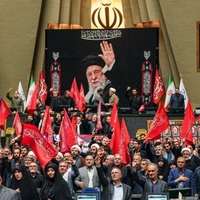
A member of Iran’s paramilitary Basij force takes part in a parade in Tehran, with flags of Iran's Revolutionary Guards carried behind him, November 27, 2025
A cluster of former officials and pundits in Tehran has sought to downplay the likelihood of a US-backed Israeli strike on Iran, arguing that Washington has little appetite for such military action.
The claims have circulated amid growing public anxiety about escalation—concerns that have begun to ripple through Iran’s currency and gold markets.
“Trump is no longer interested in playing Netanyahu’s game,” Nameh News, a conservative outlet widely seen as close to Iran’s intelligence community, quoted Heshmatollah Falahatpisheh, the former head of parliament’s national security committee, as saying.
Falahatpisheh offered little evidence for the assertion, suggesting only that “all of Trump’s attention is currently focused on the Western hemisphere.”
Those assurances stand in contrast to remarks on Wednesday by Israeli Prime Minister Benjamin Netanyahu, who said Israel still needed to “settle accounts” with Iran, adding that while Israel did not seek confrontation, it remained alert to “every possible danger.”
Meeting in Mar-a-Lago
Netanyahu is set to meet Donald Trump next week, primarily to discuss the next phase of the Gaza conflict but also Iran’s nuclear standoff.
Nameh News introduced the interview by citing the upcoming meeting, asserting that it would have no impact on Tehran’s determination to pursue its nuclear and missile programs.
Falahatpisheh further argued that the Trump–Netanyahu meeting was intended mainly to shield Israel from broader US national security priorities, claiming Washington was no longer willing to spend resources on military operations outside the Western hemisphere.
As support, he cited US national security documents, noting that Iran was mentioned 17 times in 2024 but only three times in 2025.
‘US not interested’
The same day, the outlet quoted foreign policy analyst Ali Bigdeli, who echoed Falahatpisheh’s assessment almost verbatim.
“I do not assume that the United States is likely to enter an action against Iran to assist Israel,” Bigdeli said, while maintaining that the Trump–Netanyahu meeting would indeed focus on Iran. He warned of the possibility of a “surprise military attack” but concluded that a broader conflict between Israel and Iran remained unlikely.
A similar argument appeared in the reformist daily Arman Melli, which published an interview that day with political commentator Hassan Hanizadeh.
Hanizadeh said the United States was “not interested in taking part in a new war against Iran” and accused Netanyahu and Israeli media of amplifying regional instability for domestic political reasons.
Taken together, the remarks suggest a coordinated effort to reassure domestic audiences that war is unlikely, even as official rhetoric remains confrontational. Whether such messaging can ease public anxiety—and calm markets in Iran—remains an open question.
An Iranian revolutionary court in the northwestern city of Urmia has sentenced a man to death on charges of cooperating with Israel, according to information received by Iran International and people familiar with the case.
The defendant, identified as Yaghoub Karimpour, a resident of Miandoab in West Azarbaijan province, was arrested by Iran’s intelligence ministry during the 12-day conflict between Iran and Israel earlier this year, the sources said.
Karimpour, born in 1984, was convicted of “corruption on earth” through alleged cooperation with Israel and the transmission of data, they added. He is currently being held in Urmia Central Prison.
According to the sources, Karimpour has denied the charges throughout his detention and trial, saying he had no links to Israel and had not passed any information. They said he told investigators that confessions attributed to him were extracted under coercion.
Iran’s judiciary has not publicly commented on the case, and Reuters was not able to independently verify the allegations.
Iranian authorities have intensified arrests, prosecutions and executions on charges of espionage or collaboration with Israel in the months following the brief war. Officials say the measures are necessary to safeguard national security, while rights groups say the trials often lack transparency and rely on forced confessions.
In recent weeks, Iran has carried out several executions linked to espionage allegations.
Earlier in December, authorities executed Aghil Keshavarz, an architecture student, after convicting him of spying for Israel, state-linked media reported.
The Hengaw human rights organization said that at least 17 people have been executed in Iran this year on charges related to cooperation with Israel, 15 of them after the conflict.
Iranian officials have arrested hundreds of people since the war on suspicion of espionage or collaboration with Israel.
Many of the cases have been pursued under a law passed by parliament in October that broadened definitions of espionage and cooperation with “hostile states,” including Israel and the United States, and allows for capital punishment in a wide range of activities involving alleged information sharing.
Iran’s Supreme Leader Ali Khamenei visits an exhibition of missile and drone systems operated by the Aerospace Force of the Islamic Revolutionary Guard Corps in Tehran, 2023.
Iran’s Supreme Leader approved the development of compact nuclear warheads for ballistic missiles in October, reversing years of restraint after Iran’s June war with Israel, the Italian Institute for International Political Studies said in a report on Wednesday.
“Our sources in Tehran now tell us that, in October, Khamenei decided to give the green light to the development of compact warheads for ballistic missiles,” the report said.
The report said Khamenei had previously blocked any move to enrich uranium to weapons-grade levels or to develop deliverable nuclear warheads, despite pressure from within Iran’s security establishment, particularly the Revolutionary Guards.
It said the June conflict with Israel marked a turning point, exposing weaknesses in Iran’s air defenses and allied forces, while highlighting the limits of its missile arsenal in a prolonged conflict.
“The only true deterrent that could save the Iranian regime in the event of a conflict against Israel and its US allies would be nuclear weapons,” the report said.
Enrichment still capped, for now
“At the same time, however, Khamenei would still not have authorised uranium enrichment beyond 60%,” the report said, adding that rumors persist of an undisclosed enrichment effort at a covert site not declared to the International Atomic Energy Agency.
It said Iran appears to be prioritizing warhead design over enrichment to reduce the risk of exposure to military strikes.
The report said that even if Iran chose to move quickly on enrichment, developing a deliverable warhead would take far longer.
“While enrichment to 90% would require only a few weeks if there were still enough working centrifuges, compact warheads remain a far more complex challenge,” it said, citing Pakistan’s experience in the 1990s, when years of testing and design work were needed before a viable compact warhead was achieved.
Iran’s focus on compact warheads is tied to its medium- and long-range missile force, which the report said proved decisive in forcing a ceasefire with Israel in June, even as Israel destroyed a significant number of Iranian missiles and launchers.
Recent contradictory reports over possible missile activity in Iran, later denied by state television, underscore the sensitivity around the country’s missile program and its role in deterrence.
The report said Iran could seek external assistance to shorten the timeline for developing compact warheads, noting persistent rumors within the Revolutionary Guards of cooperation with North Korea.
“Even access to previously tested warhead schematics would represent a major shortcut,” it said, while adding that cooperation beyond missile technology remains impossible to verify.
Iran has long said its nuclear program is peaceful and defensive, while Western governments accuse Tehran of keeping open the option of developing nuclear weapons.
Iran detained about 2,000 people accused of links to enemy intelligence networks during and after the 12-day war with Israel in June, a senior armed forces official said on Tuesday.
Abolfazl Shekarchi, the armed forces’ cultural deputy, said a “wide spy network” had taken shape over several years with significant investment in training and organization.
“A large network of spies and enemy agents had been formed, and years of effort and heavy costs were spent to build it,” Shekarchi was quoted as saying by Iranian state media.
Shekarchi said the arrests started months before the fighting and continued through the end of the war.
“From a few months before the start of this war, because of the readiness in place, until the end of the war, around 2,000 of these agents were arrested,” he said.
He said rebuilding such networks would take time. “Reconstructing a network like this is not simple and requires years of time and cost,” Shekarchi said.
'Severe punishment'
Iran’s judiciary chief also cited roughly the same number of arrests in comments made in July, and said some detainees could face execution if convicted of working with Israel.
“In our law, anyone who cooperates with a hostile state during wartime must be arrested and prosecuted,” judiciary chief Gholamhossein Mohseni Ejei said in an interview with state TV.
“Some of these individuals face severe punishments, including the death penalty,” he said, adding that others could receive lighter sentences or be released after investigation.
US cites executions, student case draws rights focus
The US State Department said on Tuesday that Iranian authorities executed more than 17 prisoners within 48 hours, including Aghil Keshavarz, a 27-year-old architecture student convicted of spying for Israel.
“Only in 48 hours, the Islamic Republic regime executed more than 17 prisoners,” the US State Department said in a post on its Persian-language account.
Iran’s judiciary said Keshavarz was executed after the Supreme Court upheld his death sentence and legal procedures were completed.
The execution prompted condemnation on social media and renewed focus by rights groups on Iran’s use of the death penalty in national security cases linked to alleged cooperation with Israel.
The Human Rights Activists News Agency said on Monday that at least 17 people have been executed in Iran over the past two days in prisons across Iran.