Iran executes student on charges of spying for Israel
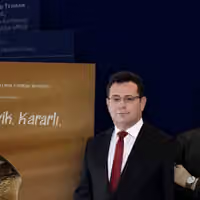
Iranian student Aqil Keshavarz
Iran carried out the execution of an architecture student convicted of spying for Israel on Saturday, the judiciary announced, despite sustained concerns raised by rights groups over his detention, trial process and allegations of torture.
Aqil Keshavarz, a student at Shahroud University and a native of Isfahan, was executed after his death sentence was upheld by the Supreme Court, the judiciary said.
The announcement was made by Mizan News Agency, the judiciary’s official outlet, which said the sentence was implemented “after legal procedures were completed.”
Keshavarz’s family had held their final visit with him on Friday at Urmia Central Prison. In the hours leading up to the execution, student groups and human rights organizations had warned that authorities appeared poised to carry out the sentence, citing his transfer to solitary confinement.
Conflicting accounts of arrest and detention
Rights groups reported that Keshavarz was arrested earlier this year during heightened security measures linked to the 12-day war between Iran and Israel. He was transferred to solitary confinement on December 17 in preparation for execution.
The family was summoned from Isfahan on Thursday for what officials described as a final visit, the Kurdistan Human Rights Network said. According to a source cited by the group, Keshavarz’s mother fainted during the in-person meeting due to severe emotional distress.
Iranian student Aghil Keshavarz
Iran’s judiciary has provided conflicting information about the arrest. While rights groups previously identified the Islamic Revolutionary Guards Corps intelligence organization as the arresting body, Mizan reported that Keshavarz was detained by an army protection patrol, without specifying an exact date.
In its report, Mizan described Keshavarz as an “agent of Mossad and the Israeli military,” accusing him of espionage, intelligence cooperation with Israel and photographing military and security sites.
Human rights organizations rejected the official narrative, saying Keshavarz was subjected to coercive interrogations. The Kurdistan Human Rights Network reported that he was tortured for a week in an IRGC intelligence detention center in Urmia to extract a forced confession, before being transferred to Evin Prison and later back to Urmia.
Broader crackdown and international criticism
The execution triggered widespread condemnation on social media and renewed scrutiny of Iran’s use of capital punishment in security-related cases. The Hengaw Organization for Human Rights said at least 17 people have been executed in Iran since the start of 2025 on charges related to alleged cooperation with Israel, most of them after the recent war.
Iranian authorities have said more than 700 people were detained on suspicion of espionage or collaboration with Israel following the conflict.
Amnesty International called on Iranian authorities on Friday to immediately release 16-year-old Mahmoud Baluchi Razi, arbitrarily detained since December 7 and subjected to torture to force his father to surrender.
“Ministry of Intelligence agents arrested Mahmoud Baluchi Razi from his school in Nikshahr County, Sistan and Baluchestan province,” Amnesty International Iran posted on its social media.
For several days, the authorities subjected the teen to enforced disappearance by refusing to disclose his fate and whereabouts to his family, the post said.
Researchers at Amnesty International learned that interrogators beat Mahmoud Baluchi Razi and forced him to phone and tell his family that his father must surrender himself to secure his son’s release.
“Days later, agents brought Mahmoud Baluchi Razi before a prosecutor who ordered him to sign documents that he could not read or understand,” the post added.
Amnesty warned that Mahmoud Baluchi Razi is being denied access to a lawyer and is being held in a youth detention facility in Kerman province, around 800 km from his family.
"Pending release, he must be protected from further torture and other ill-treatment and given access to his family and lawyer," Amnesty said.
Apart from Amnesty's social media posts, no other reports on the case have emerged.
Predominantly Sunni in Shia-majority country, concentrated in impoverished Sistan-Baluchestan province, the Baluch minority face discrimination, Amnesty International said in its latest annual report.
“Authorities used the death penalty as a tool of political repression against protesters, dissidents and ethnic minorities,” the report said. “Oppressed minorities, including Baluchis and Afghan nationals, made up a disproportionate number of those executed.”
"Security forces unlawfully fired at people in cars with impunity, causing deaths and injuries, disproportionately affecting the Baluchi minority," the report added.
The United Nations General Assembly has adopted a Canada-sponsored resolution condemning Iran's human rights violations for the 23rd consecutive year.
The non-binding measure passed on Thursday as members like Russia, China, India, Pakistan, Indonesia and Iraq voted against while Canada, the US, UK, France, Israel, Japan and Australia were among those in favor.
"There has been a record number of executions this year as serious as any time since 1980,” former Canadian UN ambassador Bob Rae told Iran International.
Amnesty International on October urged an immediate halt to executions, saying more than 1,000 had been recorded so far in 2025, many following unfair trials aimed at silencing dissent and persecuting minorities.
“Canada consults Iranian civil society and the UN Special Rapporteur during drafting.. But also diplomatic compromises dilute language to gain votes, with abstentions reflecting caution or fear of reprisals,” Rae said.
The initiative began in 2003 after Iranian-Canadian journalist Zahra Kazemi's death in custody.
While the UN General Assembly resolutions are not binding, Rae said the resolution's value in maintaining scrutiny. "It's about documenting abuses, warning that the world is watching, and refusing to normalize what is happening."
Canada shuttered its embassy and cut diplomatic ties with Iran in 2012 over what it called security concerns for its diplomats and Iran’s alleged support for terrorism and human-rights abuses.
Ottawa has levied a series of sanctions on Iran for human rights abuses since the Women, Life Freedom protest movement after the death of a young woman, Mahsa Amini, in morality police custody in 2022.
Iranian Foreign Minister Abbas Araghchi spoke by phone with UK Foreign Secretary Yvette Cooper on Friday, saying Tehran is open to diplomacy based on respect.
"Iran has never rejected negotiations and dialogue based on respect for the Iranian nation’s legal rights and legitimate interests, but considers talks based on one-sided imposition unacceptable," official media cited Araghchi as saying.
Araghchi criticized the "irresponsible" stance of the three European powers on Iran's nuclear program, saying that Tehran is open to talks respecting its legal rights and legitimate interests but rejects unilateral imposition.
Cooper underlined Britain's commitment to diplomacy on the nuclear dossier. No UK readout of the call has been issued.
The three European countries—France, Germany, and the United Kingdom—triggered the Iran nuclear deal snapback mechanism in August, leading to the reimposition of UN sanctions in September.
Iran and the International Atomic Energy Agency (IAEA) reached a technical understanding in Cairo in September, mediated by Egypt, aimed at gradually restoring inspectors’ access to nuclear sites.
Following the return of UN sanctions on Iran, Foreign Minister Abbas Araghchi said that the United States and three European powers had “killed” the Cairo nuclear agreement through what he called a sequence of hostile actions.
Araghchi said last month that Washington’s approach amounted to “dictation, not negotiation,” accusing the US of trying to achieve through diplomacy what it failed to gain by force.
“They want us to accept zero enrichment and limits on our defense capabilities,” he said. “This is not negotiation.”
Trump said Iran could avoid past and by reaching a nuclear deal, adding that any attempt to revive its program without an agreement would prompt further US action. He has repeatedly said Iran missed an earlier chance to avert the strikes by accepting a deal.
Russia's foreign minister on Friday urged UN nuclear watchdog chief to keep what he called a neutral, non-politicized approach to Iran’s nuclear file, adding any renewed cooperation must be on terms Tehran considers fair.
“We call on IAEA Director General Grossi, who is pushing to restore contacts with Tehran, to strictly adhere to the founding mission of the IAEA Secretariat,” Russia’s state news agency TASS cited Sergei Lavrov as saying in Cairo.
“This includes the neutral, unbiased, and professional nature of assessments and the broader activities of this organization,” Lavrov added.
Iran and the International Atomic Energy Agency (IAEA) reached a technical understanding in Cairo in September, when Egypt mediated a deal aimed at gradually restoring inspectors’ access to nuclear sites.
Following the return of UN sanctions on Iran, Foreign Minister Abbas Araghchi said that the United States and three European powers had “killed” the Cairo nuclear agreement through what he called a sequence of hostile actions.
Lavrov said that Iran could not be expected to resume full cooperation with the agency while feeling exposed to attacks and political pressure.
“Moscow backs efforts to resume talks between Iran and the IAEA, but only on a fair basis that Tehran views as balanced and consistent with the agency’s mandate,” he added.
The IAEA Board of Governors adopted a Western-backed resolution last month, urging Iran to provide full access and information about its nuclear program. Diplomats said the measure passed with 19 votes in favor, 3 against, and 12 abstentions, with Russia, China, and Niger voting against it.
The resolution called on Iran to allow verification of its enriched uranium stockpile and inspections at sites damaged by US and Israeli airstrikes in June.
Araghchi said last month that Washington’s approach amounted to “dictation, not negotiation,” accusing the US of trying to achieve through diplomacy what it failed to gain by force.
“They want us to accept zero enrichment and limits on our defense capabilities,” he said. “This is not negotiation.”
Trump said Iran could avoid past and by reaching a nuclear deal, adding that any attempt to revive its program without an agreement would prompt further US action. He has repeatedly said Iran missed an earlier chance to avert the strikes by accepting a deal.
Iran denies seeking nuclear weapons and says its nuclear program is for peaceful purposes. Supreme Leader Ali Khamenei has said dealing with Donald Trump is beneath the dignity of the Islamic Republic, while Iranian officials have rejected US demands to end uranium enrichment and curb missile capabilities.
Recent rains delivered Iran from a dangerous dry spell straight into to destructive floods because the land has been denuded by years of poor management, environmental expert Roozbeh Eskandari told Eye for Iran.
As heavy rainfall hits parts of the country, flooding has replaced drought as the most visible sign of Iran’s environmental crisis.
But instead of easing water shortages, the rain is accelerating destruction, washing through cities, villages and farmlands without replenishing groundwater or restoring depleted aquifers.
Decades of destructive urban expansion, dam building, interbasin water transfers and unchecked groundwater extraction have compacted the land, Eskandari said, chalking it up to "bad governance"
Trained in hydraulic structures and environmental research, Eskandari studies how dams, urban expansion, soil degradation and groundwater extraction affect flood behavior and water scarcity, placing him at the intersection of engineering, environment and policy.
Land that once drank in the rainfall no longer can: "The soil has lost the ability to absorb the water," Eskandari said.
A familiar pattern has emerged across Iran: rain arrives after prolonged drought, but instead of recharging groundwater, it turns into runoff. Water remains on the surface, rushing downhill, collecting mud and debris and producing floods.
Climate change has altered rainfall patterns, Eskandari adds, increasing intensity and shortening precipitation periods, which he calls "not a root cause, but can be considered as an intensifier."
Flooding offers little relief because Iran lacks the systems needed to manage water when it arrives. Watershed management, land-use planning and early warning mechanisms that could turn floods into a resource are largely absent.
"These floods could be used to feed the aquifers," Eskandari said. Instead, without preparation, they are simply not used."
Environmental injustice
Damage consistently concentrates in areas with weak infrastructure and limited political influence. These include villages, informal settlements and poorer urban districts.
Wealthier neighborhoods are better protected by drainage networks, reinforced construction and faster access to emergency services, turning flooding into an issue of environmental injustice.
The flooding now unfolding is also taking place against a deeper structural crisis.
When Dr. Kaveh Madani spoke to Eye for Iran earlier this year, he warned that Iran is no longer facing a typical drought but what he calls water bankruptcy, a condition in which consumption exceeds supply and reserves built over generations have already been exhausted.
“We have never seen such a thing,” Madani said. “The people of Tehran, the city that is the richest, most populous and strongest politically, is running out of water, is facing day zero.”
Madani’s warning reinforces Eskandari’s assessment that short bursts of rain or even seasonal floods will not reverse the crisis without systemic reform.
For Eskandari, the shift from drought to flooding is not an anomaly but a warning.
“We are one step closer to territorial collapse,” he said. “These policies have taken Iran into, as I call it, a point of no return,” Eskandari said, “for the land and for the people, both at the same time.”
You can watch the full episode of Eye for Iran on YouTube or listen on any podcast platform of your choosing.