• العربية
  • فارسی
Brand
  • Iran Insight
  • Politics
  • Economy
  • Analysis
  • Special Report
  • Opinion
  • Podcast
  • Iran Insight
  • Politics
  • Economy
  • Analysis
  • Special Report
  • Opinion
  • Podcast
  • Theme
  • Language
    • العربية
    • فارسی
  • Iran Insight
  • Politics
  • Economy
  • Analysis
  • Special Report
  • Opinion
  • Podcast
All rights reserved for Volant Media UK Limited
volant media logo
INSIGHT

Calculated break? Iran parliament speaker steps up attack on president

Maryam Sinaiee
Maryam Sinaiee

Iran International

Dec 23, 2025, 17:52 GMT+0Updated: 22:30 GMT+0
Iran's parliament speaker Mohammad-Bagher Ghalibaf presides over a session as President Masoud Pezeshkian presents his budget to lawmakers, Tehran, Iran, December 23, 2025

Parliament Speaker Mohammad Bagher Ghalibaf has sharply escalated his posture toward President Masoud Pezeshkian, openly floating the prospect of impeachments and implicitly questioning the government’s survival.

Speaking on Sunday, Ghalibaf warned that if the executive fails to address rising prices of basic goods, parliament would have a “duty” to take action.

But moderate voices in Tehran argue the episode is less about procedure than positioning.

“These remarks indicate a fundamental shift in relations between the presidency and parliament,” wrote the news website Rouydad24, arguing that Ghalibaf is recalibrating his role from co-manager of the system’s crises to its chief overseer.

By adopting an openly critical stance, the outlet said, Ghalibaf is seeking to distance himself from shared responsibility for deteriorating economic conditions while presenting parliament as an independent check on executive failure.

“If reshuffling occurs, parliament will claim victory; if not, impeachment becomes the ‘last unavoidable option,’” it wrote—placing political costs squarely on the government.

Moderate politician Hossein Nourani-Nejad said impeachment threats are being used to reshape the executive politically.

“The government is centrist, not reformist,” he said. “But the right is trying to gradually turn it into a conservative government.”

Parliament has already impeached and removed Economy Minister Abdolnaser Hemmati, with pressure building on ministers overseeing agriculture, roads and urban development, industry and trade, sports and welfare.

Parliamentary attacks have focused disproportionately on reformist or centrist ministers aligned with the government’s discourse.

Some lawmakers have gone further, openly calling for Pezeshkian’s resignation and even floating his impeachment on grounds of what they describe as “political incompetence.”

Most of those voices belong to the ultra-hardline Paydari Party and are closely aligned with Saeed Jalili, Pezeshkian’s rival in last year’s presidential election.

“That the head of another branch of power would threaten the president and government by invoking impeachment demands from a specific parliamentary minority is novel,” Esmail Gerami-Moghaddam of the Etemad-e Melli Party told Etemad.

By sharpening confrontation now, critics argue, Ghalibaf is seeking to shed collective responsibility for economic distress while signalling readiness for a future political contest—one in which blame, distance and “oversight” may matter as much as policy.

The backdrop is Ghalibaf’s own defeat to Pezeshkian in the last year’s presidential race—and widespread belief in Tehran that the coming years could bring major political shifts, creating incentives for senior figures to reposition early.

Deputy Speaker Ali Nikzad acknowledged the stakes, noting that if more than half the cabinet were removed or resigned, the government would lose its quorum.

He added, however, that “the position of the system”—a reference to Supreme Leader Ali Khamenei—is that the cabinet should complete its term.

Most Viewed

Iran negotiators ordered to return after internal rift over Islamabad talks
1
EXCLUSIVE

Iran negotiators ordered to return after internal rift over Islamabad talks

2
ANALYSIS

US blockade enters murky phase as tankers spoof signals and buyers hesitate

3
ANALYSIS

Why the $100 billion Hormuz toll revenue is a myth

4

US tightens financial squeeze on Iran, warns banks over oil money flows

5
ANALYSIS

US blockade targets Iran oil boom amid regional disruption

Banner
Banner

Spotlight

  • Hardliners push Hormuz ‘red line’ as US blockade tests Iran’s leverage
    INSIGHT

    Hardliners push Hormuz ‘red line’ as US blockade tests Iran’s leverage

  • Ideology may be fading in Iran, but not in Kashmir's ‘Mini Iran'
    INSIGHT

    Ideology may be fading in Iran, but not in Kashmir's ‘Mini Iran'

  • War damage amounts to $3,000 per Iranian, with blockade set to add to losses
    INSIGHT

    War damage amounts to $3,000 per Iranian, with blockade set to add to losses

  • Why the $100 billion Hormuz toll revenue is a myth
    ANALYSIS

    Why the $100 billion Hormuz toll revenue is a myth

  • US blockade targets Iran oil boom amid regional disruption
    ANALYSIS

    US blockade targets Iran oil boom amid regional disruption

  • Iran's digital economy battered by prolonged blackout
    INSIGHT

    Iran's digital economy battered by prolonged blackout

•
•
•

More Stories

Iran parliament holds closed-door meeting with government officials on economy

Dec 23, 2025, 10:28 GMT+0

Iran’s parliament convened a closed session with senior government officials on Tuesday to assess economic conditions, as lawmakers said subsidy and currency policies had not translated into tangible relief for many households.

The session was held to share information between the government and lawmakers on how to address public grievances, Abbas Goudarzi, spokesperson for parliament’s presiding board, told reporters after the meeting.

He said a five-member joint committee had been formed between the government and parliament, with briefings delivered by the heads of the Planning and Budget Organization and the Central Bank of Iran.

Ineffective policies

Goudarzi cited oil sales, the return of export earnings and unresolved foreign-currency obligations as key factors shaping current economic conditions, saying their combined impact had produced the present situation.

He pointed to the allocation of about $10 billion in subsidized foreign currency for essential goods as an example of ineffective policy design, adding that roughly $8 billion was directed to livestock feed while consumers continued to pay market prices for basic items.

“There is no logic in allocating this volume of currency if it does not reach its target,” Goudarzi said, adding that existing mechanisms had failed to translate support into lower costs for households.

  • Iranian government pins inflation on unbacked money printing

    Iranian government pins inflation on unbacked money printing

  • Inside Iran’s maze of multiple exchange rates

    Inside Iran’s maze of multiple exchange rates

Iran introduced its preferential foreign-exchange system in April 2018 under then president Hassan Rouhani, fixing the dollar at 42,000 rials in an effort to cushion households from price shocks and ensure imports of essential goods and medicines using oil revenues.

As the gap between the official and market rates widened – and the rial slid to record lows above 1.32 million per dollar this week – the policy became increasingly costly.

The administration of Ebrahim Raisi dismantled the system as part of what it branded “economic surgery,” arguing that it fueled arbitrage, corruption among importers, and failed to benefit consumers.

Several months later, the government reinstated subsidized currency at 285,000 rials to the dollar, roughly half the market rate at the time. The scheme initially covered 25 categories of goods, though the list has since been pared back.

In recent months, preferential currency has been removed from imports of staples including rice, vegetable oil, red meat, animal feed, and some medicines.

  • Iran health officials flag price rises as shortages loom over currency crunch

    Iran health officials flag price rises as shortages loom over currency crunch

  • Prices soar, basics scarce: Iranians struggle to fill the cart

    Prices soar, basics scarce: Iranians struggle to fill the cart

Budget pressure builds

The Tuesday morning session, Goudarzi said, was held behind closed doors, with an open afternoon meeting scheduled with the president.

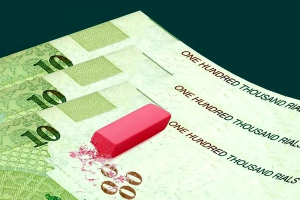
The government will submit the draft budget to Iran’s parliament on Tuesday for the first time based on the new rial, following the removal of four zeros from the national currency.

  • Iran’s Central Bank ordered to slash four zeros from national currency

    Iran’s Central Bank ordered to slash four zeros from national currency

The new year's budget bill is being submitted to parliament amid signs it has been drafted as one of the most contractionary budgets in recent years.

Goudarzi described the Tuesday meeting as an attempt to coordinate the executive and legislative branches to manage economic and currency challenges.

He outlined a compressed review timetable, saying the draft budget will be examined by the combined budget committee within three days before being sent to the plenary, whether approved or rejected.

An Iranian shopper browses staple goods in a supermarket as inflation continues to erode purchasing power, pushing food prices further out of reach for many households.
100%
An Iranian shopper browses staple goods in a supermarket as inflation continues to erode purchasing power, pushing food prices further out of reach for many households.

If endorsed, it will then move to specialist committees for further study under strict deadlines before returning to the combined committee and, ultimately, the full chamber.

Goudarzi noted that under parliamentary rules the government was required to submit the budget on December 23, but did so a day later because no open session was held to formally trigger the review process.

Tehran moderates rail against president's 'one-way' reconciliation

Dec 22, 2025, 16:30 GMT+0
•
Behrouz Turani

President Massoud Pezeshkian’s call for “unity” and “national reconciliation” has collided with Iran’s power structure, becoming a one-way street in which concessions flow to hardliners while the president gains little in return.

Since taking office, Pezeshkian has softened his language, accommodated rivals in key appointments, and defended compromise as the price of stability. 

Hardliners, however, have treated reconciliation not as mutual restraint but as opportunity—using it to settle scores, reclaim positions, and advance policies that run directly against his campaign pledges.

That imbalance was underscored last week by reformist daily Sharq, which warned that Pezeshkian’s conciliatory posture had become “a one-way road" for his political rivals.

“In private, hardline MPs admit fuel prices must rise; in public, they posture as defenders of the poor,” the paper wrote, adding that critics who decry internet filtering or strict hijab enforcement often exploit the same issues for political gain.

Taking advantage

Pezeshkian’s invocation of vefaq—the Arabic term for unity or accord—was meant to signal cooperation with constructive actors. Moderates now argue it has been interpreted as surrender rather than partnership.

Even explicit backing from the Supreme Leader has done little to shield the government. 

According to Sharq, hardliners routinely reframe his remarks to suit their own narrative, while parliamentarians amplify public anxiety by exaggerating crises such as fuel price hikes, spreading unsubstantiated claims, and calling for prosecutions that weaken state institutions.

A review of daily statements published on parliament’s official website, icana.ir, shows a steady stream of alarmist rhetoric and political point-scoring, reinforcing the impression of a faction more invested in spectacle than governance.

Compromise or surrender?

Rouydad24 this week extended the critique to Pezeshkian himself, questioning his repeated claims that he is resisting hardliner pressure.

The outlet cited his appointment of Saghab Esfahani as vice president for energy consumption optimization as evidence of retreat. 

“A president who reached office by promising honesty and resilience,” it wrote, “now repeats the language of resistance while compromising his ideals simply to remain in office.”

For a society long scarred by unfulfilled promises, such language signals repetition, not resolve.

Hardliners, Sharq concluded, offer no credible solutions to Iran’s mounting crises. Their relevance is sustained through vendettas, institutional erosion, and the exploitation of public grievance. 

Columnist Zohreh Farahani argued in a December 16 commentary that real governance requires courage, accountability, and respect for the rule of law, suggesting that all were absent from the current administration in Tehran.

The result is a deepening political deadlock, he asserted. Reconciliation has moved in only one direction, leaving Pezeshkian weakened, moderates increasingly disillusioned, and Iran’s power balance as rigid as ever.

Parliament speaker’s ultimatum ends honeymoon with president – reformist outlet

Dec 22, 2025, 13:50 GMT+0

Iran’s parliament speaker escalated pressure on President Masoud Pezeshkian’s government this week, a move that reformist website Rouydad24 said marked the end of an early political “honeymoon” and a bid to distance the legislature from a government facing an economic crisis.

The outlet said Mohammad Bagher Ghalibaf’s unusually blunt warning in parliament this week – that lawmakers could move to impeach cabinet ministers if prices continue to rise – went beyond routine oversight and marked a strategic shift away from the rhetoric of “consensus” that initially defined relations between the legislature and the administration.

According to Rouydad24, Ghalibaf is seeking to distance himself from the government’s economic record as inflation, a plunging rial and rising living costs fuel public anger, recasting himself as an independent watchdog rather than a political partner.

  • Iran parliament speaker threatens to impeach Pezeshkian government

    Iran parliament speaker threatens to impeach Pezeshkian government

The analysis said the warning reflected a broader recalibration in Tehran, where parliamentary backing for the government has given way to open boundary-setting, including criticism of economic ministers and senior appointments.

Ghalibaf’s move comes as parliament has already demonstrated its willingness to act, having impeached Economy Minister Abdolnasser Hemmati earlier this year over rising prices, showing that the threat against the Pezeshkian government is not merely symbolic.

Kazem Delkhosh, the deputy for legislative affairs in the president’s parliamentary office, said on Monday that Pezeshkian and members of his economic team will attend a joint session of parliament on Tuesday to discuss broader economic issues and rising living-cost pressures.

Guards say Israel’s war plan faltered over failure to stir unrest in Iran

Dec 22, 2025, 08:54 GMT+0

Iran’s Revolutionary Guards said on Monday that Israel was defeated in the recent 12-day conflict because it failed to trigger unrest inside Iran, despite what its spokesman described as expectations that military strikes would lead to domestic turmoil.

Ali Mohammad Naini, spokesman for the Islamic Revolutionary Guard Corps (IRGC), said Israel and its allies had pursued a dual strategy during the conflict: direct military confrontation alongside efforts to destabilize Iran from within.

“The enemy’s defeat in the 12-day war was precisely here,” Naini said. “They tried to drag the war inside the country, but that project failed.”

Naini was speaking at a meeting to organize commemorations for December 30, a state-marked anniversary tied to mass rallies that followed the disputed 2009 presidential election and the suppression of the Green Movement protests – one of the largest episodes of unrest in Iran’s recent history.

The Green Movement is often cited alongside the 2019 Bloody November protests and the 2022 Woman, Life, Freedom demonstrations as the most significant challenges to the Islamic Republic since its founding.

Naini said Iran’s adversaries had assumed that air strikes would be followed by protests, riots or internal collapse, repeating what he described as a long-standing “illusion of chaos” rooted in past episodes of unrest.

“They sat in their war rooms with a wrong calculation, waiting for disorder, riots and the breakdown of the country from within,” he said.

Instead, Naini said the attacks were followed by large public reactions that included anti-Israel rallies and funerals for those killed, which he portrayed as demonstrations of national unity.

  • Israel warns US Iran missile drills may be cover for surprise attack - Axios

    Israel warns US Iran missile drills may be cover for surprise attack - Axios

  • Israel weighs regime change in Iran, former Israeli diplomat says

    Israel weighs regime change in Iran, former Israeli diplomat says

  • Mideast upheaval leaves Iran hard-pressed to regain old footholds

    Mideast upheaval leaves Iran hard-pressed to regain old footholds

He said Israel underestimated what he described as a “fortress-like” popular cohesion and that attempts at what Iranian officials often call soft war or cognitive war aimed at weakening society from within were completely unsuccessful.

“The enemy shifted from military war to cognitive war, using pessimism, division and exaggerating social dissatisfaction to weaken the unity that was formed,” Naini said.

The remarks come as regional tensions remain high and as Israel weighs next steps.

NBC News reported over the weekend that Israeli officials are preparing to brief US President Donald Trump on options for possible new military strikes on Iran, citing concerns that Tehran is rebuilding facilities linked to ballistic missile production and repairing air defenses damaged in earlier attacks.

Israeli Prime Minister Benjamin Netanyahu is expected to raise the issue during an upcoming meeting with Trump, including options for US support or participation in any future action, according to the report.

Trump has repeatedly said US strikes in June destroyed Iran’s nuclear capabilities and has warned Tehran against trying to rebuild them. Iran denies seeking nuclear weapons and says its military and nuclear programs are defensive.

Naini said Iran continues to monitor what he described as hostile plans closely, adding that the lesson Iranian officials draw from both past unrest and the recent war is that internal cohesion remains decisive in confronting external threats.

Low voter engagement casts doubt on Tehran’s maiden proportional council elections

Dec 21, 2025, 21:46 GMT+0
•
Maryam Sinaiee

Tehran’s upcoming city council elections will be held under a proportional representation system for the first time, but widespread voter apathy has raised concerns of an extremely low turnout outside conservative ranks.

The city and village council elections in May will also be held independently of the presidential race for the first time, a change that further distinguishes them from previous electoral cycles.

City council contests are significant to political figures and groups in Iran because they have repeatedly served as springboards to national power, particularly the presidency.

Tehran’s current hardline mayor, Alireza Zakani, rose through the city council before becoming mayor and later used that position as a launchpad for his bid in last year’s presidential election, though he was ultimately unsuccessful.

Before him, Mahmoud Ahmadinejad famously moved from the Tehran mayoralty to the presidency, underscoring the political weight of municipal office in Iran.

Voter disillusion and the risk of low participation

Unlike all other elections in Iran, city council races are not supervised by the Guardian Council, an unelected body widely accused by critics of “engineering elections” in favor of conservatives and hardliners through mass candidate disqualifications.

As a result, council elections have generally been freer than presidential and parliamentary contests over the past two decades.

Even so, political analysts and activists say the depth of public frustration with elections and governance makes it unlikely that large segments of the electorate will return to the polls, with some warning that turnout could fall below levels seen five years ago, when only around 25 percent of eligible voters participated in Tehran.

This is particularly true of the so-called “gray voters,” a broad and often decisive group whose participation has frequently tipped election outcomes in favor of reformists and moderates.

Recent electoral experience reinforces these concerns. In the 2021 parliamentary elections, after most reformist candidates were disqualified, turnout in Tehran hovered around 10 percent. The top candidate in the capital won roughly 580,000 votes—about six percent of eligible voters.

The reformist-leaning daily Arman-e Melli warned of the potential total marginalization of reformists and moderates under the new electoral model and prevailing voter apathy in an article titled “The Proportional Election Trap Facing Reformists.”

“If conservatives enter the race with two lists and split their organized votes between them, while reformists fail to mobilize their political base, the total reformist vote could fall to third place. In such a scenario, even the complete exclusion of reformists from Tehran’s city council would not be far-fetched.”

Uneven campaign energy

So far, there has been little visible enthusiasm among reformists for the upcoming vote. Conservatives and hardliners, by contrast, have been planning for months.

Meanwhile, according to the centrist website Asr-e Iran, three conservative camps are already maneuvering aggressively: Mehrdad Bazrpash, a long-time rival of Tehran Mayor Alireza Zakani, is reportedly has an eye toward becoming Tehran’s next mayor by placing allies in the council, while supporters of Saeed Jalili and members of the hardline Paydari Front, and neo-conservative allies of parliamentary speaker Mohammad-Bagher Ghalibaf, also push for maximum seats.

How proportional elections work—and why they matter

Under the new model, seats are allocated based on the share of the total vote won by each party or coalition list, with independent candidates assessed according to their percentage of overall ballots cast.

In practice, this means that in Tehran, organized political forces with disciplined voter bases—particularly conservatives and hardliners—are likely to benefit the most, while candidates without party backing face steep obstacles.

While many political groups agree that proportional representation can, in theory, improve the performance of councils and municipalities, some argue that introducing it under current political and institutional conditions may produce the opposite effect.

Skepticism across the political spectrum

Opposition to the new model is not limited to any single political camp.

Masoud Zaribafan, a former close ally of Mahmoud Ahmadinejad, has publicly warned against the risks.

He said that if ideologically rigid and unqualified individuals enter the council, it will “certainly face serious problems in selecting a mayor—especially someone who intends to use the mayoralty as a springboard to a higher position, including the presidency.”

He added: “Even if they manage to elect a mayor, I doubt they will be able to choose a powerful and efficient one.”

Mohammad Mehdi Tondgouyan, a former Tehran council member close to reformists, argued that proportional elections make little sense in a country without deeply rooted parties. “Our people have no real connection with parties,” he said.

Mahmoud Mir-Lohi, a senior member of the National Trust Party and a former deputy interior minister under President Mohammad Khatami, noted that Iran has around 200 registered parties, most of which function more like professional associations than genuine political organizations.

Former parliamentary candidate Tina Amin echoed this concern in a post on X: “If proportional elections are applied based on the current party landscape, they will not solve the problems of majoritarian elections. Instead, they will reproduce party-based rent-seeking and a lack of meritocracy in a different form.”