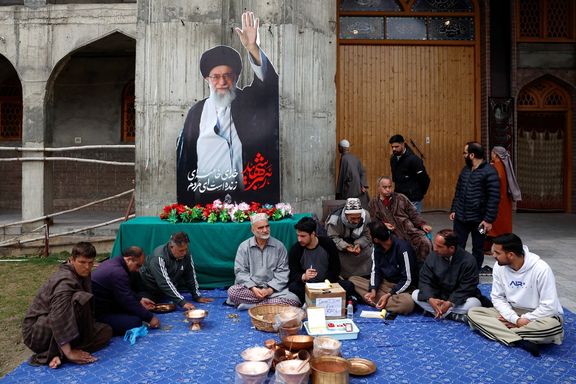
Muslim volunteers at a collection drive for Iran in Srinagar, Indian Kashmir
Fundraising drives across Indian-administered Kashmir have collected nearly $2 million for Iran following the killing of Supreme Leader Ali Khamenei, highlighting the depth of religious and ideological ties between the region’s Shia community and the Islamic Republic.
The connection runs deep enough that the region has long been nicknamed Irani Sagir (or Mini Iran.)
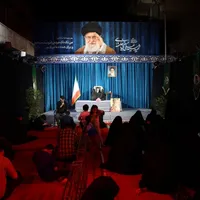
Across towns and villages, portraits of Khamenei appeared at donation events where residents contributed whatever they could spare: banknotes, gold jewellery and even copper utensils.
A Kashmiri Muslim girl donates a gold ring at an Imambara fund collection centre in Budgam
The collection drives, held in late March in cities including Budgam and Srinagar, allowed proceeds to be wired directly to the Iranian embassy in New Delhi. Iran’s embassy in India has also posted a QR code for donations on X since March 23.
In just one week, nearly ₹18 crore (about $2 million) was collected across Kashmir, excluding amounts deposited directly into the embassy’s account, according to local media reports.
One contribution seen by Iran International was ₹26 lakh (around $28,000).
A cheque written out to Iran's embassy
The fundraising came weeks after widespread protests erupted across Kashmir following the US-Israeli airstrike that killed Khamenei on Feb. 28.
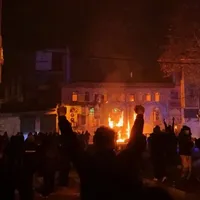
Demonstrations in Srinagar turned violent in places, leaving at least 12 people injured, including five police officers. Authorities responded with tear gas and batons, shut schools, throttled mobile internet for five days and arrested at least 50 people.
Among the outpouring of grief were calls for revenge from some protesters.“Those who oppress Muslims—we will kill them,” one unnamed demonstrator in Srinagar told Reuters on March 1.
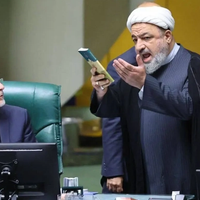
The unrest prompted authorities to investigate several political figures accused of spreading inflammatory content online. Among them was Srinagar MP Aga Syed Ruhullah Mehdi, an influential Shia cleric with a cross-sectarian following.
“Some fools in J&K Police and administration think that by withdrawing/downgrading my security detail and suspending my Facebook account will stop me from calling out their atrocities. It is laughable,” Mehdi wrote on Facebook.
Former Srinagar mayor Junaid Azim Mattu also had his security withdrawn after condemning Khamenei’s killing on X.
A Facebook page affiliated with Mattu has Ali Khamenei as the profile picture
Danny Citrinowicz, a fellow at the Institute for National Security Studies in Tel Aviv and former head of the Iran branch in Israeli military intelligence, warned that the donations were a possible indication that a post-Ali Khamenei Islamic Republic, likely dominated by the IRGC, would prove more operationally aggressive, not less.
"Those who think it will stay only at the level of donations are totally mistaken," he said.
For scholars of South Asian Islam, the reactions in Kashmir reflect a longstanding—though often misunderstood—connection between the region and Iran.
Oxford University's Associate Professor Justin Jones
Justin Jones, a specialist in modern Islam in South Asia at Oxford University, said that for most Indian Shias the Islamic Republic functions primarily as a political symbol rather than a direct religious authority.
“The actual political thought of Velayat-e Faqih doesn’t cut very deep in much of India,” he said, referencing the Islamic Republic’s central doctrine of the Guardianship of the Islamic Jurist, founded by Ruhollah Khomeini after Iran’s 1979 revolution.
“It’s simply a kind of imaginary of Shia power, which has some psychological effect, but maybe not a political one.”
Kashmir, however, is different.
“Kashmir is one of the places that has been most receptive to Iranian influence,” Jones said, citing both themes of political justice that resonate with local Shia communities and ideological currents linked to Iran’s doctrine of Velayat-e Faqih.
Javed Beigh, a human rights activist based in Budgam
“Iran is perceived as the representative of the Muslim world,” human rights activist Javed Beigh told Iran International.
“There was no other Muslim leader perceived as strongly against the United States and its allies as Seyyed Ali Khamenei,” said Beigh, who is a Shia Muslim based in Budgam.
That perception, he added, has also resonated with some Sunni Muslims across the subcontinent, particularly amid Israel’s war in Gaza.
A Kashmiri law student who asked not to be identified described two different responses among younger Shias.
One group, he said, views the Islamic Republic as a political system that must survive — and would find its collapse “almost existentially shattering”. The other sees Iran’s 1979 revolution as a historical process that may endure even if the current regime falls.
“They think of it as something in evolution,” he said. “It might fail temporarily, but they have a strong belief in the possible resurgence and resurrection of the system in the future.”
Simon Wolfgang Fuchs, an associate professor at the Hebrew University of Jerusalem who studies Shia Islam in South Asia and the Middle East, said the Islamic Republic’s influence in the region extends beyond politics.
Simon Wolfgang Fuchs, Associate Professor at Hebrew University
“For them, Iran is very much a religious landscape—an enchanted place where you have a Shia-run state,” he said.
“The symbolic capital of Iran has not weakened… for South Asian Shia, Iran has been perceived as someone who stands by them and protects them.”
That connection has deepened as Iranian-trained clerics return to South Asia and pilgrims travel through Iran to reach holy sites in Iraq, experiencing the country as part of a broader sacred geography.
The Kashmiri student said many Shias in the region view that geography, stretching from Iran to Iraq, as central to the future of Shia political movements.
“Iran and Iraq are seen to inhabit the symbols of the sacred geography of the Shiite tradition,” he said. “If such a movement is going to be reborn, it must be around that geography—not outside it.”
He estimated that roughly 60 to 70 percent of Kashmiri Shias hold that view: that any future resurgence of the ideology would belong in the Middle East rather than South Asia.
Those ties are reinforced by institutions that operate independently of Tehran.
The Imam Khomeini Memorial Trust, an Iranian-linked organisation active in Kashmir, trains local clerics and funds religious education, according to research by the Middle East Forum.
Al-Mustafa International University, headquartered in Qom and funded directly by Iran’s Supreme Leader, operates affiliated seminaries across India and Pakistan whose graduates return to run religious institutions, according to research by United Against Nuclear Iran.
“Many people, even from my village, are still in Iran — living there, doing business, studying,” Beigh said. “That’s how you actually develop a strong bond between two communities.”
For some security analysts, however, those connections raise concerns about political radicalisation.
Sajid Yousuf Shaha, a lawyer and political analyst in Jammu and Kashmir
Sajid Yousuf Shah, a political analyst in Jammu and Kashmir with India's ruling Hindu nationalist BJP party, said ideological loyalty to the Islamic Republic runs deep within the region’s Shia community.
“They don’t want modernisation. They don’t want westernisation. They don’t want any regime change in Iran,” he said, arguing that many supporters hope for the Islamic Republic’s survival rather than its replication elsewhere.
Abhinav Pandya, CEO of the Usanas Foundation, a geopolitical think tank in India, said Tehran’s ideological outreach has fostered what he described as “extraterritorial loyalties”.
Abhinav Pandya of the Usanas Foundation
“Increasingly, the Shia Muslims in India have come under the influence of the Iranian regime,” he said. “That is very problematic.”
Pandya also pointed to contacts between Iran-aligned militant groups such as Hamas and Hezbollah and anti-India militant networks in the region, citing Indian media reports linking such groups to militant activity in Kashmir.
It was a similar concern voiced by Citrinowicz, who said Iran’s student and religious networks in India could potentially serve as recruitment channels.
Danny Citrinowicz, a fellow at the Institute for National Security Studies in Tel Aviv
“The platform they are able to build—through control of religious centres, through academia, through social media—has transformed these places into fertile ground for recruitment,” he said.
Citrinowicz points to the Islamic Republic’s history of retaliating globally following the killing of its senior figures, with plots disrupted across Africa, Europe and Asia after the assassinations of Qasem Soleimani and Mohsen Fakhrizadeh in 2020.
"Nobody should be surprised if you'll see in the next couple of weeks or months (Iran) again tries to do something against India.”
Indian officials familiar with the issue, however, say such fears may be overstated.
A former official at India’s National Security Council Secretariat said the solidarity expressed after Khamenei’s killing reflected religious sentiment more than political mobilisation.
“The reverence is more on the religious side than on a struggle side,” he said, describing the protests as a form of collective mourning typical of Shia communities.
While authorities were monitoring the donation drives, he said they did not consider them significant enough to warrant intervention. The donations themselves also reveal a more complex picture.
Local media reported that some Hindu donors sympathetic to Iran’s historical ties with the subcontinent also contributed to the fundraising drive.
Fabrizio Speziale, Professor at CEIAS
Fabrizio Speziale, a Professor of Indo-Persian history at the School for Advanced Studies in the Social Sciences in Paris, said the cultural connections between Iran and South Asia have long crossed religious boundaries.
Persian culture historically served as a shared intellectual language across the region, linking Sunni, Shia, Hindu and even European scholars.
That legacy, he said, differs significantly from the modern political ideology of Velayat-e Faqih.
For Beigh, however, the bond between Kashmir’s Shia community and Iran transcends politics. “We have more than 90 percent of things we do in our daily lives similar to what you do in Iran,” he said.
Even if the Islamic Republic were to collapse, he believes the connection would endure. “They will have to embrace any change in Iran,” he said. “But the bond will remain.”
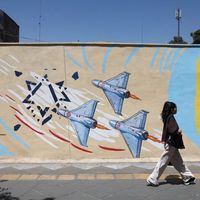
A woman walks across the street, with a banner of all three leaders of Iran, late Ruhollah Khomeini, late Ayatollah Ali Khamenei, and Mojtaba Khamenei in the background, amid the US-Israeli conflict with Iran, in Tehran, Iran, March 15, 2026.
War damage to Iran’s economy has reached $270 billion in 40 days, equivalent to roughly $3,000 per person, according to official figures, with losses expected to grow as trade disruptions deepen under a US blockade of Iranian ports.
Fatemeh Mohajerani, the spokesperson for the Iranian government, said on Tuesday losses from the US-Israeli military campaign are estimated at around $270 billion.
The New York Times, citing three Iranian officials and two economists, reported that early estimates broadly align with that figure, placing the damage at roughly $300 billion or higher.
Preliminary estimates by the US-based think tank Foundation for Defense of Democracies also suggest Iran absorbed roughly $150–$300 billion in economic damage.
Using a population of about 92 million, the lower estimate of $150 billion translates to roughly $1,600 per person, rising to nearly $3,250 per person under the higher estimate.
These figures reflect national wealth lost through destruction, halted production and disrupted trade.
Iran’s central bank has warned President Masoud Pezeshkian that rebuilding the country’s war-damaged economy could take more than a decade, sources familiar with internal deliberations told Iran International.
In a stark assessment delivered to the president in recent days, senior economic officials said the damage inflicted during the 40-day war with the United States and Israel—combined with Iran’s already fragile economic situation—could take up to 12 years to repair.
Industrial sectors bear largest losses
Petrochemicals account for the largest share of damage. Iran’s petrochemical sector, with annual sales of $29.1 billion, has seen about 85% of export capacity disrupted following strikes on major hubs including Mahshahr and South Pars. Estimated losses range from $30 billion to $50 billion.
Energy infrastructure has also been heavily affected. Refineries, storage depots and gas facilities have been struck, weakening a sector that generated about $78 billion in exports in 2024. Losses are estimated at $15 billion to $25 billion.
Explosion at Iran's Mahshahr petrochemical complex during US-Israeli strikes
Steel production, which underpins both industrial output and reconstruction, has been severely reduced, with about 70% of capacity disrupted. Losses are estimated at $5 billion to $10 billion.
Beyond physical losses, the war has triggered a sharp contraction in output.
Experts estimated a decline of more than 10% in GDP, equivalent to $34 billion to $44 billion in lost economic activity, affecting an economy that was already under strain before the conflict.
Beyond physical damage, policy-driven disruptions have compounded the losses.
Internet shutdown
A nationwide internet blackout beginning Feb. 28 has imposed additional costs.
Direct losses are estimated at $37 million to $42 million per day, totaling $1.5 billion to $2.5 billion over more than five weeks.
Afshin Kolahi, a member of Iran’s Chamber of Commerce, said Monday indirect losses could raise the daily figure to $70 million to $80 million due to disruption to online businesses.
Online sales fell by about 80% during the shutdown, while the Tehran Stock Exchange lost 450,000 points within four days.
The shutdown is affecting multiple layers of the economy simultaneously, according to economic analyst Masoumeh Taherkhani.
“The Iranian economy is damaged at three levels by internet disruption, starting with the digital core, which employs between four and five million people,” Taherkhani told Iran International. “Then the platform layer collapses, and finally the broader economy is affected in a way that spreads across production and services.”
Taherkhani said the combined effect leads to widespread job losses. “When the economy is fully stagnant, the outcome is unemployment for workers, and that is not something that can easily be reversed,” she said.
Trade disruption and self-inflicted losses
Disruptions linked to the Strait of Hormuz have added further pressure, with estimated losses of $5 billion to $15 billion.
The restrictions have affected imports of essential goods and weakened non-oil exports, contributing to supply chain disruptions across the economy.
A US naval blockade targeting Iran’s maritime trade routes is expected to deepen losses.
Sanctions strategist and former US Treasury official Miad Maleki estimated that cutting off seaborne trade could eliminate about $435 million in daily economic activity, equivalent to roughly $13 billion per month.
Iran relies on the Persian Gulf for more than 90% of its trade, leaving it highly exposed to sustained disruption.
Oil exports of about 1.5 million barrels per day – generating roughly $139 million daily – could be halted almost entirely, removing the country’s main source of foreign currency.
What the losses could have funded
The scale of damage corresponds to investment levels that could have reshaped core sectors of the economy.
A large combined-cycle power plant with capacity of around 1,000 to 1,500 megawatts typically costs between $600 million and $1 billion to build, depending on technology and fuel infrastructure.
At the lower estimate of $150 billion in losses, Iran could have financed roughly 150 to 250 such plants. At the upper estimate of $300 billion, that rises to between 300 and 500 plants, enough to eliminate electricity shortages and significantly expand export capacity.
In housing, average construction costs for a modest apartment unit range between $30,000 and $50,000. With $150 billion, between 3 million and 5 million housing units could have been built. At $300 billion, that increases to roughly 6 million to 10 million units, enough to address shortages across major urban areas.
High-speed rail construction typically costs between $20 million and $40 million per kilometer. The lower estimate of losses could have funded approximately 3,750 to 7,500 kilometers of rail, while the higher estimate could support up to 15,000 kilometers, connecting major cities nationwide.
A modern hospital costs between $200 million and $500 million to construct and equip. The lower-end losses could have built 300 to 750 hospitals, while the higher estimate could fund up to 1,500 facilities, expanding healthcare access across the country.
What it means for individual Iranians
The per capita loss of up to $3,250 represents a substantial share of annual income for many households.
With average monthly earnings between $150 and $200, an individual earns roughly $1,800 to $2,400 per year, meaning a $3,250 equivalent exceeds a full year of income for many citizens.
If such an amount were available, it could cover between 12 and 20 months of living expenses for an average worker. Families could use it toward housing costs, including down payments or completing home purchases in smaller cities.
Small businesses could be launched with startup capital of $2,000 to $5,000, enabling self-employment in sectors such as retail, services or online commerce. Households could also afford private healthcare, education or relocation costs that are otherwise beyond reach.
Even the lower estimate per person represents several months of income, providing a buffer against inflation, job loss or unexpected expenses.
The overall range reflects damage already incurred, with additional losses building as trade, production and financial flows remain disrupted.
At up to $3,250 per person and rising, the economic toll underscores the scale of damage to Iran’s productive capacity, with long-term implications for recovery and growth.
FILE PHOTO: A vessel at the Strait of Hormuz, off the coast of Oman’s Musandam province, April 12, 2026.
The idea that Iran could generate tens of billions of dollars annually by charging ships to pass through the Strait of Hormuz has gained traction in media commentary, but the claim does not withstand scrutiny.
Estimates circulating in public debate frequently suggest Iran could earn $40–100 billion annually by imposing transit fees on vessels using the strait, effectively turning the country into a “$100 billion gatekeeper” of global energy flows.
Yet a closer look at shipping volumes, pricing norms and international law suggests the potential revenues would likely be closer to $1–2 billion a year, even under optimistic assumptions.
According to the US Energy Information Administration, nearly 21 million barrels of oil per day passed through the strait in early 2025—around 20% of global petroleum liquids consumption and roughly a quarter of seaborne oil trade. About 20% of global LNG trade, largely from Qatar, also transits the waterway.
With petroleum cargo alone worth more than $500 billion annually, it is easy to see why the toll narrative is appealing.
Simple arithmetic of multiplying a hypothetical transit fee by daily vessel traffic quickly produces headline-grabbing estimates of tens of billions of dollars. But those calculations overlook how maritime transit actually works.
Legal and practical limits
Unlike the Suez Canal, the Strait of Hormuz is a natural waterway, not an engineered passage requiring dredging, infrastructure and navigation services.
The canal charges substantial transit fees partly because it is an artificial route requiring constant maintenance. Those fees typically range from about $200,000 to $700,000 per vessel.
Natural straits such as Hormuz operate under the transit passage regime established by the United Nations Convention on the Law of the Sea, which prohibits charging vessels simply for passage and requires non-discriminatory treatment.
Although Iran has not formally ratified the convention, these principles are widely recognized as customary international law. Oman, which shares jurisdiction over the strait and has ratified the treaty, has shown little willingness to support aggressive tolling policies.
Any unilateral attempt to impose large transit fees would likely trigger legal challenges and opposition from maritime powers and major energy importers.
The math behind the myth
Even ignoring legal constraints, realistic pricing benchmarks produce far smaller revenue estimates.
Applying Suez-style fee levels to Hormuz traffic dramatically reduces the numbers. Pre-conflict flows included roughly 10 very large crude carriers per day, alongside LNG and product tankers.
Using comparable Suez pricing (roughly $535,000 per tanker), and accounting for Oman’s jurisdictional share, Iran’s portion would likely amount to around $1.5 billion annually under ideal conditions.
And even that estimate assumes stable traffic, full compliance and minimal enforcement costs—conditions unlikely to hold if Tehran attempted to impose tariffs unilaterally.
In practice, traffic would likely fall as ships sought alternative routes or bypass pipelines such as Saudi Arabia’s East–West pipeline.
Geopolitical reality
The geopolitical constraints are equally significant.
The Strait of Hormuz is a critical energy lifeline for major economies including China, India, Japan and European states. Countries heavily dependent on Middle East energy supplies would be unlikely to accept large additional costs imposed unilaterally.
History offers a clear precedent. During the 1980s Tanker War, attacks on Persian Gulf shipping triggered international military intervention to secure maritime flows. Similar dynamics would likely emerge if transit fees were imposed on a large scale.
For Iran itself, the economic logic is also questionable. The country already struggles to monetize its oil exports because of sanctions and financial restrictions. Attempting to impose transit tariffs would likely intensify geopolitical pressure and reduce shipping volumes, offsetting much of the potential revenue.
The danger of the narrative
The biggest risk lies not in the policy itself but in the narrative surrounding it.
Inflated revenue estimates exaggerate Iran’s potential leverage over global energy markets. For Tehran, they may encourage overconfidence in the economic value of coercive maritime policies.
For external actors, they risk inflating the perceived threat and encouraging responses based on exaggerated assumptions.
The strategic value of the Strait of Hormuz lies not in its potential as a revenue-generating toll system, but in its role as a stable transit corridor for global energy flows.
The widely cited estimates are not supported by legal precedent, market behavior or geopolitical realities.
The “$100 billion gatekeeper” is not a viable strategy. It is a catchy headline for an economic illusion.
Sun sets over an Iranian oil tanker in the Persian Gulf in this undated file photo
The United States moved to impose a naval blockade on Iran just as the country’s oil exports were surging to their highest levels in years, underscoring Washington’s effort to halt a wartime boom in Tehran’s energy revenues.
The move followed the collapse of negotiations in Pakistan and comes amid a war that has disrupted much of the Persian Gulf’s energy trade.
Since the launch of joint military operations by Israel and the United States, Iran has effectively closed the Strait of Hormuz. Even after the April 8 ceasefire, maritime traffic through the strategic waterway has yet to recover.
Data from the International Energy Agency show exports from Persian Gulf states have fallen sharply during the conflict, with more than 170 million barrels of their oil stranded in tankers anchored across the region, according to Kepler data.
Iran exports rise as others fall
At the same time, shipping data point to a striking countertrend: rising Iranian oil exports.
Despite the conflict, Iran has increased its daily oil loadings and exports to around 2 million barrels over the past three months.
China has raised its purchases of Iranian crude by more than 300,000 barrels per day, bringing total imports close to 1.6 million barrels daily. India, which halted Iranian oil imports in 2019, has also resumed purchases, receiving at least 2 million barrels this month.
Tehran has also opened discussions with Singapore, Taiwan, Japan and other Asian importers to expand its market share.
Reuters has reported that Iranian crude has recently been sold to some Chinese buyers at prices even higher than the Brent benchmark—an unusual development for a country that typically sells at a discount due to sanctions.
Windfall revenues
The World Bank estimates the economies of Kuwait, Qatar and Iraq, whose oil and LNG exports have been severely disrupted, could contract by between 5 and 9 percent this year.
Iran, by contrast, appears to be benefiting from both increased exports and a roughly 40 percent rise in global oil prices during the war.
Tehran has also begun collecting ad hoc transit fees from vessels passing through the Strait of Hormuz. Ships are required to register with the Islamic Revolutionary Guard Corps and transit near Iranian islands.
Reports suggest Iran is charging up to $2 million per vessel. Under normal conditions, roughly 150 ships pass through the strait each day.
Blockade seeks to cut revenue
US President Donald Trump announced the naval blockade in an effort to halt Iranian oil exports while warning that vessels paying transit fees to Iran could face seizure.
Yet Iran appears to have prepared for disruption. Kpler estimates Tehran had already stockpiled roughly 200 million barrels of crude in Asian waters before the conflict began in late February, with an additional 23 million barrels stored in the Sea of Oman.
Those reserves could allow Iran to continue supplying customers for months even without new shipments.
Although Washington has threatened sanctions against buyers of Iranian oil, it remains unclear whether China—effectively Tehran’s main customer since 2019—will comply.
The conflict is also raising wider maritime risks across the region.
Iran has attacked around 20 vessels in its southern waters over the past 50 days, while incidents are spreading beyond the Gulf.
The UK Maritime Trade Operations agency reported on April 12 that armed individuals in a small boat attempted to approach a vessel in the Bab el-Mandeb Strait, another vital energy chokepoint handling roughly 9.3 million barrels of oil and petroleum products each day.
Whether the US blockade will succeed in curbing Iran’s export surge—or further deepen disruption across global energy markets—remains uncertain.
Iranians face a severe shortage of essential medicines and a spike in prices, according to reports sent by citizens to Iran International, as the country struggles with a deepening healthcare crisis.
The shortages affect both life-saving treatments for cancer and heart disease as well as common over-the-counter painkillers. Despite the public struggle, earlier this month, Vice President Mohammad Reza Aref said current strategic reserves are in good condition and the government ordered urgent imports.
Price increases for critical drugs have left many patients unable to afford treatment. Citizens told Iran International that the price of Xgeva, a drug used for bone cancer, rose from 15,000,000 rials ($9.38) to 420,000,000 rials ($262.50) in two months. The treatment requires an injection every two months.
In the city of Karaj, the price of Lantus insulin rose from 1,770,000 rials ($1.11) to 7,100,000 rials ($4.44). Other residents said some types of insulin now cost more than 70,000,000 rials ($43.75) following recent regional conflicts.
Cancer patients told the broadcaster that a 30-day supply of Aromasin, which previously cost 5,000,000 rials ($3.13) with insurance, now sells for 44,000,000 rials ($27.50) when available. Many patients said they cannot find imported versions and that local substitutes are not effective.
The shortages extend to basic items. Residents in Tehran said pharmacies now ration common pills like GeloFen, while elderly patients in Mashhad reported they cannot find basic antidepressants like Amitriptyline.
Medical supplies such as disposable gloves are also difficult to find in many pharmacies. Patients said they are forced to delay treatment or face financial ruin to buy medicine.
More than 1,000 hours of internet shutdown in Iran is crippling small businesses and startups, with officials estimating losses of at least $35 million per day.
The disruption has cut off companies that depend on global connectivity, from e-commerce retailers to freelance service providers.
With access largely limited to domestic platforms, many users cannot reach essential global tools such as search engines, email services and widely used social media networks.
Iran’s digital economy accounts for an estimated 5% to 6% of the country’s gross domestic product.