National Iranian Oil Company HQ in London's Victoria street
The ruling to confiscate the National Iranian Oil Company’s last European headquarters is yet another sign of the country’s shrinking global footprint and deepening isolation.
NIOC House, located on Victoria Street in central London overlooking Parliament and Westminster Abbey, was Iran’s last base in the Western hemisphere for managing oil contracts and sales. Brutalist in style, the 1975 building is valued at around £100 million ($125 million).
Iran lost its Rotterdam office in 2022, and Crescent may now seek additional Iranian assets in the UK or elsewhere, including frozen funds, though international sanctions could complicate enforcement.
NIOC still has the option to appeal to the UK Supreme Court—a process that could take up to two years.
The Calamitous Crescent
The Monday ruling upholds a 2021 decision ordering NIOC to pay damages, lost profits, interest, and legal costs, with interest continuing to accrue. A 2014 judgment had already confirmed that Iran breached a 2001 gas-supply contract with Crescent.
The 25-year Gas Sales and Purchase Contract (GSPC), signed under President Mohammad Khatami, envisioned Crescent processing up to 500 million cubic feet per day from Iran’s offshore Salman field and reselling it near the UAE border.
By 2005, however, NIOC halted deliveries, citing technical delays, and later accused Crescent executives of corruption before unilaterally terminating the contract. In subsequent proceedings, Iran failed to substantiate its claims.
Crescent began arbitration in 2009 under the International Chamber of Commerce. The ICC issued its first award in 2014 confirming Iran’s breach, and a final award in 2021 ordering NIOC to pay $2.4 billion. English courts later dismissed NIOC’s challenges.
In 2024, a UK court ordered the seizure of NIOC House, describing NIOC’s attempt to transfer ownership to the Oil Industry Pension and Welfare Fund as a “sham” maneuver to evade creditors.
Experts estimate the total cost to Iran — including legal fees and lost revenue from flared gas—at more than $7.25 billion.
Timeline
2005—NIOC halts gas deliveries, terminates contract
2009—Crescent files ICC arbitration
2014—ICC rules Iran breached contract
2021—Final award: $2.4 billion
2022—Dutch court seizes NIOC Rotterdam office
2023—UK High Court dismisses NIOC challenge
2024—UK orders seizure of NIOC House
2025 Sep 30—High Court enforces full award
2025 Oct 6—Court of Appeal rejects NIOC appeal
Reactions in Tehran
Iran’s state media framed the court ruling as “political interference,” linking it to sanctions despite the dispute predating them.
Former lawmaker Heshmatollah Falahatpisheh urged authorities to identify those responsible and “arrest those who make a fortune by exploiting their power and the nation’s assets.”
Political commentator Ahmad Zeidabadi lamented: “It is a shame that after 23 years, the people of Iran still do not know what happened, why the contract was terminated, and why the country must now pay such a steep price.”
For over two decades, hardliners and moderates have accused each other of wrongdoing and undermining the national interest over the Crescent deal.
But Crescent is not an exception in the Islamic Republic of Iran; it is the norm. And so would be the potential loss of NIOC House.
When Iran purchased the London building in 1975, it symbolized the country’s expanding reach in the global oil market. Today, Iran’s oil is traded through ghost fleets, and revenues flow through opaque networks tied to regime insiders.
NIOC House now stands as an emblem of Iran’s stunted growth and deepening isolation—the last remnant of an ambitious past, and a window into a despondent future.
Iranian traders, economists and digital market participants are alarmed by new state curbs on stablecoin holdings, telling Iran International the Central Bank’s decision will choke savings and drive capital offshore amid the historic devaluation of rial.
“Iran’s stablecoin limits will not stop dollar demand — they will only drive it deeper underground,” a Tehran-based economist who did not want to reveal his identity told Iran International.
The Central Bank’s High Council late last month approved a $5,000 annual purchase limit per person and a $10,000 ceiling on total stablecoin holdings.
The rule, announced as the rial plunged to a record low of 1,170,000 per US dollar earlier this month, drew sharp criticism from Iranians using Tether and other digital currencies to protect their assets from geopolitical headwinds.
The slump was triggered by the UN sanctions which resumed late last month after European countries suspicious about Iran's nuclear activities activated the so-called snapback mechanism.
The rial stood slightly below 1,140,000 at the time this report was published.
Even a prominent government official criticized the move.
“A disaster is when policymakers with good intentions, but based on wrong reasons and ignoring evidence, make a decision. The result will be weakening governance, erosion of public trust, a threat to people’s assets and discrediting institutions,” Deputy Minister of Communications Ehsan Chitsaz wrote on X.
Crypto market endangered
Traders contacted by Iran International described the new ceilings as both impractical and punitive. “The government keeps tightening controls because it has no real answer for the collapsing rial,” said Farzad, a 29-year-old trader in Tehran.
“They call it regulation, but it’s just another way to shift the burden onto ordinary people. When markets tumble, traders like us will be trapped — unable to cash out or protect our savings.”
“They’ve also started deciding how much people can spend based on their job status — fifty billion rials if you’re unemployed, 200 billion if you earn a salary,” Parham, a 25-year-old in Tehran, said.
“These limits kill initiative and push everyone toward informal channels.”
Parham referred to another Central Bank directive last week that set tiered limits on rial transactions — 200 billion rials for wage earners, 50 billion for the unemployed, and five billion for inactive entities.
Manipulation risk
The new regulation and a concurrent media campaign were meant to manipulate prices, the economist said.
“The $5,000 Tether cap is not about stability; it’s a cover for manipulation,” he said. “They’re draining liquidity under the guise of regulation and trying to buy time while the rial keeps falling. Fear about frozen assets fuels panic, making people sell at a loss.”
Tasnim, a media outlet linked to Iran's Revolutionary Guards, reported that “thousands of addresses on the Tether network have so far been frozen and their assets effectively made inaccessible,” calling for tighter oversight of exchanges such as Nobitex.
Black-market growth likely
Other commentators say the measure will only feed a shadow economy. Saeed Reza Moradian of OTC Crypto Exchange warned that such limits “will lead to the spread of rented accounts.”
“A $5,000 annual Tether limit destroys the digital economy. People’s needs won’t disappear — they will just move to opaque and foreign platforms,” wrote a user called Sepideh on X.
Iran International has observed advertisements offering cash for renting national ID numbers, allowing others to exploit the $5,000 per person stablecoin quotas.
Central Bank officials insist the measure is needed to prevent capital flight. Asghar Abolhasani, Secretary of the bank's High Council said users have one month to comply. But crypto traders told Iran International the rule is unenforceable.
“You can’t police digital assets with outdated banking tools,” said Farrokh, a Tehran-based trader. “Once trust is gone, people won’t wait — they’ll take their money abroad in whatever form they can.”
Failing controls
The comments by people depict a widening gap between official policy and public behavior. Small traders and households that once relied on Tether as a hedge against inflation now face the choice of breaking the rules or watching their savings erode.
For many Iranians confronting another devaluation and the return of UN sanctions, the Central Bank’s rule represents yet another blow to financial autonomy.
Those who spoke to Iran International said the cap will narrow legal channels, amplify underground trade and further alienate citizens from a banking system which is already widely distrusted.
A man cycles to work in a flooded road in the northern city of Astara, Iran, September 2025
Iran’s parliament speaker Mohammad Bagher Ghalibaf ramped up pressure on the government to issue ration coupons for essential goods, invoking Supreme Leader Ali Khamenei’s warnings about the deterioration of the economy.
His initiative appeared to be a thinly-veiled rebuke to the relatively moderate president as Iran's ruling classes resort to traditional infighting as diplomatic isolation and sanctions mount.
“The livelihoods of various social groups are under duress. Once again I stress the urgent need for officials to implement the electronic coupon scheme,” Ghalibaf told lawmakers on Sunday.
“This is not the first time I have raised this point from this podium,” he added, in an implicit jab at President Masoud Pezeshkian — who defeated him in the 2024 election.
Ghalibaf’s call highlighted the depth of hardship and the absence of a coherent strategy from the cabinet, but also the continued factional attempts to score points.
The president has indeed acknowledged the severity of the crisis, but his responses remain vague and reactive, prompting critics to see him as resigned rather than decisive.
Blame game
Recent measures such as removing four zeros from banknotes are widely dismissed as superficial attempts to patch a sinking economy.
Several economists have warned in recent weeks that while such steps may cosmetically reduce exchange rate figures, they do little to address underlying problems of inflation, unemployment or a growing budget deficit.
But Iran’s crisis is not only economic. Its roots are political as well, shaped by fundamental foreign-policy choices that fall far outside Pezeshkian’s remit.
Both Ghalibaf and the Supreme Leader he invokes know this, yet they continue the blame game rather than confront the structural causes.
Khamenei’s intervention at last month’s cabinet meeting served mainly to bolster his image as a defender of the poor.
Television bulletins and newspaper front pages were saturated with his concern over rising prices, portraying him as attentive to ordinary people’s plight even as implementation of solutions lags.
For the Supreme Leader, the messaging is as much about maintaining legitimacy as it is about practical policy.
Priorities lost
The Pezeshkian administration does not help itself, offering almost daily reminders it is out of touch.
Last week, Beheshti University of Medical Sciences announced it was renaming its “Office of Vice Chancellor for Student and Cultural Affairs” to “Office of Vice Chancellor for Cultural and Student Affairs,” a cosmetic change that amused and angered many Iranians on social media.
In Manjil, northern Iran, local officials staged a ribbon-cutting ceremony for a new staircase at the regional power authority headquarters, just ten meters from an existing one.
A photo of the local Friday Imam inaugurating the stairs ran in conservative outlet Ghatreh News, sparking public frustration and ridicule, with many questioning priorities and the government’s will to address real problems.
The expletive-laden jibes on social media point to a deeper truth that neither Ghalibaf nor Pezeshkian are willing to admit: inefficiency in Iran’s theocratic system is not incidental, but systemic.
The German national flag flies in Berlin, Germany.
Germany’s foreign ministry told Iran International that the European Union’s reimposed sanctions on Iran include financial restrictions but still allow limited personal money transfers.
“The measures contain restrictions in the financial sector, but provide exceptions, thresholds or authorizations to enable certain transactions, for example money transfers with Iranian persons in limited amounts as well as certain private transactions,” the ministry said in a written response to a query on Tuesday.
It added that EU sanctions regulations are directly applicable in Germany and that Berlin has not introduced additional national restrictions. “Possible further measures taken by banks or other private actors on their own responsibility are not necessarily based on sanctions law,” the ministry said.
The EU sanctions were restored last month after Britain, France and Germany triggered the United Nations “snapback” mechanism over what they called Iran’s repeated breaches of the 2015 nuclear deal. Six previous Security Council resolutions on Iran’s nuclear and missile activities were reinstated, along with autonomous EU measures.
Last week, German Foreign Minister Johann Wadephul said the return of sanctions was unavoidable because of Tehran’s actions, adding that “Iran must never come into possession of a nuclear weapon.”
Iran has rejected the sanctions as illegal and said it will not recognize any attempt to revive measures that expired under Resolution 2231.
A file photo of Sarab Niloufar lake in Kermanshah province in 2011
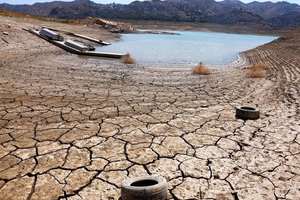
The Sarab Niloufar spring, one of western Iran’s most iconic natural landmarks, has dried up, local environmental officials said, warning that years of groundwater depletion, unregulated farming and drought have destroyed the 25-meter-deep lake once covered in lotus flowers.
Located near the city of Kermanshah, Sarab Niloufar -- famous for its blue lotus flowers and migratory birds -- has turned into cracked earth after years of over-extraction of groundwater, repeated droughts, and unregulated farming, Tasnim reported on Tuesday.
Provincial authorities blamed excessive water use for crop irrigation, illegal wells, and reduced rainfall for the collapse of the lake’s ecosystem.
Soraya Ghorbani, deputy head of Kermanshah’s Department of Environment, said this week that more than half of the factors driving the crisis stem from “repeated planting of water-intensive crops and poor management of groundwater resources.”
She warned that even heavy rainfall would no longer be enough to restore the body of water due to severe shortage of its groundwater.
A view from Sarab Niloufar lake in Kermanshah province in a recent photo
Experts say the drying of Sarab Niloufar mirrors a national trend of environmental decline.
A new satellite-based study shows that Iran is undergoing severe land subsidence across 106 regions covering about 31,400 square kilometers -- an area roughly the size of Belgium -- mainly due to excessive groundwater extraction for agriculture.
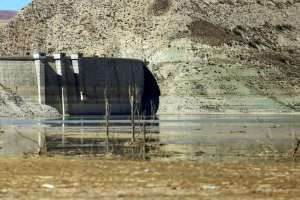
Iran’s water reservoirs have reached their lowest levels in decades -- with only 35% of dam capacity remaining, according to government data -- while 19 major dams are nearing depletion and three have already run dry.
Across the north, wetlands in Golestan Province have also shrunk dramatically after years of drought and dam construction, leaving vast tracts of land barren and driving away hundreds of thousands of migratory birds.
Environmentalists warn that the loss of these wetlands could turn fertile regions into new dust storm hotspots, worsening air quality and threatening nearby farms.
In western Iran, the crisis has both ecological and social dimensions. Once a key habitat and tourist attraction, Sarab Niloufar supported local livelihoods and served as a natural water reservoir.
Officials say its disappearance shows how climate change, mismanagement, and overuse are converging to push Iran’s fragile water systems toward collapse.
“Without immediate national action on sustainable agriculture, groundwater control and interprovincial water sharing, more wetlands will follow the same fate,” Ghorbani said.
Iranian businessman Babak Zanjani during a court session in Tehran
Iranian businessman Babak Zanjani, a tycoon once sentenced to death for corruption before receiving clemency, said that $2.3 billion from a Malaysian bank account tied to him was seized to help pay an international arbitration award against Iran’s National Oil Company (NIOC).
Zanjani wrote on the social platform X that the UAE-based Crescent Petroleum had “not only seized Iran’s Oil Ministry building in London worth $125 million, but also confiscated $2.3 billion belonging to the National Iranian Oil Company held in Malaysia’s First Islamic Investment Bank.”
He added that the funds had been converted to euros and were awaiting transfer “to a Singapore bank,” while the company’s total claim against NIOC had reached $2.9 billion plus $13 million in accrued penalties.
According to Iranian media, the Kuala Lumpur High Court implemented a 2021 ruling by The Hague’s arbitration tribunal, ordering Iran to compensate Crescent over a failed 2001 gas supply contract for the offshore Salman field. The enforcement follows similar seizures of NIOC properties in London and Rotterdam.
On Monday, Iran’s state media also confirmed that a UK appeals court had upheld the confiscation of the NIOC House, a historic £100 million property near the British Parliament, ruling that it could be used to help satisfy Crescent’s arbitration award.
The judgment found that Iran’s attempt to transfer ownership of the building to another state entity was intended to evade debt recovery.
The Crescent case -- one of Iran’s longest-running energy disputes -- stems from a 25-year gas export contract. Iran withdrew from the deal in 2010, alleging unfavorable terms, prompting years of arbitration and legal challenges.
Once worth an estimated $13.5 billion, Zanjani made his fortune helping Iran bypass Western sanctions during the presidency of Mahmoud Ahmadinejad through complex oil trading networks.
Zanjani, convicted in 2016 of embezzling $1.9 billion in oil revenues, had his death sentence commuted to 20 years after agreeing to help recover state funds abroad. Released last year, he has since rejoined Iran’s oil sector under government oversight, according to local media.