• العربية
  • فارسی
Brand
  • Iran Insight
  • Politics
  • Economy
  • Analysis
  • Special Report
  • Opinion
  • Podcast
  • Iran Insight
  • Politics
  • Economy
  • Analysis
  • Special Report
  • Opinion
  • Podcast
  • Theme
  • Language
    • العربية
    • فارسی
  • Iran Insight
  • Politics
  • Economy
  • Analysis
  • Special Report
  • Opinion
  • Podcast
All rights reserved for Volant Media UK Limited
volant media logo
OPINION

Iranian Love Island mirrors social shifts but carries new risks

Kambiz Hosseini
Kambiz Hosseini

Host of nightly show The Program

Oct 1, 2025, 03:00 GMT+1Updated: 00:33 GMT+0

An Iranian remake of Love Island has exploded online, sparking fierce debate about taboos, personal freedom and the responsibilities of new media.

Marketed as Eternal Love, the show gathers young contestants in a luxury villa, reshuffles their romantic ties and pits them in staged challenges—following a formula that has proved commercially irresistible from Britain to Netflix.

But in Iran’s fraught cultural landscape, its rise is about more than entertainment: it reflects social shifts, strained relationships and the clash between audience demand and media censorship.

Global lessons

Reality shows worldwide have long faced serious criticism.

In the 2025 season of Love Island alone, Ofcom—the UK’s media regulator—received over 14,000 complaints.

Social pressure led to protective protocols: restricting contestants’ social-media use during broadcast, offering psychological support before and after filming and mandating training for television appearances.

In the US, lawsuits against Love Is Blind producers raised the question of whether contestants were mere “entertainment tools” or employees entitled to rights. The outcome was costly settlements and the entry of labor organizations into the fray.

The message is clear: reality TV is never “just entertainment”—mental health, labor rights and human dignity are at stake.

Added sensitivities

Eternal Love reproduces the same criticisms: commodifying emotions, privileging appearance over character, crafting heroes and villains and fueling collective judgment.

The main difference lies in its platform.

YouTube, unlike television, lacks a regulatory body and binding standards. That absence can intensify psychological and social pressure on participants—especially when their intimate relationships are laid bare to millions of viewers, including teenagers.

Supporters counter that a weary, anxious Iranian society deserves entertainment. They argue taboos must be broken and media should serve as a “mirror” to new realities of relationships.

There is some truth to this. Yet global experience shows that a mirror that sells also carries responsibility—for participants’ well-being and for the younger audiences exposed to such content.

Need for standards

This responsibility raises urgent questions for the makers of Eternal Love: is there a public care protocol, do contestants have access to counseling, are contracts fair and allow withdrawal without penalty, and has an age rating been defined?

Most of all, where is the line between reality and scripted drama, and don’t audiences have the right to know?

Eternal Love embodies two realities at once: society’s right to entertainment and taboo-breaking, and the dangers of crossing into unregulated territory.

If this genre is to persist in Persian-language media—and it likely will—clear standards are essential: transparent care protocols, contractual protections for participants, anti-harassment policies, social-media management during broadcast, age guidance and stronger media literacy.

Global precedents exist. It only takes the will to adopt and enforce them.

Most Viewed

Ghalibaf defends Iran-US talks amid hardline backlash
1
INSIGHT

Ghalibaf defends Iran-US talks amid hardline backlash

2
INSIGHT

Iran diplomacy wobbles as factions compete to avoid looking soft on US

3
VOICES FROM IRAN

Bread shortages, soaring prices strain households in Iran, residents say

4
ANALYSIS

The politics of pink: how Iran uses cuteness to rebrand violence

5

Scam messages seek crypto for ships’ safe passage through Hormuz, firm warns

Banner
Banner

Spotlight

  • Diplomacy tolls at Hormuz as conflict returns to its doorstep
    OPINION

    Diplomacy tolls at Hormuz as conflict returns to its doorstep

  • Opposition to US talks grows in Tehran as ceasefire deadline nears
    INSIGHT

    Opposition to US talks grows in Tehran as ceasefire deadline nears

  • Tehran moderates see ‘no deal–no war’ limbo as worst outcome
    INSIGHT

    Tehran moderates see ‘no deal–no war’ limbo as worst outcome

  • The future has been switched off here
    TEHRAN INSIDER

    The future has been switched off here

  • Lights out, then gunfire: Witnesses recount Mashhad protest crackdown
    VOICES FROM IRAN

    Lights out, then gunfire: Witnesses recount Mashhad protest crackdown

  • Is Iran entering its Gorbachev moment?
    INSIGHT

    Is Iran entering its Gorbachev moment?

•
•
•

More Stories

Four Iranian directors compete for Oscars from four countries

Sep 30, 2025, 22:02 GMT+1

Four Iranian directors are competing in the Academy Awards Best International Feature Film category this year, each representing a different country, with a shortlist of finalists due to be announced on March 2.

Iran submitted Cause of Death: Unknown by Ali Zarnegar after a selection process that excluded films by independent and dissident filmmakers.

Among those left out was the critics’ favorite It Was Just an Accident, secretly filmed by internationally acclaimed director Jafar Panahi, who is banned from filmmaking.

Panahi's drama was in turn submitted to the Oscars by France while fellow dissident filmmaker Alireza Khatami’s The Things You Kill will represent Canada.

Shahram Mokri’s Black Rabbit, White Rabbit has also been selected by Tajikistan.

Panahi’s film, which won the Palme d’Or at the 2025 Cannes Film Festival, was selected as France’s submission from a shortlist that also included Richard Linklater’s Nouvelle Vague and Rebecca Zlotowski’s A Private Life.

Oscars rules allow submissions in the category for productions "largely in the hands of citizens or residents of the submitting country."

The plethora of films by Iranian filmmakers has stoked some criticism, however, as LA Times columnist Glenn Whip wrote in an article titled, "The Oscars’ international feature category is broken. But there’s no easy fix".

"All this leads to a question raised annually: Isn’t there a better way to choose movies for the Oscars’ international feature category, one that sidesteps the politics of repressive regimes and produces a list of films that are the best the world has to offer?" he wrote.

The global presence of Iranian directors highlights both the richness of Iran’s cinema and the challenges artists face under domestic repression.

Earlier this month, an association of independent Iranian filmmakers called on the Academy of Motion Picture Arts and Sciences (AMPAS) to overhaul how it accepts films from countries under authoritarian rule, warning that the current system legitimizes state-controlled cinema bodies.

In a letter to the Academy, the Iranian Independent Filmmakers Association (IIFMA) said the Farabi Cinema Foundation, which oversees Oscar submissions from Iran, enforces censorship and sidelines independent voices at home and abroad.

  • Dissident Iranian filmmakers urge Oscars to reject state-linked submissions

    Dissident Iranian filmmakers urge Oscars to reject state-linked submissions

Many Iranian talents, facing censorship and restrictions at home, have fled abroad. Panahi remains in Iran under travel and work restrictions, but his French residence gives him the chance to participate in the Oscar submission process.

Mohammad Rasoulof, whose The Seed of the Sacred Fig was Germany's Oscars submission last year, was previously sentenced to prison and now lives and works in Germany.

While Iranian cinema has global reputation for its exploration of social themes, independent filmmakers operate under a system of strict censorship at home.

The government requires script approval and screening permits by the Ministry of Culture and Islamic Guidance, punishing those who challenge political or social taboos with bans, imprisonment or exile.

Iran ‘youth population’ law linked to rise in Down syndrome births - daily

Sep 30, 2025, 08:16 GMT+1

Curbs to prenatal screenings and abortions in Iran’s 2021 Youth Population law have contributed to the doubling of Down syndrome births, according to a report by Shargh newspaper.

The current rate is about one in 700 births, compared to one in 1,000 in developed countries, it reported, and Down syndrome rates in Iran have risen from 1.2% to 2.9%.

The law, officially titled the Youthful Population and Family Support Act, was ratified in late 2021 and implemented in 2022. It seeks to raise fertility rates to 2.5 children per woman amid declining population growth, which currently stands at about 0.7%.

The law restricts abortions, prenatal screenings and contraceptives while offering incentives for marriage and childbearing.

Midwives in health centers are barred from requesting or discussing prenatal screenings, and legal obstacles have made voluntary pregnancy terminations nearly impossible, the report said.

Abortion now requires both a medical commission and judicial approval even in cases of confirmed fetal abnormalities under the justification of “intolerable hardship.”

These restrictions have pared back screening visits, with a 20–30% decline in Tehran and a 50% decline in less-privileged provinces, contributing to more chromosomal disorder births, according to Shargh.

“There are an estimated 120,000 individuals with Down syndrome currently living in Iran,” said Pourandokht Bonyadi, head of the Iran Down Syndrome Charity Foundation.

Underground abortion market

While the law has failed to significantly raise birth rates, it has fueled an underground abortion market.

Iran’s judiciary announced last week that a person in Hormozgan province had been sentenced to death for performing 140 illegal abortions. The case is under Supreme Court review.

“Out of 12,000 annual forensic medicine referrals for pregnancy termination, 8,000 involve fetal abnormalities, but 2,000 are rejected due to procedural issues or late referrals,” said Mohammad Akrami, president of the Iranian Medical Genetics Association.

Experts warn the law’s restrictive measures could have long-term social and healthcare consequences, urging policymakers to reconsider the legislation to curb rising disability rates and the spread of illegal abortions.

Incentives but limited results

Alongside restrictions, the law provides incentives to encourage fertility, including marriage loans, child allowances, housing loans for young couples, tax breaks for parents, employment priority for families and expanded health and transportation subsidies.

Despite these measures, the law has not produced the intended rise in fertility. According to official media, the rate of population decline has slowed by about 20% over the past seven years, but fertility has only stabilized at 1.6 children per woman, far below the 2.5 target.

Concessions or distractions? Iran's pop culture challenges theocratic rule

Sep 29, 2025, 18:12 GMT+1
•
Maryam Sinaiee

Pop concerts and late summer parties are spreading across Iran as music, as dance and fashion become battlegrounds testing the limits of state control.

Videos on social media show unveiled women dancing and singing freely at these events, some of them open to the public. In Tehran’s Grand Bazaar, models recently walked a red-carpet fashion show with no hijab in sight.

Just a few years ago, such scenes brought swift arrests. Most seem to meet no retaliation, and the fashion show earned only a limp judicial summons.

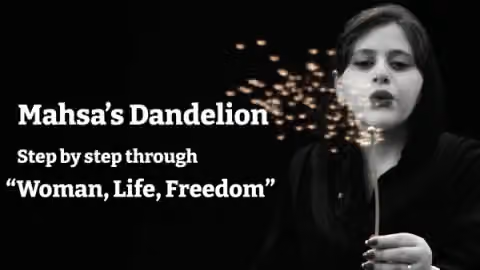
Some view these as proof of state retreat under social pressure. Others say it’s not real change but fleeting gestures to distract from economic hardship and the anniversary of the 2022–23 Woman, Life, Freedom protests in which hundreds were killed.

Hardliners fight on

Hardliners denounce hijab-free events as a betrayal of revolutionary values, warning that such openings erode ideological control and deepen rifts inside the establishment.

“It’s as if all the cultural officials of the country have perished together,” one conservative commentator posted online.

“Why did we have a revolution, sacrifice our loved ones to the enemy’s blade, and create a cemetery of martyrs? Only to become so like Westerners and allow a civilization … detached from Sharia to dominate us?”

At the Shah’s palace

The clash was visible at a September concert by pop star Sirvan Khosravi on the grounds of the Shah’s former palace, now run by Tehran Municipality. Clips of unveiled women singing and dancing went viral.

Only a year earlier, women were detained at another Khosravi concert for Islamic dress code violations. This time, police stood back. Some described the atmosphere as euphoric.

“Sirvan Khosravi’s concert was more than just a performance; it was walls breaking down,” said Nazanin, a 21-year-old student. “The compulsory hijab has nearly collapsed, and women are reclaiming cultural freedoms one by one.”

On X, a user named Mostafa used the hashtag #retreat: “Did anyone notice? The attendees sang ‘I love my life’ with no interference from enforcers … or police? The Mayor and City Council paid the costs, and police chief (Ahmadreza) Radan was busy protecting the dancers!”

Both officials had long promoted and enforced Islamic dress codes.

Opening or survival instinct?

Some among Tehran’s opposition accuse both artists and fans of playing into the establishment’s hands, saying that such events coincide with families mourning the third anniversary of Mahsa Amini’s killing.

“When certain groups in the government stage free street concerts during the protests’ anniversary, a wise person shouldn’t play on its turf,” one user posted on X. “Whatever the mullahs say and do, the opposite is right.”

Some see this tolerance as a survival tactic rather than real liberalization. Others believe it signals cracks in the Islamic Republic’s cultural order.

Music journalist Bahman Babazadeh argued: “The system has learned its lesson. It has moved beyond the stupidity of canceling concerts. It’s no big deal if a few reactionary zealots get angry by these images. For survival, the system has adapted.”

Filmmaker and academic Ali Azhari suggested the state tolerates “safe” cultural expressions while clamping down on those with social impact.

“The regime has concluded, more or less, that cultural mediocrity is harmless,” he wrote.

“Pop beats, commercial comedies with a few sexual jokes … don’t really pose a threat to the system. But when culture drives real social mobilization, there is no compromise.”

Coupons and concerts: Tehran scrambles for quick fixes as sanctions loom

Sep 23, 2025, 16:15 GMT+1
•
Behrouz Turani

Officials in Tehran are scrambling to blunt the impact of impending UN sanctions later this month and avert another popular flare-up that even insiders warn is near.

Among the proposals floated by politicians and economists are issuing coupons or smart ration cards to placate the public—especially the younger generation.

Efforts to introduce coupons began nearly a decade ago but stalled as rival factions in parliament and the cabinet fought over control of lucrative contracts.

In recent weeks, however, the idea has regained traction, with President Masoud Pezeshkian publicly backing it.

“We have no choice but to raise prices as subsidies on fuel and other goods are cut,” Pezeshkian said last week. “Issuing coupons will help low-income workers afford essential items.”

The system was used successfully during the 1980s war with Iraq, and many Iranians still credit then-prime minister Mir Hossein Mousavi, who is now under house arrest for nearly 15 years for leading protests against the disputed 2009 election.

‘A silent crisis’

Analysts in Tehran predict another spike in exchange rates once sanctions return on September 27. The government is expected to face a severe shortage of hard currency as oil sales become increasingly difficult.

Tehran’s priority appears to be containing unrest.

On September 18, Vice President Mohammad Reza Aref instructed the Tax Office to ease pressure on businesses and “avoid making people feel oppressed by the government.”

Many firms have already shuttered in recent months due to prolonged power outages and water shortages.

Just hours before the UN vote to reinstate sanctions last week, the reformist website Rouydad24 ran a headline warning of “A Silent Crisis in Iran.”

“Persistent economic problems … and limited access to basic services like electricity and water have severely impacted daily life, fostered a sense of despair and eroded public trust in the government,” the editorial said.

‘Bread riots’

Several academics, including political scientist Ahmad Naghibzadeh and sociologist Taghi Azad Armaki, have warned of “blind protests” and “bread riots” as public dissatisfaction reaches a boiling point.

Yet as economic warnings mount, officials have leaned on cultural gestures many see as unserious.

One initiative was a proposed free-for-all concert by renowned vocalist Homayoun Shajarian at Tehran’s iconic Azadi Square. Hardliners blocked the event, citing security concerns, and also vetoed a proposed indoor venue.

Wooing exiled artists

Once the resolution to extend Iran’s sanctions relief was voted down, government officials floated another gesture: inviting Iranian expatriate singers in Los Angeles to return to Tehran.

“I know that some of them in Los Angeles are struggling financially,” Vice President Aref said. “I invite them to come back freely.”

The administration’s spokeswoman Fatemeh Mohajerani insisted groundwork was being laid for such a move: “God forbid we end up only seeing their bodies brought back to Iran,” she told reporters on Tuesday. “They should be able to come home while they’re alive.”

Since 1979, Los Angeles has been a hub for Iranian musicians, many banned from working in Iran, stripped of homes and assets, and still censored despite their music being widely played in cars, weddings,and parties. Most are now elderly, many no longer able to perform.

No artist has yet responded. Some young users have—wryly.

“You can’t fool the new generation,” one commented on the vice president’s remark. “Even if you brought Lady Gaga to Tehran, she couldn’t make people forget their financial hardships.”

Condom sales in Iran surged during Israel war, online retailer says

Sep 23, 2025, 07:58 GMT+1

Condom purchases in Iran jumped 26% during the country’s 12-day conflict with Israel in June, according to data from the country’s largest e-commerce platform Digikala.

The report on consumer behavior showed a surge in demand for a range of health-related products during the war, including sanitary pads, disinfectants, blood glucose test strips, medical bandages, nail extension supplies, blood glucose monitors, adult diapers, and sanitary underpads.

The report comes three months after Israel launched a surprise military campaign on June 13, striking military and nuclear facilities in Iran. Air attacks killed nuclear scientists along with hundreds of military personnel and civilians. Iran retaliated with drone and missile attacks which killed 31 Israeli civilians and one off-duty soldier.

The United States joined the conflict on June 22, conducting strikes on major nuclear sites including Fordow, Natanz and Isfahan, before brokering a ceasefire on June 24.

Global perspective

Similar spikes in condom sales have been reported in other countries during times of conflict or crisis. After North Korea’s nuclear test in October 2006, South Korean convenience stores recorded a surge, with condom sales averaging 1,930 per day, compared to about 1,508 per day previously.

In Russia, following the invasion of Ukraine in March 2022, major retailers reported sharp increases. The pharmacy chain Rigla noted a 26% rise, while online marketplace Wildberries saw sales climb by about 170% year-on-year, a surge linked to consumer fears of shortages and price hikes.

Similar behavior was documented in the United States during the early months of the COVID-19 pandemic, when condom makers such as Reckitt Benckiser reported sales jumps linked to consumer uncertainty and supply chain fears but not necessarily increased use.